



Evernorth’s newest findings spotlight five key signals pointing to the XRP Ledger emerging as a major player in the world of tokenized real-world assets, directly challenging Ethereum’s long-running lead in this space.
Here, we break down each trend, decode what the numbers actually mean, and explore why institutions are increasingly turning to XRP.
Speed and Momentum Fueling the XRP Ledger’s Rise
Real-world asset tokenization means placing traditional financial instruments—such as U.S. Treasuries, money market funds, and corporate bonds—directly onto blockchains. Evernorth mapped how different networks have grown their tokenization volume over time.
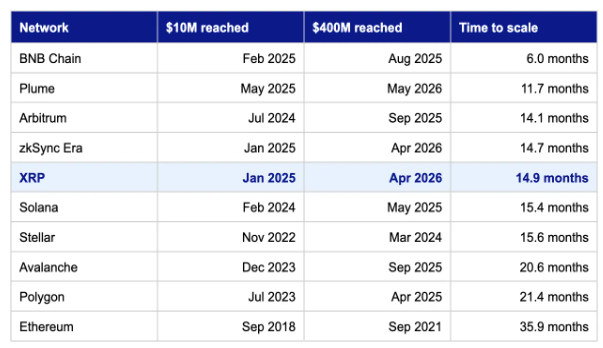
The first trend centers on raw growth speed. It took the XRP Ledger just 15 months to reach $400 million in tokenized assets, compared to Ethereum’s 36 months to hit the same milestone from a comparable starting point.
That pace puts the XRP Ledger neck-and-neck with Solana, Arbitrum, and zkSync Era—the chains many developers still see as the cutting edge of tokenization. Only BNB Chain and Plume grew faster, though both benefited from unique conditions.
BNB Chain’s surge was powered largely by a single dominant asset. Plume entered a market where the tokenization blueprint was already well mapped out, handing it a structural head start from day one.
Follow us on X to catch breaking news as it unfolds
The XRP Ledger enjoyed neither advantage. It accelerated at frontier pace from a dead stop, pointing to real demand rather than a single outsized catalyst inflating the numbers.
The second trend looks at year-to-date growth momentum. Among the 14 networks holding over $200 million in tokenized assets, the XRP Ledger is outpacing Ethereum by more than 2x—with Ethereum itself growing at roughly 35% year-over-year.
Networks currently growing faster than XRP Ledger in 2025 include SEI, Plume, and zkSync. All three operate from a much smaller base, where outsized percentage swings are easier to hit but harder to maintain over the long haul.
How Growth Concentrates and the Peer Hierarchy Shifts
The third trend reveals the real shape of that growth. Just 20 days accounted for 96% of all new tokenization inflows on the XRP Ledger over the past year, signaling large, treasury-grade deployments rather than steady retail participation.
Ethereum tells a different story. Its top 20 inflow days made up roughly one-third of annual growth, since contributions are spread across hundreds of smaller transactions each week from a far broader base of participants.
Each of the XRP Ledger’s three biggest inflow days aligns with a single major issuer moving substantial capital on chain. That pattern fits an institutional adoption story far more closely than a retail accumulation trend.

The fourth trend explores how the peer landscape is reshuffling. The XRP Ledger has long been grouped with Algorand, Mantle, and Aptos as enterprise-focused chains targeting institutional and corporate tokenization use cases across financial markets.
A year earlier, all three counterparts led the XRP Ledger in tokenized value. Algorand topped the XRP Ledger by 2.6x on this metric at the time, making it the default benchmark for enterprise issuance activity.
Today the rankings have completely reversed. All three peer networks now trail the XRP Ledger, marking a decisive shift in where issuers see long-term momentum heading within the enterprise tokenization segment.
Evernorth cautions that the data isn’t able to confirm assets migrating between chains. Still, the appeal of these networks for tokenization has clearly shifted, with new issuance now consistently selecting XRP over its former rivals.
A 134x Growth Curve and the Institutional Architecture
The fifth trend steps back to view the full arc. The XRP Ledger’s first measurable tokenization figure was $3 million in September 2024. Twenty months later, it sits near $404 million—a 134x climb.
Against networks scaling in roughly the same timeframe, Evernorth calls that trajectory the steepest absolute rise from a comparable starting point among all Layer 1 infrastructure in the dataset examined.

Context is everything. Against Ethereum’s $18.7 billion, $404 million may seem small. But reading it as “from $3 million to $404 million in 20 months” tells a much more revealing story about where this network is heading.
Why is this happening now? The XRP Ledger was purpose-built for financial markets: round-the-clock settlement, three-to-five-second transaction finality, costs measured in fractions of a cent, and built-in support for asset issuance and compliance.
Those capabilities align precisely with what regulated activity demands from public blockchain infrastructure—helping explain why institutional pilots and partnerships are increasingly gravitating toward this network for serious tokenization work.
Subscribe to our YouTube channel for expert insights from industry leaders and journalists
The post 5 Ways XRP Ledger is Changing the RWA Tokenization Map appeared first on BeInCrypto.
