



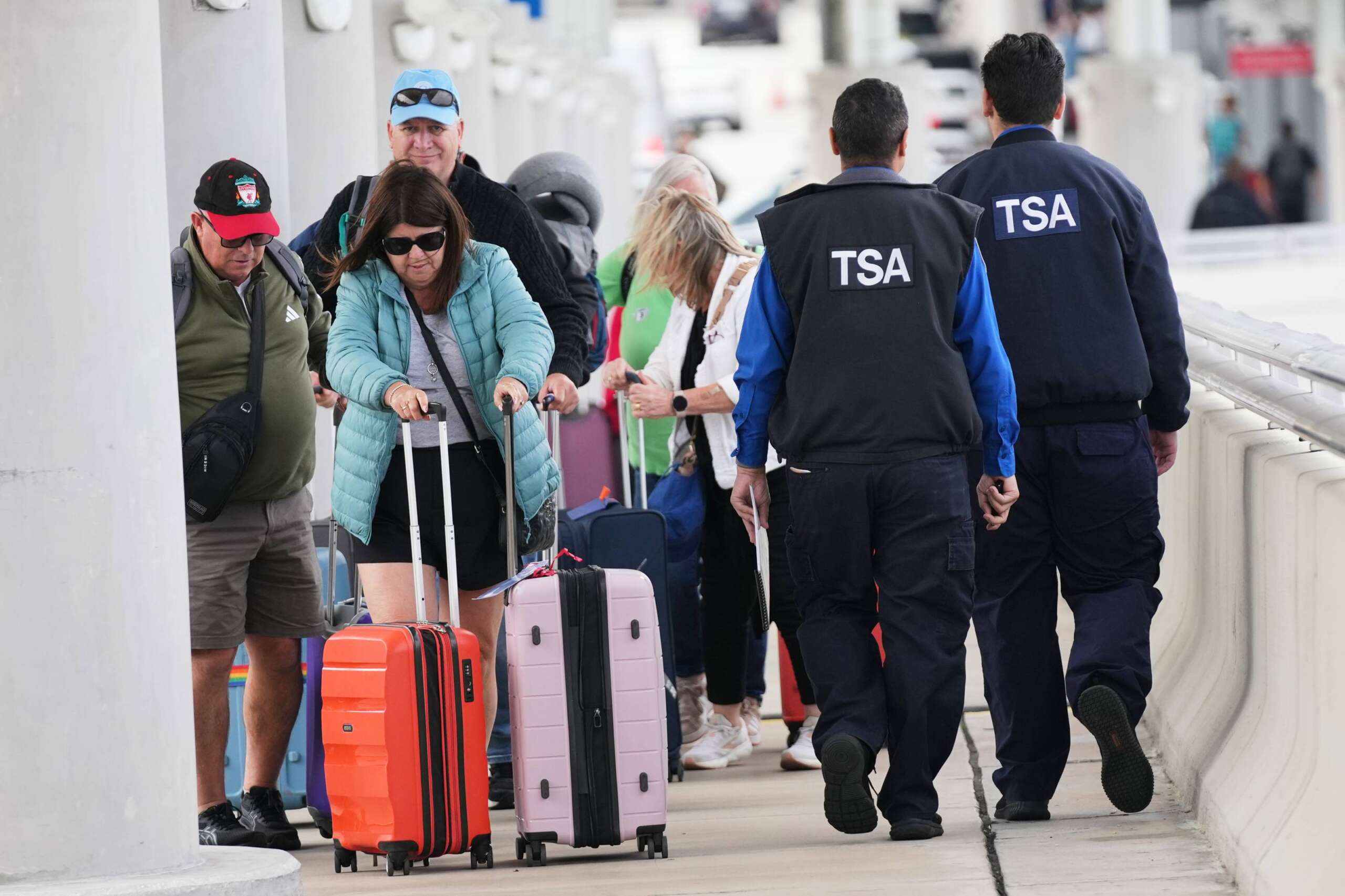
NEW YORK (AP) — On Wednesday, a House committee voiced strong bipartisan backing for guaranteeing that Transportation Security Administration employees receive wages during any upcoming government shutdowns and have access to up-to-date technology. The discussion took place as the Trump administration pushes to transition airport screening duties to private companies.
The House Committee on Homeland Security hosted a hearing centered on how to modernize the TSA, just over 25 years after its formation following the September 11 attacks. However, concerns over the well-being of TSA workers who missed paychecks during three separate funding gaps starting October 1, and who the administration aims to replace at smaller airports, dominated the conversation about improved equipment and steady funding.
Republican Andrew Garbarino of New York, the committee chair, noted in his opening statement: “Over the course of the 2025 and 2026 shutdowns, TSA officers were affected by a combined total of 119 days of shutdown conditions. That translates to officers showing up to work without pay for roughly 40% of this fiscal year, all while performing one of the federal government’s most vital security roles.”
Several other lawmakers highlighted that Congress has not yet approved any legislation meant to secure ongoing pay for TSA staff. Representative Lou Correa, a California Democrat, remarked that if TSA workers go unpaid during shutdowns, members of Congress should face the same consequence.
Correa also criticized President Donald Trump’s budget proposal, which allocates $477.3 million to shift airport screening responsibilities to private firms at approximately 250 smaller airports while also cutting over 4,500 TSA positions to save $529.3 million in pay and benefits. In related developments, the TSA recently allowed contractors within its airport staffing initiative to purchase and maintain screening equipment—a task previously reserved exclusively for government personnel.
“Advanced equipment alone can’t replace the skilled individuals who’ve kept security checkpoints running efficiently for the past 25 years,” Correa said. “This is about advancing an anti-government privatization agenda.”
Approximately 20 U.S. airports currently utilize the Screening Partnership Program for checkpoint staffing. At present, airports voluntarily choose to join. However, under Trump’s proposed budget, participation would become compulsory for smaller airports.
The TSA has outlined plans to permit private screeners at airports serving scheduled flights using planes with 10–30 passenger seats, as well as those handling charter and unscheduled private flights. Examples listed on an FAA spreadsheet include Oxnard Airport in California, Ocala International Airport in Florida, Tuscaloosa International Airport in Alabama, and Gary-Chicago International Airport in Indiana.
Testifying before the committee were Christopher Sununu, head of the Airlines for America trade group; Chris McLaughlin, CEO of Dallas Fort Worth International Airport; and Everett Kelley, President of the American Federation of Government Employees, which represents TSA staff. All three expressed that airports should retain the choice of whether to contract out screening.
“It’s essential that the Screening Partnership Program remains optional for airports, not a mandated requirement,” Sununu stated.
Kelley voiced firm opposition to the privatization proposals in Trump’s budget.
“I’m completely opposed to privatizing any airport. Would you outsource the CIA?” he asked.
After several Democratic members argued that transferring airport security to private entities could endanger U.S. airspace, Garbarino stepped in to note that “even deeply conservative cities—San Francisco, Seattle, and Atlanta—rely on private screeners at their airports, so this isn’t purely a partisan issue.”
Garbarino and Representative Tim Kennedy, a New York Democrat, promoted legislation they and three colleagues introduced earlier this month. The bill would increase from $250 million to $500 million the amount the TSA administrator must allocate to cover airport capital costs related to security. It would also create a $250 million annual TSA fund dedicated to screening technology upgrades.
Both initiatives would be funded by the existing $5.60 fee passengers pay per one-way domestic flight—the 9/11 Passenger Security Fee established in 2002. Since 2013, Congress has required a portion of this revenue to be used for deficit reduction instead. According to the bill’s sponsors, around $15 billion has been diverted to the U.S. Treasury for that purpose over the past decade.
“Americans and Congress intended this fee to directly support our aviation security system, yet nearly half the revenue goes elsewhere,” Garbarino said. “Congress must realign the passenger security fee with its original purpose: funding next-generation screening technology that keeps travelers safe.”
Trump’s fiscal 2027 budget proposal would stop redirecting passenger fees and instead use the projected $1.68 billion previously earmarked for deficit reduction to help fund TSA operations.
Copyright
© 2026 The Associated Press. All rights reserved. This website is not intended for users located within the European Economic Area.
