



Stay updated with ZDNET: Set us as a preferred source on Google.
Microsoft’s 12th-generation Surface Pro for Business reinforces its standing as a high-end, ultra-sleek device, boasting a refined design and several fresh additions to the series. The Microsoft Surface Laptop now includes a built-in privacy screen that restricts visibility for anyone not directly in front of the display, along with compatibility for Windows’ latest OS-level Advanced Haptics. Meanwhile, the Surface Pro is equipped with Intel’s newest Series 3 processors and 5G support.
Over a two-week period, I used the 13.8-inch Surface Pro for Business with an Intel Core Ultra 5 as my primary device and discovered it to be a highly responsive and versatile machine that effectively mirrors the laptop experience while also functioning as a capable tablet.
Also: The most premium work laptop I’ve tested so far lets me finally ditch Wi-Fi for good
The inclusion of 5G connectivity makes it more than just a device for the office, and from an IT standpoint, it offers strong management tools through Microsoft Intune and the Surface Management Portal.
Business professionals will value these features, but the compact size and small trackpad demand some adjustment. Additionally, the keyboard and accessories are sold separately—a tough sell given that Windows alternatives are increasingly affordable.
Best laptop deals of the week
Deals are selected by the CNET Group commerce team, and may be unrelated to this article.
Build and hardware: What’s new
Fundamentally, the Surface Pro for Business is a well-built tablet with a premium feel and a practical built-in kickstand. The 12th-generation model is powered by an Intel Core Ultra 5 335 or 7 366H (Series 3) processor and integrated graphics. Memory options range from 16GB to 32GB of LPDDR5x RAM, with 256GB, 512GB, or 1TB removable SSDs for improved repairability: Nearly every component can be replaced.
The 13-inch OLED touchscreen display is vibrant and sharp, with a pixel density of 267 PPI, a refresh rate of up to 120Hz, an anti-reflective coating, and 3K resolution. It supports 10-point multi-touch and reaches up to 600 nits of brightness for standard content and 900 nits for HDR, making it a capable tablet for both business and personal use.
The eighth-generation Microsoft Surface Laptop introduces Microsoft’s new integrated privacy screen, a built-in filter that, when activated, restricts the screen’s visibility from side angles. It operates at the hardware level, using in-cell TDM technology to reduce the brightness of individual pixels.
In practice, the screen appears significantly dimmed when viewed from the sides—though the effect depends on the overall display brightness. At maximum brightness, the screen is still visible from the sides, but details are hard to discern. At half brightness or lower, it looks as if the screen is completely off. Either way, it works effectively.
Also: I was not expecting a Razer keyboard to enhance my office productivity – here’s how it did
While there are plenty of third-party privacy screens available, they often compromise the display’s clarity for the user. That’s not the case here—when activated, there’s no visible impact for the person using the device. It can be toggled with a single hotkey (F1) in Windows, and for business environments, it can be managed by IT administrators.
Another new feature exclusive to the Surface Laptop is advanced haptics, integrated not just into the touchpad but into the operating system itself. Introduced in Windows 11 and (for now) unique to Surface devices, Advanced Haptics is a system-wide interaction framework that delivers tactile feedback for various user actions, such as snapping windows to a grid, double-clicking icons, or responding to prompts in important dialog boxes.
The Microsoft Surface Laptop with the privacy screen activated.
Kyle Kucharski/ZDNET
Of course, not everyone will want this feature, so it’s entirely optional. The haptic feedback also extends to the stylus, providing subtle cues that confirm supported actions or respond to usability triggers like moving beyond canvas borders, scaling or rotating elements, or hovering over specific buttons.
Microsoft describes this as part of broader Windows enhancements and usability improvements that go beyond visual cues—a positive step as Windows becomes increasingly filled with information and notifications. Currently, only select applications support Windows’ Advanced Haptics, including Wondershare Filmora, with more expected to follow later this year.
Pro enough for business
Microsoft’s front-facing Surface Studio camera features a Quad HD 1440p sensor with an ultrawide field of view. Image quality is solid, though it favors lower-light environments, as it tended to appear washed out in bright or harsh lighting. All the AI-powered camera features are active here, resulting in a processed look that appears by default in the video conferencing apps I tested (Google Meet, Zoom, and Teams). In contrast, opening the Camera app in Windows produced the clearest and most natural image for me.
A camera this capable is let down by excessive processing and softening; the most natural look is usually the best—something Apple has mastered with its Center Stage camera system. Still, once you fine-tune the settings for your environment, it’s one of the better webcams available on a PC.
Also: After trying these boomless headphones in the office, I’m feeling hopeful for the future of work tech
For business users who frequently join video calls, the Surface Pro delivers strong performance. The overall video call experience is excellent, with loud, clear audio (the 2W speakers outperform some laptops), dual studio microphones with Dolby Atmos, and physical volume controls.
I should note that the back of the tablet, where the camera module is located, does warm up during extended calls, with the thermal system releasing warm air around the edges of the upper half of the device.
As anyone who has experienced audio distortion during a call knows, however, hardware is only half
Microsoft tries to address these challenges by offering a variety of connectivity options, including 5G support, which lets you get online wherever cellular data is available.
However, setting up 5G on a personal device can be costly and complicated, so it’s still best handled by IT teams using enterprise cellular plans that can be professionally rolled out to devices. This way, the end user simply needs to click the 5G icon in the Windows system tray.
Usability and battery life
The 13-inch Surface Pro for Business may feel a bit tight for extended use, even though the 120Hz display is sharp and clear. The small trackpad isn’t the most comfortable for everyone, and the detachable keyboard, while responsive, doesn’t quite match a traditional laptop keyboard. On the plus side, the device can drive up to three external monitors at 4K/60Hz, making it an excellent choice for docking setups.
Both USB-C ports support fast charging with a 60W charger and also support DisplayPort 2.1 and Thunderbolt 4.
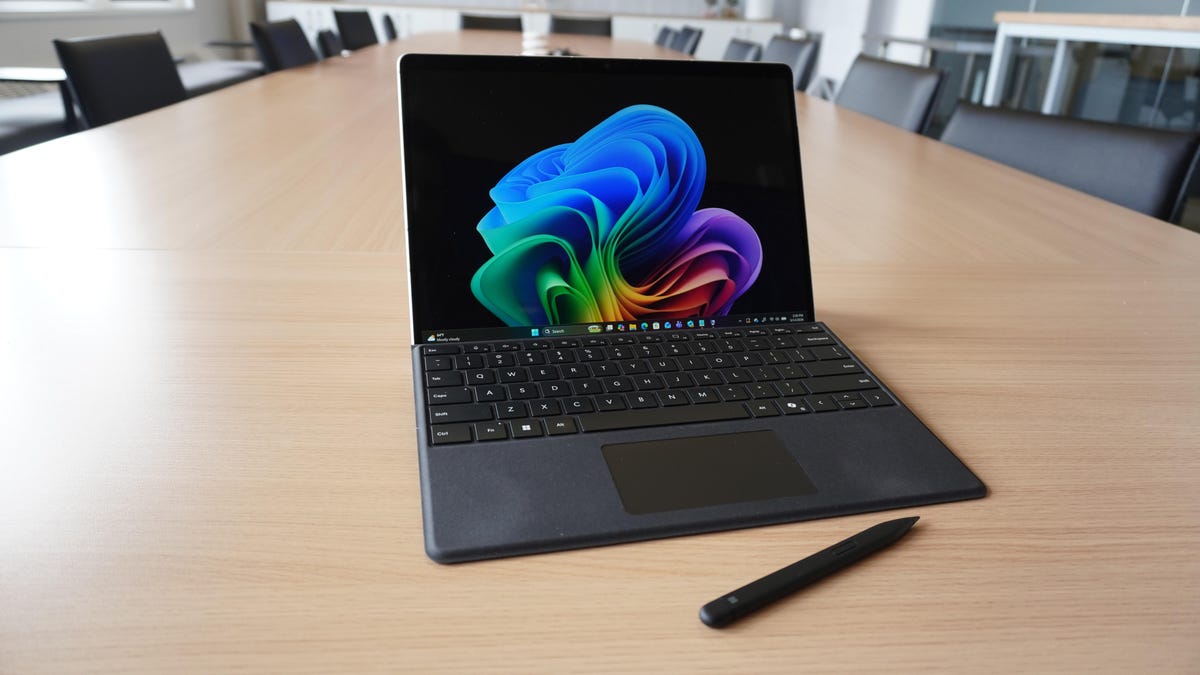
The detachable keyboard can be set up in two ways: elevated, with the pen tucked underneath, or flat, with the pen accessible. Its magnetic attachments connect to the tablet easily and securely, and the whole setup feels sturdy. Keep in mind that the keyboard is sold separately, along with the mouse and even the charger, which only comes with the device in certain markets. In most others, you’ll need to pay $70 for it.
Also: After using this HP laptop, I get why its ‘boring’ design is preferred by business users
The battery life is quite solid. Microsoft claims up to 17 hours for video playback and 11 hours of regular web browsing. I used the Surface Pro for several workdays in a row and consistently got over 10 hours of typical use (working in the browser, taking a few video calls, and some idle time in between).
ZDNET’s buying advice
The 12th-Edition Surface Pro for Business stands out as a premium tablet on its own, packed with business-focused features that add up to a high-end package. It’s a well-built device with a great display, and the 5G connectivity offers a reliable solution that shouldn’t be overlooked, though it’s best suited for enterprise users.
Of course, the price reflects its premium build, starting at $1,949 for the base configuration and going up from there, with the detachable keyboard and charger sold separately. The compact form factor and textured keyboard make for a striking package, but the fabric is best kept in the office, away from dust, spills, or dirt.
Also: How I disabled ‘fast startup’ on my Windows 11 laptop to stop overnight battery drain
Committing to this portable form factor means accepting some trade-offs. While the keyboard and trackpad are well-designed, they don’t quite replace a full-size laptop. Still, as a premium device with strong security features, it delivers a functional package with plenty of options.
