



They teach you how to build a model accurately. They rarely teach you the choices that come right after.
How do you know when to fully automate something versus keeping a human in the loop?
When does prompting stop being enough and fine-tuning become worth the cost? What does it actually mean to pick real-time inference over batch when the bill arrives?
These questions don’t show up in coursework. They show up your first week in production!
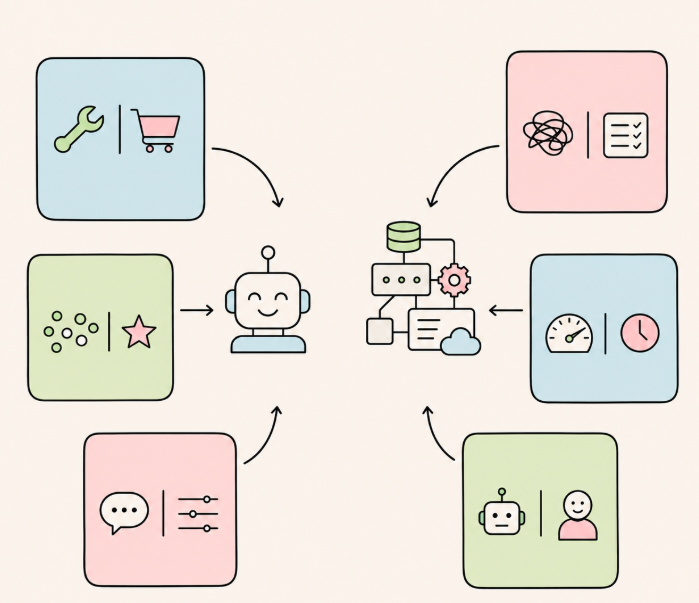
This article walks through 6 trade-offs that show up in production AI work. All backed by the latest research, so you get a glimpse into how people are handling these common trade-offs.
There are no right answers here. There are useful frames, real numbers, and the kind of context that makes the next decision faster.
- Build vs. Buy in the LLM Era (When calling an API stops making sense)
- Model Complexity vs. Maintainability (Who debugs this in 6 months?)
- Data Quantity vs. Data Quality (More data isn’t always the answer)
- Throughput vs. Latency (Batch or real-time)
- Prompt Engineering vs. Fine-Tuning (Two very different investment curves)
- Automation vs. Human Oversight (How much do you trust the model to act alone?)
Hey there! My name is Sara Nóbrega and I teach you how to become an AI power user on Learn AI. Free to subscribe!
1. Build vs. Buy in the LLM Era
When calling an API stops making sense
The old version of this question was: do we train our own model? That one is mostly settled. Almost nobody trains from scratch anymore.
The 2026 version is harder.
You have 3 options now: call an API, fine-tune an open-source model, or build and host your own stack. Each one has very different cost curves and very different failure modes.
A 2025 Omdia survey of 376 technical and business stakeholders found that 95% agreed building gives more customization and control
The same survey found 91% agreed prebuilt platforms ship faster. Both numbers are true at the same time, which is the problem.
Where it gets concrete is at scale. Below 100k daily requests, calling an API like GPT-4o Mini is usually the right call. Low overhead. Fast iteration. Above 1M daily requests, per-token costs start eating margin [2].
Here is the part teams undervalue. A 2024 analysis found that hardware and electricity make up only 20 to 30% of self-hosting cost. Staff is the other 70 to 80% [2]. This means that most build-vs-buy spreadsheets account for the GPUs and forget the engineers.
Another study found teams exceeded their LLM cost budgets by 340% on average. In most cases the cause was missing per-tenant usage tracking and missing query-level cost attribution, not the per-token rate itself [3].
Teams couldn’t see which feature or prompt was burning the budget, so they couldn’t fix it.
Framework lock-in shows up later and shows up hard. Hugging Face’s Text Generation Inference went into maintenance mode in late 2025, and teams who built on it had to migrate. Teams who used an API didn’t have to do anything.
The practical frame I use:
- Start with the API.
- Instrument every call with cost, latency, and feature attribution from day 1.
- Switch when the math forces you to.
2. Model Complexity vs. Maintainability
Who debugs this in 6 months?
A famous Google paper introduced the CACE principle: Changing Anything Changes Everything [4].
In ML systems, a small tweak in one part of the pipeline can trigger surprising changes elsewhere. This rarely happens with a linear regression. It happens often with ensembles and neural nets.
Research on ML technical debt shows that data dependency is more expensive than code dependency [4].

Why? Because data is harder to track, harder to version, and harder to explain to whoever inherits the system 6 months from now.
The original paper estimated that the actual model code is a small fraction of a real-world ML system. The bulk is feature stores, pipeline logic, monitoring, retraining triggers, and the glue between all of them [5].
In practice, teams pick a more complex model for a 2% accuracy gain and pay for that choice for 18 months in debugging time, retraining overhead, and the “nobody remembers why we did this” tax.
The question to ask before shipping a complex model is: who owns this in a year? If the honest answer is “unclear,” that is the decision point.
Learn how to give your fav AI unlimited updated context: Give Your AI Unlimited Updated Context | Towards Data Science
3. Data Quantity vs. Data Quality
More data isn’t always the answer
More data wins for foundation models trained on internet-scale corpora. In applied ML, the relationship breaks down much sooner.
Research shows that beyond a noise threshold, adding more low-quality data flattens or degrades model performance [6].
This means that the relationship between sample
Once noise passes a certain threshold, both size and accuracy fall apart.

This is what the “data swamp” problem looks like inside companies. Teams hoard data because storage is inexpensive and they assume it will prove valuable someday.
Without proper governance, you end up with a mess that takes weeks to sort through, drives up storage and pipeline expenses, and hampers experimentation without delivering better results [7].
Medical AI offers the most striking example. Small datasets with labels verified by experts have consistently beaten larger datasets with questionable annotations. The model picked up the correct patterns from a smaller amount of data because the signal was clear.
The question I find more practical:
how noisy is our current data, and what does an additional hour of cleaning get us compared to an extra day of gathering more data?
4. Throughput vs. Latency: Batch or Real-Time
Batch versus real-time
Batch and real-time inference represent two distinct architectural approaches. Choosing incorrectly creates ripple effects across infrastructure, cost, and user experience that are difficult to undo down the line.
Batch inference: predictions are produced on a fixed schedule (hourly, daily), saved in a database, and served from there. Cheaper. Simpler to set up and troubleshoot. Predictions may be outdated.
Real-time inference: predictions are generated on the fly, within milliseconds to seconds. Always up to date and pricier (24/7 availability). More components to manage and harder to monitor [8].

The trade-off at the system level is that larger batch sizes deliver greater throughput but add latency per request. Real-time systems process one request at a time, which is fast but can sacrifice efficiency.
The most common mistake I see is teams defaulting to real-time because it sounds more cutting-edge.
Yet the majority of business problems don’t require predictions in under a second!
Nightly churn scoring, weekly recommendation updates, daily fraud-model refreshes. These are batch problems being unnecessarily built as real-time solutions, and the cost gap at scale is substantial.
A practical rule of thumb: if your users can’t tell the difference between a prediction that’s 5 minutes old versus 5 milliseconds old, stick with batch inference instead of real-time.
5. Prompt Engineering vs. Fine-Tuning
Two very different investment curves

The decision framework here has become clearer in recent months.
Prompt engineering is quick, inexpensive, and adaptable. Iterations can take hours to days and it performs well for most tasks, particularly with today’s capable frontier models.
The drawback is brittleness because minor shifts in input lead to unpredictable outputs, and lengthy prompts with intricate formatting rules tend to fall apart on edge cases.
Fine-tuning demands significant upfront investment in compute, data preparation, and engineering effort. But once complete, it delivers dependable, consistent performance at scale.
A real-world example I’ve come across: fine-tuning GPT-4o for a customer support chatbot cost roughly $10k in compute and 6 weeks of data preparation [9]. The RAG alternative was deployed in 2 weeks.
My take on current best practices: begin with prompts.
Move to fine-tuning only when you encounter failure modes that prompting can’t resolve. For fewer than 100k queries, prompting is almost always the better choice. Research shows that fine-tuning becomes worthwhile at scale when the task is stable and clearly defined [10].
A 2025 study found that prompt optimization using tools like DSPy outperformed fine-tuning by 6 to 19 points on certain benchmarks, while requiring 35x fewer rollouts [10].
The gap appears to be narrowing each year. Fine-tuning has become a final step in most pipelines I observe, applied only after prompting has clearly reached its limits.
The hybrid approach is increasingly common in production: a model fine-tuned for domain-specific style and tone, paired with RAG for factual accuracy. The two methods address different challenges.
6. Automation vs. Human Oversight
How much do you trust the model to act independently?

The key question in production is: what is the impact of a wrong decision, and who bears the consequences?
Human-in-the-loop (HITL) exists on a continuum.
On one end, humans review every AI output before it takes action. On the other, full automation with humans stepping in only when something looks off.
Most production systems fall somewhere in between, flagging low-confidence predictions for human review while letting high-confidence ones pass through [11].
But the operational burden of HITL is real: reviewing every single model output doesn’t scale!
The reality is that real-time human involvement slows the system down and inconsistent reviewer judgments erode label quality.
The effective approach is selective HITL: human review is triggered only for edge cases, low-confidence outputs, and high-stakes decisions.
In healthcare, finance, and legal domains, HITL is frequently a regulatory requirement. A radiologist examining AI-flagged tumors or a lawyer reviewing AI-highlighted contract clauses. These are situations where the cost of a mistake is too high to fully automate.
A useful way to think about the division:
- AI handles volume, speed, and pattern recognition.
- Humans handle irreversibility.
Thedesign question is where exactly that line sits in your specific workflow, and whether the humans in the loop have clear authority to override the model when they disagree.
What to Take Away
If I had to compress the 6 trade-offs into one principle, it would be this: in production, the cost of a decision is rarely paid where the decision is made.
A more complex model costs you in maintenance 6 months later. A real-time system costs you in 24/7 infra forever.
Dirty data at scale costs you in retraining cycles. A clever prompt costs you in fragility under edge cases. And full automation costs you when something irreversible goes wrong!
The hard part is knowing where the cost actually lands, and asking the right question early enough to act on it.
Thanks for reading!
References
[1] Omdia, Navigating Build-Vs.-Buy Dynamics for Enterprise-Ready AI (2025).
Source:
[2] Ptolemay, LLM Total Cost of Ownership 2025: Build vs Buy Math (2025).
Source:
[3] TianPan, The Build-vs-Buy LLM Infrastructure Decision Most Teams Get Wrong (2026).
Source:
[4] D. Sculley et al., Hidden Technical Debt in Machine Learning Systems (2015), NeurIPS.
Source:
[5] CMU MLIP, Technical Debt — Machine Learning in Production (2024).
Source:
[6] Z. Qi et al., Impacts of Dirty Data: an Experimental Evaluation (2018).
Source:
[7] S. Sigari, Striking the Balance Between Data Quality and Quantity in Machine Learning (2023).
Source:
[8] C. Zhou, Batch Inference vs. Real-Time Inference: What, When, and Why (2025).
Source:
[9] S. Jolfaei, Fine-Tuning vs RAG vs Prompt Engineering: When to Use What (2025).
Source:
[10] LLM Stats, Is Fine-Tuning Better Than Prompt Engineering in 2026? (2026).
Source:
[11] A. Masood, Operationalizing Trust: Human-in-the-Loop AI at Enterprise Scale (2025).
Source:
