



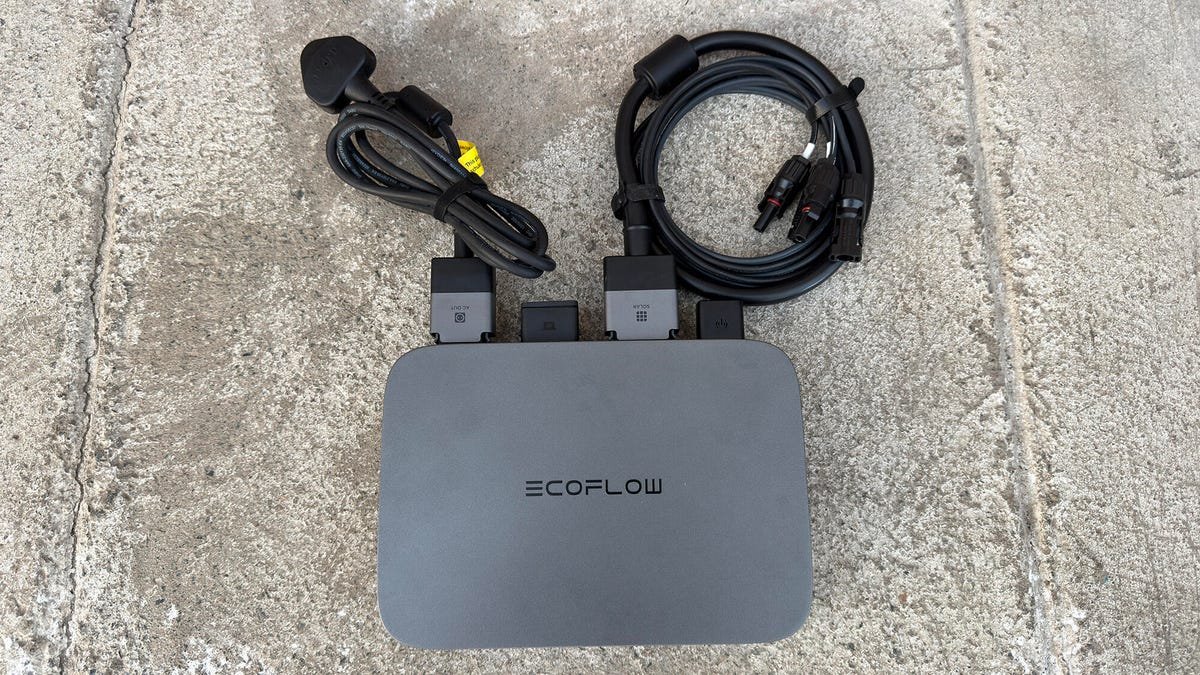
The heart of plug-in solar is the microinverter.
Adrian Kingsley-Hughes/ZDNET
Stay updated with ZDNET: Make us your go-to source on Google.
ZDNET’s main points
- Plug-in solar relies on microinverters to channel energy into a home’s electrical setup.
- In the US, only Utah has so far enacted laws permitting these systems.
- Around $2,400 is the typical cost, with payback stretching over several years.
Ever since I first experimented with a small solar panel many decades ago, I’ve been hooked. The idea that a simple sheet of glass could capture energy from a massive nuclear reactor 93 million miles away amazed me then—and still does today. Over time, solar panels have become larger, more efficient, and significantly cheaper, making it increasingly practical for everyday people to generate their own electricity.
But once you’ve got that power, what should you do with it?
Also: After testing countless power stations, here’s my strategy for handling summer outages
Until recently, there were two main paths. Either install a full rooftop solar array professionally wired into your home’s grid, or hook up your panels to a portable power station and run your devices off that. The first option is expensive because it requires professional installation. The second is limited in scope since all energy must flow through the power station itself.
But what if you could link your solar panels straight to your home’s AC wiring—all by yourself?
That’s the promise of plug-in solar, sometimes called balcony solar or portable solar.
What plug-in solar is—and what it isn’t
Let’s clear up a common misconception once and for all: plug-in solar doesn’t mean plugging solar panels directly into an AC outlet. Homes run on AC power, but solar panels produce DC (direct current)—they’re fundamentally incompatible. Attempting to connect them directly would likely result in sparks, damage, or worse.
EcoFlow PowerStream was among the first balcony solar solutions.
EcoFlow
Plug-in solar is a modern innovation that lets you safely feed solar energy into your home’s electrical system. The concept is straightforward: panels gather sunlight during the day, convert it, and supply power to cover your home’s daytime base usage—and possibly a bit extra (we’ll explain base load shortly).
Between your solar panels and your wall outlet sits a microinverter. This compact device transforms the DC electricity from the panels into AC power compatible with household appliances. It then channels that electricity into your home via a regular plug and wall socket (turning your outlet into an input source). Beyond conversion, the microinverter must deliver this power safely and in sync with your home’s existing electrical flow.
Also: After two years of testing home wind power, here’s why I still prefer solar
The beauty is how simple it is—no electrician needed, just a DIY setup. This also makes solar accessible for renters and apartment dwellers. In Utah, for example, landlords are prohibited from preventing tenants from installing plug-in solar systems, as long as they use a standard outlet and don’t make permanent changes to the property.
Understanding base load
Base load refers to the constant background electricity draw in your home when major appliances aren’t running. It includes always-on devices like internet routers, phone chargers, refrigerators, and freezers. On average, this ranges from 200 to 400 watts—or roughly 4.8 to 9.6 kWh over a full day—for a typical U.S. household.
Also: This wheeled Bluetti power station has completely changed how I power my tools and gadgets
The amount of energy you can harvest depends on several factors: the wattage capacity of your solar array, your local sunlight levels (known as Peak Sun Hours, or PSH), and deductions for losses due to inefficiencies, shading, or dirt buildup (called the derate factor).
The derate value varies, but I’ve used 0.77 (representing a 23% loss), which leans conservative.
Daily Energy Harvested (kWh) = Panel Capacity (kW) × Peak Sun Hours (PSH) × Derate Factor (0.77)
For example, in Alabama—where you get about 3.5 hours of peak sun daily—a 1 kW (1,000-watt) solar setup would yield:
1 × 3.5 × 0.77 = 2.7 kWh per day
Now switch to Arizona, where peak sun averages around 6.5 hours:
1 × 6.5 × 0.77 = 5 kWh per day
How does it actually work?
Position your solar panels in your yard or on a balcony—ideal for apartment living or renters. Connect them to the microinverter, then plug the inverter into a standard wall outlet. That’s it! You start generating solar energy as soon as the sun shines. If your system consistently produces 200–400 watts, you’re covering your base load.
Also: I powered my off-grid cabin entirely with one power station—here’s how it went
But what happens to the extra energy?
You’ve got choices. The surplus can be sent back into the grid—though you probably won’t get paid for it under current residential rates, though policies may evolve. Alternatively, you can store excess power in a portable power station for later use. Keep in mind, adding a storage unit increases the overall investment.
So why isn’t everyone using plug-in solar?
The short answer: regulatory hurdles.
While countries like Spain and Germany widely embrace plug-in solar—you can even buy kits at big-box stores—the U.S. and UK are trailing. (In the UK, Anker recently introduced the SolarBank 4 E5000 Pro—quite a name!—just as regulations are shifting to permit such systems.)
The Anker SOLIX Solar Bank 4 E5000 Pro has just debuted in Europe.
Anker
Based on current information, Utah remains the only U.S. state so far to have legalized plug-in solar units, with
Twenty-nine other states are currently working on laws to legalize these systems. In Utah, you can install systems up to 1.2 kW without needing utility approval or paying extra fees. Most proposed legislation across states is aligning with that 1.2 kW cap.
Also: How I boosted my portable solar panels’ power by up to 30% – 11 expert-approved tips
Colorado stands out as an exception, aiming to raise the limit to 1.92 kW. In contrast, the UK and Europe cap the power at just 800W.
Costs and benefits
Price is clearly a major barrier to plug-in solar adoption, as these systems aren’t cheap—especially when compared to the average cost of electricity, which is around 17 cents per kWh.
A 1,200 W plug-in solar kit currently costs about $2,400. I expect prices to drop as more states approve plug-in solar and more companies enter the market.
If you’re in Utah and spend $2,400 on a system, what kind of savings can you expect? Utah’s best-case peak sun hours (PSH) are 7 hours. Plugging that into the formula gives:
1.2 x 7 x 0.77 = 6.5 kWh
That’s a significant amount of energy, worth roughly $0.86 per day (Utah’s electricity rate was $0.1333 per kWh in February, according to government data), or about $315 annually. Under ideal conditions, you’d recover your initial investment in 7.5 years.
However, if you’re only using the plug-in solar system to cover your base load during daylight hours, the savings look much less impressive. Assuming your base load is a substantial 400 W, your system would generate 2.8 kWh during the day, but that’s only worth about $0.37 per day, or $135 per year.
At that rate, it would take 17 years to pay off the system.
Also: I spent two years testing wind power at home – here’s why solar is still my preferred source
You’d need to run significantly more than just base load during the day—such as powering heavy appliances like air conditioning or heating, or charging electric vehicles—or store the extra energy in a power station (which, as mentioned earlier, significantly increases your overall setup costs).
Is plug-in solar safe?
Some state legislators have raised safety concerns about plug-in solar installations. While anything can pose risks (lithium batteries are now a leading cause of house fires), there’s a chance plug-in solar could be misused or damaged to the point of becoming unsafe. All plug-in solar systems must comply with National Electrical Code (NEC) standards and require Underwriters Laboratories (UL) certification.
That makes them about as safe as any other electrical product we use.
I’ve been using an EcoFlow PowerStream microinverter for over six months on an isolated test grid (plug-in solar isn’t yet legal in the UK either, so I’ve been limited to test setups), and I’ve experienced no hardware issues.
EcoFlow PowerStream microinverter tech specs.
Adrian Kingsley-Hughes/ZDNET
Do you need plug-in solar?
At the moment, plug-in solar remains a niche product, meaning prices are high and the payback period is long. But as more countries and states embrace plug-in solar, I anticipate increased competition and lower prices.
Also: American Airlines has new portable battery rules – here’s what travelers should know
My current advice is this: if you live in a sunny area and consume a lot of power during the day—perhaps you charge an EV or have a Tower of Power setup like mine—you could recoup your costs within a few years. But if you’re in a place like Alaska, where you get only a couple of hours of sunlight per day, and your system would only power something like an internet router, it’s not worth it. At least not yet.
But keep an eye on this space, because the landscape is going to change significantly over the coming months and years, and prices could shift dramatically.
