



The US Bureau of Labor Statistics (BLS) is scheduled to release the April Consumer Price Index (CPI) report on Tuesday.
The data is anticipated to reveal another notable surge in consumer prices following March’s steep climb, fueled by rising Oil costs stemming from the ongoing tensions between the United States (US) and Iran.
Economists predict the monthly CPI will increase by 0.6%, down from the 0.9% jump seen in March, while the yearly figure is projected to reach 3.7%—its highest point since September 2023—up from 3.3% in March.
Core CPI numbers, which strip out unpredictable food and energy costs, are forecast at 0.4% for the month and 2.7% on an annual basis.
Between the start of the Middle East conflict on February 28 and the close of April, West Texas Intermediate (WTI) crude prices soared by over 50%. While Oil prices pulled back slightly during the first week of May, they remain roughly 40% higher than pre-war levels.
Commenting ahead of the inflation release, Deutsche Bank’s Jim Reid noted, “our economists expect headline inflation to rise by +0.58% month-on-month, moderating from March’s +0.9%, but still relatively firm.”
“In contrast, the core measure is projected to accelerate to +0.39% MoM from +0.2%, suggesting underlying price pressures remain sticky even as energy-related effects fade. The YoY rates would move from 3.3% to 3.8% for the former and from 2.6% to 2.8% for the latter,” Reid added.
What to Expect in the Next CPI Data Report?
The April CPI figures will capture the effect of sustained high Oil prices on inflation. Since this outcome is largely priced in, the core inflation data will be key in determining whether climbing energy expenses are filtering through to the wider economy and pushing up costs for other goods and services.
A monthly core CPI reading above the anticipated 0.4% could intensify worries that elevated inflation is becoming entrenched. On the other hand, a result below forecasts could help calm fears of runaway prices.
However, even in that more favorable scenario, investors are unlikely to feel fully at ease, as the US-Iran crisis remains unresolved and the disruption to shipping in the Strait of Hormuz continues to threaten global energy supply chains.
Minneapolis Federal Reserve (Fed) President Neel Kashkari warned that a prolonged closure of the strait could jeopardize inflation expectations and would demand a decisive policy response.
Similarly, St. Louis Fed President Alberto Musalem pointed out that inflation is significantly above the Fed’s target and stressed that policymakers must pay close attention to underlying inflation, along with the impacts of tariffs and Oil price shocks.
How Could the US Consumer Price Index Report Affect EUR/USD?
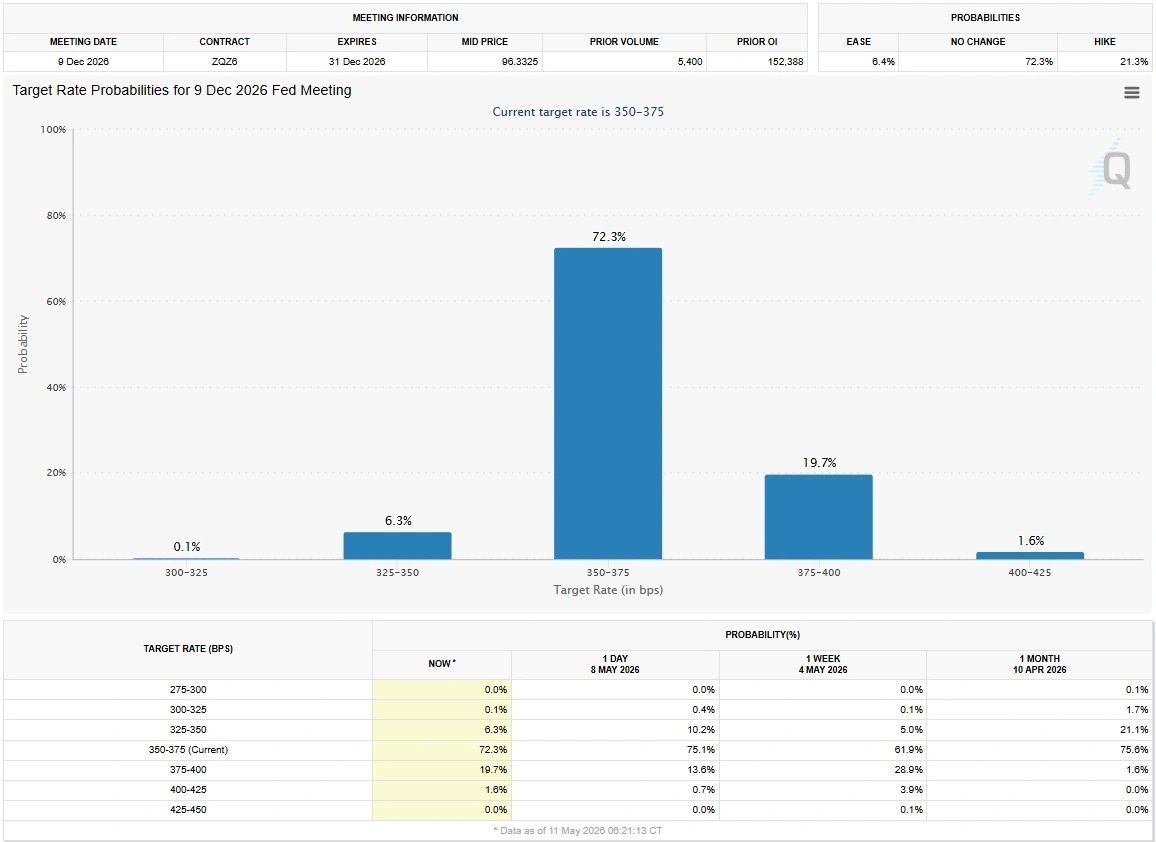
According to the CME FedWatch Tool, markets are currently pricing in roughly a 73% probability that the Fed will hold the policy rate steady at 3.5%-3.75% through year-end, with about a 20% chance of a 25 basis points (bps) increase.
A higher-than-expected monthly core CPI reading for April could push investors toward pricing in a rate hike later in the year. In such a scenario, the US Dollar (USD) would likely strengthen in the immediate aftermath.
Conversely, a weaker core CPI print could weigh on the USD. That said, unless there are meaningful signs that the US-Iran conflict is nearing a resolution, any downward pressure on the Dollar is likely to be temporary.
“Investors will be on heightened alert for the possibility of further delays to the first rate cut – or even an inability to ease in 2H26 altogether – should energy prices rise sharply and persistently due to an escalation or prolongation of the Middle East conflict,” UOB Group’s Alvin Liew explains.
“A broader oil-related price spillover across the CPI basket would materially complicate the inflation outlook, raising the risk that the anticipated year-end cut is pushed into 2027,” Liew elaborates.
Eren Sengezer, FXStreet European Session Lead Analyst, offers a brief technical perspective on EUR/USD.
“EUR/USD’s near-term technical outlook suggests a bullish bias that lacks conviction. The Relative Strength Index (RSI) on the daily chart sits above 50 but has pulled back after approaching 60, and the pair continues to struggle to distance itself from the 20-day Simple Moving Average (SMA) despite closing well above it at the end of last week.”
“To the upside, the first resistance zone sits at 1.1800-1.1820, where the upper Bollinger Band meets the Fibonacci 61.8% retracement of the February-April downtrend. Should EUR/USD manage to hold above this area, 1.1900-1.1910 (round level, Fibonacci 78.6% retracement) could act as the next barrier before 1.2000 (psychological level).”
Looking lower, a solid support zone appears to have formed at 1.1730-1.1680 (Fibonacci 50% retracement, 100-day SMA, 200-day SMA). If EUR/USD breaks below this range and begins treating it as resistance, technical sellers may step in. In that case, 1.1660 (ascending trend line) could serve as interim support ahead of 1.1560 (Fibonacci 23.6% retracement).”

The post US Inflation Set for Another Sharp Jump as US-Iran Conflict Lifts Oil Prices appeared first on BeInCrypto.
