



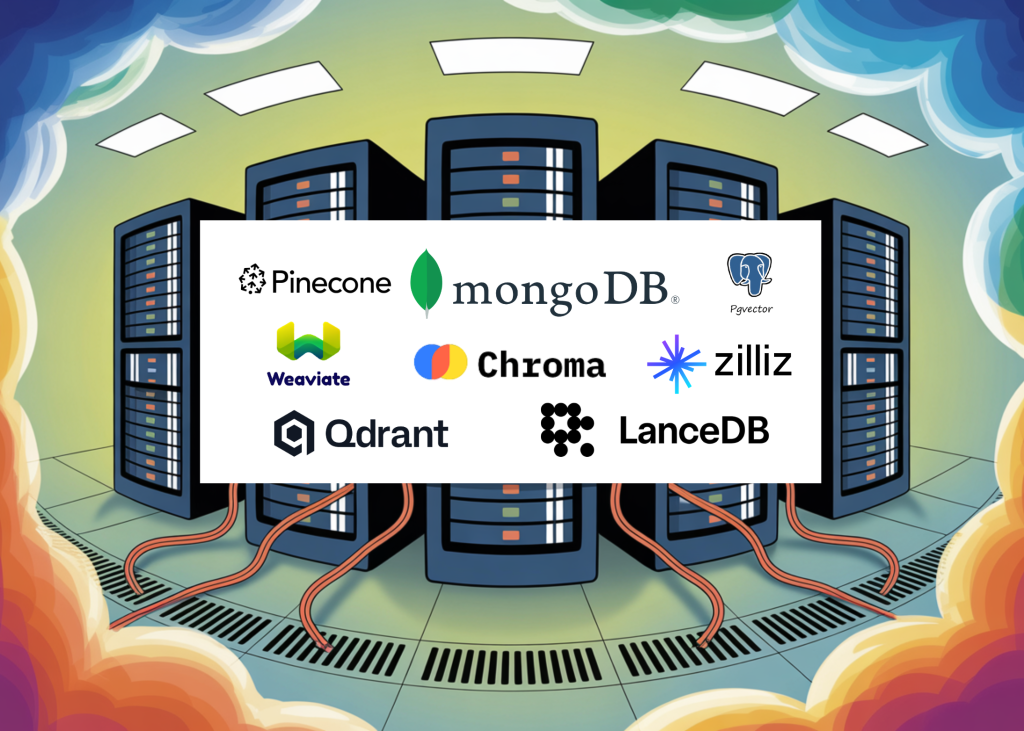
Vector databases have moved beyond experimental tools and are now essential infrastructure. In 2026, they form the backbone of RAG pipelines, semantic search systems, and agentic AI workflows — and picking the wrong one can lead to real costs and performance issues. This guide reviews the top vector databases available today, covering their architecture, performance, pricing, and ideal use cases.
Why Vector Databases Are More Important Than Ever in 2026
The change is fundamental. As large language models become standard in enterprise software, the ability to store, index, and retrieve high-dimensional embeddings at scale is no longer optional. Retrieval-Augmented Generation (RAG) has emerged as a leading approach for grounding LLM outputs in private or real-time data, with many production RAG systems relying on vector databases as a core retrieval layer. The question is no longer whether you need a vector database — it’s which one best fits your infrastructure, scale, and budget.
MARKTECHPOST · UPDATED MAY 2026 · 9 DATABASES REVIEWED · FACT-CHECKED AGAINST PRIMARY SOURCES
▸ Best Managed, Zero-Ops Vector DB
Pricing
Free / $20 / $50 / $500 min
CEO (Sep 2025)
Ash Ashutosh
The strongest fully managed option for minimal operational overhead. A new Builder tier ($20/month) was added in 2026. Nexus & KnowQL launched during May 2026 Launch Week.
View Pricing ↗
▸ Best for Billion-Scale Deployments
Pricing
OSS free / Zilliz managed
GitHub Stars
40,000+ (Dec 2025)
Engine
Cardinal (10x vs HNSW)
The go-to choice for billion-scale deployments with GPU acceleration. Zilliz Cloud’s Cardinal engine delivers up to 10x throughput and 3x faster index builds compared to open-source alternatives.
View Pricing ↗
▸ Best Price-Performance Ratio
Free Tier
1GB RAM / 4GB disk (no credit card required)
Series B (Mar 2026)
$50M led by AVP
A favorite among engineers. Offers composable vector search: dense + sparse + filters + custom scoring in a single query. Built in Rust. Self-hosted setups can handle millions of vectors for $30–50/month.
View Pricing ↗
▸ Best for Hybrid Search
Flex (Oct 2025)
$45/mo min (retired $25)
Search
BM25 + dense + filters
The hybrid search leader. Processes BM25, vector similarity, and metadata filters simultaneously in one query. Note: the $25/month pricing was retired in October 2025.
View Pricing ↗
▸ Best for PostgreSQL-Native Teams
Pricing
Free (open source)
If you’re already using PostgreSQL and working with fewer than 10M vectors, add pgvector before introducing a new database. It lets you store vectors and relational data in the same transaction with zero additional infrastructure.
GitHub Repo ↗
▸ Best for MongoDB-Native Teams
Free Tier
M0 (512MB, forever)
Flex Cap
$0–$30/mo (GA Feb 2025)
Dedicated
From ~$57/mo (M10)
Indexing
HNSW, up to 4096 dims
Eliminates data sprawl — vectors, JSON documents, and metadata all in one collection. Automated Embedding (powered by Voyage AI) enables one-click semantic search. Natively integrates with LangChain & LlamaIndex.
View Pricing ↗
▸ Best for LLM-Native Dev & Prototyping
OSS
Free (embedded / server)
Cloud Starter
$0/mo + usage
Cloud Team
$250/mo + usage
The fastest way to go from zero to a working vector search. Runs in-process or as a client-server setup. Not optimized for extreme production scale — purpose-built for scaffolding LLM applications.
View Pricing ↗
▸ Best for Serverless & Multimodal Retrieval
Pricing
OSS free / Cloud & Enterprise
Storage
S3, GCS (file-based)
Format
Lance columnar (on-disk)
Modalities
Text, images, structured
Sits directly on object storage — no always-on server required. AWS-validated for serverless stacks at billion-vector scale. Offers strong multimodal support for cross-modal retrieval pipelines.
GitHub Repo ↗
▸ Best for Research & Custom Pipelines
Pricing
Free (open source)
Type
A library, not a database
Indexes
IVF, HNSW, PQ, IVFPQ
This is a library, not a full database — it offers no built-in persistence, query API, or operational tooling. It serves as the foundation many production systems are built upon. Ideal for ML researchers and custom similarity search pipelines.
GitHub Repo ↗
Quick Comparison Overview
| Database | Type | Best Scale | Managed | Pricing Start | Key Strength |
|---|---|---|---|---|---|
| Pinecone | SaaS | Billions | Yes | Free / $20 / $50 min | Zero-ops, agentic AI |
| Milvus / Zilliz | OSS + Cloud | 100B+ vectors | Optional | OSS free / Zilliz mgd | GPU acceleration, scale |
| Qdrant | OSS + Cloud | Up to 50M | Optional | Free tier (1GB RAM) | Price-perf, composability |
| Weaviate | OSS + Cloud | Large | Optional | $45 Flex min | Native hybrid search |
| pgvector | PG Extension | Millions | Via PG | Free | PostgreSQL unification |
| MongoDB Atlas | Managed SaaS | Millions | Yes | M0 free / Flex $0–$30 | Doc + vector in one DB |
| Chroma | OSS + Cloud | Small–Med | Yes | OSS free / Cloud $0+ | Developer experience |
| LanceDB | OSS + Cloud | Small–Large | Yes | OSS free | Serverless / multimodal |
| Faiss | Library | Any (custom) | No | Free | Research, GPU search |
How to Choose in 2026
EDITOR’S ECOSYSTEM PICK
MongoDB Atlas Vector Search
Already using MongoDB? No need for a separate database.
Atlas Vector Search stores operational data, metadata, and vector embeddings together in a single collection — eliminating sync delays, dual-write complexity, and extra billing. Automated Embedding through Voyage AI enables one-click semantic search. The Flex tier is capped at $30/month. An M0 free tier is available with no credit card required.
Free TierM0 (512MB, forever)
Flex Cap$0 – $30 / month
IndexingHNSW, up to 4096 dims
IntegrationsLangChain, LlamaIndex, Semantic Kernel
Explore Atlas Vector Search ↗
Already on PostgreSQL with fewer than 10M vectors?
→ pgvector — no new infrastructure needed
Building a RAG prototype or internal tool?
→ Chroma — ship fast
Need semantic, keyword, and filter search in one query?
→ Weaviate — native hybrid search
Budget-conscious but need production-grade performance?
→ Qdrant — self-host on a VPS
Enterprise scale with no DevOps bandwidth?
→ Pinecone — pay for simplicity
Serverless or object-storage-native architecture?
→ LanceDB — S3-native
Custom research or similarity search pipeline?
→ Faiss — a library, not a database
Pinecone — Well-Managed, Zero-Ops Vector Database
Type: Fully managed SaaS | Built in: Proprietary Rust engine | Best for: Startups and enterprises focused on rapid time-to-market
Pinecone continues to be one of the top fully managed solutions for teams seeking minimal operational burden. Its serverless design lets developers store billions of vectors without provisioning any servers, backed by strong multi-tenant isolation and high-availability SLAs.
During 2025–2026, Pinecone refined its serverless architecture to handle the rising demand for large-scale agentic workloads. Notable features include Pinecone Inference (hosted embedding and reranking models built directly into the pipeline), Pinecone Assistant for production-grade chat and agent applications, Dedicated Read Nodes (DRN) for read-intensive workloads, and native full-text search now in public preview. BYOC (Bring Your Own Cloud) — currently in public preview across AWS, GCP, and Azure — runs the data plane within the customer’s own cloud account. Pinecone also introduced Nexus and KnowQL in early access as part of its May 2026 Launch Week.
Pricing: Pinecone offers four tiers: Starter (free), Builder ($20/month flat), Standard ($50/month minimum usage), and Enterprise ($500/month minimum usage). The Builder tier is new for 2026, aimed at solo developers and small teams. At production scale, costs can rise considerably — but the zero-DevOps model makes it worthwhile for teams without dedicated infrastructure engineers.
Milvus / Zilliz Cloud — Best for Billion-Scale Deployments
Type: Open-source + managed cloud (Zilliz) | Best for: Massive datasets, high-ingestion workloads
Milvus is the leading open-source option for billion-scale deployments. Its managed counterpart, Zilliz Cloud, runs on Cardinal — a proprietary vector search engine that Zilliz claims delivers up to 10x higher query throughput and 3x faster index building compared to open-source HNSW-based alternatives — with native integration into streaming data platforms like Kafka and Spark.
Milvus is built for efficient vector embedding and similarity search, supporting GPU acceleration, distributed querying, and optimized indexing. It is highly configurable and supports a variety of indexing methods including IVF, HNSW, and PQ, letting users balance accuracy and speed based on their requirements. The database offers outstanding scalability with efficient index storage and shard management.
In distributed mode, Milvus adds extra operational dependencies — such as metadata storage, object storage, and WAL/message-log infrastructure — depending on the deployment setup. For most teams, this means more infrastructure than the workload typically requires.
Qdrant — Best Price-Performance Ratio
Type: Open-source + managed cloud | Built in: Rust | Best for: Performance-critical RAG, self-hosting, edge deployment
Its 2026 differentiator is composable vector search: every aspect of retrieval is a composable primitive that engineers control directly — indexing, scoring, filtering, and ranking are all fully tunable, with nothing hidden. Operators can combine dense vectors, sparse vectors, metadata filters, multi-vector retrieval, and custom scoring within a single query.
Qdrant
delivers the best value for money in 2026. When self-hosted on a modest VPS, it can manage millions of vectors for just $30–$50 per month.
The free tier includes 1GB of RAM and 4GB of disk space with no credit card needed. Cloud pricing follows a resource-based model rather than a fixed monthly rate — costs adjust based on the compute and storage you allocate. Filtering is a standout strength for Qdrant — the platform supports powerful JSON-based filters that work seamlessly alongside vector search. Go with Qdrant when you’re watching your budget, need sophisticated filtering at moderate scale (fewer than 50 million vectors), want edge or on-device deployment through Qdrant Edge, or need a well-rounded feature set without overspending.
Weaviate — Best for Hybrid Search
Type: Open-source with managed cloud option | Best for: Projects that combine vector search, keyword matching, and metadata filtering
Weaviate leads the hybrid search space in 2026, offering native BM25 keyword search, dense vector search, and metadata filtering all within a single query. Built-in vectorization through integrated embedding models removes the need for external processing pipelines. Multi-modal capabilities let you work with text, images, and audio within the same vector space.
While Pinecone and Milvus concentrate on pure vector search, Weaviate excels at one thing above every other database in this roundup: hybrid search. You submit a vector embedding, layer on keyword filters via BM25, and apply metadata constraints — Weaviate handles all three at once and delivers ranked results. Other databases bolt these capabilities on separately or force you to merge multiple queries; Weaviate bakes them into its core design.
The modular architecture allows teams to swap out embedding models, vectorizers, and rerankers without reworking the entire application — a major advantage when models change on a regular basis.
Pricing: Weaviate overhauled its cloud pricing in October 2025. The previous Serverless tier ($25/month) was discontinued and replaced with Flex starting at $45/month (shared cloud, 99.5% SLA, pay-as-you-go), Standard from $280/month (annual commitment, 99.9% SLA), and Premium from $400/month (dedicated infrastructure, 99.95% SLA). A complimentary 14-day sandbox is offered with no credit card required, but it expires on its own and cannot be renewed. Any source still listing $25/month is referencing outdated pre-October 2025 pricing.
pgvector — Best for PostgreSQL-Native Teams
Type: PostgreSQL extension | Best for: Teams looking to unify relational and vector data in one system
The biggest shift in modern architecture is the rapid rise of pgvector. If PostgreSQL is already part of your stack, you probably don’t need a separate database. It now handles millions of vectors at production-grade speed and provides full ACID compliance across both relational and vector data.
pgvector introduces a vector column type to PostgreSQL with built-in support for cosine similarity, L2 distance, and inner product calculations. It offers both HNSW and IVFFlat indexing options.
The operational benefit is substantial: vectors sit right alongside relational data, both can be queried within the same transaction, and your team manages a single system rather than two. For use cases where vector search is one capability among many — rather than the primary workload — this is usually the smartest choice.
MongoDB Atlas Vector Search — Best for MongoDB-Native Teams
Type: Fully managed SaaS (Atlas) | Best for: Full-stack applications that need vectors stored alongside JSON documents and operational data
MongoDB Atlas Vector Search integrates vector retrieval directly into the Atlas managed database platform — solving the “data sprawl” issue of running a separate vector store next to your primary database. Operational data, metadata, and vector embeddings all reside in the same collection and can be queried through a single pipeline. This is MongoDB’s strongest selling point in the vector space: zero synchronization delay between document updates and their corresponding vector index.
Atlas Vector Search leverages HNSW-based ANN indexing and accommodates embeddings up to 4,096 dimensions, with scalar and binary quantization available to optimize cost and performance. Search Nodes let teams scale vector search workloads independently from their transactional cluster — essential for read-heavy RAG applications. The platform offers native integration with LangChain, LlamaIndex, and Microsoft Semantic Kernel, and supports RAG, semantic search, recommendation engines, and agentic AI patterns right out of the box.
A notable 2026 addition is Automated Embedding — a one-click semantic search feature powered by Voyage AI that creates and manages vector embeddings on your behalf, eliminating the need to write embedding code or maintain model infrastructure.
Atlas Vector Search is bundled into Atlas cluster pricing — there’s no separate fee for the vector search capability itself. The M0 tier is free forever (512MB storage). The Flex tier (generally available February 2025) supports Vector Search and is capped at $30/month, replacing the older Serverless and Shared tiers. Dedicated clusters start at roughly $57/month (M10) for production workloads.
Chroma — Best for Prototyping and LLM-Native Development
Type: Open-source, embedded or client-server | Best for: Early-stage development, local prototyping, and LLM application scaffolding
Chroma is an open-source embedding database built with developer experience in mind. It can run in-process (embedded) or as a client-server setup, making it the quickest route from nothing to a functioning vector search.
Chroma features an intuitive API that streamlines integration into applications, making it approachable for developers and researchers who don’t want to wrestle with complex database administration. It achieves high accuracy with strong recall rates, supporting embedding-based search and advanced ANN (Approximate Nearest Neighbor) techniques.
Chroma DB’s blend of simplicity, flexibility, and AI-native design makes it a strong pick for developers building LLM-powered applications. Its open-source model and active community drive rapid iteration and improvement.
Chroma Cloud is available with a Starter plan ($0/month plus usage charges), Team plan ($250/month plus usage charges), and custom Enterprise pricing — meaning Chroma is no longer exclusively self-hosted.
LanceDB — Best for Serverless, Object-Storage-Backed, and Multimodal Retrieval
Type: Open-source with cloud/enterprise options | Best for: Serverless functions, object-storage-backed deployments, and multimodal AI pipelines
LanceDB is an open-source, serverless vector database that stores data in the Lance columnar format, purpose-built to sit directly on object storage (S3, GCS, and so on) without needing an always-running server. AWS specifically highlights LanceDB as an excellent fit for serverless architectures because it’s file-based and integrates natively with S3 — enabling elastic, pay-per-query retrieval at billion-vector scale with no persistent infrastructure to maintain.
LanceDB’s columnar format enables fast random access and efficient
It seems like you’ve provided a snippet of an HTML article about vector databases and Faiss, along with some author information and social media links. However, you haven’t provided the *entire* article that needs to be paraphrased.
To fulfill your request, I need the complete HTML content of the article you want me to rewrite. Please provide the full HTML, and I will then paraphrase the text content while keeping the HTML structure and the original language intact.
