



Follow ZDNET: Add us as a preferred source on Google.
ZDNET’s key takeaways
- I tested 5G on rural backroads and farmland over a three-day weekend.
- Verizon delivered the strongest overall network presence, with AT&T and T-Mobile trailing behind.
- T-Mobile was the sole provider that managed to secure a 5G connection at all.
My mission to evaluate 5G performance has led me to a baseball game and long stretches of interstate between Chicago and Nashville. On every leg of the journey, I’ve carried three phones representing the three major US carriers to assess which offers the most reliable coverage. I went through this process once more, but with a fresh approach.
Also: I pitted Verizon, T-Mobile, and AT&T 5G coverage against each other on a road trip, and the outcome caught me off guard
I still loaded up my car for a weekend excursion, and I still had three phones stowed in the back seat. I relied on nPerf (details on that below) to constantly monitor carrier and network performance along the entire route. But this time, I channeled my inner John Denver and stayed entirely on rural backroads. Highway stretches were completely off the table. As I pointed out during the Nashville expedition, it makes sense for carriers to invest in infrastructure where populations are densest, such as urban centers and major highways. So I deliberately steered toward areas where few people venture.
I also swapped out my test devices. Previously, I carried three Google Pixel 10 Pro models. For this round, I moved up to three identical Samsung Galaxy S26 Ultras. Samsung supplied one unit, while the other two were provided by AT&T and T-Mobile, respectively. All three operated on carrier-supplied eSIMs.
The setup
This time, my prep work was more polished. During my last outing, I jury-rigged a contraption with a 2-by-4 plank zip-tied to an Anker battery pack, secured with bolts attached to inexpensive phone clamps. It got the job done.
Also: It’s simple to add a secondary carrier to your phone, and it won’t cost you much
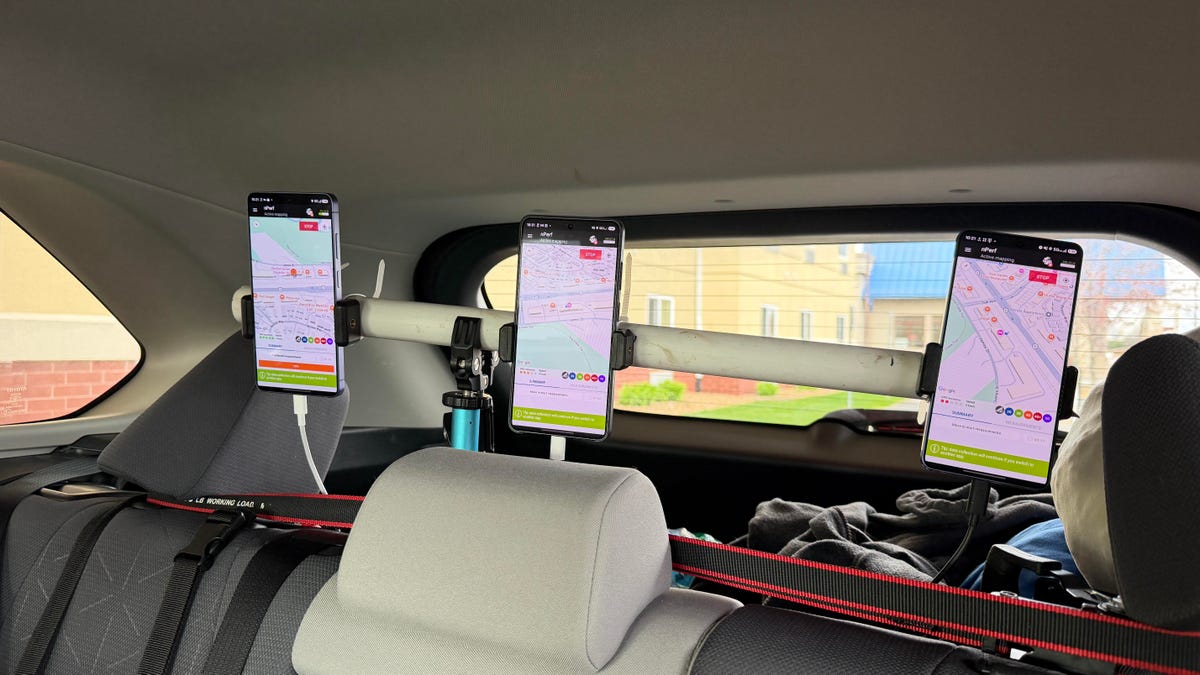
I fastened phone holders to a piece of old PVC pipe, mounted it atop a tripod, and tightened everything down with a ratchet strap. I called it “polished” — not “elegant.” One advantage of that arrangement was that I could check my rearview mirror and instantly see all three phones in action. As a bonus, nPerf on the S26 Ultra crashed far less frequently than it had on the Pixel 10 Pro. On the Nashville journey, I was grateful for frequent stops since one of the phones would often quit running between checks. That problem was completely absent this time.
A car fully loaded for a road trip, equipped with three phones set up to test 5G.
Adam Doud/ZDNET
Throughout that stretch, southern Wisconsin was the only region where I lost internet access entirely.
Also: I tested the foldable phone that sets the benchmark for Samsung and Apple in 2026
For the most part, I managed to get by, even though the connection did slow down occasionally. Out in the rural farmlands of Wisconsin, I barely accomplished anything, but those interruptions were brief — roughly 20 minutes total, more or less — and I noticed them on two separate occasions. All things considered, it wasn’t terrible. It’s also worth mentioning that the phone I was tethering to was the Oppo Find N6, which was never designed to operate in the US, so that likely contributed to the issues.
However, the fact that T-Mobile (my carrier) logged a network level of 1 for 52% of the trip doesn’t reflect well. Ultimately, all three carriers have their pros and ventures once you venture off the interstate. If I hadn’t been using a T-Mobile device as my personal phone during the trip, I’d be quite concerned about these findings. But based on my personal experience, the situation isn’t as dire as the numbers suggest.
Also: T-Mobile is offering 5G customers free Hulu and Netflix subscriptions – here’s how to claim them
The key takeaway is that if you live away from the interstate, most carriers will face challenges, and those “Fastest network” ads don’t apply to you. There’s room for improvement, but overall, the experience wasn’t nearly as poor as I anticipated.
Next time, I can skip pre-downloading podcast episodes.
