



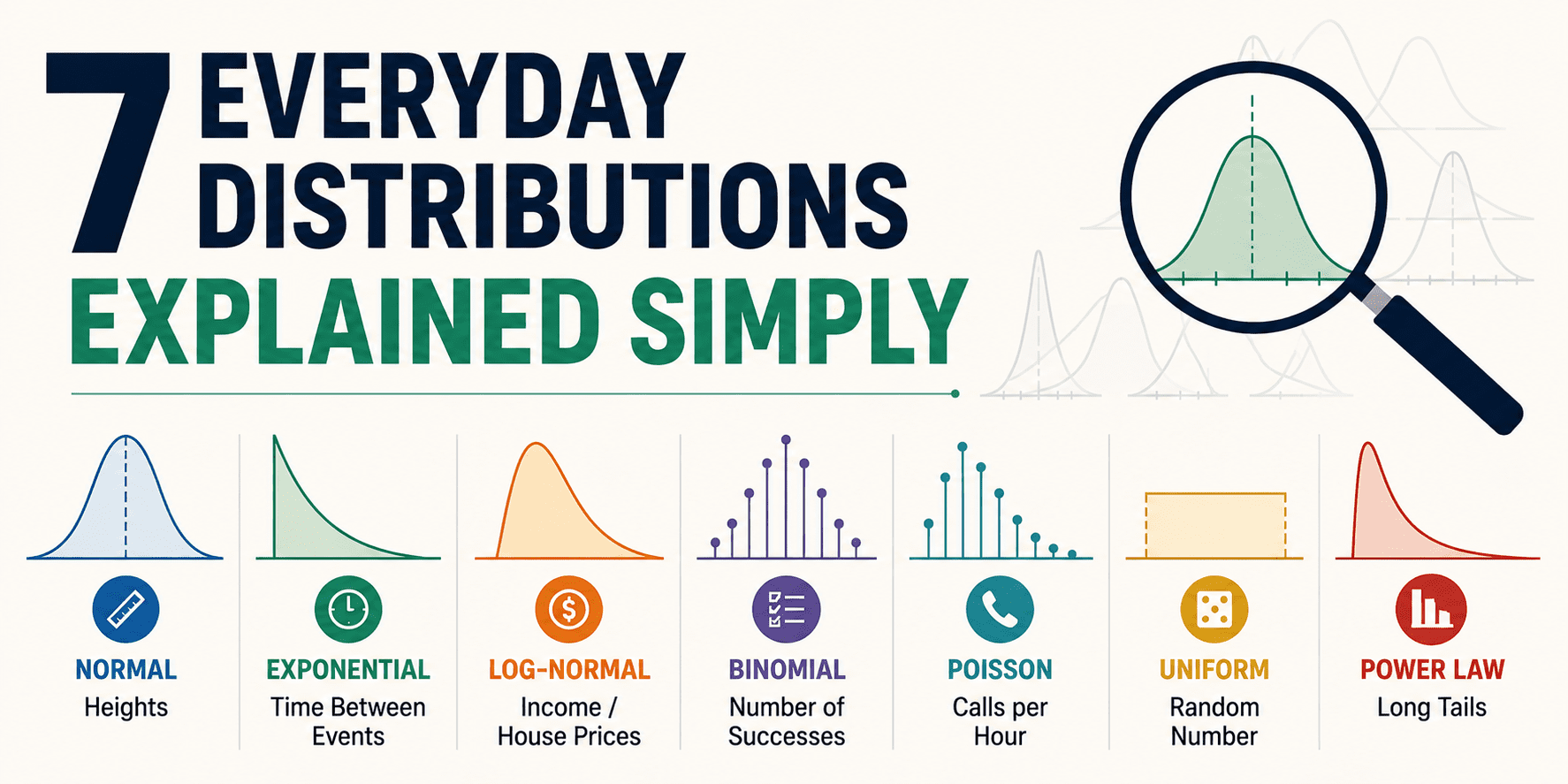
# The Big Picture
Chances are you’ve heard someone refer to something as being “normally distributed,” as if that alone explains everything. But here’s the truth without the mystery: probability distributions are simply descriptions of how data points tend to appear in everyday situations. Some follow smooth, predictable patterns. Others are uneven. And a few are essentially coin flips dressed up in more sophisticated clothes.
This guide offers an approachable walkthrough of seven key distributions you’ll recognize once you understand what they look like in practice. Skip the complex formulas and exclusive jargon. Instead, you’ll pick up a straightforward sense of: “Ah, now I get why these data patterns act the way they do.” Once you begin noticing these distributions around you, statistics transforms from a dry academic subject into a practical lens for making sense of the world.
# 1. Normal Distribution
The Classic “Everything Gathers Around the Center” Shape
The normal distribution is the well-known bell curve. It arises when a measurement is influenced by countless small, independent factors, each one pushing the value slightly higher or lower. Picture a committee project where every member chips in a small contribution, and the outcome typically settles somewhere close to the middle.
Real-world situations where it appears:
Typical adult heights (within a defined population and age bracket), tiny measurement inaccuracies, exam results across a large class, and “how many minutes it takes me to respond to a message” on an otherwise routine day.
What gives the normal distribution its recognizable quality is its symmetry. A central zone holds the bulk of values, and the farther you venture from that midpoint, the less common things become. When people reference “two standard deviations from the mean,” they’re really saying “that outcome is fairly rare for this particular bell curve.”
# 2. Uniform Distribution
The “All Outcomes Stand Equal” Arrangement
The uniform distribution is defined by complete fairness — every possible result within a given range has an identical probability of occurring.
The clearest examples come from human-designed systems:
Rolling an unbiased die, drawing a random card from a thoroughly shuffled deck, producing a random decimal between 0 and 1, or giving a prize wheel with equal-sized segments a spin.
Authentic uniformity is uncommon outside of controlled settings, because the real world inherently carries biases. Still, it serves as a tremendously useful conceptual framework. When you need a simple baseline for randomness or a neutral assumption in a model, the uniform distribution is your ideal starting point.
There are two main varieties:
- Discrete uniform (rolling a die that yields values 1 through 6)
- Continuous uniform (selecting any value anywhere between 0 and 1)
# 3. Binomial Distribution
The “Tallying the Wins” Calculator
The binomial distribution applies when three conditions are met:
- You have a predetermined number of attempts
- Each attempt results in either success or failure
- The likelihood of success remains constant across every attempt
It tells you how many successes to expect overall.
Relatable examples:
How many recipients open an email you sent to 100 people, how many successful free throws you sink out of 20 tries, how many days you wore safety gear on a construction job in a given month.
At its core, the binomial distribution offers a structured answer to the question: “If I attempt N times with a success rate of p, which outcome counts are most probable?”
It’s also quietly powering a great deal of “conversion rate” reasoning. When a team says “our signup conversion sits at 8%,” the binomial distribution is working behind the scenes, clarifying which fluctuations are routine and which ones should raise eyebrows.
# 4. Poisson Distribution
The “Counting Events in a Set Window” Estimator
The Poisson distribution is the right tool when you’re tallying how many random events occur within a specific interval of time or space — particularly when those events are relatively infrequent and independent of one another.
Practical scenarios:
Support tickets filed per hour, typos discovered on each page of a manuscript, vehicles crossing a particular intersection in a five-minute stretch, daily website signups during steady traffic periods, incoming calls at a modest-sized business.
Poisson carries a very particular purpose: it’s focused on counts within an interval. Not “did it happen at all,” but “how many times did it happen?”
It’s also one of the first distributions that catches people off guard in a good way: “Hold on — statistics can actually anticipate that?” And yet it does a remarkably serviceable job of capturing the unpredictable nature of how real-world events accumulate.
# 5. Exponential Distribution
The “How Long Until It Happens?” Predictor
While Poisson tallies how many events land within a given interval, the exponential distribution takes the inverse view: it asks, “How much time passes before the next event occurs?”
Typical examples:
How long until the next support ticket comes in, gaps between people joining a queue, the stretch of time before the next customer enters a quiet store, the interval between random system failures in certain simplified reliability analyses.
Here’s the human reality: if events truly arrive at a steady, random pace, then even after waiting 20 minutes, the next event isn’t any more “overdue.” This can feel counterintuitive, because people naturally look for patterns, but the exponential distribution remains a valuable model for estimating future waiting times from historical records, so long as the process doesn’t retain memory of past occurrences.
# 6. Lognormal Distribution
The “Long Right Tail” Reality Check
The lognormal distribution emerges when a quantity is shaped by multiplying factors together rather than adding them. That multiplicative nature produces a distribution where most values sit at the lower or middle end, while a few stretch out to be extremely large.
Where you’ll encounter it:
Personal incomes, housing prices in most markets, the time required to finish a project, file sizes on a computer, durations of website visits, and how far a social media post spreads.
This distribution is the reason “average” numbers can be deceiving. With lognormal data, a modest number of very large values can drag the mean upward sharply, even though the bulk of the data sits considerably lower. That’s why the median provides a more accurate picture in these situations.
# 7. Power Law Distribution
The “A Handfly Outliers Dominate” Phenomenon
Power laws represent the most extreme form of long-tailed behavior. They emerge when large outcomes are uncommon yet far more frequent than a normal distribution would predict. The tail remains stubbornly heavy.
Observe it in contexts such as:
Populations of cities, follower counts across social platforms, page-level website traffic, revenue generated by individual products, wealth distribution in certain simplified frameworks, and the frequency of particular words in natural language.
The underlying concept is straightforward: a tiny collection of items accounts for a disproportionately large share of the total, and their influence vastly outweighs that of the remaining majority. This same behavior manifests in the physical universe — setting aside the complexities of gravity, dark matter, and cosmic expansion — which helps explain why vast cosmic voids exist instead of matter being spread evenly through space.
# A Final Thought
The most enjoyable part is that you don’t need to commit formulas to memory to make good use of distributions. All it takes is learning to recognize the underlying pattern in your data.
Once you start labeling these structures, your instincts sharpen quickly. Statistics becomes less about textbooks and more about pattern recognition backed by evidence.
You’ll glance at daily numbers — from your inbox habits to sudden traffic surges — and you’ll instinctively understand what falls within the realm of normal, what’s just noise, and what genuinely deserves a closer look.
Nahla Davies is a software developer and technology writer. Prior to shifting her full-time focus to technical writing, she served — among a variety of notable roles — as a lead programmer at an Inc. 5,000 experiential branding firm whose clients have included Samsung, Time Warner, Netflix, and Sony.
