



Stay updated with ZDNET: Mark us as a preferred source on Google.
Key insights from ZDNET
- Photoshop can fabricate details that weren’t captured by the camera.
- The combination of Rotate Object and Harmonize works remarkably well.
- Achieving great outcomes still demands Photoshop expertise, judgment, and touch-up work.
Adobe keeps rolling out impressive AI-powered tools for Photoshop. Last fall, I thoroughly enjoyed experimenting with the Harmonize feature, which automatically tweaks an object’s color, lighting, and shadows to blend seamlessly with a background. Now, it’s time for the Rotate Object feature, which twists a flat object in virtual 3D space.
Also: The hottest new Photoshop AI tool lets me blend images with just one click—and I can’t quit using it
You need to watch this feature in action, especially when paired with Harmonize, to truly appreciate what this new magic trick can accomplish.
Upgrade Photoshop first
This particular feature comes with Photoshop version 27.6. If your version is older, simply open the Creative Cloud app and run the update.
Breaking down the Rotate Object panel
Photoshop has always let you spin objects, but only in flat, 2D rotations around a single point. The new Rotate Object panel, however, lets you twist an image in three dimensions—and fills in the hidden portions automatically.
You can find Rotate Object under the Edit menu, or by right-clicking within the contextual toolbar.
As illustrated above, there are four key controls. You can tilt an object along the X axis (labeled 1), turn it along the Y axis (labeled 2), fine-tune the object’s perspective (labeled 3), and spin the entire thing around any corner anchor point (such as the one marked 4).
Also: I had ChatGPT Images 2.0 redesign my app interfaces—and the results were stunning
The AI will render the unseen parts of the object. This ability is useful, but bear in mind that the AI doesn’t know what everything actually looks like. It would have been helpful if Adobe let you provide multiple reference angles of the object, but for now, the AI takes its best guess.
When you select Rotate Object, the AI first shows a rough, low-resolution preview of how it imagines the rotated object. Once you’ve finalized all your adjustments, Photoshop refines the image into a polished result.
Putting it to the test
For my initial compositing demo, I wanted to highlight how rotation and harmonization work together. I rummaged through my digital archives until I landed on an older snapshot of a MacBook Pro. I picked this particular photo because of its extremely warm color cast, which really showcases the Harmonize adjustment. Alongside the laptop image, you’ll see a set of AirPods Max. This photo is especially interesting because its cool, neutral tone contrasts sharply with the laptop’s warm palette.
Side by side, you can see how the headphones were rotated to reveal the side and underside of the ear cups—areas completely absent from the original photo. One small complaint: the AI conjured up a glowing ring that doesn’t actually exist on the real headphones. That said, the 3D rotation and the lighting harmonization make the composite look convincingly real.
Also: I rely on Photoshop’s AI tool daily—here are my 5 must-know tips for top-notch results
You could easily erase that phantom ring of fabricated light using the Clone Stamp tool or Generative Fill, so it’s hardly a dealbreaker.
Remember, Photoshop is a professional tool that assumes you bring some skill to the table. While it handles the heavy lifting of generating a rotated image, it’s up to you to decide how far to rotate, how to scale the composited element, and where to position it. I’m not a compositing expert, and my final image shows that. Still, it’s close enough for practical purposes.
A trip back in time
For my next experiment, I decided to drop my mid-2010s Dodge Challenger into early 1990s San Francisco. This project called for rotation, scaling, and several classic Photoshop techniques.
As you can see, this wasn’t a simple horizontal flip. The entire car was rotated, and the AI generated the opposite side of the vehicle. It also produced appropriate shadows, shifting them from the front of the car (as in the original) to the side, matching the new angle.
Also: I pitted ChatGPT Images 2.0 against Gemini Nano Banana to find out which is superior—and one clearly wins
I applied a 2-pixel motion blur to the Dodge because the original background photo was shot on an old film camera, and the other cars showed slight motion blur (this was San Francisco, after all, where bumper-to-bumper traffic is far more common than speeding). I also added 5% noise to bridge the gap between the crisp digital image of the red car and the film grain visible throughout the rest of the photo.
Hitting a wall
Even though I still had 3,620 out of 4,000 generative credits remaining, I had to stop working on this article because Adobe blocked me. You can count the number of images I generated today just by scrolling through this article.
To be frank, I don’t think that’s an excessive number of images. And when you’re doing real production work in Photoshop, that kind of abrupt cutoff is pretty harsh. If I’d been facing a tight deadline, I would have been furious about being locked out, even though I’d only used roughly 10% of my credits.
It’s also 11:30 at night on the West Coast, so this hardly qualifies as peak usage time for the businesses and professionals relying on Photoshop’s AI features. It’s unlikely I was cut off due to server capacity issues, though I suppose anything is possible.
Back in action
It’s now the following afternoon, and Photoshop has once again granted me access to the Rotate Object and Harmonize tools.
Also: I gave ChatGPT Images 2.0 a spin: A fun, massive leap forward—and surprisingly handy for real-world tasks
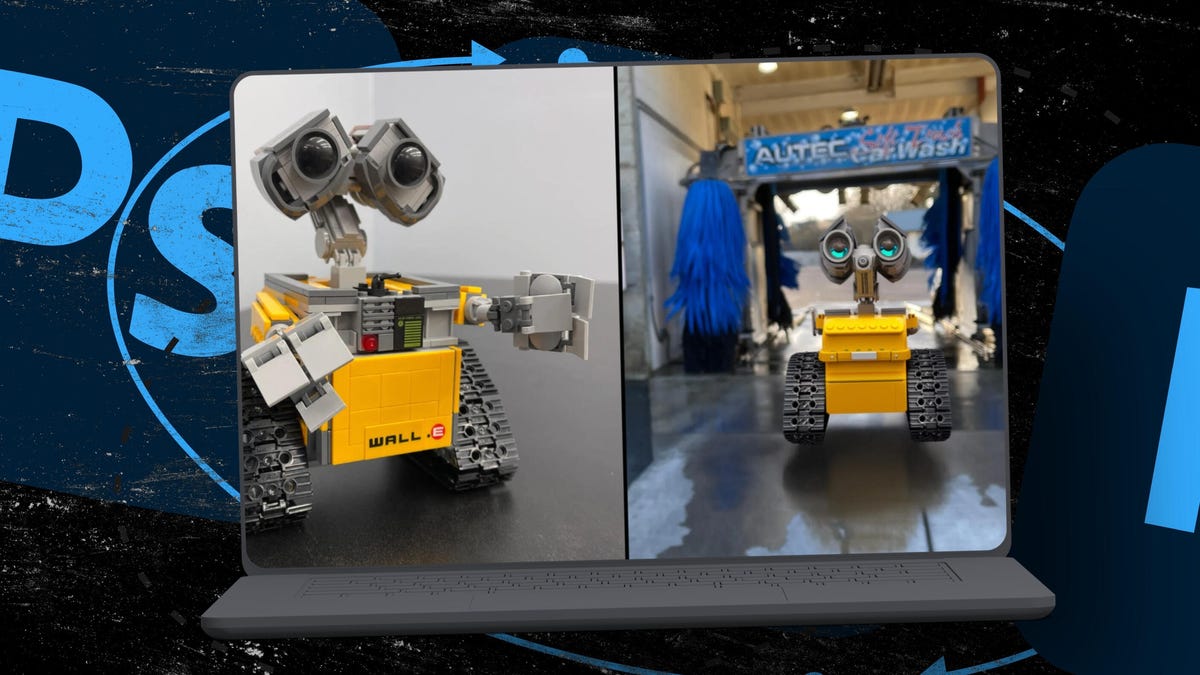
This time around, I started with a photo of a nearby car wash. Don’t ask me why I have such a photo in my collection. Anyway,
Conveniently, our smartphones ensure a camera is always at hand. I recently paired mine with a photo I snapped of a budget-friendly off-brand Temu WALL-E that I constructed some time ago.
Turn your attention to the WALL-E image: it captures the robot from a front-corner angle. Since the AI had no reference for the robot’s posterior view, the generated back view isn’t faultless—especially with regard to the strange eyes appearing on the rear of WALL-E’s “head.” By coupling the rotation feature with Harmonize, however, it appears quite convincing, as if the little robot is genuinely standing within the setting.
Following that experiment, I selected a front-quarter perspective and converted it into a side-on shot. This time, I used a 1930s-era Ford pickup parked next to a local barn here in Oregon.
Take note of the bright midday shadow across the barn face. Its position confirms that the sun is nearly directly overhead. In the original pickup image, fell from behind the truck, extending a shadow forward. After compositing, rotating, and harmonizing the layers, the shadow now rests primarily beneath the vehicle rather than ahead of it.
I’d like to wrap up with an example that didn’t go quite as smoothly. I possess a snapshot of a Dreo air fryer alongside an image of a hotel suite’s mini-kitchen. My intention was rotating the appliance to tuck it alongside the basin.
Although I succeeded with the basic rotation, I struggled to get the perspective Photoshop’s Perspective Warp feature should be the ideal tool for this adjustment, but I couldn’tachieve a result I was happy with.
Conversely, positioning the air fryer on the lower-right counter allowed for a successful rotation. I then employed Perspective Warp to resize it correctly, followed by applying Harmonize to weave it into the scene seamlessly.
The air fryer’s glossy, highly reflective surface posed a significant challenge. I attempted using Generative Fill to tone down the excessive reflections, but the AI couldn’t nail it—or perhaps my prompting wasn’t quite up to scratch.
Do you place enough trust in AI to fill in the gaps of a composite image, or is manual retouching still your preferred method? Drop your thoughts in the comments below.
You can follow my day-to-day project updates on social media. Be sure to subscribe to my weekly update newsletter, and follow me on Twitter/X at @DavidGewirtz, on Facebook at Facebook.com/DavidGewirtz, on Instagram at Instagram.com/DavidGewirtz, on Bluesky at @DavidGewirtz.com, and on YouTube at YouTube.com/DavidGewirtzTV.
