



Here’s the paraphrased HTML, keeping the structure intact while making the text clearer and easier to read:
Follow ZDNET: Add us as a preferred source on Google.
ZDNET’s key takeaways
- If you’d rather not lug a laptop everywhere, there are plenty of alternatives.
- These options vary widely in size, from AR headsets down to your smartphone.
- Here’s a look at several approaches and which ones work best for different scenarios.
I cover mobile technology for a living, and I do a lot of my writing on the go. That means I frequently find myself without a laptop—or in situations where using one isn’t practical, like crammed into the back seat of a car or squeezed into an airplane seat. Other times, I’m simply tired of staring at a laptop and want a change of pace. In those moments, I switch to something else. Over time, I’ve discovered a handful of devices that handle these situations surprisingly well.
Also: My top 3 distraction-free writing apps that helped me write dozens of novels
Over the last month, I revisited some older devices I’ve relied on before and tested out some new ones too. I figured you might be interested in learning about alternative ways to create content when a laptop isn’t an option.
Writing without a keyboard
One device I came across is called SpeakOn. It’s a small AI-powered voice transcription gadget, roughly the size of an Oreo cookie. It sticks to the back of your iPhone or Android phone using MagSafe (a magnetic ring comes in the box) and connects via Bluetooth. There’s a power button on the back and a front button that activates push-to-talk for transcription.
I had my doubts about this device because my brain doesn’t naturally work by just talking and having words appear on a screen. I usually need to think through what I want to say, figure out the best way to phrase it, and then type it out. So this was definitely a new way of working for me.
SpeakOn attaches to the back of your phone using MagSafe.
Adam Doud/ZDNET
I used SpeakOn to draft this article, and everything up to this point was dictated into the device and then heavily edited. But it confirmed something I’ve long suspected—my brain just isn’t wired to create this way. I also found it pretty frustrating when I was lying on my bed, speaking into the device, only to realize, “Oh, it missed part of that.” That happened more than once.
Also: The most impressive piece of tech I’ve tested (and it isn’t smart glasses)
I also don’t love how the device tweaks your voice, making it sound either more professional or more casual. For example, when I said “happened on a couple of occasions,” SpeakOn transcribed it as “happened a couple of times.” That kind of automatic rewriting isn’t for me.
So from here on out, I’m going back to the traditional method—fingers on a keyboard, as it should be. Of course, the choice of keyboard and display is where things get really interesting. Let’s take a look.
Samsung Galaxy XR
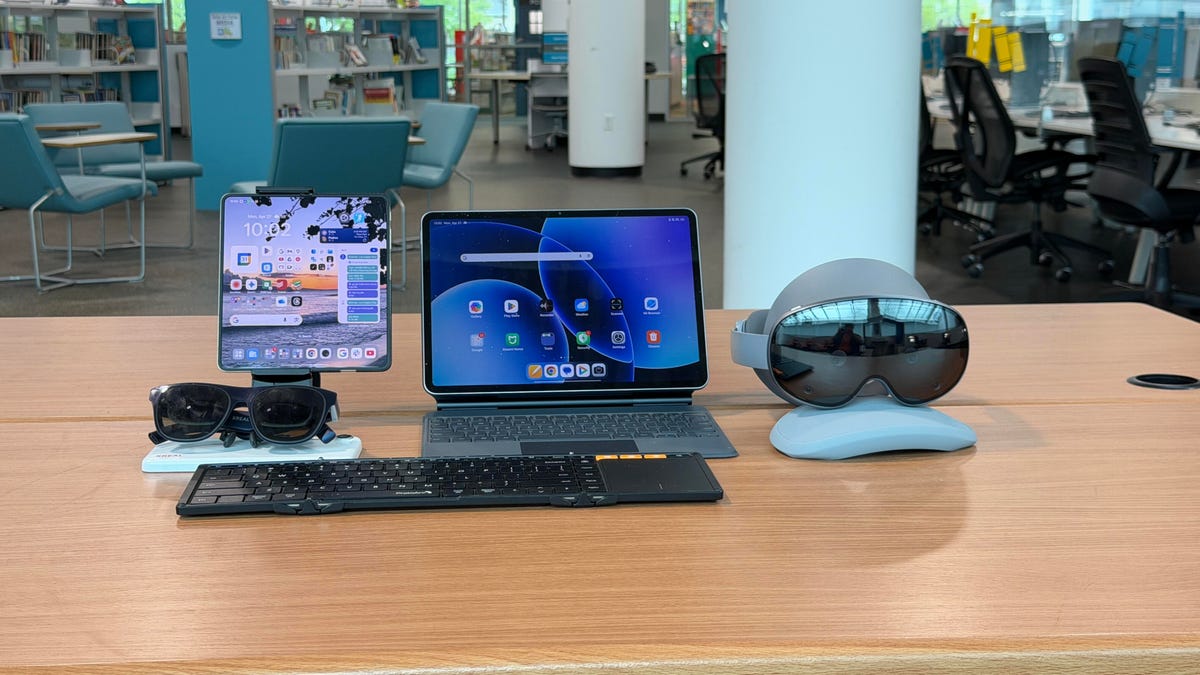
I’ll start with what’s probably the most impressive yet least practical option—the Samsung Galaxy XR headset, which launched last October. Think of it as Samsung’s answer to the Apple Vision Pro, but at half the price. It’s a standalone computer that you wear on your face.
Samsung and several app developers have created some compelling experiences for the Galaxy XR, including the MLB app, Google Maps, and Gemini, which can transform content into 3D on the fly using AI. It’s genuinely impressive, but if all you want to do is write, browse the web, or watch something, it feels like overkill.
The headset itself is bulky, and the virtual keyboard is, to be generous, difficult to use. I paired it with a ProtoArc XK01 TP Keyboard, which works great. You’ll hear more about that keyboard as we go.
As it stands right now, the Galaxy XR isn’t a great tool for creating content. But once XReal’s Project Aura arrives—offering a similar experience in a pair of glasses instead of a bulky headset—this conversation will change completely, and I’m looking forward to it. Speaking of XReal…
XReal 1S Glasses
The XReal 1S glasses are a step below Samsung’s headset in the XR lineup. These glasses project a display that appears to float in front of you. You can use it as a secondary monitor, though I prefer using it as my main screen. I’m a big guy, so working on an airplane is tight and uncomfortable. But with the ProtoArc keyboard and a Samsung Galaxy S26 Ultra running in DeX mode, I can essentially have a full windowed workspace wherever I am.
The glasses need to be connected to your phone for this setup, and it’s worth noting that they’ll drain the battery of whatever device they’re plugged into. I typically get a solid 4 to 5 hours of work out of the glasses and the S26 Ultra before battery life becomes a concern.
DeX mode is the real key here, giving you a proper windowed interface. The XReal glasses offer two modes—follow mode and locked mode—and I prefer locked mode. In follow mode, the entire screen moves when you turn your head, but in locked mode, the display stays fixed in space in front of you.
You can simply turn your head to look at different parts of the screen as needed. On the funny side, when the airplane banks into a turn, the screen drifts along with it—but a quick tap to recenter fixes the issue.
Xiaomi Pad 7 and Pro Magnetic Keyboard
One of the most popular laptop replacements is the classic tablet-and-keyboard combo, but not every tablet and keyboard pairing is created equal. Arguably the best setup for content creation is the iPad with the Magic Keyboard—which I don’t own. A very close runner-up is the Xiaomi Pad 7 paired with its companion keyboard.
Also: This Android tablet brings a $1,700 iPad Pro feature to the $400 price range – and it’s just as good
I’ve always been an Android person at heart—iOS is great, but I like having more flexibility—so using a tablet and keyboard like the Xiaomi feels like a game-changer. The tablet packs a Snapdragon 8 Elite processor and 8GB of RAM, so it’s more than capable of handling my content creation workflow. I could (and have) edited video on it if needed, but since Android apps aren’t ideal for video editing, I still prefer doing that on a laptop.
When it comes to a portable ‘laptop’ that’s easy to carry and toss into a bag, this device really stands out. If you’re in the US, finding the Xiaomi might be a bit tricky. While the Samsung Galaxy Tab S10 Ultra is a strong alternative, I prefer how this one lets the screen “float” above the keyboard—unlike the S10 Ultra, whose keyboard just hangs down from the bottom of the tablet.
Foldable phones and external keyboards
The best camera is the one you’ve got on you—and the same goes for content creation. Right now, I’m using the Oppo Find N6, a fantastic foldable with a large inner display. In a pinch, I’ve propped it up against something and used the ProtoArc Keyboard to write articles. I’d love it even more if it had MagSafe built in. I added a third-party ring, but it tends to come loose when I take the phone out of my case.
Also: Google Pixel 10 Pro Fold vs. Samsung Galaxy Z Fold 7: We tested both—and here’s our pick
A foldable phone gives you plenty of screen real estate for productivity. The Find N6 packs the Snapdragon X Elite Gen 2 chip and 16GB of RAM, making it just as powerful as the Xiaomi tablet—and it also has built-in internet connectivity, which is a huge plus.
Of course, other foldables offer similar experiences. The Samsung Galaxy Z Fold 7 and Google Pixel 10 Pro Fold have comparable screen sizes, but the Find N6’s battery life is simply unmatched.
Regular phones and virtual keyboards
If you’ve got some free time but no larger device handy, your phone is still a capable content creation tool. I usually do most of my work on my iPhone 17 Pro Max, but any smartphone will do. Some argue that phones are too cramped and virtual keyboards aren’t efficient—and those are valid points. But with practice, typing on a phone becomes surprisingly manageable.
Also: The best Samsung phones to buy
After all, we type on our phones every day, so writing 1,000 words on one isn’t that unusual—it just takes a bit longer. Over the past few weeks, I’ve written several 700+ word articles on my phone while riding in a car or waiting for my daughter’s soccer game to start.
Here’s a handy trick you might already know: long-press the space bar on most virtual keyboards (including iOS) to move the cursor. It’s saved me a lot of time and frustration!
Final thoughts: It feels great
That’s how I’ve been creating content lately. I don’t always want to lug around a laptop—and honestly, these past few weeks have made me want to leave it at home even more. That’s a pretty liberating feeling.
Also: The best Android tablets: Lab tested, expert recommended
Being able to sit or even stand anywhere and get work done on your phone makes balancing work and life much easier. It gives you the flexibility to be present wherever you are—without needing to carry a laptop just in case. Next time you get the chance, give it a try.
