



pros and cons
- Clean, well-built, and easy to carry.
- Backed by a large, active community of users and developers.
- Priced very affordably.
- Can be challenging to learn at first.
Not as powerful or versatile as the Raspberry Pi or Flipper Zero.
Follow ZDNET: Add us as a preferred source on Google.
Bring up the idea of a computer small enough to fit in your pocket, and most people tend to react in one of two ways:
They either say, “Oh, like a Raspberry Pi!” Or they respond, “Ah, more like a Flipper Zero!”
Also: The Flipper One may be the ultimate Linux PC for hackers in 2026 – and I’m excited
When it comes to the M5stack Cardputer Adv, it shares traits with both—but doesn’t fully belong to either category. What it definitely is, though, is a fascinating piece of hardware for anyone eager to dive in and experiment.
So, what exactly is it?
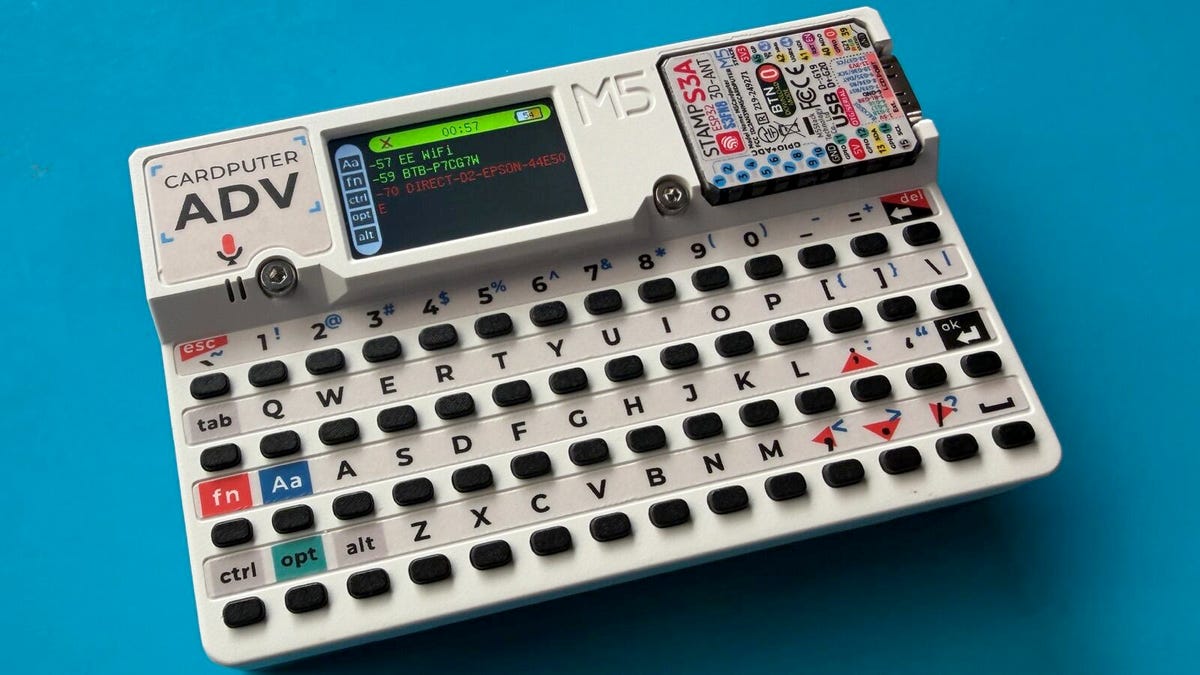
In terms of hardware, the Cardputer Adv is a pocket-sized computer roughly the dimensions of a thick stack of credit cards (think more Warren Buffett than average wallet), complete with a built-in keyboard and a tiny screen.
The Cardputer Adv is about as thick as a stack of credit cards.
Adrian Kingsley-Hughes/ZDNET
Designed for quick prototyping, industrial automation, and smart home projects, it’s powered by the M5Stack Stamp-S3A core—a low-power, dual-core chip with Wi-Fi and Bluetooth 5.0 Low Energy support. If you had to draw a comparison, the closest relatives would be the Raspberry Pi 400 or 500. Essentially, it’s a compact computing module paired with a keyboard.
Also: I used a $4 timer to reboot my router, and it actually made my internet faster
This little device packs a surprising amount of features. The keyboard includes 56 fully functional keys that are surprisingly comfortable to type on—even for someone dealing with mild peripheral neuropathy. The display is a 1.14-inch color LCD that’s remarkably clear for its size. Audio is handled by an ES8311 codec, a high-quality MEMS microphone with excellent signal-to-noise ratio, and a standard 3.5mm headphone jack.
Additionally, it includes a six-axis motion sensor (IMU), an infrared emitter for controlling TVs and other remote-compatible devices, a microSD card slot for extra storage, a 0-4P Grove connector, and a 2.54-14P expansion header for connecting external hardware.
The Cardputer Adv even includes expansion ports!
Adrian Kingsley-Hughes/ZDNET
And there’s more: the base has built-in magnets so you can attach it to metal surfaces, plus LEGO-compatible holes for integrating it into custom builds.
Oh, and it also has a lanyard hole—handy for carrying or attaching to a keychain.
All of this runs on a 1,750mAh lithium-ion battery, which is quite impressive for such a compact device. It’s a sleek, well-designed piece of tech. The exterior is also labeled with helpful icons explaining each component’s function—a thoughtful detail that matches the clean aesthetic of other M5Stack products.
What can it actually do?
Right out of the box, you’ll find a variety of built-in tools to explore—like accessing the six-axis motion sensor and IR emitter, scanning Wi-Fi networks, recording audio, connecting a GPS receiver, using LoRaChat for long-range radio communication, and more. These are simple starter apps meant to help you get comfortable with the system. A quick online search will reveal many more downloadable apps to expand its capabilities (here are a few to begin with).
The preloaded apps are a great way to familiarize yourself with the Cardputer Adv.
Adrian Kingsley-Hughes/ZDNET
One tool you’ll need to get comfortable with is the M5Burner app, which is used to upload new apps and code to the Cardputer Adv. It might take a little troubleshooting to set up—I ran into some minor issues getting it to work on my Mac and had to install additional drivers—but that’s all part of the learning process, and it helps you connect with the broader online support community.
Where the Cardputer Adv truly shines is when you start writing your own programs. You can use M5Stack’s UIFlow 2.0 visual programming environment or switch to Arduino for more advanced coding. This is where another learning curve begins. How steep it feels depends on your prior programming experience and what you’re hoping to achieve.
I really admire the design of the Cardputer Adv.
Adrian Kingsley-Hughes/ZDNET
I recommend beginning with simple projects and gradually increasing complexity to avoid feeling overwhelmed. Just like with a new Raspberry Pi or Arduino, you’ll quickly accomplish things that impress you.
Cardputer Adv vs. Raspberry Pi vs. Flipper Zero
A common question I come across is whether to choose the Cardputer Adv, a Raspberry Pi, or a Flipper Zero. Let’s start by comparing it to the Flipper Zero.
Indeed, the Cardputer Adv is an impressive device and certainly capable of supporting ethical hacking activities. However, it’s essential to recognize its hardware limitations.
Also: I tested 4 Bluetooth trackers (including AirTags) for reliability here’s how Android competitors stacked up
For instance, the IR function is transmit-only, meaning it cannot clone remotes like the Flipper Zero can. Additionally, it lacks sub-GHz and NFC/RFID capabilities, and there’s no USB-RS232 interface, so it can’t emulate a keyboard. While the Cardputer Adv does feature Bluetooth comparable to the Flipper Zero, the software ecosystem for the Flipper Zero is significantly more advanced.
One advantage the Cardputer Adv has over the Flipper Zero is built-in Wi-Fi support. I was able to get Marauder Wi-Fi security scanning software running on it, though it required quite a bit of online research and troubleshooting.
The Cardputer Adv will help you start coding.
Adrian Kingsley-Hughes/ZDNET
The Raspberry Pi, on the other hand, is a completely different platform. It boasts a mature ecosystem and a massive community. It’s much easier to get started with because you’re booting into a full OS with access to a proper keyboard and monitor.
I often think of the Cardputer Adv as being similar to the Adafruit HUZZAH32, which serves as either a compact development board for Arduino projects or a safe environment for learning how to program with Arduino.
Also: I discovered an M.2 dock that clones SSDs without needing a computer and with just one click
The Cardputer Adv is also enjoyable to use, and from what I’ve seen, its community is lively, active, and welcoming to newcomers something that can’t always be said about the Raspberry Pi community.
ZDNET’s Buying Recommendation
The M5Stamp Cardputer Adv is also very affordable at around $42, which is roughly the same price as a 1GB Raspberry Pi 5 these days. You can also expand its capabilities with accessories, such as the components needed to set up a Meshtastic open-source, off-grid communication system using LoRa, for about $30.
All this mention of integrated development environments and driver installations might make the Cardputer Adv sound daunting, and honestly, compared to most modern devices it is. But it’s also a lot of fun and can spark deep, meaningful learning.
