



The April 29 FOMC decision arrives with a 99% chance of a rate hold, but on-chain data shows crypto whales are already positioning ahead of Powell’s tone.
BeInCrypto analysts have identified three tokens experiencing notable whale accumulation in the hours before the meeting, each driven by a distinct rationale. One benefits from a fresh exchange listing driving pre-FOMC liquidity inflows. Another follows a reliable inverse pattern pointing toward a 17% breakout. The third is being quietly absorbed through a supply-shock window.
Onyxcoin (XCN)
Onyxcoin (XCN) is trading at $0.0058, up 3.15% for the day, following a 64% surge to $0.0086 on April 27 after Upbit announced it would list the token. The South Korean exchange launched KRW and USDT trading pairs at 07:00 UTC, pushing daily volume up 629% to $37 million.
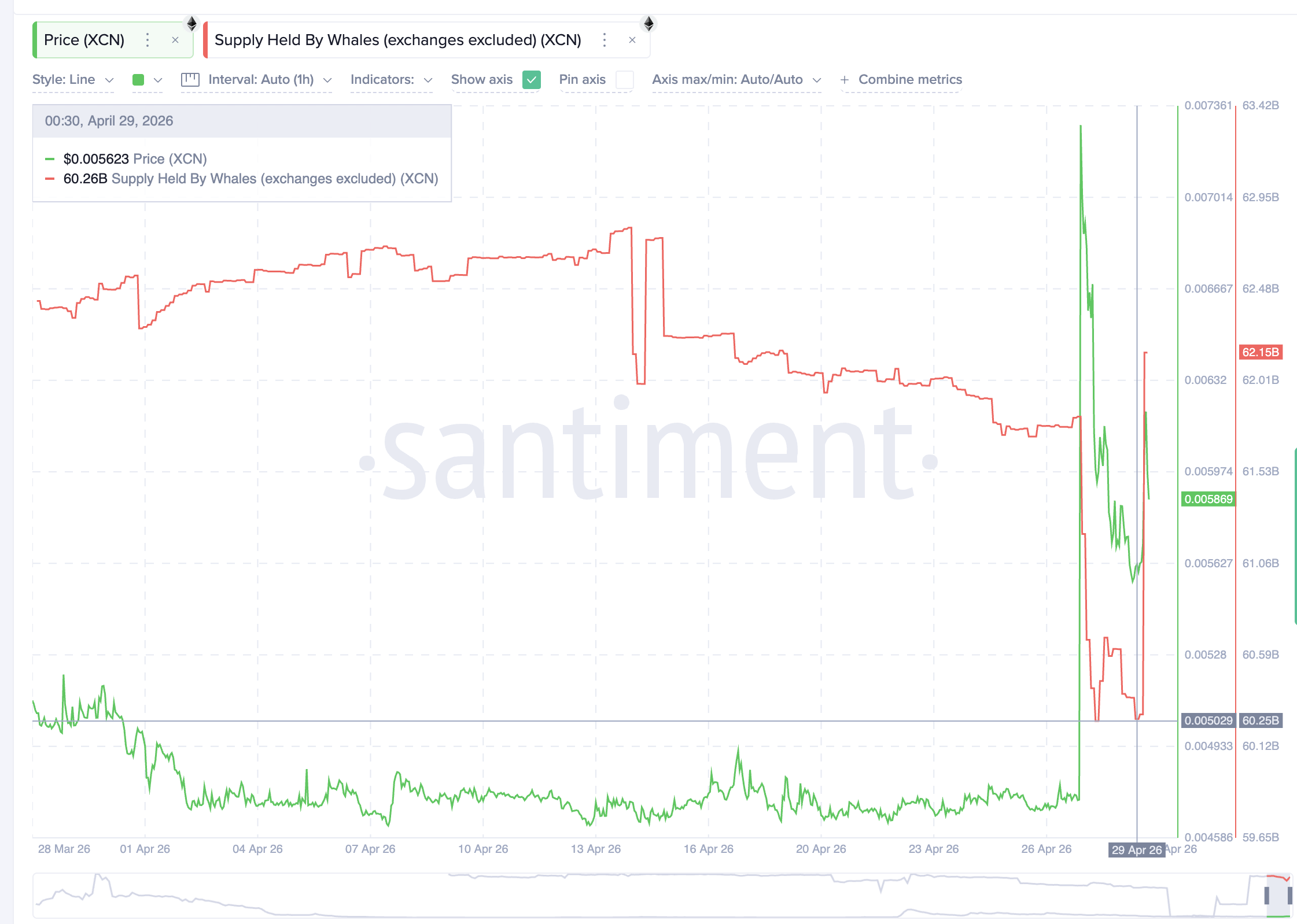
Whale activity paints the more compelling picture in the context of the FOMC event. Large wallets distributed tokens aggressively during the listing rally, with Santiment’s supply-held-by-whales metric dropping between April 26 and April 28.
Looking for more insights like this? Sign up for Editor Harsh Notariya’s Daily Crypto Newsletter here.
That sell-off has now flipped. Whale accumulation has pushed the metric back up to 62.15 billion XCN in the hours leading into the April 29 FOMC decision, recovering nearly 1.9 billion tokens. The timing is critical because the broader crypto market is higher at the time of writing as traders rotate out of the S&P 500 ahead of Powell’s press conference. Whales appear to be positioning XCN as a candidate to benefit from pre-FOMC liquidity rotating into altcoins.
The chart backs up the bullish case. Between October 8 and April 28, the daily Relative Strength Index (RSI), a momentum oscillator that gauges price strength on a 0–100 scale, formed a higher low while price formed a lower low. That bullish divergence is the technical foundation whales seem to be counting on.
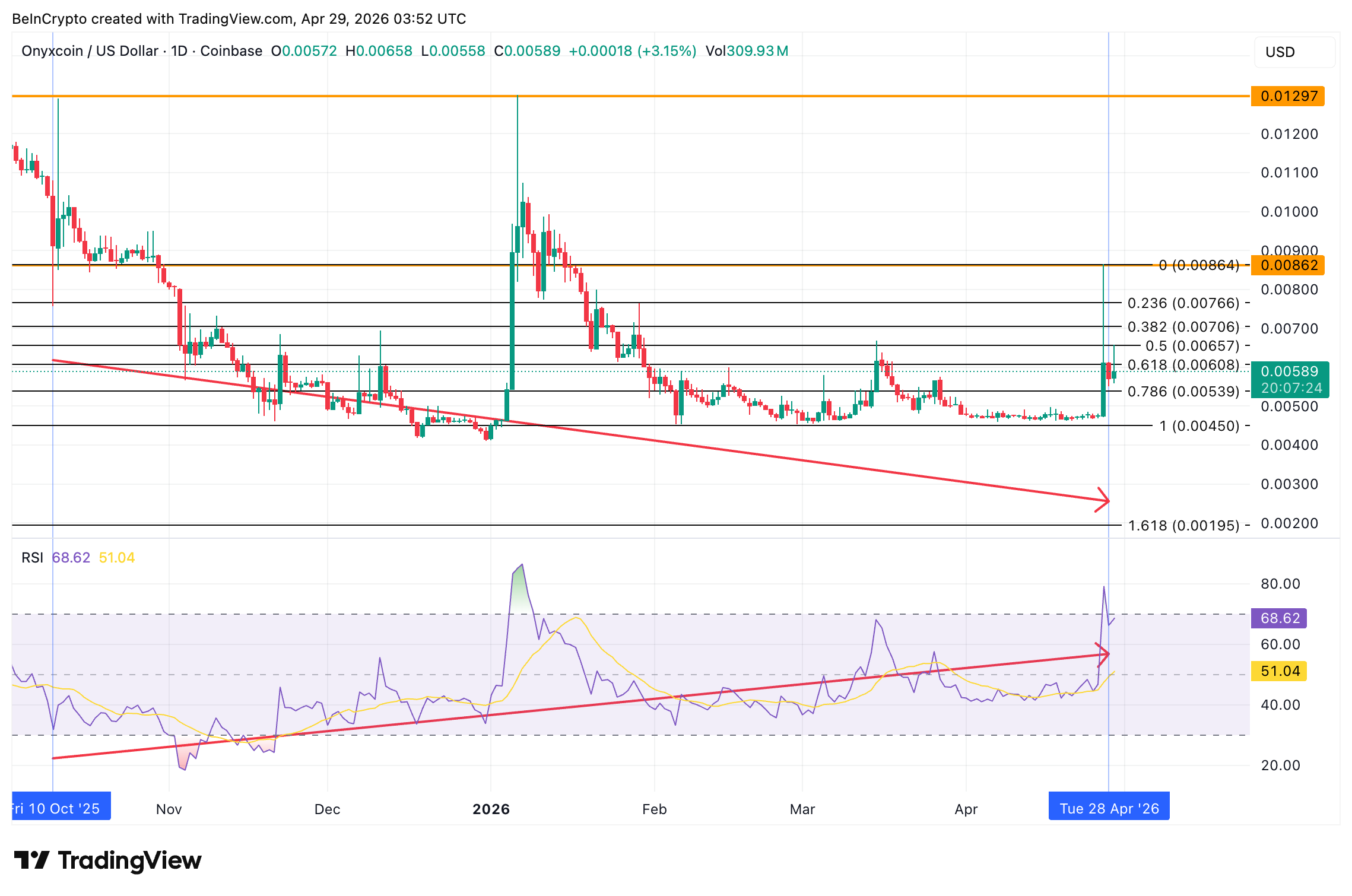
The target math is clear. XCN needs a daily close above $0.0060, the 0.618 Fibonacci level, to confirm the breakout and set sights on the $0.0086 listing high. A close above $0.0086 reopens the $0.0129 resistance zone from January. On the downside, a fall below $0.0053 invalidates the divergence and opens the door to $0.0045.
Chainlink (LINK)
Chainlink (LINK) is trading at $9.30, hovering just beneath a key technical barrier at $9.39 heading into the April 29 FOMC decision. The setup shows the most consistent whale accumulation signal among the crypto picks ahead of the meeting.
Santiment data shows LINK whale wallets, excluding exchange addresses, have increased their holdings from 663.21 million LINK on April 23 to 667.84 million LINK on April 29. That translates to roughly 4.6 million LINK accumulated over six days, worth approximately $42.7 million at current prices. The buying has climbed steadily without the dump-and-reaccumulate pattern seen in more volatile assets.
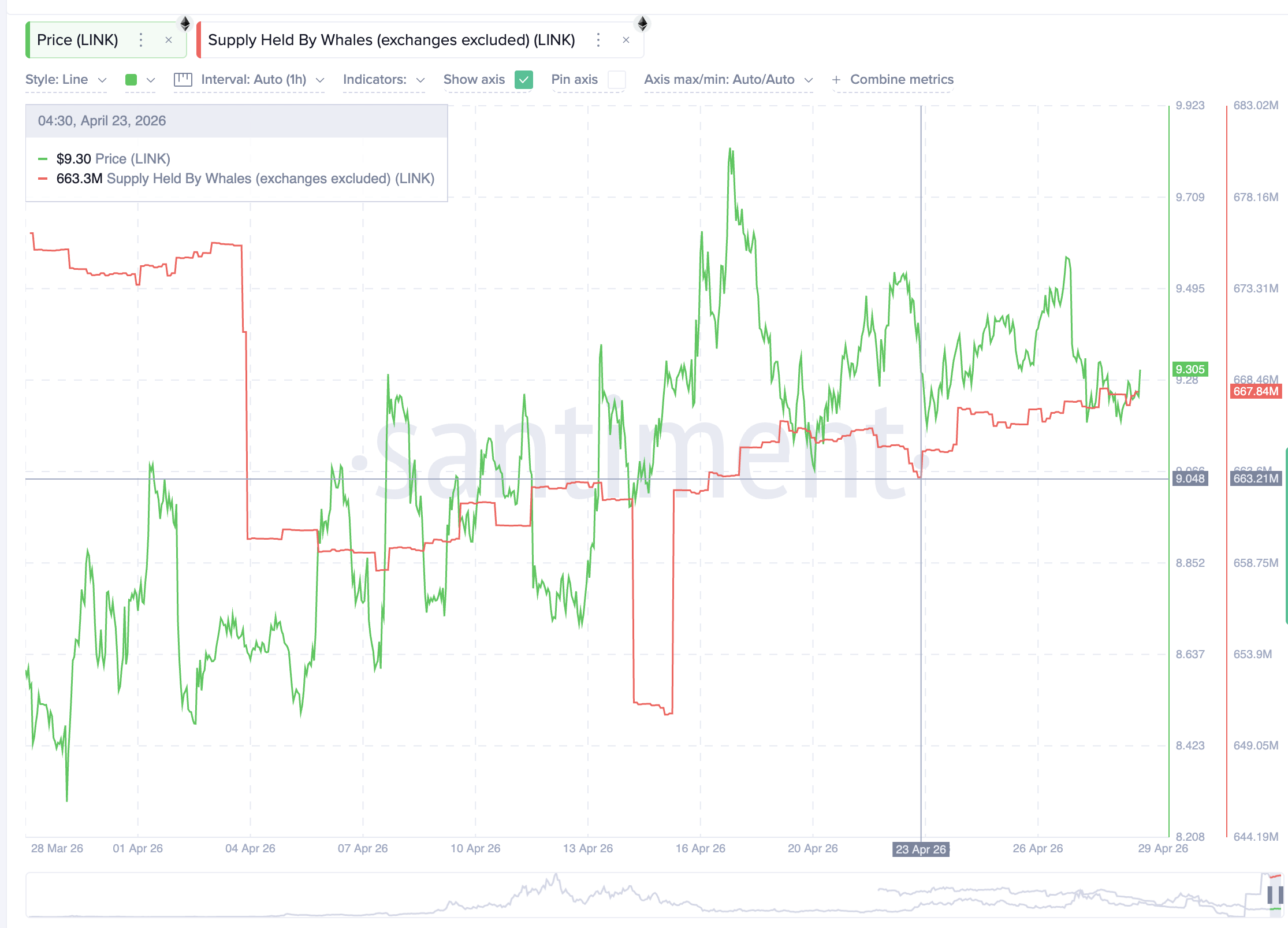
Persistent large-player buying during a macro de-risking period typically signals conviction rather than reaction, and LINK’s flow profile fits that description.
The chart validates what whales are positioning for. LINK has formed an inverse head and shoulders, a bullish reversal pattern. The head sits at $8.19, and the right shoulder developed near $8.99.
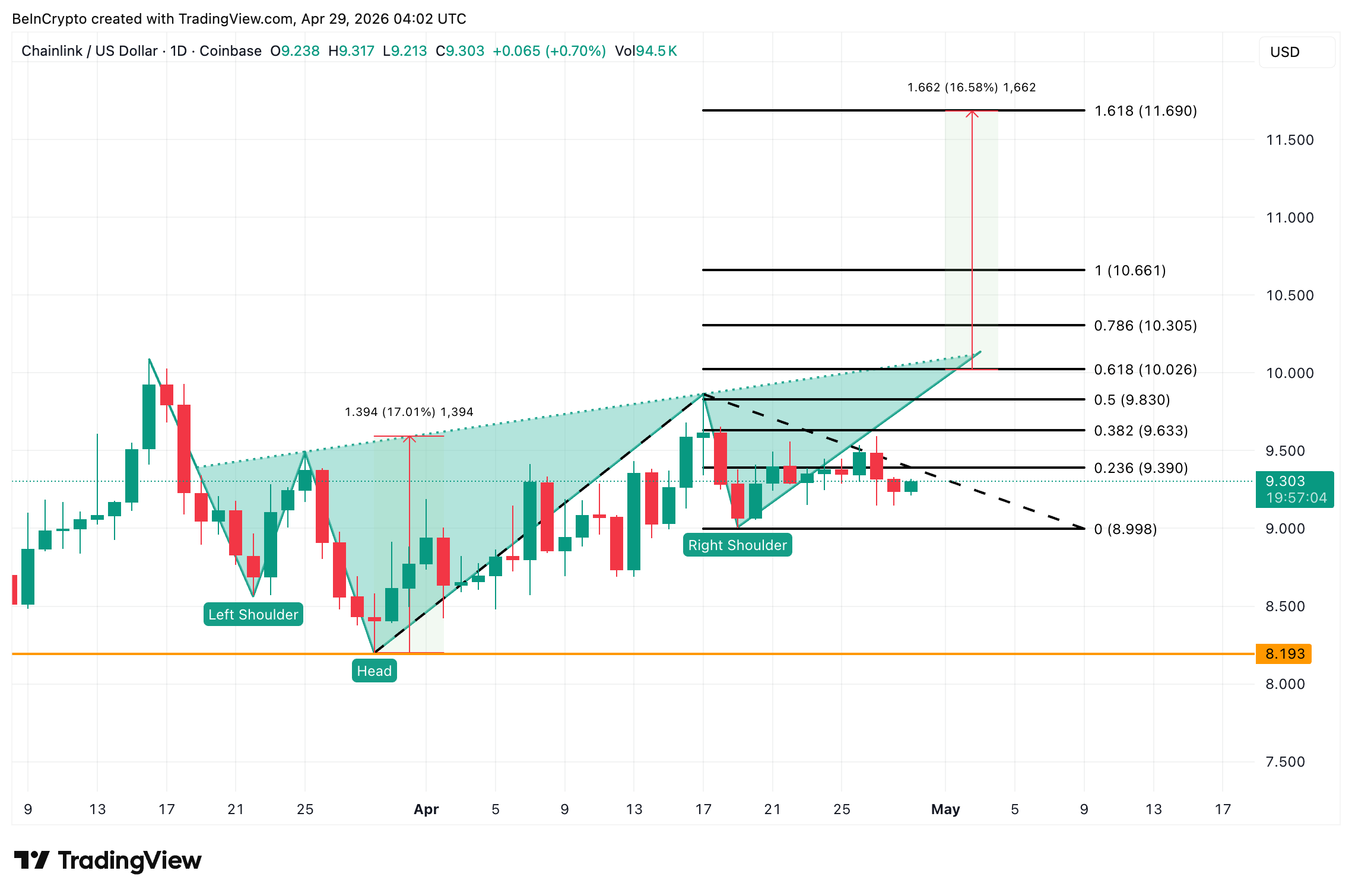
A daily close above $9.39 targets $10.02, a neckline-adjacent zone that also aligns with the 0.618 Fibonacci range. A decisive break above $10.02 unlocks a 17% measured move toward $11.69. However, a rejection at $9.39 followed by a drop below $8.99 weakens the formation, and a close below $8.19 invalidates the pattern entirely.
Ethereum (ETH)
Ethereum (ETH) is trading at $2,309, holding above the 20-day Exponential Moving Average (EMA), an indicator that gives greater weight to recent prices to track short-term trend shifts, at $2,294. Positioning above the 20-day EMA provides the bullish setup with its first technical anchor.
The whale story here is the most measured of the three. Santiment data shows ETH supply held by whale wallets, excluding exchange addresses, has risen from 123.35 million ETH on April 19 to 124.43 million ETH on April 29. That amounts to roughly 1.08 million ETH accumulated over 10 days, worth around $2.49 billion at current prices.
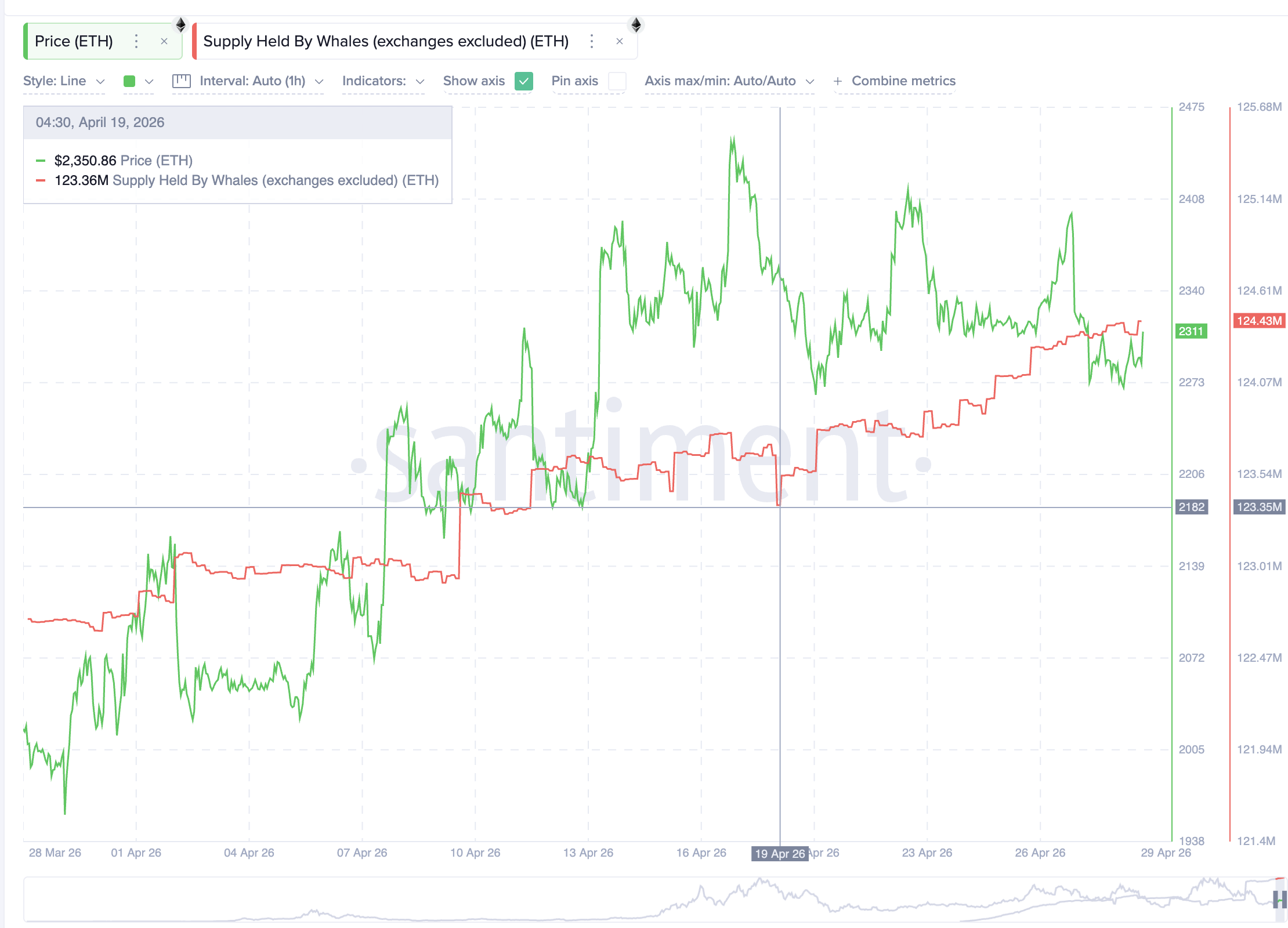
The economic logic separates ETH from the FOMC-rotation trade. Whales are not buying ETH on rate-cut speculation, since CME FedWatch shows zero probability of one. Instead, the accumulation lines up with structural on-chain demand. ETH exchange reserves have fallen to their lowest level since 2016, with 331,000 tokens withdrawn since April 19, and corporate treasuries such as BitMine added 101,901 ETH last week, worth roughly $233 million.
Whales appear to be using the pre-FOMC consolidation as a discount window before the supply-shock thesis gets fully priced in. The ongoing drawdown of liquid ETH supply is the catalyst, not Powell’s tone.
The chart confirms the patient setup. ETH has traded in a tight range between $2,250 and $2,377 since mid-April, a narrow 5% band that whales have used to absorb supply without pushing price higher.
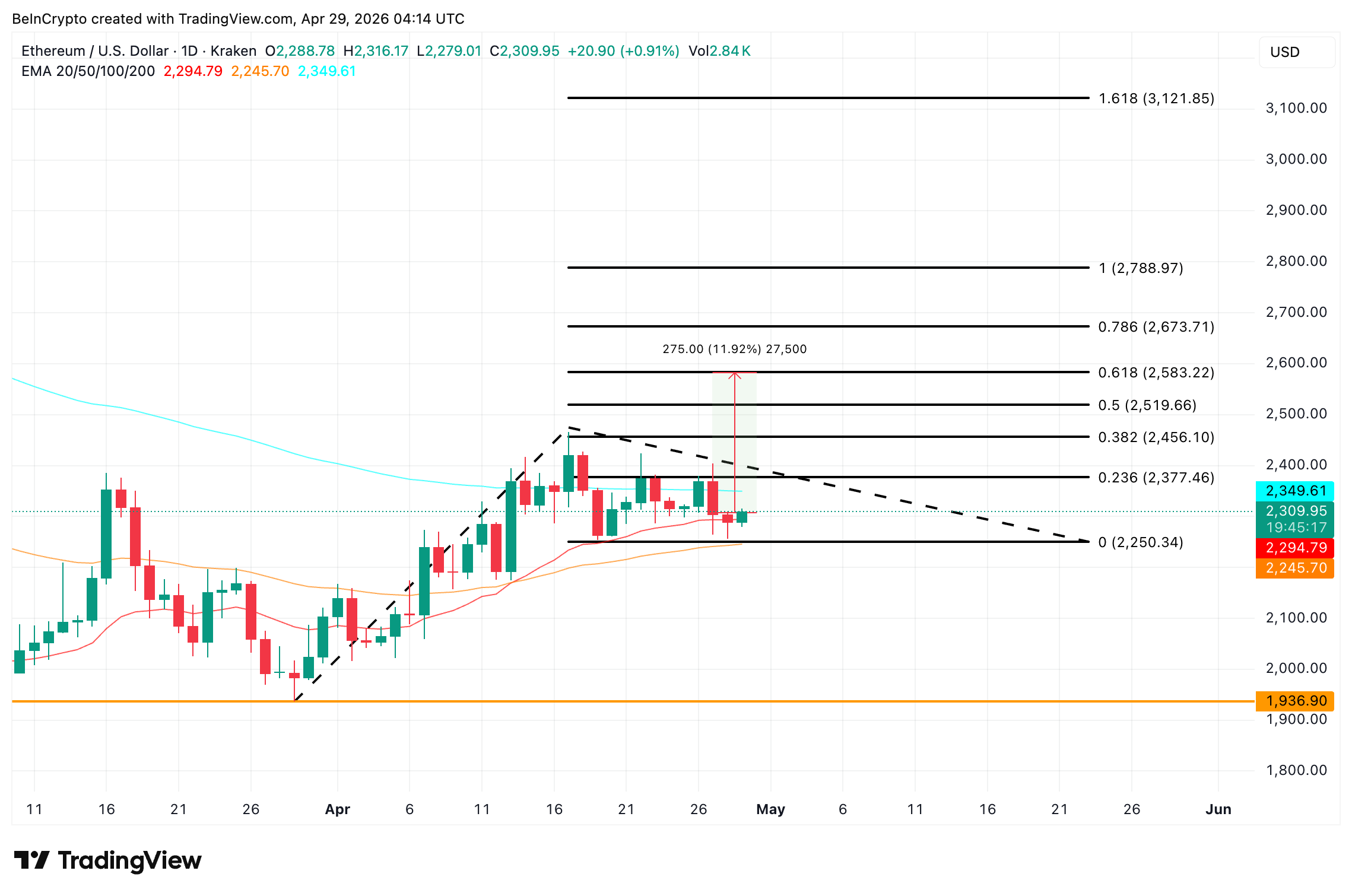
A daily close above $2,349, the 100-day EMA, followed by $2,377 unlocks an 11.92% measured move toward $2,583. Below the range, $2,294 (20-day EMA) and $2,245 (50-day EMA) serve as the first lines of defense. A break below $2,250 invalidates the structure and exposes $1,936.90.
The post What Crypto Whales Are Buying Ahead of the April FOMC Meeting appeared first on BeInCrypto.
