




Here’s the paraphrased HTML version:
When cybercrime networks get dismantled, it’s usually not because of sophisticated detection—instead, it typically comes down to simple operational mistakes like reusing identities, failing to properly separate systems, or overlooking metadata.
In a recent post on a cybercrime forum, spotted and examined by Flare researchers, a threat actor outlined a structured OPSEC (operational security) framework built for “large-scale carding operations.” Rather than discussing tools or how to cash out, the focus was entirely on one thing: how to stay hidden over the long haul.
The actor presents this framework as a “methodology that’s been through the fire—it’s the reason our teams are still running while competitors have been taken offline.” What makes the post stand out is its tone: it reads less like casual forum advice and more like a formal internal operations manual. It includes a three-tier system, a breakdown of the most common mistakes that get people caught, and fallback procedures pulled straight from intelligence tradecraft.
Most of the individual tactics aren’t groundbreaking. What’s notable is how they’re woven together into a disciplined operational structure—suggesting a more mature approach to running large-scale criminal activity.
For security teams, this offers a valuable window into how cybercriminals are building out their long-term operational defenses.
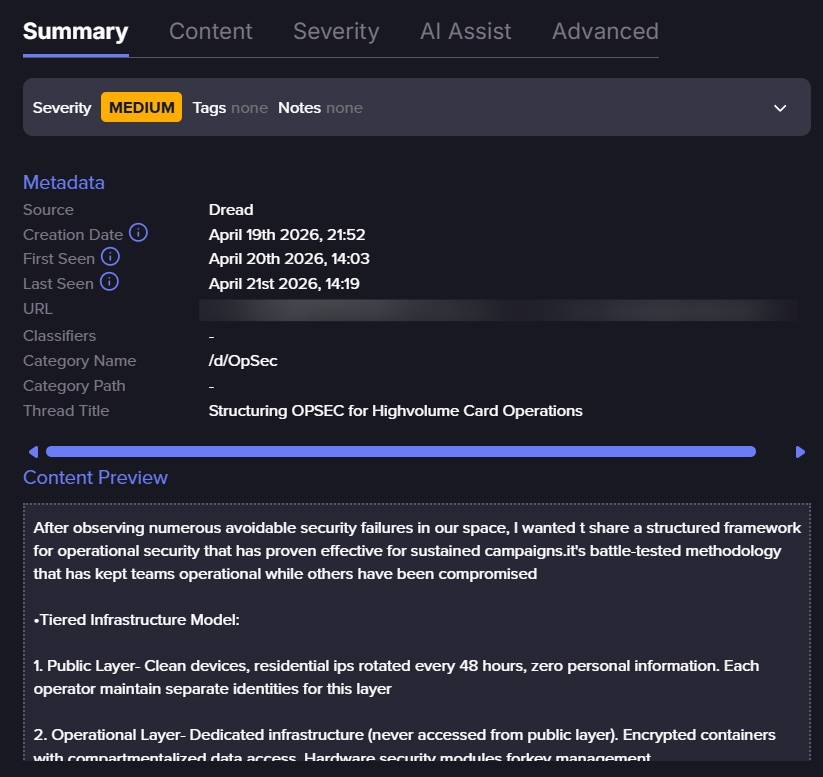
Flare link to the post—sign up for the free trial if you’re not yet a subscriber
A Three-Tier OPSEC Model
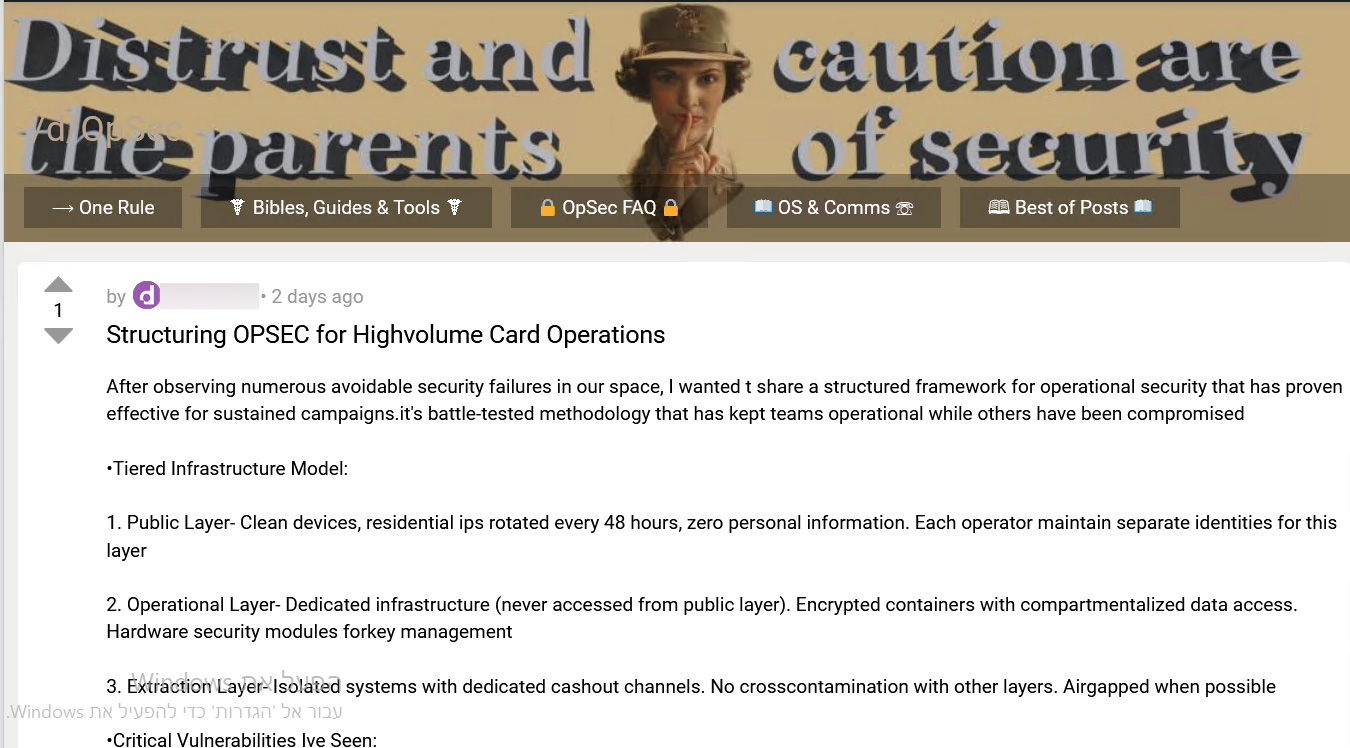
The foundation of the actor’s approach rests on a three-layer infrastructure built to decouple exposure from execution and from money movement.
Public Layer
According to the actor, the public layer should consist of “pristine devices, residential IP addresses swapped out every 48 hours, and absolutely no personal identifying data.” Each person operating within the team would maintain completely distinct identities.
This reveals a sharp awareness of how modern detection works. Anti-fraud platforms lean heavily on correlating identities and tracking behavior across touchpoints—making reused personas one of the biggest liabilities.
The use of rotating residential proxies also mirrors what’s seen in active fraud rings, where operators lean on proxy networks to blend their traffic in with legitimate users.
Operational Layer
The operational layer must remain entirely cut off from the public layer. The actor is clear: “never access this layer from a public-facing environment.” Within this zone, the following should be housed:
The central idea here is compartmentalization—making sure that if one segment gets compromised, the rest of the infrastructure stays intact. This echoes how real-world cybercrime ecosystems are structured. Ransomware outfits like LockBit, for example, use affiliate setups where separate groups own different parts of the attack—initial access, execution, and monetization—each working independently to minimize overall risk exposure.
Formalized OPSEC frameworks mean sophisticated threat actors are operating under the radar for longer periods.
Flare tracks cybercrime forums, dark web communities, and Telegram channels—giving your team advance notice before threats ever touch your environment.
Stay ahead of threat actors at no cost
Extraction Layer
The outermost layer is where money moves. The actor specifies that this should be “standalone systems with dedicated cashout channels” and, ideally, “airgapped from the rest.” They stress “zero cross-contamination with any other layer.”
This highlights a key insight: financial transactions are often the weakest link from an investigator’s standpoint. By isolating the cashout infrastructure entirely, actors are attempting to sever the forensic trail connecting the fraud itself to the payout.
The Mistakes That Keep Getting People Caught
The actor flags several recurring failures that continue exposing cybercriminal operations.
Identity Reuse
Reusing burner accounts is called out as a critical vulnerability. The actor describes it as one of the most frequent operational breakdowns in practice. This aligns with numerous law enforcement cases where agencies successfully linked criminal activity to individuals through the same usernames and personas popping up across multiple platforms.
Weak Fingerprinting Defenses
The actor is critical of “sloppy digital fingerprint countermeasures.” This reflects how central device fingerprinting has become in fraud detection. Modern platforms scrutinize:
The actor’s dismissive attitude toward basic OPSEC implies that simply routing traffic through a VPN is no longer considered sufficient—even in criminal circles.
Loose Boundaries Between Operations
The actor calls out “failing to properly separate data acquisition from cashout workflows.”
When the same infrastructure runs every phase of the operation, defenders can more easily follow activity across the entire attack lifecycle. The actor argues that airtight separation is essential for any operation built to last.
Metadata Leaks
The actor also points to “oversight around metadata in operational files.”
This is a subtle but significant risk. Information baked into files—timestamps, device IDs, geolocation tags—has been used in multiple confirmed cases to track down threat actors.
Advanced Methods for Staying One Step Ahead
Beyond the basics, the actor outlines more advanced techniques intended to make operations harder to disrupt.
Time-delayed triggers: The actor suggests deploying “automated triggers set on a delay” to break the correlation between an action and the infrastructure involved. This technique frequently appears in malware operations, where a delayed payload complicates forensic reconstruction and makes it nearly impossible to tie cause to effect.
Behavioral randomization: To stay under the radar, the actor recommends “randomizing behavioral patterns.” This directly targets behavioral analytics engines, which are widely deployed in fraud prevention. By imitating how a typical user behaves, attackers try to slip past automated detection systems.
Distributed verification: Reference to “distributed validation protocols” hints at multi-step checks spread across systems or team members, reducing dependence on any single point that could fail—or be compromised.
Dead man’s switches: The actor proposes “dead man’s switches for sensitive data.” These mechanisms can automatically wipe
or disable sensitive knowledge when particular situations are met, signaling a give attention to not simply evasion but additionally hurt discount when plans go awry.
Core TTPs Recognized from the Actor’s Playbook
From the actor’s evaluation, a number of distinct ways grow to be obvious:
Community segmentation to comprise potential fallout
Identification isolation throughout a number of platforms and layers
Use of residential proxies and anti-fingerprinting instruments to bypass conduct monitoring techniques
Rigorous separation of operational tiers, spanning entry, execution, and monetization
Conduct randomization to keep away from predictable patterns
Constructed-in resilience instruments like lifeless man’s switches and time-delayed actions
These strategies are speculative. They mirror ways already noticed in lively cybercriminal operations.
OPSEC as a Aggressive Edge
Some of the telling facets of the put up is how the actor views operational safety. Because the actor notes, “For those who’re nonetheless counting on VPNs as your foremost safety, it’s time to step up your recreation.”
The emphasis just isn’t on executing fraud, however on sustaining operations long-term. The inflexible layering, enforced siloing, and pre-planned backup techniques all level to a single objective: keep away from being shut down.
This means OPSEC is now not a fundamental safeguard—it’s turning into a key differentiator within the cybercrime world. Actors counting on easy protections are caught sooner, whereas these utilizing structured fashions function longer and extra boldly.
The framework doesn’t create new methods, it organizes them. As extra actors comply with related blueprints, sustaining entry might rely much less on technical talent and extra on who can keep hidden the longest.
Methods for Defenders
Though the unique content material is directed at risk actors, it presents essential takeaways for defenders.
Perceive cross-platform linking: The warning in opposition to reusing identities highlights the necessity for cross-platform and cross-session correlation. Defenders ought to try to attach actions throughout accounts, gadgets, and conduct.
Increase conduct primarily based detection: The actor’s use of fingerprinting and randomization exhibits why superior behavioral evaluation is required over static indicators of compromise.
Monitor the complete assault lifecycle: The strict section separation implies that defenders should piece collectively alerts from preliminary entry via monetization.
Use metadata evaluation: Metadata is usually ignored however is a strong forensic device. When analyzed appropriately, it might probably expose hidden ties between actions.
Anticipate resilient threats: The presence of contingency instruments implies attackers count on disruption. Defensive plans should prioritize persistence and adaptableness, not simply blocking preliminary entry.
The discussion board put up reveals how sure risk actors are prioritizing sustainable operations over fast wins. Because the actor states, failures not often stem from poor instruments, however from sloppy habits: repeated identities, unfastened separation, and careless errors.
For defenders, this modifications the dynamic. As attackers concentrate on endurance, detection can’t depend on remoted alerts—it should map behaviors, identities, and infrastructure over time.
Be taught extra by signing up for our free trial.
Sponsored and written by Flare.
