



that “groups are remarkably intelligent, and are often smarter than the smartest people in them.” He was writing about decision-making, however the identical precept applies to classification: get sufficient individuals to explain the identical phenomenon and a taxonomy begins to emerge, even when no two individuals phrase it the identical method. The problem is extracting that sign from the noise.
I had a number of thousand rows of free-text knowledge and wanted to do precisely that. Every row was a brief natural-language annotation explaining why an automatic safety discovering was irrelevant, which features to make use of for a repair, or what coding practices to comply with. One particular person wrote “this is test code, not deployed anywhere.” One other wrote “non-production environment, safe to ignore.” A 3rd wrote “only runs in CI/CD pipeline during integration tests.” All three meant the identical factor, however no two shared greater than a phrase or two.
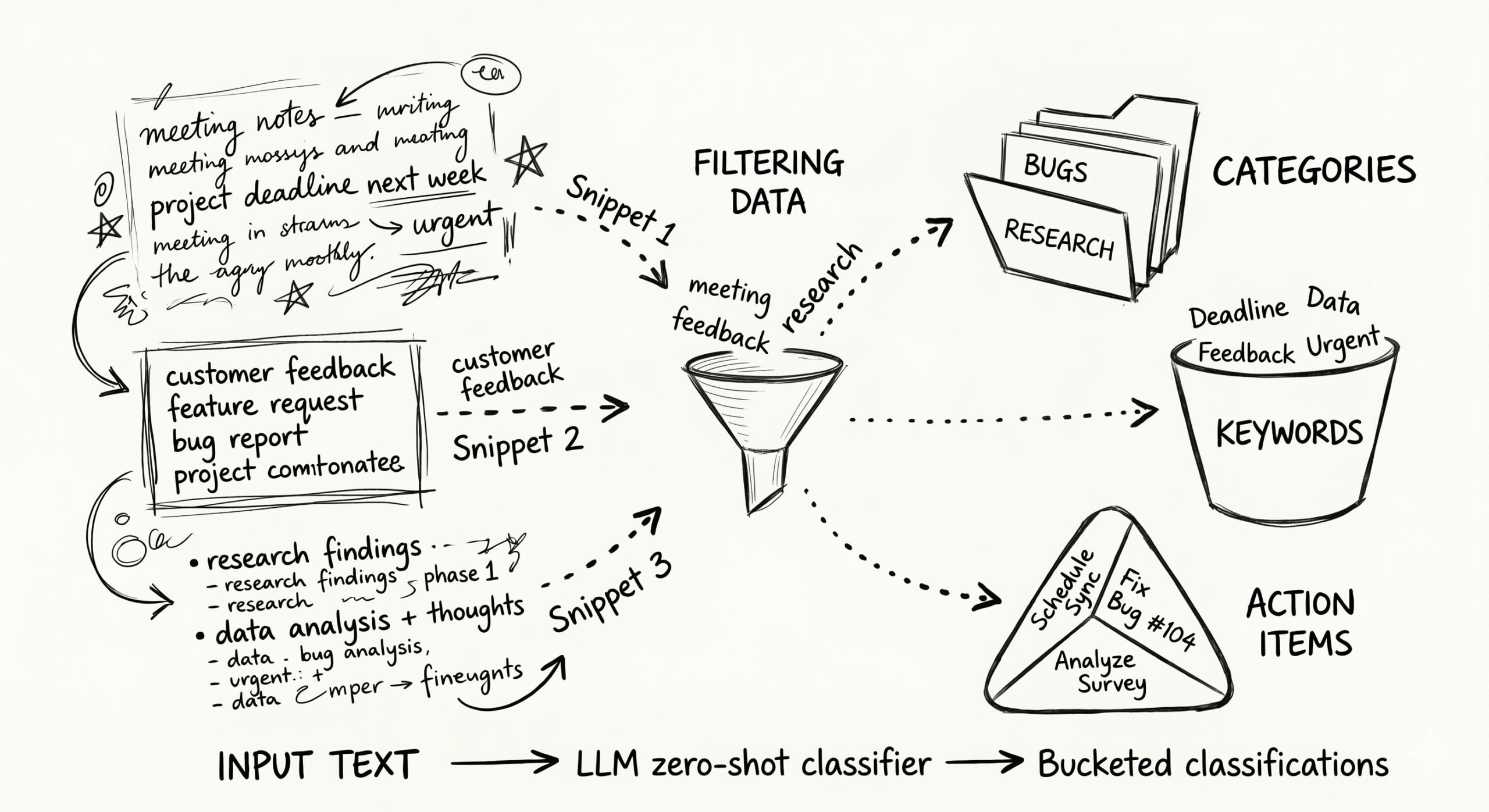
The taxonomy was in there. I simply wanted the correct device to extract it. Conventional clustering and key phrase matching couldn’t deal with the paraphrase variation, so I attempted one thing I hadn’t seen mentioned a lot: utilizing a regionally hosted LLM as a zero-shot classifier. This weblog publish explores the way it carried out, the way it works, and a few suggestions for utilizing and deploying these techniques your self.
Why conventional clustering struggles with brief free-text
Normal unsupervised clustering works by discovering mathematical proximity in some characteristic house. For lengthy paperwork, that is normally fantastic. Sufficient sign exists in phrase frequencies or embedding vectors to kind coherent teams. However brief, semantically dense textual content breaks these assumptions in a couple of particular methods.
Embedding similarity conflates totally different meanings. “This key is only used in development” and “This API key is hardcoded for convenience” produce comparable embeddings as a result of the vocabulary overlaps. However one is a few non-production surroundings and the opposite is about an intentional safety tradeoff. Ok-means or DBSCAN can’t distinguish them as a result of the vectors are too shut.
Subject fashions floor phrases, not ideas. Latent Dirichlet Allocation (LDA) and its variants discover phrase co-occurrence patterns. When your corpus consists of one-sentence annotations, the phrase co-occurrence sign is simply too sparse to kind significant matters. You get clusters outlined by “test” or “code” or “security” moderately than coherent themes.
Regex and key phrase matching can’t deal with paraphrase variation. You would write guidelines to catch “test code” and “non-production,” however you’d miss “only used during CI,” “never deployed,” “development-only fixture,” and dozens of different phrasings that every one categorical the identical underlying concept.
The frequent thread: these strategies function on floor options (tokens, vectors, patterns) moderately than semantic which means. For classification duties the place which means issues greater than vocabulary, you want one thing that understands language.
LLMs as zero-shot classifiers
The important thing perception is straightforward: as an alternative of asking an algorithm to find clusters, outline your candidate classes based mostly on area data and ask a language mannequin to categorise every entry.
This works as a result of LLMs course of semantic which means, not simply token patterns. “This key is only used in development” and “Non-production environment, safe to ignore” include nearly no overlapping phrases, however a language mannequin understands they categorical the identical concept. This isn’t simply instinct. Chae and Davidson (2025) in contrast 10 fashions throughout zero-shot, few-shot, and fine-tuned coaching regimes and located that enormous LLMs in zero-shot mode carried out competitively with fine-tuned BERT on stance detection duties. Wang et al. (2023) discovered LLMs outperformed state-of-the-art classification strategies on three of 4 benchmark datasets utilizing zero-shot prompting alone, no labeled coaching knowledge required.
The setup has three parts:
- Candidate classes. A listing of mutually unique classes outlined from area data. In my case, I began with about 10 anticipated themes (take a look at code, enter validation, framework protections, non-production environments, and many others.) and expanded to twenty candidates after reviewing a pattern.
- A classification immediate. Structured to return a class label and a short purpose. Low temperature (0.1) for consistency. Quick max output (100 tokens) since we solely want a label, not an essay.
- A neighborhood LLM. I used Ollama to run fashions regionally. No API prices, no knowledge leaving my machine, and quick sufficient for 1000’s of classifications.
Right here’s the core of the classification immediate:
CLASSIFICATION_PROMPT = """

Classify this textual content into considered one of these themes:

{themes}

Textual content:
"{content}"

Reply with ONLY the theme quantity and title, and a short purpose.
Format: THEME_NUMBER. THEME_NAME | Motive
Classification:

"""
And the Ollama name:
response = ollama.generate(
    mannequin="gemma2",
    immediate=immediate,
    choices={
        "temperature": 0.1,  # Low temp for constant classification
        "num_predict": 100,  # Quick response, we simply want a label
    }
)
Two issues to notice. First, the temperature setting issues. At 0.7 or greater, the identical enter can produce totally different classifications throughout runs. At 0.1, the mannequin is sort of deterministic, which helps clean classification. Second, limiting num_predict retains the mannequin from producing explanations you don’t want, which accelerates throughput considerably.
Constructing the pipeline
The total pipeline has three steps: preprocess, classify, analyze.
Preprocessing strips content material that provides tokens with out including classification sign. URLs, boilerplate phrases (“For more information, see…”), and formatting artifacts all get eliminated. Frequent phrases get normalized (“false positive” turns into “FP,” “production” turns into “prod”) to scale back token variation. Deduplication by content material hash removes actual repeats. This step lowered my token price range by roughly 30% and made classification extra constant.
Classification runs every entry via the LLM with the candidate classes. For ~7,000 entries, this took about 45 minutes on a MacBook Professional utilizing Gemma 2 (9B parameters). I additionally examined Llama 3.2 (3B), which was quicker however barely much less exact on edge circumstances the place two classes have been shut. Gemma 2 dealt with ambiguous entries with noticeably higher judgment.
One sensible concern: lengthy runs can fail partway via. The pipeline saves checkpoints each 100 classifications, so you’ll be able to resume from the place you left off.
Evaluation aggregates the outcomes and generates a distribution chart. Right here’s what the output regarded like:
The chart tells a transparent story. Over 1 / 4 of all entries described code that solely runs in non-production environments. One other 21.9% described circumstances the place a safety framework already handles the chance. These two classes alone account for half the dataset, which is the sort of perception that’s exhausting to extract from unstructured textual content some other method.
When this method is just not the correct match
This system works finest in a particular area of interest: medium-scale datasets (tons of to tens of 1000’s of entries), semantically advanced textual content, and conditions the place you’ve gotten sufficient area data to outline candidate classes however no labeled coaching knowledge.
It’s not the correct device when:
- your classes are keyword-defined (simply use regex),
- when you’ve gotten labeled coaching knowledge (practice a supervised classifier; it’ll be quicker and cheaper),
- whenever you want sub-second latency at scale (use embeddings and a nearest-neighbor lookup),
- or whenever you genuinely don’t know what classes exist. On this case, run exploratory subject modeling first to develop instinct, then swap to LLM classification as soon as you’ll be able to outline classes.
The opposite constraint is throughput. Even on a quick machine, classifying one entry per fraction of a second means 7,000 entries takes near an hour. For datasets above 100,000 entries, you’ll need an API-hosted mannequin or a batching technique.
Different functions price making an attempt
The pipeline generalizes to any drawback the place you’ve gotten unstructured textual content and want structured classes.
Buyer suggestions. NPS responses, assist tickets, and survey open-ends all endure from the identical drawback: diverse phrasing for a finite set of underlying themes. “Your app crashes every time I open settings” and “Settings page is broken on iOS” are the identical class, however key phrase matching gained’t catch that.
Bug report triage. Free-text bug descriptions could be auto-categorized by element, root trigger, or severity. That is particularly helpful when the particular person submitting the bug doesn’t know which element is accountable.
Code intent classification. That is one I haven’t tried but however discover compelling: classifying code snippets, Semgrep guidelines, or configuration guidelines by objective (authentication, knowledge entry, error dealing with, logging). The identical method applies. Outline the classes, write a classification immediate, run the corpus via a neighborhood mannequin.
Getting began
The pipeline is easy: outline your classes, write a classification immediate, and run your knowledge via a neighborhood mannequin.
The toughest half isn’t the code. It’s defining classes which can be mutually unique and collectively exhaustive. My recommendation: begin with a pattern of 100 entries, classify them manually, discover which classes you retain reaching for, and use these as your candidate record. Then let the LLM scale the sample.
I used this method as half of a bigger evaluation on how safety groups remediate vulnerabilities. The classification outcomes helped floor which varieties of safety context are commonest throughout organizations, and the chart above is without doubt one of the outputs from that work. If you happen to’re within the safety angle, the complete report is out there at that hyperlink.
