



Thales launched the 2026 Digital Belief Index, one of the crucial complete international research of digital belief. Surveying greater than 15,000 shoppers, enterprise companions, and IT resolution makers throughout 13 industries, the analysis reveals that digital belief is gained or misplaced throughout sign-up, login, and all through the lifecycle of private knowledge dealing with.
Shopper belief is gained or misplaced at login
For shoppers, digital belief usually begins at login. But, 57% reported issues accessing an internet site up to now yr, and 68% deserted or switched suppliers on account of gradual efficiency or difficult sign-up processes. When entry feels too gradual or intrusive, 33% change to a competitor or abandon the try, whereas 36% delay engagement or search for various channels.
Customers should not demanding velocity on the expense of safety. Forty-five % say they like stronger safety checks, even when sign-ups take longer, in comparison with 22% who favour sooner entry with lighter protections. Acquainted safeguards assist construct confidence, with 69% saying multifactor authentication will increase belief and 68% saying the identical about passkeys. Nonetheless, solely 16% say they clearly perceive how firms acquire and use their private knowledge.
AI adoption outpaces belief
As organizations speed up their use of generative AI, 93% of IT leaders say they’re already utilizing, deploying or planning AI initiatives. But client confidence has not stored tempo: solely 23% say they belief firms to make use of AI responsibly with their knowledge, whereas 77% stay involved about AI brokers performing on their behalf on-line.
Belief gaps widen as banking pulls forward
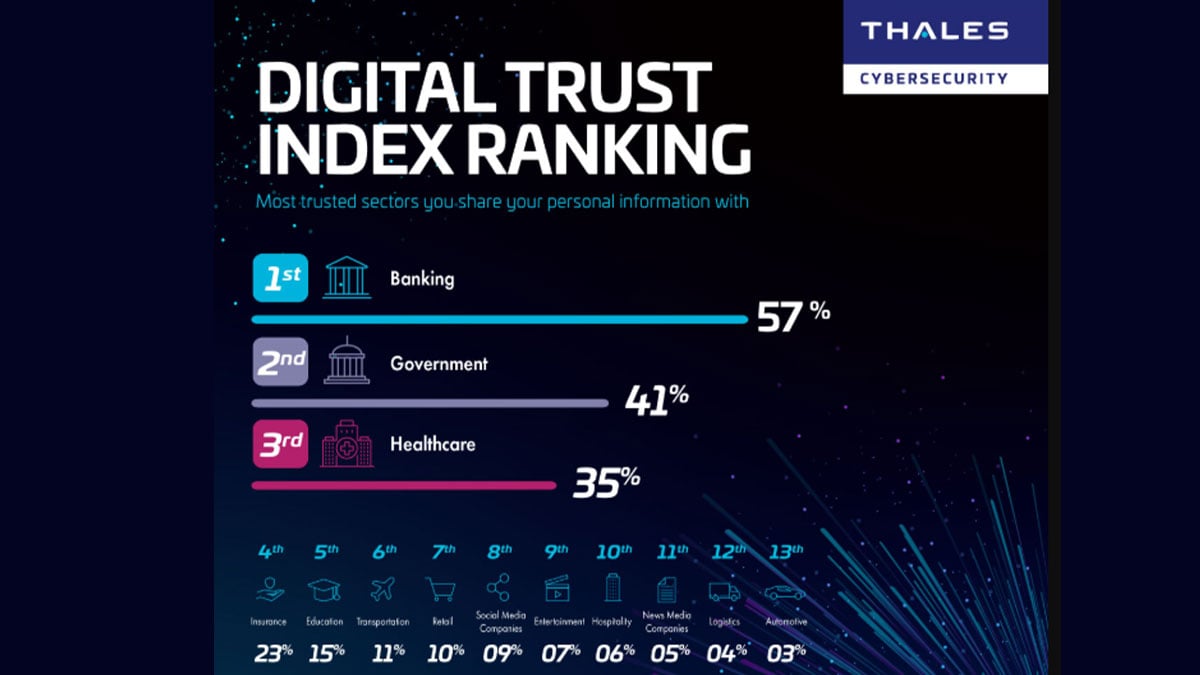
The 2026 Digital Belief Index reveals the hole between probably the most trusted sectors and the remaining widening sharply. Banking stands out because the clear trusted sector at 57% (up from 44% in 2025), making it the one trade the place greater than two in 5 shoppers really feel snug sharing private data on-line. Most different sectors proceed to function in a belief deficit, the place the disconnect between what organisations imagine they ship and what customers really expertise drives abandonment, time-consuming workarounds, and elevated danger.
Past banking’s clear lead, the remainder of the sectors fall properly behind in client confidence. Authorities companies rank second at 40%, adopted by healthcare at 35%. Belief declines sharply past these prime sectors, with insurance coverage (23%) and training (15%) forming a distant second tier. Shopper-facing industries rating a lot decrease, together with retail (10%), social media (9%), leisure (7%), and hospitality (6%), whereas information media (5%), logistics (4%), and automotive (3%) rank on the backside. Total, shoppers place the best on-line belief in sectors answerable for managing delicate private knowledge and important companies, whereas leisure, media, and platform firms face decrease confidence.
Friction fuels delays and danger for companions
For enterprise accomplice customers, entry reliability immediately impacts venture supply and income. Onboarding stays inconsistent as solely 22% obtain login credentials instantly, and simply 30% get full permissions on first entry, creating delays that ripple throughout gross sales cycles and buyer commitments. When official processes lag, dangerous workarounds emerge. Sixty-six % admit to sharing or borrowing credentials, usually due to gradual provisioning, creating hidden safety debt and elevated breach danger.
IT leaders see the danger however battle to shut the hole
The 2026 Digital Belief Index reveals IT leaders recognise the significance of recent authentication. Eighty-seven % say providing passkeys is essential, but solely 49% at present achieve this. This hole represents each danger and alternative as shoppers count on stronger, seamless safety.
“The 2026 Digital Trust Index shows that as AI adoption is accelerating, trust is struggling to keep pace,” mentioned Danny DeVreeze, Vice President of Id and Entry Administration at Thales. “When AI simply helps people work faster, confidence is high. But when AI starts acting autonomously and making decisions or interacting with systems on a user’s behalf, people begin asking harder questions about security, control, and accountability.”
Architecting entry as enterprise technique
The Digital Belief Index 2026 reveals that identification and entry administration are industrial levers, not back-office features. Belief improves when authentication and permissions are dependable, adaptive, and clearly defined. When they’re gradual or opaque, abandonment rises, credential sharing spreads, and income leaks. Organisations that modernise authentication, restrict pointless knowledge assortment, present permission visibility, and deploy AI transparently will likely be finest positioned to compete in an more and more digital and AI-driven financial system.
