



displays the state of Claude Abilities, MCP, and subagents as of February 2026. AI strikes quick, so some particulars could also be outdated by the point you learn this. The ideas this submit focuses on, nonetheless, are timeless.
In case you’ve been constructing with LLMs for some time, you’ve in all probability lived via this loop again and again: you’re taking your time crafting a terrific immediate that results in wonderful outcomes, after which a number of days later you want the identical habits once more, so that you begin prompting from scratch once more. After some repetitions you perhaps notice the inefficiencies, so that you’re going to retailer the immediate’s template someplace with the intention to retrieve it for later, however even then you must discover your immediate, paste it in, and tweak it for this explicit dialog. It’s so tedious.
That is what I name the immediate engineering hamster wheel. And it’s a essentially damaged workflow.
Claude Abilities are Anthropic’s reply to this “reusable prompt” downside, and extra. Past simply saving you from repetitive prompting, they introduce a essentially completely different method to context administration, token economics, and the structure of AI-powered growth workflows.
On this submit, I’ll unpack what abilities and subagents really are, how they differ from conventional MCP, and the place the ability / MCP / subagent combine is heading.
What are Abilities?
At their core, abilities are reusable instruction units that AI Brokers, like Claude, can mechanically entry once they’re related to a dialog. You write a ability.md file with some metadata and a physique of directions, drop it right into a .claude/abilities/ listing, and Claude takes it from there.
Their seems to be
In its easiest type, a ability is a markdown file with a reputation, description, and physique of directions, like this:
---

identify:

description:

---
Their strenghts
The principle power of abilities lies within the auto-invocation. When beginning a brand new dialog, the agent solely reads every ability’s identify and outline, to avoid wasting on tokens. When it determines a ability is related, it hundreds the physique. If the physique references extra information or folders, the agent reads these too, however solely when it decides they’re wanted. In essence, abilities are lazy-loaded context. The agent doesn’t eat the total instruction set upfront. It progressively discloses data to itself, pulling in solely what’s wanted for the present step.
This progressive disclosure operates throughout three ranges, every with its personal context finances:
- Metadata (loaded at startup): The ability’s identify (max 64 characters) and outline (max 1,024 characters). This prices roughly ~100 tokens per ability, negligible overhead even with lots of of abilities registered.
- Ability physique (loaded on invocation): The total instruction set inside
ability.md, as much as ~5,000 tokens. This solely enters the context window when the agent determines the ability is related. - Referenced information (loaded on demand): Extra markdown information, folders, or scripts inside the ability listing. There’s virtually no restrict right here, and the agent reads these on demand, solely when the directions reference them and the present activity requires it.
Perception: Abilities are reusable, lazy-loaded, and auto-invoked instruction units that use progressive disclosure throughout three ranges: metadata, physique, and referenced information. This minimizes the upfront price by stopping to dump every little thing into the context window (taking a look at you, MCP 👀).
The issue in token economics
Price components
It’s no secret; an agent’s context window house isn’t free, and filling it has compounding prices. Each token in your context window prices you in 3 ways:
- Precise price: the apparent one is that you simply’re paying per token. This may be straight via API utilization, or not directly via utilization limits.
- Latency: you’re additionally paying together with your time, since extra enter tokens means slower responses. One thing that doesn’t scale effectively with the size of the context window (~consideration mechanism).
- High quality: lastly, there’s additionally a degradation in high quality on account of lengthy context home windows. LLMs demonstrably carry out worse when their context is cluttered with irrelevant data.
The pricey overhead of MCPs
Let’s put this into perspective, via a fast back-of-the-envelope calculation. My go-to MCP picks for programming are:
- AWS for infrastructure deployment. Three servers (
aws-mcp,aws-official,aws-docs) mixed yield a value of round ~8,500 tokens (13 instruments). - Context7 for documentation. Metadata is round ~750 tokens (2 instruments).
- Figma for bringing design to frontend growth. Metadata is round ~500 tokens (2 instruments).
- GitHub for looking code in different repositories. Metadata is round ~2,000 tokens (26 instruments).
- Linear for mission administration. Metadata is round ~3,250 tokens (33 instruments).
- Serena for code search. Metadata is round ~4,500 tokens (26 instruments).
- Sentry for error monitoring. Metadata is round ~12,500 tokens (22 instruments).
That’s a complete of roughly ~32,000 tokens of software metadata, loaded into each single message, whether or not you’re interacting with the software or not.
To place a greenback determine on this: Claude Opus 4.6 costs $5 per million enter tokens. These 32K tokens of idle MCP metadata add $0.16 to each message you ship. That sounds small, till you notice that even a easy 5-message dialog already provides $0.8 in pure overhead. And most builders don’t ship simply 5 messages; add some quick clarifications and context-gathering questions and also you shortly attain 10s if not 100s of messages. Let’s say on common you ship 50 messages a day over a 20-day work month, that’s $8/day, ~$160/month* in pure overhead, only for software descriptions sitting in context. And that’s earlier than you account for the latency and high quality influence.
*A small asterisk: most fashions cost considerably much less for cached enter tokens (90% low cost). An asterisk to this asterisk is that a few of them cost additional when enabling caching, they usually don’t all the time allow (API) caching by default (cough Claude cough).
The associated fee-effective method of abilities
The loading patttern of Abilities essentially change all three price components. On the outset, the agent solely sees every ability’s identify and a brief description, roughly ~100 tokens per ability. Like this, I might register 300 abilities and nonetheless eat fewer tokens than my MCP setup does. The total instruction physique (~5,000 tokens) solely hundreds when the agent decides it’s related, and referenced information will solely load when the present step wants them.
In observe, a typical dialog may invoke one or two abilities whereas the remaining stay invisible to the context window. That’s the important thing distinction: MCP price scales with the variety of registered instruments (throughout all servers), whereas abilities’ price scales extra intently with precise utilization.

Perception: MCP is “eager” and hundreds all software metadata upfront no matter whether or not it’s used. Abilities are “lazy” and cargo context progressively and solely when related. The distinction issues for price, latency, and output high quality.
Wait, that’s deceptive? Abilities and MCP are two utterly various things!
If the above reads like abilities are the brand new and higher MCPs, then enable me to right that framing. The intent was to zoom in on their loading patterns and the influence they’ve on token consumption. Functionally, they’re fairly completely different.
MCP (Mannequin Context Protocol) is an open customary that provides any LLM the flexibility to work together with exterior functions. Earlier than MCP, connecting M fashions to N instruments required M * N customized integrations. MCP collapses that to M + N: every mannequin implements the protocol as soon as, every software exposes it as soon as, they usually all interoperate. It’s a easy infrastructural change, however it’s genuinely highly effective (no surprise it took the world by storm).
Abilities, then again, are considerably “glorified prompts”, and I imply that in the absolute best means. They provide an agent experience and path on easy methods to method a activity, what conventions to observe, when to make use of which software, and easy methods to construction its output. They’re reusable instruction units fetched on-demand when related, nothing extra, nothing much less.
Perception: MCP provides an agent capabilities (the “what”). Abilities give it experience (the “how”) and thus they’re complementary.
Right here’s an instance to make this concrete. Say you join GitHub’s MCP server to your agent. MCP provides the agent the flexibility to create pull requests, record points, and search repositories. But it surely doesn’t inform the agent, for instance, how your group constructions PRs, that you simply all the time embrace a testing part, that you simply tag by change sort, that you simply reference the Linear ticket within the title. That’s what a ability does. The MCP gives the instruments, the ability gives the playbook.
So, when earlier I confirmed that abilities load context extra effectively than MCP, the true takeaway isn’t “use skills instead of MCP”, it’s that lazy-loading as a sample works. Therefore, it’s value asking: why can’t MCP software entry be lazy-loaded too? That’s the place subagents are available in.
Subagents: better of each worlds
Subagents are specialised baby brokers with their very own remoted context window and instruments related. Two properties make them highly effective:
- Remoted context: A subagent begins with a clear context window, pre-loaded with its personal system immediate and solely the instruments assigned to it. Every part it reads, processes, and generates stays in its personal context, the principle agent solely sees the ultimate end result.
- Remoted instruments: Every subagent will be geared up with its personal set of MCP servers and abilities. The principle agent doesn’t must learn about (or pay for) instruments it by no means straight makes use of.
As soon as a subagent finishes its activity, its total context is discarded. The software metadata, the intermediate reasoning, the API responses: all gone. Solely the end result flows again to the principle agent. That is really a terrific factor. Not solely can we keep away from bloating the principle agent’s context with pointless software metadata, we additionally forestall pointless reasoning tokens from polluting the context. As an illustrative instance, think about a subagent that researches a library’s API. It’d search throughout a number of documentation sources, learn via dozens of pages, and check out a number of queries earlier than discovering the best reply. You continue to pay for the subagent’s personal token utilization, however all of that intermediate work, the useless ends, the irrelevant pages, the search queries, will get discarded as soon as the subagent finishes. The important thing profit is that none of it compounds into the principle agent’s context, so each subsequent message in your dialog stays clear and low-cost.
This implies you’ll be able to design your setup in order that MCP servers are solely accessible via particular subagents, by no means loaded on the principle agent in any respect. As an alternative of carrying ~32,000 tokens of software metadata in each message, the principle agent carries practically zero. When it must open a pull request, it spins up a GitHub subagent, creates the PR, and returns the hyperlink. Just like abilities being lazy-loaded context, subagents are lazy-loaded staff: the principle agent is aware of what specialists it will possibly name on, and solely spins one up when a activity calls for it.
A sensible instance
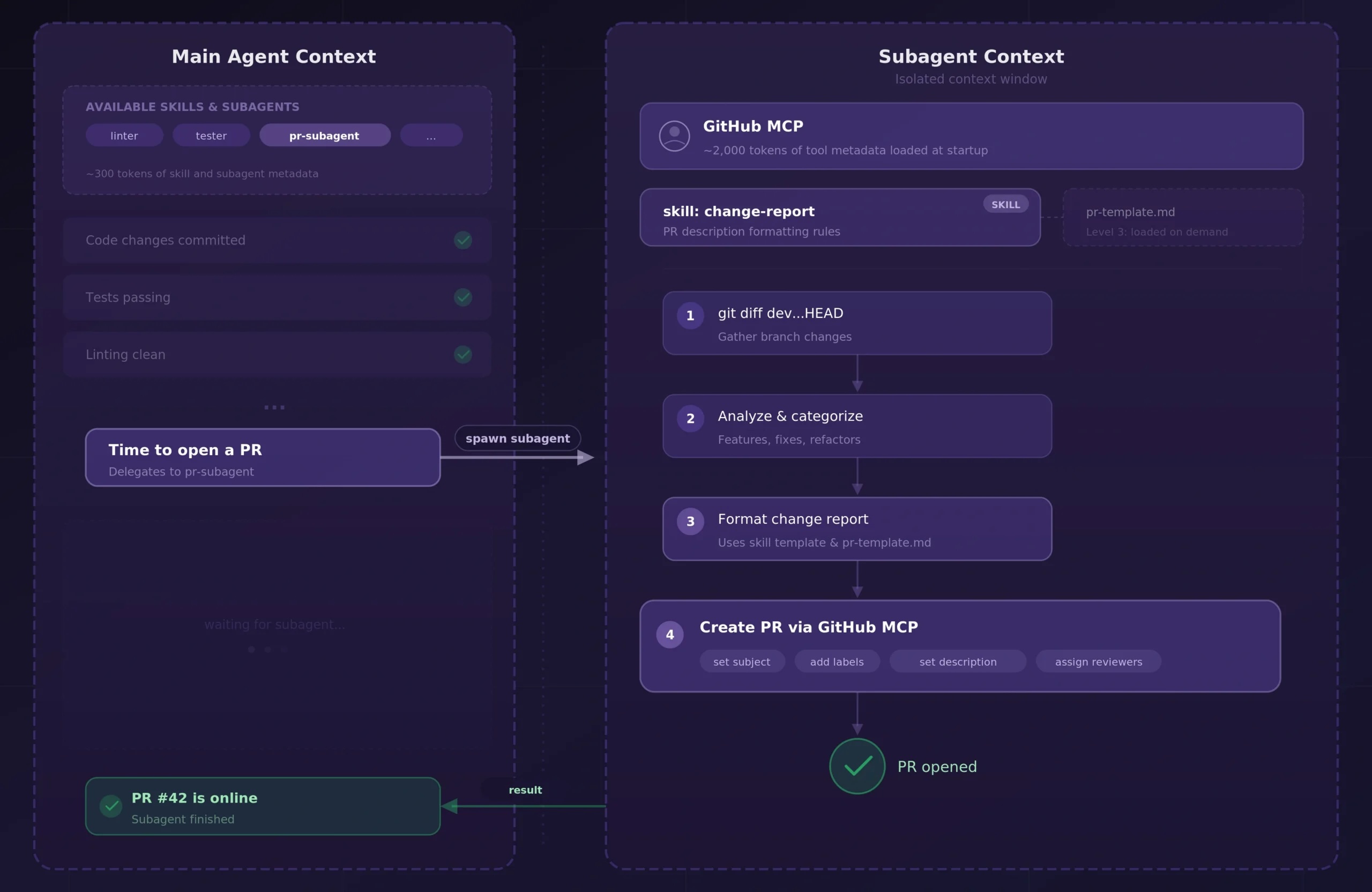
Let’s make this tangible. One workflow I take advantage of each day is a “feature branch wrap-up” that automates most of a really tedious a part of my growth cycle: opening a pull request. Right here’s how abilities, MCP, and subagents play collectively.
After the principle agent and I end the coding work, I ask it to wrap up the function department. The principle agent doesn’t deal with this itself; it delegates your complete PR workflow to a devoted subagent. This subagent is provided with the GitHub MCP server and a change-report ability that defines how my group constructions PRs. Its ability.md seems to be roughly like this:
---
identify: change-report
description: Use when producing a change report for a PR.
   Defines the group's PR construction, categorization guidelines, and formatting
   conventions.
---

1. Be sure that there aren't any staging adjustments left, in any other case report again to
   the principle agent
2. Run `git diff dev...HEAD --stat` and `git log dev..HEAD --oneline`
   to assemble all adjustments on this function department.
3. Analyze the diff and categorize essentially the most essential adjustments by their sort
   (new options, refactors, bug fixes, or config adjustments).
4. Generate a structured change report following the template
   in `pr-template.md`.
5. Open the PR by way of GitHub MCP, populating the title and physique from
   the generated report.
6. Reply with the PR hyperlink.
The pr-template.md file in the identical listing defines my group’s PR construction: sections for abstract, adjustments breakdown, and testing notes. That is degree 3 of progressive disclosure: the subagent solely reads it when step 4 tells it to.
Right here’s what makes this setup work. The ability gives the experience on how my group reviews on adjustments, the GitHub MCP gives the aptitude to truly create the PR, and the subagent gives the context boundary to carry out all of this work. The principle agent, then again, solely calls the subagent, waits for it to finish, and will get both a affirmation again or a message of what went unsuitable.

Perception: abilities, MCPs, and subagents work in concord. The ability gives experience and instruction, MCP gives the aptitude, the subagent gives the context boundary (conserving the principle agent’s context clear).
The larger image
Within the early days of LLMs, the race was about higher fashions: fewer hallucinations, sharper reasoning, extra inventive output. That race hasn’t stopped utterly, however the heart of gravity has actually shifted. MCP and Claude Code have been genuinely revolutionary. Upgrading Claude Sonnet from 3.5 to three.7 truthfully was not. The incremental mannequin enhancements we’re getting as we speak matter far lower than the infrastructure we construct round them. Abilities, subagents, and multi-agent orchestration are all a part of this shift: from “how do we make the model smarter” to “how do we get the most value out of what’s already here”.
Perception: the worth in AI growth has shifted from higher fashions to higher infrastructure. Abilities, subagents, and multi-agent orchestration aren’t simply developer expertise enhancements; they’re the structure that makes agentic AI economically and operationally viable at scale.
The place we’re as we speak
Abilities clear up the immediate engineering hamster wheel by turning your finest prompts into reusable, auto-invoked instruction units. Subagents clear up the context bloat downside by isolating software entry and intermediate reasoning into devoted staff. Collectively, they make it potential to codify your experience as soon as and have it mechanically utilized throughout each future interplay. That is what engineering groups following the state-of-the-practice already do with documentation, type guides, and runbooks. Abilities and subagents simply make these artifacts machine-readable.
The subagent sample can be unlocking multi-agent parallelism. As an alternative of 1 agent working via duties sequentially, you’ll be able to spin up a number of subagents concurrently, have them work independently, and acquire their outcomes. Anthropic’s personal multi-agent analysis system already does this: Claude Opus 4.6 orchestrates whereas Claude Sonnet 4.6 subagents execute in parallel. This naturally results in heterogeneous mannequin routing, the place an costly frontier mannequin orchestrates and plans, whereas smaller, cheaper fashions deal with execution. The orchestrator causes, the employees execute. This will dramatically scale back prices whereas sustaining output high quality.
There’s an essential caveat right here. The place parallelism works effectively for learn duties, it will get a lot tougher for write duties that contact shared state. Say, for instance, you’re spinning up a backend and a frontend subagent in parallel. The backend agent refactors an API endpoint, whereas the frontend agent, working from a snapshot taken earlier than that change, generates code that calls the previous endpoint. Neither agent is unsuitable in isolation, however collectively they produce an inconsistent end result. This can be a basic concurrency downside, coming from the AI workflows of the near-future, which up to now stays an open downside.
The place it’s heading
I anticipate ability composition to develop into extra subtle. Right now, abilities are comparatively flat: a markdown file with elective references. However the structure naturally helps layered abilities that reference different abilities, creating one thing like an inheritance hierarchy of experience. Assume a base “code review” ability prolonged by language-specific variants, additional prolonged by team-specific conventions.
Most multi-agent methods as we speak are strictly hierarchical: a essential agent delegates to a subagent, the subagent finishes, and management returns. There’s at the moment not a lot peer-to-peer collaboration between subagents but. Anthropic’s not too long ago launched “agent teams” function for Opus 4.6 is an early step in the direction of this, permitting a number of brokers to coordinate straight fairly than routing every little thing via an orchestrator. On the protocol facet, Google’s A2A (Agent-to-Agent Protocol) might standardize this sample throughout suppliers; the place MCP handles agent-to-tool communication, A2A would deal with agent-to-agent communication. That stated, A2A’s adoption has been sluggish in comparison with MCP’s explosive development. One to observe, not one to guess on but.
Brokers will develop into the brand new features
There’s a broader abstraction rising right here that’s value stepping again to understand. Andrej Karpathy’s well-known tweet “The hottest new programming language is English” captured one thing actual about how we work together with LLMs. However abilities and subagents take this abstraction one degree additional: brokers have gotten the brand new features.
A subagent is a self-contained unit of labor: it takes an enter (a activity description), has its personal inside state (context window), makes use of particular instruments (MCP servers), follows particular directions (abilities), and returns an output. It may be known as from a number of locations, it’s reusable, and it’s composable. That’s a perform. The principle agent turns into the execution thread: orchestrating, branching, delegating, and synthesizing outcomes from specialised staff.
Other than the analogy, it will possibly have the identical sensible implications that features had for software program engineering. Isolation limits the blast radius when an agent fails, fairly than corrupting your complete system, and failures will be caught via try-except mechanisms. Specialization means every agent will be optimized for its particular activity. Composability means you’ll be able to construct more and more advanced workflows from easy, testable elements. And observability follows naturally; since every agent is a discrete unit with clear inputs and outputs, tracing “why did the system do X” turns into inspecting a name stack fairly than gazing a 200K-token context dump.

Conclusion
Abilities appear like easy “reusable prompts” on the floor, however they really characterize a considerate reply to a number of the hardest issues in AI tooling: context administration, token effectivity, and the hole between uncooked functionality and area experience.
In case you haven’t experimented with abilities but, begin small. Decide your most-repeated prompting sample, extract it right into a ability.md, and see the way it adjustments your workflow. As soon as that clicks, take the following step: determine which MCP instruments don’t must stay in your essential agent, or which subprocesses require numerous reasoning that’s used after you discover the reply, and scope them to devoted subagents as an alternative. You’ll be stunned how a lot cleaner your setup turns into when every agent solely carries what it really wants.
Key insights from this submit
- Abilities are reusable, lazy-loaded, and auto-invoked instruction units that use progressive disclosure throughout three ranges: metadata, physique, and referenced information. This minimizes the upfront price by stopping to dump every little thing into the context window (taking a look at you, MCP 👀).
- MCP is “eager” and hundreds all software metadata upfront no matter whether or not it’s used. Abilities are “lazy” and cargo context progressively and solely when related. The distinction issues for price, latency, and output high quality.
- MCP provides an agent capabilities (the “what”). Abilities give it experience (the “how”) and thus they’re complementary.
- Abilities, MCPs, and subagents work in concord. The ability gives experience and instruction, MCP gives the aptitude, the subagent gives the context boundary (conserving the principle agent’s context clear).
- The worth in AI growth has shifted from higher fashions to higher infrastructure. Abilities, subagents, and multi-agent orchestration aren’t simply developer expertise enhancements; they’re the structure that makes agentic AI economically and operationally viable at scale.
Remaining perception: The immediate engineering hamster wheel is elective. It’s time to step off.
Discovered this handy? Comply with me on LinkedIn, TDS, or Medium to see my subsequent explorations!
All photos proven on this article have been created on my own, the writer.
