



Key Insights
- Etherlink transactions elevated 50% QoQ to 18.6 million, and every day lively addresses practically doubled to 9,860, solidifying Etherlink’s function as the first execution layer for the Tezos ecosystem.
- DeFi TVL declined throughout each layers, with Etherlink falling 39.3% QoQ to $37.2 million and Tezos L1 falling 18.2% to $33.5 million. The decline on Etherlink was concentrated in Curve, which misplaced 50.4% of its TVL and accounted for over half of the full loss.
- Two back-to-back kernel upgrades introduced all-time highs in governance participation and greater than tripled Etherlink’s throughput in This autumn 2025. Ebisu was activated in October 2025, elevating capability to 14 million fuel per second, with Farfadet following in December, practically doubling throughput once more to 27 million fuel per second.
- XTZ’s worth fell 26.1% QoQ to $0.49 however outperformed the broader altcoin market, with its circulating market cap rank enhancing from 98th to eightieth. Stablecoin provide on Tezos remained basically flat at $54.2 million, and the lively validator rely grew 3% QoQ to 264.
- This autumn was the strongest quarter for Tezos artwork in 2025. The Artwork on Tezos: Berlin pageant in November 2025 was highlighted by Francisco Carolinum’s acquisition of 15 TeleNFT works and qubibi’s sale of “hello world” for 62,000 XTZ.
Primer
Tezos (XTZ) is a Proof-of-Stake (PoS) blockchain acknowledged for its sturdy emphasis on safety, upgradeability, and community-driven governance. Sensible contracts on its Layer-1 (L1) community are applied utilizing the Michelson language, designed to facilitate formal verification whereas additionally providing Ethereum digital machine (EVM) compatibility by means of Etherlink, a community-governed, non-custodial Layer-2 (L2). The community options onchain governance and self-amending performance, enabling stakeholders to undertake protocol upgrades with out requiring a community laborious fork.
Tezos’ latest upgrades have targeted on scalability and efficiency by means of Sensible Rollups and a Information Availability Layer (DAL). The Mumbai improve in March 2023 launched Sensible Rollups, an L2 scaling answer designed for top throughput and customization to adapt to particular use instances, reminiscent of implementing new coding environments. The Paris improve in June 2024 lowered L1 block instances from 15 to 10 seconds, bringing 20-second finality. It additionally launched the DAL, a data-availability answer that enhances Sensible Rollup scalability. Lastly, the Paris improve applied a brand new staking mechanism and Adaptive Issuance, which adjusts token issuance primarily based on the staked ratio of XTZ.
Present R&D work from groups throughout the ecosystem focuses on realizing “Tezos X,” a proposed roadmap that enhances the blockchain’s efficiency, composability, and interoperability, delivering a “cloud-like” developer expertise. Leveraging Sensible Rollup know-how and the built-in Information Availability Layer, builders can construct advanced, scalable purposes on a unified software layer with a number of runtimes, utilizing mainstream programming languages, and with improved connectivity throughout Tezos and different blockchain ecosystems.
Web site / X / Discord
Key Metrics
Monetary Evaluation
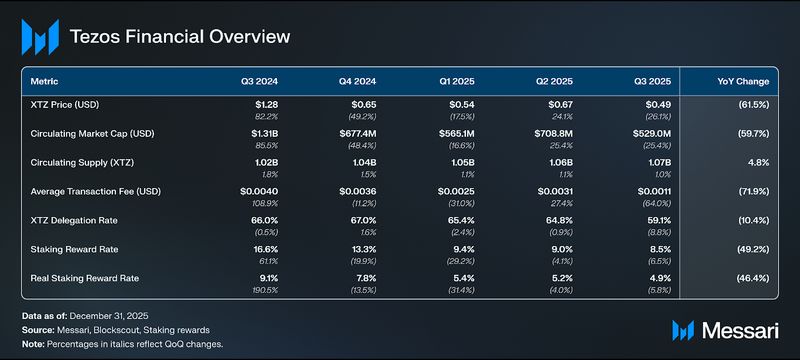
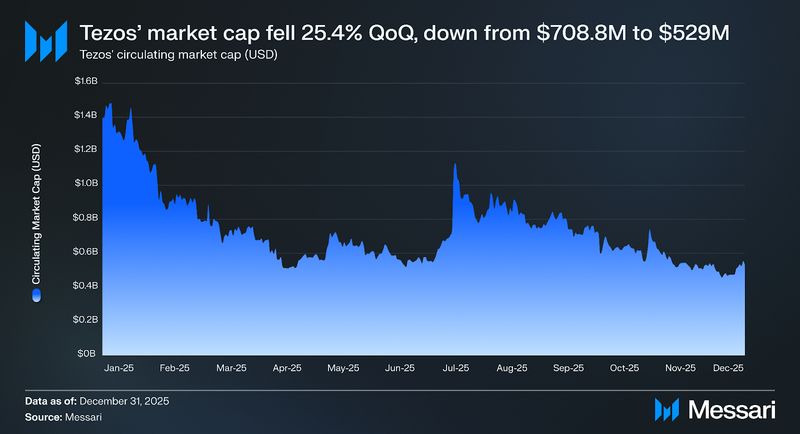
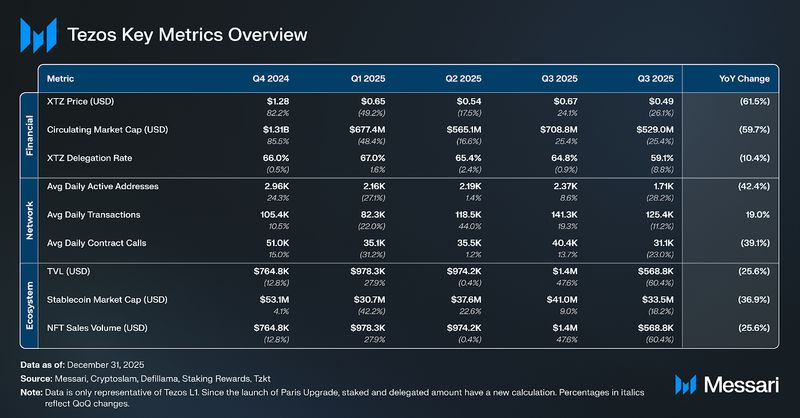
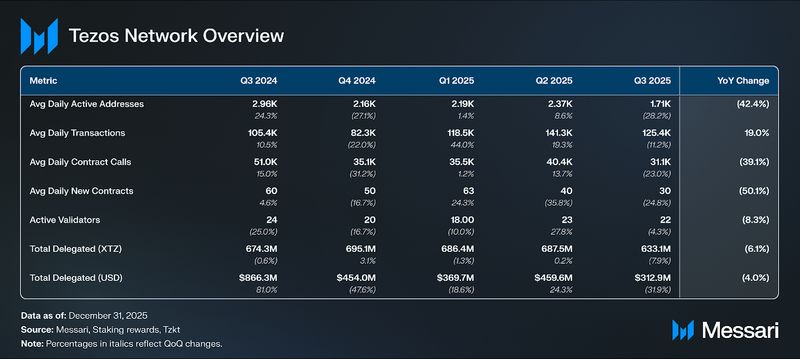
Tez (XTZ) is the native token of the Tezos blockchain. It’s used (i) for staking, delegation, and governance and (ii) as the first medium for paying transaction charges on each the Tezos Layer-1 (L1) and the EVM-compatible Layer-2 (L2) community, Etherlink. In This autumn 2025, XTZ’s worth decreased 26.1% QoQ from $0.67 to $0.49, whereas its circulating market cap (USD) fell 25.4% QoQ to $529 million. The slight discrepancy is because of XTZ’s circulating provide rising 1.0% QoQ to 1.07 billion XTZ, in step with the protocol’s inflation schedule. XTZ’s circulating market cap rating rose from 98th in Q3 2025 to eightieth in This autumn 2025, suggesting that XTZ held up higher than different property throughout the market-wide downturn.
As of Dec. 31, 2025, XTZ’s circulating provide was 1.07 billion. The Paris improve, launched in April 2024, launched the Adaptive Issuance mechanism, designed to incentivize a safe community whereas minimizing inflation. The goal for staking is 50% of the full XTZ provide, and the mechanism dynamically adjusts staking rewards to realize this with the least doable XTZ issuance. The goal is to reduce XTZ dilution, enhance liquidity, scale back inefficiencies, and optimize XTZ for real-world use instances. The entire XTZ staked on the community decreased by 8.1% from 688.1 million in Q3’25 to 633.1 million on the finish of This autumn’25.
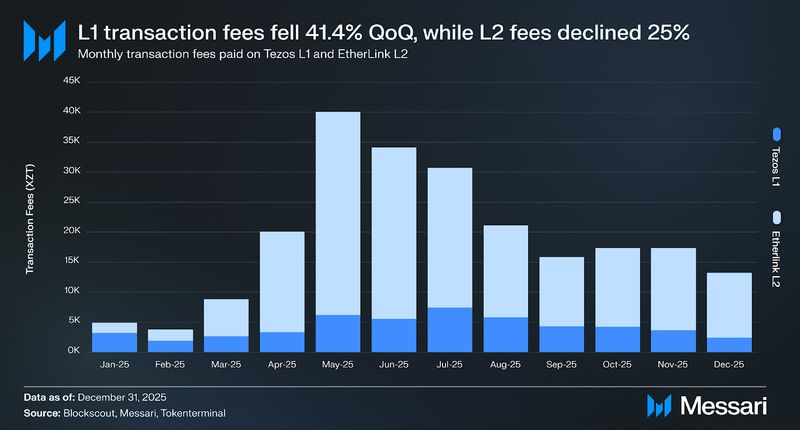
In This autumn 2025, whole charges paid on Tezos L1 fell 41.4% QoQ to 10,230 XTZ, whereas Etherlink L2 charges declined solely 25% QoQ to 37,660 XTZ. The L1 price decline coincided with lowered onchain exercise as each transactions and contract calls fell QoQ. A number of governance votes executed in This autumn’25 on Tezos L1 and Etherlink generated poll transactions, serving to maintain exercise all through the quarter. Nevertheless, these governance-related charges weren’t sufficient to offset the broader decline in L1 utilization.
On Etherlink, the Ebisu improve activated on Oct. 15, 2025, switching the EVM engine from SputnikVM to REVM and elevating the throughput restrict from 8 million to 14 million fuel per second. The Farfadet improve adopted on Dec. 17, 2025, practically doubling capability once more to 27 million fuel per second and introducing instantaneous transaction confirmations. These capability will increase allowed Etherlink to deal with a 50% QoQ improve in transactions whereas the demand-indexed base price continued to fall, leading to decrease whole L2 charges regardless of elevated throughput. Etherlink L2 charges remained increased than the L1 as a result of every batch of L2 transactions have to be written to the Tezos base layer for settlement, including L1 information prices on prime of Etherlink’s personal base price.
Community Overview
Utilization
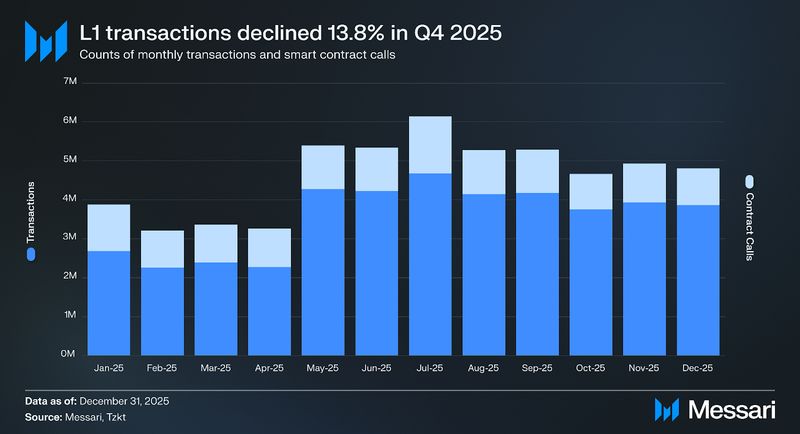
Transactions on Tezos L1 fell 11.2% QoQ in This autumn 2025, falling to a mean of three.8 million transactions, down from 4.8 million in Q3’25. Moreover, contract calls declined 23% QoQ, right down to 953,270 million from 1.2 million in Q3. The decline doubtless displays L1 exercise persevering with emigrate towards Etherlink, which processed 50% extra transactions QoQ in the identical interval. The Seoul improve activated on the finish of Q3’25, and its effectivity enhancements to attestations and unstaking could have contributed to the lowered quantity of repetitive L1 operations in This autumn. In the meantime, the Tallinn governance cycle generated poll and voting transactions in November and December 2025, however was inadequate to offset the shift towards Etherlink.
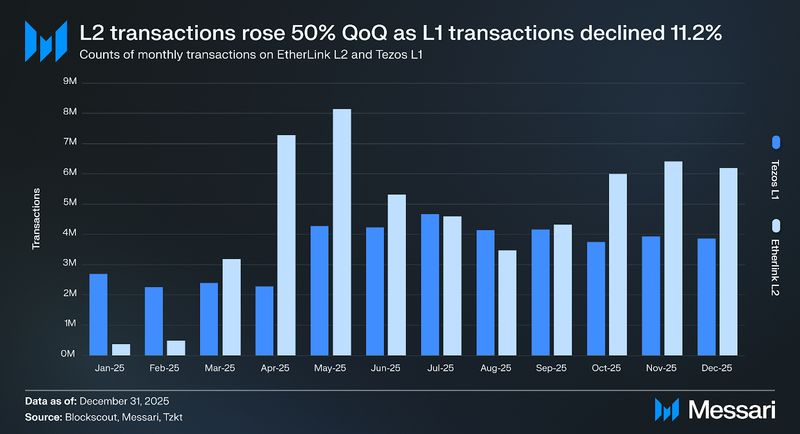
Etherlink processed 18.6 million transactions in This autumn 2025, a 50% QoQ improve from 12.4 million in Q3. Two kernel upgrades drove a lot of Etherlink’s development in This autumn’25. Ebisu, activated on Oct. 10, 2025, offered builders with broader EVM compatibility and better throughput. Farfadet adopted on Dec. 17, 2025, pushing throughput to 27M fuel per second and enabling instantaneous transaction confirmations. Collectively, these upgrades allowed Etherlink to soak up extra exercise with out rising charges. Apple Farm Season 2 incentives ran by means of most of This autumn 2025, and stored DeFi-related transactions elevated as customers farmed rewards throughout Curve, Superlend, and different built-in protocols. MEXC additionally enabled native XTZ deposits on Etherlink on Nov. 5, 2025, including one other onramp that doubtless contributed to the rise in transaction quantity.
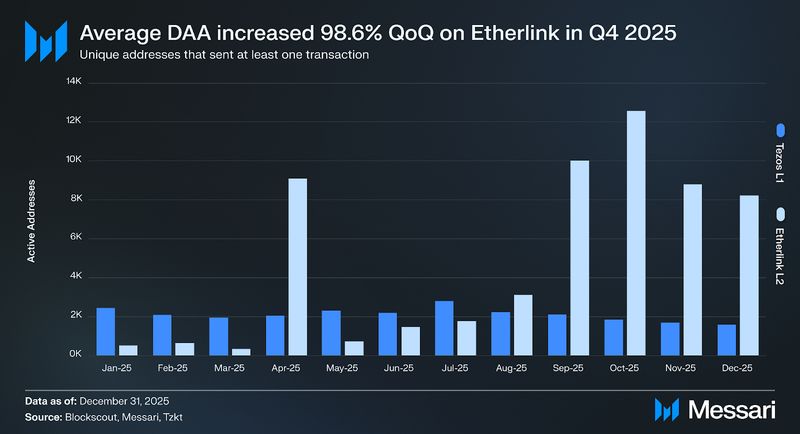
In This autumn 2025, every day lively addresses (DAAs) on Tezos L1 decreased 28.1% QoQ, averaging 1,710 distinctive addresses per day. On Etherlink, DAAs surged 98.7% QoQ, from averaging 4,960 in Q3’25 to over 9,860 in This autumn’25. The rise in DAAs on Etherlink was doubtless pushed by a mixture of recent trade onramps, gaming launches, and ongoing DeFi incentives. Following KuCoin’s XTZ integration in Q3’25, MEXC added help for XTZ in This autumn, giving customers two main centralized trade (CEX) pathways straight onto the L2. The Reaper Precise Basis Alpha launched on Oct. 8, 2025, onboarding a brand new cohort of wallets prematurely of the sport’s full launch. Moreover, Apple Farm Season 2 rewards sustained DeFi participation throughout built-in protocols in This autumn 2025.
Governance and Community Upgrades
Tezos makes use of an LPoS mechanism, enabling staked XTZ for use for each community safety and governance. The community’s self-amending blockchain reduces the necessity for laborious forks by using onchain governance for protocol upgrades. Customers delegate their XTZ to bakers, and governance voting energy is weighted by delegated balances, independently of staking participation. The governance course of is split into 5 intervals, spanning roughly two months and ten days.
To enhance protocol governance, Tezos Commons established the Tezos Ecosystem DAO, which manages and allocates XTZ for group initiatives. The DAO’s preliminary funding got here from NFT gross sales on Objkt and donations from ecosystem members.
Etherlink follows an onchain governance mannequin much like Tezos L1, guaranteeing equity and transparency. Governance for Etherlink options the identical self-amending properties (which means no laborious fork wanted) and is managed by L1 bakers. In contrast to L1, Etherlink governance pilots each upgrades. Moreover, it has an alternate “fast governance” course of principally for swift incident responses, with shorter period however increased participation necessities. The governance course of happens solely on Tezos L1 by means of devoted good contracts and consists of a proposal interval and a promotion interval.
Ebisu: Prague EVM Compatibility
Ebisu, the fifth Etherlink kernel improve, activated on October 15, 2025, aligning Etherlink’s EVM with Ethereum’s Prague execution modifications, the execution-layer portion of Ethereum’s broader Pectra improve. Pectra is the umbrella identify for 2 halves of a single improve: Prague (execution layer) and Electra (consensus layer). Since Etherlink implements the EVM execution setting somewhat than Ethereum’s consensus mechanism, Ebisu adopted solely the Prague modifications.
Ebisu added three Prague options to Etherlink in This autumn’25:
- EIP-7702: Permits an everyday, externally owned account to connect contract code for a single transaction and delegate what it may possibly do. This allows smart-account options, together with batching steps, session keys, and sponsored charges, with out transferring funds to a brand new contract pockets. After the transaction completes, the account returns to regular.
- EIP-2537: Added a local precompile for BLS12-381 curve operations, making BLS signature verification and sure ZK-proof computations quicker and cheaper than equal Solidity implementations. Apps utilizing light-client proofs or zero-knowledge tooling profit straight as a result of these operations beforehand needed to be applied in Solidity at considerably increased fuel prices.
- EIP-7623: Elevated the fuel charged per byte of calldata. This principally impacts data-heavy transactions, discouraging spam and aligning price math with mainnet Ethereum tooling. Contracts that ship massive payloads now have to compress information or batch extra rigorously.
Past Prague compatibility, Ebisu additionally migrated the EVM engine from SputnikVM to REVM, elevating the throughput velocity restrict to 14 million fuel per second beneath the target-based price mannequin, practically a 75% improve over the prior Kernel 4.1 ceiling.
Farfadet Protocol Improve
The Farfadet Improve (Kernel 6.0) adopted on December 17, 2025, practically doubling capability once more to 27 million fuel per second. Farfadet additionally launched instantaneous transaction confirmations by means of a brand new JSON-RPC methodology. Below this mannequin, the sequencer advertises its meant transaction set earlier than block creation, permitting purchasers to compute receipts earlier than the block is definitely produced. On the compatibility entrance, Farfadet moved Etherlink’s EVM from Prague to Osaka, including 4 new EIPs, together with:
- EIP-7951: Prolonged secp256r1 help to allow batch verification of a number of P-256 signatures in a single name, lowering fuel prices for purposes that validate a number of passkey or hardware-backed signatures per transaction.
- EIP-7939: Launched the CLZ (rely main zeros) opcode, a low-level bitwise operation utilized in fixed-point math, binary search, and compact encoding.
- EIP-7883 and EIP-7823: Set an specific higher sure on the fuel restrict a block can carry, stopping misconfigured or adversarial validators from proposing blocks with unreasonably excessive limits that might destabilize node efficiency.
This made Etherlink one of many first rollups to activate a brand new EVM model inside days of an Ethereum laborious fork.
Etherlink 6.1: Farfadet Bugfix
On Dec. 17, 2025, a regression in Farfadet broke FA token deposits by means of the Tezos bridge. The bug brought on deposit transactions to fail throughout the possession switch step, locking tokens within the rollup’s L1 good contract somewhat than minting them on Etherlink. Just one person depositing Lyzi tokens was straight affected, and their funds remained safely held on L1 all through. The difficulty prolonged to all FA token varieties, prompting Optimistic Labs to pause FA deposits within the bridge frontend as a precaution, although tez transfers and different bridges had been unaffected. The group used Etherlink’s quick governance course of, which compresses the usual multi-period governance cycle right into a single day with increased participation thresholds, to suggest and promote a 6.1 patch from December 19-20, 2025. The patch included a migration operate that re-injected the caught deposit into the delayed inbox for automated supply upon kernel activation. Kernel 6.1 went stay on December 20, 2025, restoring full bridge performance inside 72 hours.
Tallinn Protocol Improve
Tallinn, Tezos’ twentieth protocol improve, was proposed in November 2025 and was activated on mainnet on January 24, 2026. Tallinn introduces three modifications to Tezos L1:
- Diminished Block Instances: Lower L1 block instances from 8 seconds to six seconds, rising throughput and lowering affirmation latency for each L1 transactions and Sensible Rollup dedication posting.
- Tackle Indexing Registry: Assigns compact numerical indices to addresses, lowering storage prices for contracts that reference many accounts. That is notably helpful for NFT ledgers and token registries.
- All-Baker Attestations: Permits each lively baker to attest every block, changing the committee-based sampling mannequin. This tightens finality ensures and aligns with the shorter block-time cadence. This function can be triggered as soon as 50% of bakers, no matter stake, have switched to BLS signatures. As soon as triggered, this function won’t ever deactivate, even when the proportion of bakers utilizing BLS decreases beneath 50%.
Collectively, these modifications goal L1 throughput and price effectivity, two areas most related to Etherlink’s rollup posting and to NFT-heavy use instances that stay on the L1.
App Growth
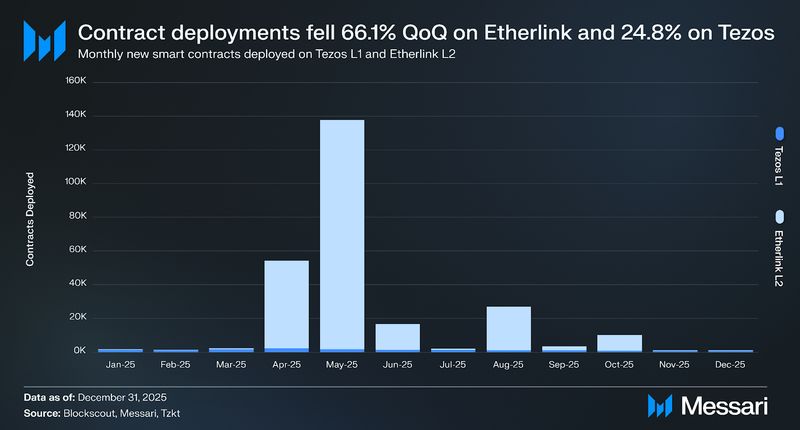
Regardless of a 24.8% and 66.1% QoQ decline in contract deployments throughout each Tezos L1 and Etherlink L2, respectively, over 12,000 good contracts had been deployed throughout each networks in This autumn’25. The Q3’25 deployment spike, largely pushed by Apple Farm Season 2 launches and Kernel 4.1 tooling, inflated the baseline that This autumn was measured towards. Etherlink deployments fell to 9,760, although a number of new protocols, reminiscent of UltraYield and Reaper Precise, deployed their preliminary contracts throughout the quarter. On Tezos L1, the Tallinn improve proposal launched contract-level modifications to deal with indexing and storage prices, which can affect deployment patterns going ahead. Quarterly contract deployments on Etherlink declined to 9,760, down 66.1% QoQ from 28,780 in Q3’25. Tezos L1 deployments had a smaller drop to 2,780, a 24.8% QoQ lower.
As of December 2025, Tezos continues to keep up a rising base of lively open‑supply contributors, with 229 month-to-month lively builders working throughout greater than 4,300 Git repositories, a 16.2% QoQ improve from Q3’25.
Financial Safety
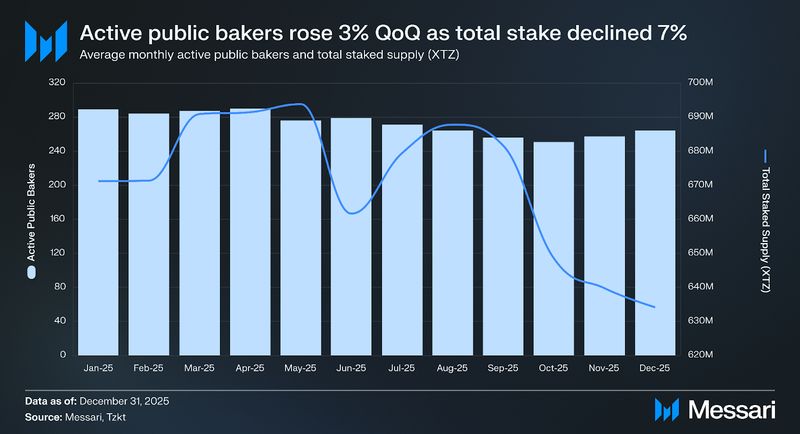
Tezos makes use of a Liquid Proof-of-Stake (LPoS) mechanism, which requires validators (often known as “bakers” within the Tezos ecosystem) and delegators to stake XTZ as collateral to safe the community. Rewards and costs collected from transactions are paid to validators and delegators to keep up the community. In This autumn 2025, the variety of lively public validators grew 3% QoQ, from 256 in September 2025 to 264 in December 2025. Public validators make a fraction of the full validator set. Whole stake decreased 8.1% over the identical interval, lowering from 688.1 million XTZ to 633.1 million XTZ. Regardless of the continuing downtrend in staking participation, total staking ranges have remained steady, indicating continued community safety and financial alignment amongst members.
Adaptive Issuance dynamically adjusts the issuance of XTZ primarily based on the proportion of staked tokens to the full provide. On the finish of every blockchain cycle, the issuance charge is modified to focus on a protocol-defined staking stage, at present set at 50%. This mechanism incentivizes staking to supply steady safety for the community.
The Tezos community has demonstrated constant year-over-year stability within the variety of validators and delegators, in addition to within the quantity of staked XTZ. This stability is essential for safe and scalable L2 development. Validators within the ecosystem are additionally decentralized geographically and by host service suppliers, additional guaranteeing the community’s resilience and safety.
Ecosystem Overview
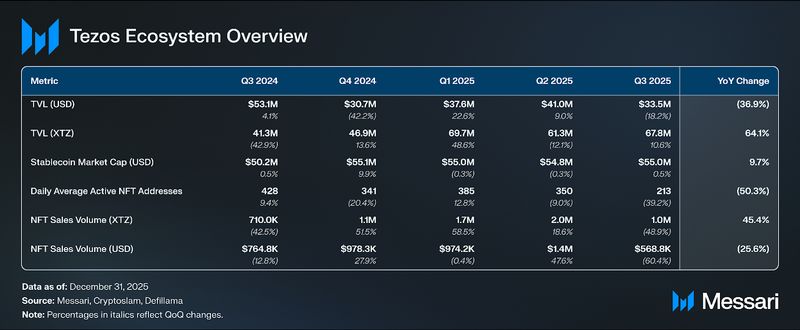
Two back-to-back kernel upgrades on Etherlink reshaped the community’s throughput in This autumn’25. Moreover, the technical problem with Farfadet prompted further onchain exercise to go the 6.1 patch inside 72 hours. On the L1 aspect, the Tallinn protocol improve entered its exploration vote in December and reached promotion by December 27, 2025. In the meantime, Etherlink consolidated its place as the first DeFi venue throughout the Tezos ecosystem, accounting for roughly 68% of the mixed TVL by the top of This autumn. New entrants like Reaper Precise and UltraYield, together with MEXC’s native XTZ deposit help in November 2025, broadened Etherlink’s attain past its current DeFi person base. The Tezos artwork group additionally had a robust quarter, highlighted by the Artwork on Tezos pageant in Berlin and the 12 Days of Tezmas marketing campaign.
DeFi
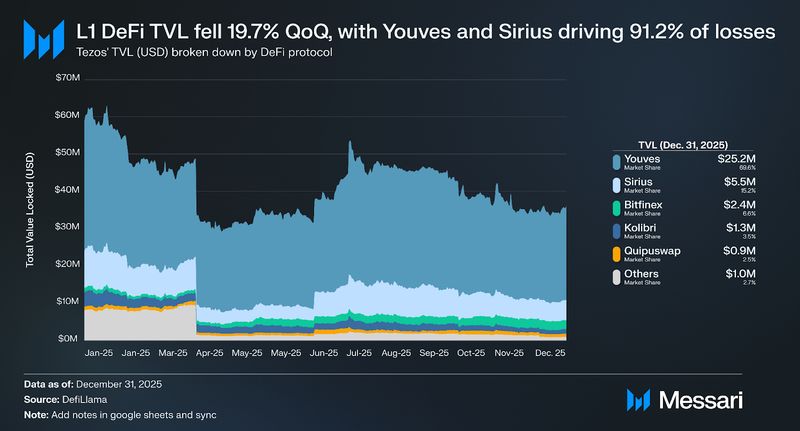
Tezos’ DeFi TVL fell 19.7% QoQ to $36.2 million. The decline was pushed largely by Youves, as a consequence of its dominant share of TVL within the Tezos ecosystem. A strong DeFi ecosystem can create a extra vibrant and self-sustaining economic system on Tezos, offering customers with alternatives to earn yields, commerce property, and entry monetary providers.
- Youves: A set of instruments for onchain treasuries and artificial property on Tezos L1.
- Youves had the most important contribution to the general decline in DeFi TVL on Tezos. Its TVL declined 19.8% from $31.4 million to $25.2 million; nevertheless, Youves remained the dominant protocol, capturing 69.6% of TVL in This autumn’25.
- Sirius: A liquidity venue that facilitates swaps throughout XTZ and wrapped BTC (tzBTC).
- Sirius ended This autumn with $5.5 million in TVL. This can be a 25.5% lower from the earlier quarter. Nevertheless, its market share solely declined from 16.3% to fifteen.2% of the community’s TVL.
- Bitfinex: Supplies custodial staking and liquidity channels that join institutional customers to Tezos.
- Bitfinex closed This autumn with $2.4 million in TVL, a 20.5% QoQ improve from Q3. In consequence, its market share elevated from 4.4% to six.6%.
- Kolibri: An overcollateralized stablecoin backed by onchain collateral on Tezos.
- Kolibri ended This autumn with $1.3 million in TVL, a 23.6% QoQ decline, whereas its share of total TVL fell from 3.7% to three.5%.
- QuipuSwap V1/V2: A concentrated-liquidity AMM that helps price tiers and tighter pricing across the center bands. Whereas property are primarily focused on V2, QuipuSwap V1 offers a legacy constant-product AMM that continues to serve long-tail property.
- Collectively, Quipuswap V1 and V2 ended This autumn with a TVL of $0.89 million, a 0.2% decline from Q3.
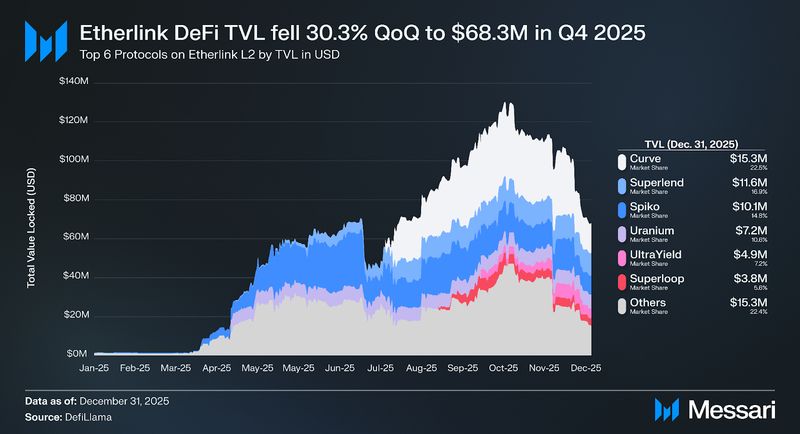
Etherlink’s DeFi TVL fell 30.3% QoQ to $68.3 million. This decline was largely pushed by Curve, which misplaced a big share of the TVL within the Etherlink ecosystem in This autumn’25. The Etherlink DeFi ecosystem has shortly turn out to be the first venue for DeFi liquidity throughout each Tezos L1 and Etherlink L2.
- Curve: A concentrated-liquidity AMM on Etherlink that helps price tiers and tight ranges for steady and unstable pairs. Liquidity concentrates in a small set of core swimming pools, which mixture most routing.
- Curve had the most important drop in DeFi TVL on Etherlink in This autumn. Its TVL declined from $31 million in August to $15.3 million, a 50.4% drop that accounted for 52.7% of the general TVL loss. Curve stays the dominant DeFi vacation spot on Tezos, accounting for 22.5% of all TVL on Etherlink in This autumn 2025.
- Curve didn’t turn out to be lively on Etherlink till August 2025
- Superlend: A lending and borrowing market with variable charges and danger controls tuned for Etherlink.
- Superlend ended This autumn with $11.6 million in TVL, a 1.3% improve from the earlier quarter. Notably, its market share elevated from 11.7% to 16.9% of the community’s TVL.
- Superloop, a subset of Superlend, is infrastructure for shifting property and liquidity throughout Etherlink and linked venues with decrease operational overhead. Superloop launched in September 2025 and ended This autumn with a TVL of $3.8 million, capturing 5.6% of all DeFi TVL This autumn’25.
- Spiko: Points tokenized cash market funds on Etherlink, providing UCITS-style shares backed by U.S. and EU T-Payments that settle onchain.
- Spiko closed This autumn with $10.1 million in TVL, a 38.1% QoQ lower from Q3 2025. Its market share decreased from 16.6% to 14.8%, doubtless reflecting broader outflows as Apple Farm incentives wound down and Curve’s TVL contraction lowered the liquidity out there for pairing with Spiko’s tokenized fund shares.
- Uranium: A tokenized-commodity platform on Etherlink that offers traders direct, onchain possession and switch of bodily uranium held with regulated custodians.
- Uranium ended This autumn with a TVL of $7.2 million, a 0.1% lower QoQ. Uranium noticed its market share improve from 7.4% to 10.6% whilst bigger protocols like Curve skilled a TVL discount.
- UltraYield: A vault curator constructed by the hedge fund, Edge Capital, that manages market-neutral yield methods on behalf of depositors.
- Ultrayield launched in October 2025 and completed This autumn with $4.9 million in TVL, capturing 7.2% of Etherlink’s total TVL in its first lively quarter.
Protocol Interactions
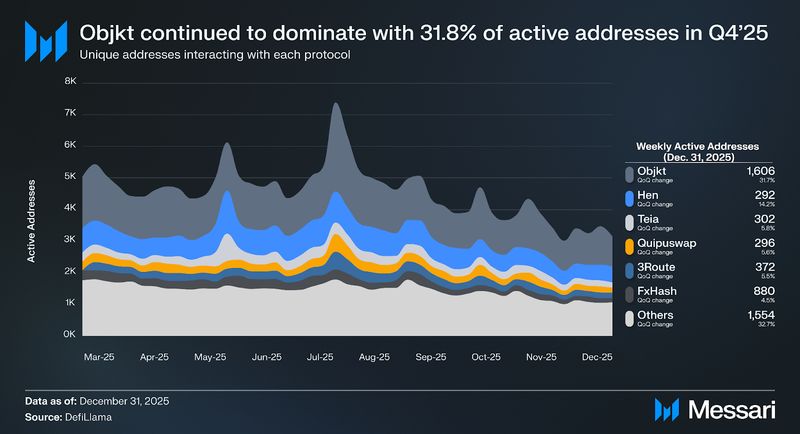
Objkt remained the main market on Tezos by distinctive handle exercise, averaging 1,170 weekly lively addresses in This autumn 2025, a 25.3% QoQ lower from 1,570. Objkt continued to dominate the NFT class, sustaining the most important share of lively customers throughout the community. Objktlabs launched drop.artwork, enabling artists to launch blind mint drops with absolutely customizable touchdown pages. Within the DeFi class, QuipuSwap and 3route skilled related declines. QuipuSwap fell from 305 to 207 common weekly customers, whereas 3route fell from 317 to 204. The “Others” class, which incorporates dozens of smaller or rising protocols, fell from 1,560 to 1,210 weekly lively addresses, representing the same decline in participation throughout the lengthy tail of purposes.
Group & Growth
This autumn was the strongest quarter for Tezos artwork occasions in 2025. The flagship Artwork on Tezos: Berlin pageant ran from November 6–9, 2025, drawing over 700 guests and that includes greater than 200 artists and platforms throughout exhibitions, talks, and stay performances. Francisco Carolinum’s acquisition of 15 items from the TeleNFT exhibit on the pageant marked a serious milestone for institutional funding in onchain artwork. One other notable sale throughout the occasion was qubibi’s generative work, “hello world,” which offered for 62,000 XTZ. On the Paris Photograph honest, Artverse offered a sales space that includes distinguished artists Niceaunties, Grant Yun, Reuben Wu, Shavonne Wong, Emi Kusano, and Genesis Kai, a number of of whom had been releasing works on Tezos for the primary time. The Museum of the Transferring Picture and the Tezos Basis renewed their partnership, this time specializing in blockchain as a artistic medium. The primary commissioned work, ‘Contingent’ by James Bloom and Gottfried Jager, opened at MoMI in November 2025. The 12 Days of Tezmas marketing campaign ran from December 12–23, 2025, and supplied every day inventive rewards by means of quests and raffles. Tezos Wrapped ran alongside this marketing campaign, providing customers a customized onchain exercise recap for 2025. On the schooling aspect, the Tezos Basis expanded its partnership with the Processing Basis to provide a sequence of p5.js 2.0 tutorials led by generative artists, with interactive art work releases on EditArt.
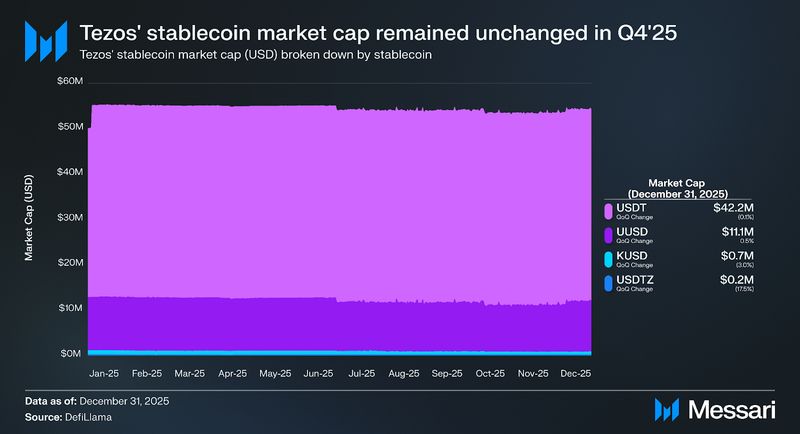
The circulating provide of stablecoins on Tezos remained largely unchanged, declining solely 0.1% QoQ, from $54.3 million to $54.2 million. USDT remained the dominant stablecoin on the community with $42.2 million in issuance, adopted by uUSD at $11.1 million. The most important Tezos-native stablecoins, kUSD and USDTez, had a circulation of $650,680 and $224,340, respectively. The small lower in TVL was primarily pushed by a lower within the steadiness of USDT and USDtez, whereas uUSD remained steady all through the quarter.
Closing Abstract
In This autumn 2025, Tezos’ middle of gravity continued to shift towards Etherlink, extending a development that started earlier within the yr. Etherlink transactions rose 50% QoQ to 18.6 million, and every day lively addresses practically doubled to 9,860, whereas L1 transactions and DAAs fell 11.2% and 28.1%, respectively. DeFi liquidity declined on each layers, with Etherlink TVL dropping 39.3% QoQ to $37.2 million, with Curve accounting for over half of that loss. L1 TVL noticed a softer decline, falling 18.2% to $33.5 million as XTZ’s worth declined 26.1% QoQ.
Infrastructure was the quarter’s clear spotlight. Two kernel upgrades, Ebisu in October and Farfadet in December 2025, raised Etherlink’s throughput from 8 million to 27 million fuel per second and launched instantaneous transaction confirmations. On Tezos L1, the Tallinn improve reached its promotion interval simply earlier than year-end, bringing lowered block instances, handle indexing, and tighter finality ensures. Developer exercise expanded as effectively, with month-to-month lively contributors rising 16.2% QoQ to 229 throughout greater than 4,300 repositories, and the Tezos artwork group had its strongest quarter of the yr with Artwork on Tezos: Berlin, a sales space at Paris Photograph in collaboration with ArtVerse, and the renewal of the MoMI x Tezos Basis Partnership.
Heading into 2026, consideration shifts as to if latest infrastructure upgrades can help sustained liquidity and utilization past incentive-driven exercise reminiscent of Apple Farm. Tallinn’s lowered block instances will decrease L1 prices for Etherlink’s rollup posting, however the finish of Apple Farm Season 2 creates a pure check of natural demand going ahead. Superlend, Uranium, and UltraYield held or modestly grew TVL by means of the inducement wind-down, indicating {that a} portion of Etherlink’s DeFi exercise continued past backed liquidity, although longer-term sustainability stays unproven.
