



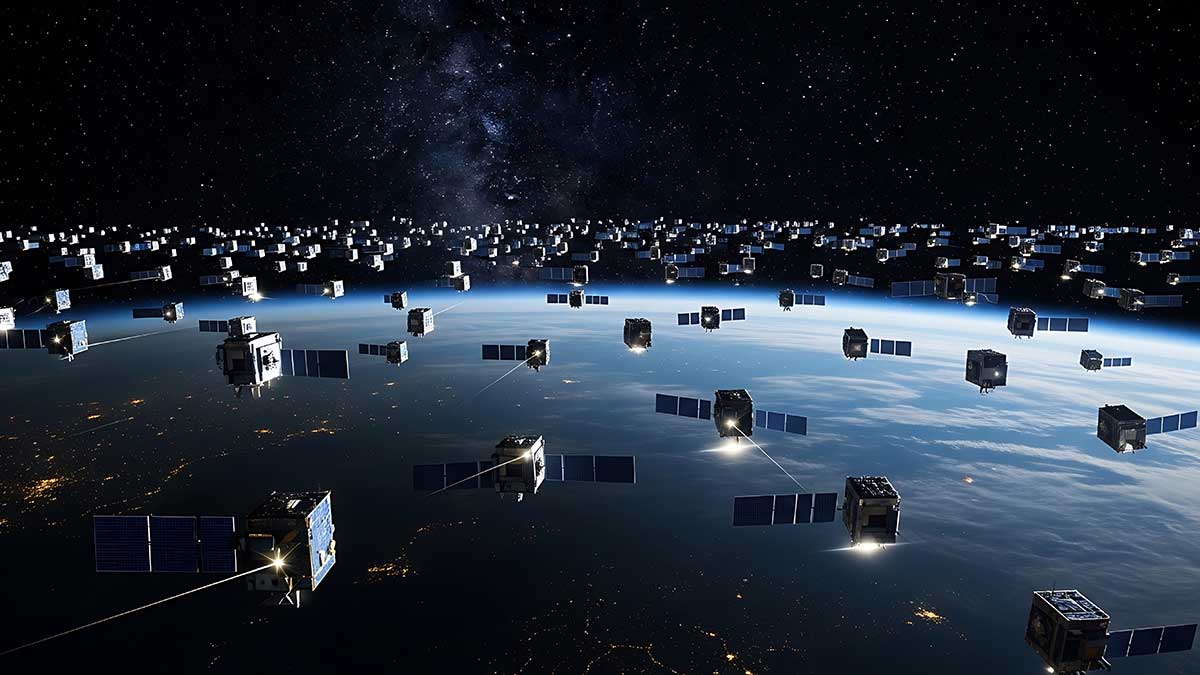
Community operators world wide are racing to adapt as Low Earth Orbit (LEO) satellites put together to reshape world connectivity.
With new constellations from Amazon, Starlink, and OneWeb coming on-line, telcos say 2026 is shaping up as a landmark yr by which satellite tv for pc networks are not area of interest options, however a viable complement—and even various—to terrestrial fibre and mobile infrastructure.
“People are going to be surprised how fast the transition is going to go once it becomes mainstream,” says Fernando Vargas, Director of Media and Company Communications at MTN. “Suddenly you’re not going to rely on a cable to have internet at your home or in your company or in your business, how fast connectivity is going to come from the sky.”
Actually, the previous few months has witnessed a scurry of offers and company agreements as operators forge partnerships, combine hybrid methods, and rethink enterprise choices to make sure they will ship resilient, always-on connectivity in an period the place the sky itself is turning into a part of the community.
In Europe, Vodafone introduced an settlement with AST SpaceMobile, aiming to eradicate cellular “not-spots” by connecting units on to space-based networks. BT Group introduced a partnership with Starlink to ship dependable, high-speed, low-latency satellite tv for pc broadband to BT and EE clients, initially specializing in enterprise and client broadband moderately than direct-to-device providers. And Virgin Media O2 has additionally introduced a multi-year partnership with Starlink Direct to Cell, which goals to deliver cellular protection to among the nation’s hardest-to-reach “not-spots.”
For US-based MTN, an organization that has made a reputation for itself delivering absolutely managed connectivity for crucial methods and distant groups throughout the maritime, power, authorities, and enterprise sectors, it’s an opportunity to combine extra suppliers into its present hybrid providers.
MTN’s core platforms, StarEdge and StarEdge Horizon, already combine LEO satellites—together with Starlink and OneWeb—with GEO satellites and terrestrial 5G/4G/LTE networks – one thing Vargas says means it could actually chop and alter between totally different networks and constellations, sustaining continuity even in catastrophe zones, distant farms, or maritime operations.
The corporate’s StarEdge Horizon provides a non-public Layer 2 connection over Starlink, making certain delicate knowledge travels on to MTN regional factors of presence with out touching the general public web. Direct Cloud integration with Amazon LEO additionally gives a seamless “Edge-to-Cloud” connection for enterprises already working throughout the AWS ecosystem.
“When you have an earthquake, it can break the system… satellite connectivity doesn’t have that weakness. You can count on first responders having connectivity to assist and operate effectively,” says Vargas, talking to IoT Insider on the IoT Tech Expo in London final week. “Rather than being disrupted by a single provider, MTN integrates LEO with other systems; if one constellation has a localised outage or congestion, StarEdge Horizon automatically fails over to the next.”
Hybrid community fashions additionally permit operators to handle regulatory and geopolitical complexities. MTN can change robotically between LEO suppliers relying on the place a vessel or operation is situated, making certain authorized compliance and uninterrupted service even in areas with restricted entry to sure satellite tv for pc constellations.
Vargas says competitors amongst LEO suppliers is reducing {hardware} prices and creating choices for community operators to optimise service for efficiency or worth.
“Millions of lives are going to improve, because now farmers in remote places or workers in remote areas are going to be part of the digital economy—they have the same level of connection as someone in the middle of the city,” he says.
The sensible purposes span industries. In agriculture, IoT sensors can now transmit real-time soil and crop knowledge from distant fields, enabling farmers to optimise yield and effectivity. In power, oil and gasoline platforms in the midst of oceans can keep mission-critical monitoring and operational knowledge flows. Maritime purchasers, from business transport to expedition cruise strains reaching the Arctic, depend on satellite tv for pc connectivity as their main or backup community.
“If you want devices working everywhere, LEO satellites… fibre can’t always reach, and deploying it is often too expensive,” Vargas says. “The first question IoT companies should ask is: how reliable is your network right now? In mining, every hour of downtime can cost millions. With LEO satellites, you can maintain connectivity even in remote operations.”
Wanting forward, MTN sees the adoption curve accelerating. “People are going to be surprised how fast the transition is going to go,” Vargas says. By 2027, satellite tv for pc connectivity is predicted to be a normal characteristic in company networks moderately than a distinct segment backup, offering enterprises with seamless entry anyplace.”
There’s loads of different editorial on our sister web site, Digital Specifier! Or you may at all times be a part of within the dialog by commenting beneath or visiting our LinkedIn web page.
