




IPIDEA, one of many largest residential proxy networks utilized by risk actors, was disrupted earlier this week by Google Risk Intelligence Group (GTIG) in collaboration with trade companions.
The motion included taking down domains related to IPIDEA companies, contaminated gadget administration, proxy site visitors routing. Moreover, intelligence has been shared on the IPIDEA software program growth kits (SDK) that distributed the proxying software.
The operators of IPIDEA marketed it as a VPN service that “encrypts your on-line site visitors and hides your actual IP handle,” utilized by 6.7 million customers worldwide.

Residential proxy networks use residence person or small enterprise IP addresses to route site visitors after compromising units on the community. Usually, the an infection happens by trojanized apps and software program posing as helpful utilities.
In a court docket letter, Google explains that risk actors use residential proxies in numerous malicious actions, akin to account takeovers, pretend account creation, credential theft, and delicate info exfiltration.
“By routing site visitors by an array of client units all around the world, attackers can masks their malicious exercise by hijacking these IP addresses. This generates vital challenges for community defenders to detect and block malicious actions,” Google says in a report at present.
Within the case of IPIDEA, GTIG noticed a variety of malicious exercise, with greater than 550 distinct risk teams utilizing its exit nodes in a single week, together with actors from China, Iran, Russia, and North Korea.
The noticed actions included entry to sufferer SaaS platforms, password spraying, botnet management, and infrastructure obfuscation. Beforehand, Cisco Talos linked IPIDEA to large-scale brute-forcing assaults focusing on VPN and SSH companies.
IPIDEA infrastructure additionally supported record-breaking DDoS botnets akin to Aisuru and Kimwolf.
Google says IPIDEA enrolled units utilizing not less than 600 trojanized Android apps that embedded proxying SDKs (Packet SDK, Castar SDK, Hex SDK, Earn SDK), and over 3,000 trojanized Home windows binaries posing as OneDriveSync or Home windows Replace.
Supply: Google
IPIDEA promoted a number of VPN and proxying apps to Android customers that secretly turned their units into proxy exit nodes with out their information or consent.
In keeping with Google, IPIDEA operators ran not less than 19 residential proxy companies that pretended to be official companies and offered entry to units compromised with the BadBox 2.0 malware. A few of the affiliate manufacturers are listed beneath:
-
360 Proxy (360proxy.com)
-
922 Proxy (922proxy.com)
-
ABC Proxy (abcproxy.com)
-
Cherry Proxy (cherryproxy.com)
-
Door VPN (doorvpn.com)
-
Galleon VPN (galleonvpn.com)
-
IP 2 World (ip2world.com)
-
Ipidea (ipidea.io)
-
Luna Proxy (lunaproxy.com)
-
PIA S5 Proxy (piaproxy.com)
-
PY Proxy (pyproxy.com)
-
Radish VPN (radishvpn.com)
-
Tab Proxy (tabproxy.com)
- Aman VPN (defunct)
Regardless of the a number of manufacturers, all companies are linked to a centralized infrastructure below the only management of IPIDEA operators, who stay unidentified.
Google Play Shield now routinely detects and blocks on up-to-date, licensed Android units the purposes that embody IPIDEA-related SDKs.
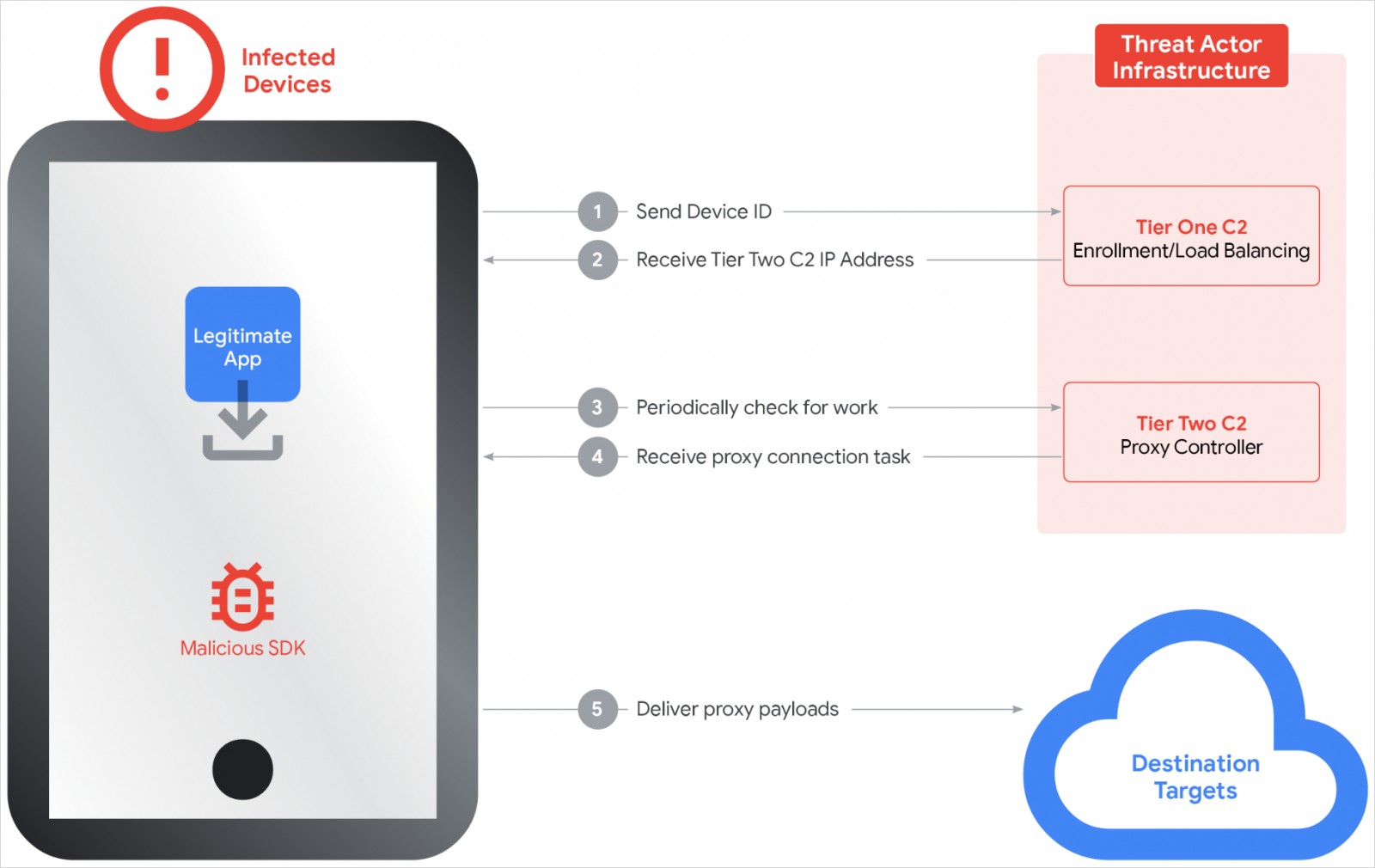
Concerning its construction, Google explains that IPIDEA operated on a two-tier command-and-control (C2) system. The primary tier supplies configuration and timing, and the node lists for the second tier.
In keeping with the researchers, the second tier comprised roughly 7,400 servers that assigned proxying duties and relayed site visitors.
Supply: Google
Google researchers word that the operators of the networks additionally provided free VPN companies by apps that supplied the marketed fucntionality. Nevertheless, the units had been added to the IPIDEA community, appearing as an exit node.
Though GTIG and companions’ motion probably had a big influence on IPIDEA’s operations, the risk actor might attempt to rebuild its infrastructure. Presently, there aren’t any arrests or indictments introduced.
Customers ought to stay cautious about apps that supply cost in alternate for bandwidth, in addition to free VPN and proxy apps from non-reputable publishers.
It is finances season! Over 300 CISOs and safety leaders have shared how they’re planning, spending, and prioritizing for the yr forward. This report compiles their insights, permitting readers to benchmark methods, determine rising traits, and examine their priorities as they head into 2026.
Find out how prime leaders are turning funding into measurable influence.
