



**New Article: The Quiet Shift in Tokenization – Where the Real Money Is Moving in 2026**
A close look at on-chain real-world asset (RWA) data reveals that the narrative around tokenization is shifting quietly beneath the headlines. While attention has long been focused on traditional asset tokenization, the actual movement of capital tells a different story. According to analysis of RWA.xyz database between May 31 and July 9, 2026, the money is no longer where many assume it is.
**Reading the Numbers**
All figures cited below are drawn from RWA.xyz, which tracks distributed on-chain value—meaning assets natively issued on a blockchain are counted once per token. The data reflects 30-day growth rates based on daily API snapshots and platform dashboards.
**Tokenized Stocks Surpassing Treasuries in Momentum**
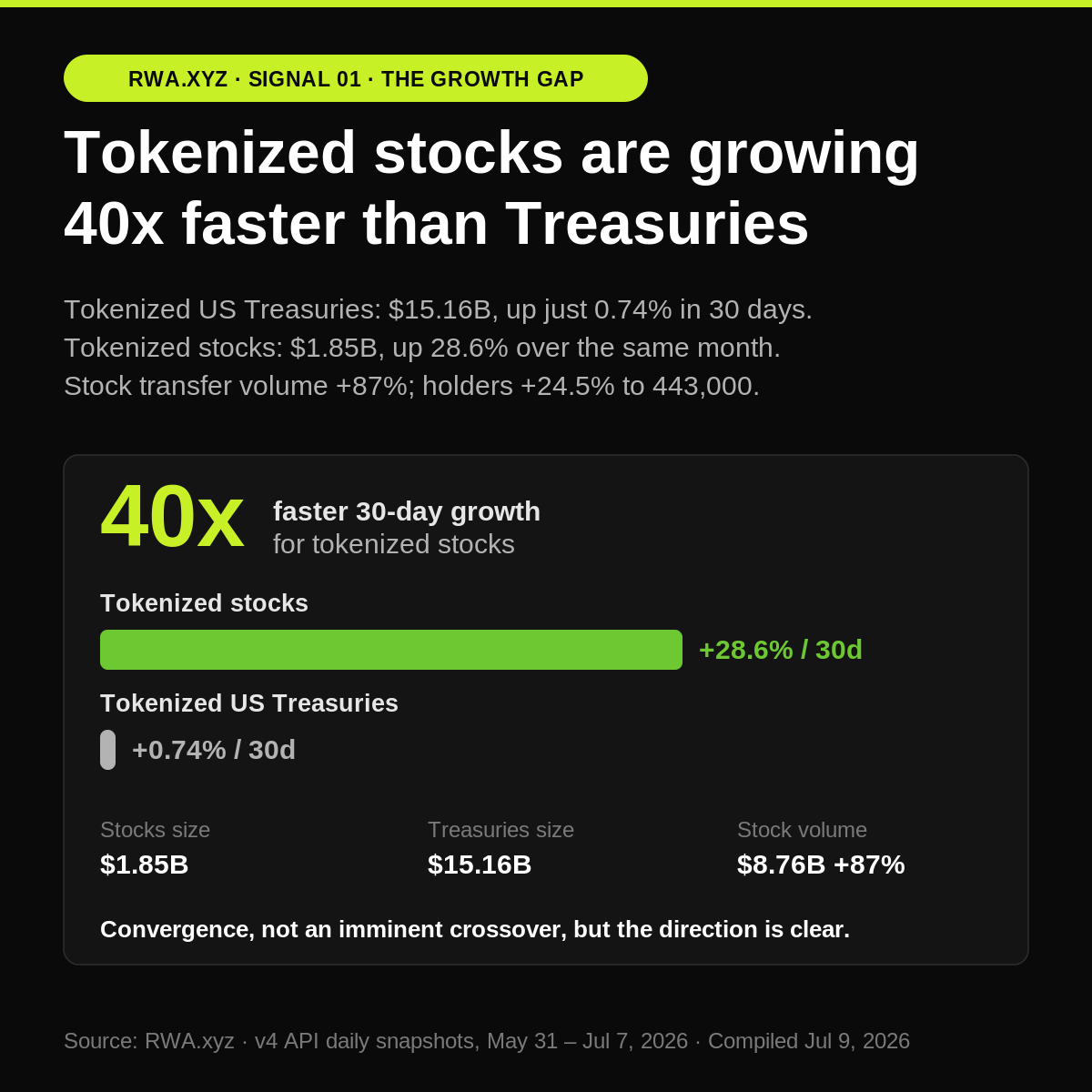
For two years, tokenization efforts largely centered on U.S. government bonds. However, that segment has begun to plateau. Tokenized U.S. Treasuries (represented by funds such as BUIDL and BENJI) sit at $15.16 billion, showing minimal growth of just 0.74% over the past month.
In contrast, tokenized equities are growing at a much faster clip. Currently valued at $1.85 billion—roughly one-eighth the size of Treasury tokens—they jumped 28.6% in the same 30-day window. Monthly transfer volumes for stock tokens rose 87% to $8.76 billion, and holder counts increased 24.5% to over 443,000.
The difference in pace is striking: stock token growth is nearly 40 times that of tokenized Treasuries. While Treasury tokens remain a cash-product with strong existing demand, stock tokens represent an access-driven product with rising appetite. The trend suggests convergence rather than an immediate takeover, but the directional shift is clear.
**The $20 Billion Home-Loan Token Dominating the Market**
The largest tokenized asset by far is not a BlackRock or other traditional fund token, but a home-equity token issued by Figure Technologies. This home-equity line of credit (HELOC) is recorded on the Provenance blockchain, then financed and traded on-chain.
As of July 7, the token stood at approximately $20.1 billion, up $730 million in just three weeks. That figure exceeds the combined value of all tokenized U.S. Treasuries and is more than ten times the total market for tokenized stocks. The asset’s strength comes from its role in securitization plumbing—bundling loans for institutional investors—rather than retail appeal.
When factoring all tokenized credit vehicles, the broader private credit category tops $31 billion on-chain, making it the largest non-stablecoin category overall.
**Stablecoins: Flat on the Surface, Dynamic Beneath**
Aggregate stablecoin supply has remained nearly flat over the last month, hovering near $321 billion since early June. However, beneath that surface-level stability lies significant internal churn.
Regulated dollar tokens are gaining ground: USDGO, issued by Anchorage Digital Bank, grew 54% in three weeks to $6.12 billion. The Global Dollar (USDG) rose 16%, while Dai increased 8%. Conversely, Ethena’s synthetic dollar USDe fell 16%, or about $1.4 billion, as holders redeemed amid falling yield and leverage unwinding.
Capital is moving out of yield-bearing synthetic dollars and into fully reserved, regulated dollar tokens—indicating a preference for safety over yield in the current environment.
**The Rotation in Perspective**
When comparing 30-day growth rates, a clear pattern emerges:
– Tokenized stocks: +28.6%
– Tokenized credit: +7.6% (to $6.58 billion)
– Tokenized U.S. Treasuries: +0.74%
Credit includes private credit, on-chain lending, corporate bonds, and structured debt, held by nearly 185,000 addresses across more than 2,500 assets. When Figure Technologies’ HELOC token and other on-chain lending protocols are included, tokenized credit surpasses $31 billion. Leading platforms include lending protocols such as Maple’s Syrup pools and tokenized CLO funds from Janus Henderson and Securitize.
Treasury tokens served as the proof of concept for tokenization. Today, credit instruments and fund wrappers developed by leading tokenization platforms are where meaningful growth is compounding.
**What This Rotation Means**
There has been little new capital entering the tokenization space; instead, existing capital is rotating. Money is moving out of Treasury tokens into equities and credit, and out of synthetic dollars into regulated, fully reserved stablecoins. This dynamic has important liquidity implications. Growth driven by rotation—rather than fresh inflows—leads to a thinner market, with value concentrated in a few large tokens. The $20 billion home-loan token and a stock market valued at $1.85 billion across hundreds of instruments illustrate this concentration.
The speed of exits is also a concern. The $1.4 billion redemption from USDe demonstrates how quickly capital can leave when yields decline. This highlights a core liquidity challenge in the RWA market.
As the tokenization landscape matures, the coming weeks will reveal whether stock tokens can sustain growth near 40 times the pace of traditional Treasury tokens—or whether the current rotation proves short-lived.
**Source**
This article is based on an analysis originally published by BeInCrypto. For more insights, you can read the original article here:
[3 Surprising Tokenization Stats Reshaping On-Chain Markets in 2026 | BeInCrypto](https://www.beincrypto.com/latest/crypto-news/exclusive-rwa-stats-on-chain-tokenization-2026/)
