



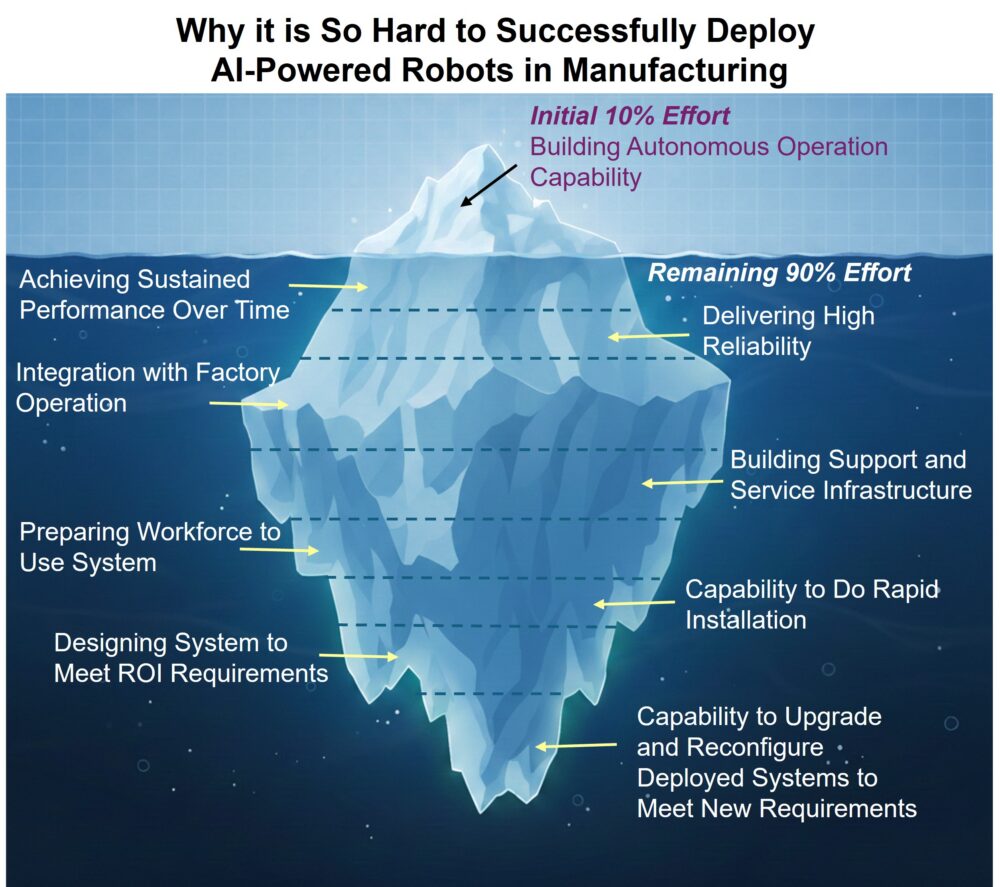
Excessive-mix manufacturing poses many challenges for robotic automation. Now we have seen many spectacular demonstrations of robotic automation in high-mix functions during the last 10 years. Usually these demonstrations are at expertise readiness stage (TRL) 5 or 6 stage. These demonstrations generate an excessive amount of curiosity in expertise and other people begin anticipating speedy expertise transition.
Nevertheless, expertise maturation on this space has been very sluggish. Only a few robotics applied sciences have been truly deployed in high-mix functions. This text explores the explanations behind this sluggish transition.
Robotic automation for high-mix functions requires a essentially totally different method. Elements of this method embrace:
- 1. Sensor-based methods for constructing half and workspace fashions
- 2. Automated robotic trajectory era based mostly on half fashions constructed from sensing
- 3. Management system to deal with sensor uncertainties
Most expertise demonstration tasks concentrate on improvement of notion, planning, and management capabilities to automate the duty. Typically, novel human-robot interplay capabilities are developed as a part of these demonstration efforts. Success metrics throughout demonstration typically concentrate on exhibiting that acceptable course of high quality will be achieved utilizing a small variety of consultant elements.
Listed here are the reason why robotics demonstrations fail to transition to deployments in high-mix manufacturing environments.
1. Lack of knowledge to successfully use AI-based approaches
Excessive-mix manufacturing requires use of sensors to localize elements and assess high quality. So, utilizing an AI-based notion system turns into a beautiful choice to complement conventional machine imaginative and prescient approaches. Solely a restricted quantity of knowledge will be collected throughout the demonstration venture to coach a mannequin to carry out notion perform. Sensor noise is rigorously managed throughout demonstrations to make sure success. Subject deployments inherently have a excessive quantity of sensor noise that breaks the notion system educated on restricted information.
Creating a strong system able to functioning properly within the area requires coaching the notion system with a considerable amount of information and deciding on an structure that may successfully cope with the sensor noise. Constructing a strong notion system able to performing properly within the area requires accessing many robotic cells and gathering information from these cells below all kinds of situations.
This isn’t possible throughout the proof-of-concept demonstration methods. Utilizing artificial information is a viable method, Nevertheless, artificial information is just helpful if it matches actuality. So, constructing an artificial information era pipeline is just not helpful throughout demonstration levels. Subsequently, the notion system developed throughout demonstrations typically requires important redesign. This takes important time and sources.
2. Restricted half variety makes it tough to design strong algorithms
Demonstrations are carried out on a restricted variety of half geometries. Which means that the planning and management capabilities aren’t examined rigorously. New half geometries encountered throughout deployment pose challenges for planning and management algorithms, typically requiring main upgrades to the method that may take a very long time to finish. Correctly validating planning and management capabilities requires testing with a number of hundred half geometries. This scale of testing is just not potential throughout the demonstration part. Subsequently, conclusions drawn relating to the feasibility of planning and management approaches don’t generalize throughout deployment.
3. Processes aren’t optimized for robots
Many handbook processes are designed based mostly on human capabilities. Robots have essentially totally different capabilities. Demonstrations that target robotic methods which are human-competitive by way of pace are sometimes removed from being cost-effective throughout deployment. Efficiently integrating robotic automation requires course of improvements by growing new course of recipes. For instance, robots can apply a lot greater forces and subsequently can use inexpensive abrasives and dramatically cut back abrasive prices.
Robots are very constant and, subsequently, can use aggressive course of parameters with out the danger of inflicting half harm. This has the potential to dramatically cut back the cycle time. Automation also can use device motions that might not be possible for people to execute as a consequence of pace or vibration concerns. Most demonstration tasks concentrate on automation and shouldn’t have sources to appreciate course of innovation wanted for profitable deployment. It’s typically potential to realize superhuman efficiency by investing sufficient sources in course of innovation for robotic automation and creating pathways to favorable ROI for profitable deployment.

4. Human-system interplay points aren’t thought of
In lots of functions, full automation is just not possible. Usually, we are able to notice important advantages if we are able to automate 90% or 95% of the duty. This ensures that the automation resolution doesn’t turn into overly costly to automate the toughest a part of the job. Subsequently, many demonstration tasks goal automation of 90% or 95% of the duty. The remaining job is carried out by people.
This mannequin works in precept. Nevertheless, most demonstration tasks ignore points associated to human integration with robotic cells. For instance, it is very important determine what work a human employee would do when the robotic is engaged on the half. They can’t be merely watching the robotic and ready for his or her flip to do the work. Until the human employee utilization will be stored very excessive, it’s tough to justify robotic automation value. For instance, if a human employee can help a number of cells, then human employee utilization will be excessive and automation will be justified.
Alternatively, a robotic cell will be designed to maintain the robotic busy for half-hour or extra and subsequently giving the human operator adequate time to work on different duties Most demonstration tasks concentrate on the design of a single cell. Subsequently, human integration subjects are ignored. This results in design of methods that can’t be justified as a result of they result in a variety of idle time for human employees.
5. Workforce readiness points aren’t addressed
Workforce associated points are sometimes not addressed throughout demonstration tasks. Good automation is commonly offered as an answer to labor scarcity. Nevertheless, people are an integral a part of the manufacturing course of. To get the total worth of automation, we’d like employees with the suitable ability units. For instance, human operators could must work together with automated machines and robotic cells by feeding elements into them or eradicating elements from them. If human employees can not successfully make the most of the automated gear, it can not ship worth.
For current employees to carry out successfully, the interface to the automation system have to be intuitive and easy to make use of. Ease of consumer interface and coaching is a key to getting buy-in from the workforce. One other problem is the upkeep and servicing of automation applied sciences. Usually growing in-house expertise to take care of automation gear turns into cost-prohibitive and the methods fail to transition as a consequence of lack of workforce readiness.
6. Low system availability as a consequence of failures and time wanted to restore
Robotic cells which are deployed in high-mix functions are advanced cyber-physical methods working in dynamic environments. Subsequently, there may be important potential for the onset of opposed situations that if not dealt with promptly can function a precursor to failure. Beneath are a couple of consultant examples. Stress within the airline can fluctuate and may result in the malfunction of pneumatic elements; Suboptimal particles removing can result in issues with imaging methods; Elevated friction within the rail drive system can result in overheating of motors; Human errors can result in the loading of improper instruments or inadequate clamping of elements. Any of those errors can result in critical failure and trigger harm. For instance, if the sensing system is performing suboptimally, then it might result in a collision which will break a cable or the device.
Recovering from critical failures requires appreciable human experience and important downtime. This limits system availability. Delivering excessive system availability requires growing and deploying an AI-based Prognostics and Well being Administration (PHM) system. A single robotic cell implementation throughout demonstration won’t be able to provide sufficient quantities of coaching information to implement a PHM system to ship an sufficient stage of system availability. Subsequently, PHM associated points aren’t addressed throughout demonstration. Creating a PHM system wanted for profitable deployment requires a considerable quantity of further sources.
7. Lack of service infrastructure
A PHM system can concern alerts and convey the system to a secure state. Typically, recovering from opposed occasions detected by the PHM system requires service. Subsequently, the PHM system must be complemented by a service infrastructure. This requires fielding a service staff to help robotic cells. If a corporation has deployed only a few cells, then it’s economically infeasible for them to develop an in-house service staff. They’ll most certainly want an out of doors firm to service the robotic cells. These service associated points aren’t addressed throughout the demonstration tasks. With out addressing this concern, it isn’t potential to deploy robotic options in high-mix manufacturing functions.
8. Robotic cells aren’t optimized to ship acceptable efficiency
For a robotic cell to carry out properly, the general cycle time must be optimized. This requires addressing automation of a variety of auxiliary capabilities resembling device change, particles assortment, calibration and so forth. This typically requires including further {hardware} and software program capabilities. This in flip can improve prices. Deploying a system requires a trade-off between cycle time and value and discovering a system design idea that delivers helpful worth. Demonstration tasks typically ignore most of these system design points and narrowly concentrate on the method automation. Subsequently, a variety of new technological improvement must happen to automate auxiliary capabilities earlier than a system will be efficiently deployed.
9. The general manufacturing system is just not streamlined to allow the automation resolution to ship its true worth
Demonstration tasks have a look at the method automation in insolation with out contemplating upstream or downstream steps. Usually, a course of step that faces high quality points or is difficult from an ergonomic perspective is focused for automation. Even when this course of step will be efficiently automated, its total efficacy will be restricted by downstream processing steps. For instance, if a downstream course of is inefficient, it should turn into a bottleneck. Even when the automated course of operates at excessive pace, it is not going to be absolutely utilized as a consequence of downstream bottlenecks and therefore it can not ship its full worth.
Moreover, if the downstream course of is handbook, then it would neutralize the prime quality produced by the automated course of. However, if an upstream course of is handbook and displays important variability in high quality, it might pose a problem for the automated course of. Variability could pressure the automated course of to carry out further work, slowing it down, or lead to decrease high quality outputs. Automation generally can not repair high quality issues originating from upstream processes. Subsequently, when deploying an automatic course of step, it’s essential to think about all the workflow. This will likely require modifications within the total course of stream and system-level optimization to make sure the automated course of step can ship the anticipated worth. This step can take important time and sources and therefore delay deployment.
10. Infrastructure to replace/improve software program doesn’t exist
Automation in high-mix functions makes use of a big quantity of software program. This software program must be maintained and up to date at common intervals. Demonstration tasks don’t account for these wants. Constructing infrastructure for steady upgrades will be costly for particular person websites. However sadly, automation in high-mix functions can’t be deployed with out this infrastructure.
11. ROI can’t be justified based mostly on labor saving alone
Usually, when efforts are made to mature an illustration system right into a manufacturing system, the associated fee will increase quickly due to the entire elements talked about above. Subsequently, ROI turns into laborious to justify purely based mostly on the labor financial savings. ROI can turn into extra favorable if further values are delivered. For instance, automated options can cut back use of consumables and supply important course of innovation. These elements aren’t thought of throughout demonstration tasks and integrating these throughout deployment requires important time and sources.
Most pilot demonstration tasks primarily concentrate on demonstrating the feasibility of automating a course of step. Now we have seen a variety of reinvention of identified applied sciences/ideas throughout demonstrations tasks. A majority of these demonstration tasks don’t add a lot worth to expertise deployment. Efficiently, deploying robotic automation in high-mix manufacturing functions requires a variety of supporting expertise improvement, system design, and consideration of workforce points. All of those require substantial sources and time. And not using a correct resolution deployment roadmap, demonstration tasks are more likely to be shelved.
It’s extremely unlikely that the event of some robotic cells will allow a corporation to create the economic system of scale essential to achieve success in deployment. Subsequently, a corporation keen on deploying robotic automation in high-mix manufacturing both must have calls for for numerous robotic cells to create the economic system of scale internally or associate with an exterior group that has already addressed the scaling concern.
In regards to the writer
 Dr. Satyandra Ok. Gupta is co-founder and chief scientist at GrayMatter Robotics. He additionally holds Smith Worldwide Professorship within the Viterbi Faculty of Engineering on the College of Southern California and serves because the Director of the Middle for Superior Manufacturing. His analysis pursuits are physics-informed synthetic intelligence, computational foundations for decision-making, and human-centered automation. He works on functions associated to Manufacturing Automation and Robotics.
He has printed greater than 5 hundred technical articles in journals, convention proceedings, and edited books. He additionally holds twenty one patents. He’s a fellow of the American Society of Mechanical Engineers (ASME), Institute of Electrical and Electronics Engineers (IEEE), Strong Modeling Affiliation (SMA), and Society of Manufacturing Engineers (SME). He has obtained quite a few honors and awards for his scholarly contributions. Consultant examples embrace a Presidential Early Profession Award for Scientists and Engineers (PECASE) in 2001, Invention of the 12 months Award on the College of
