



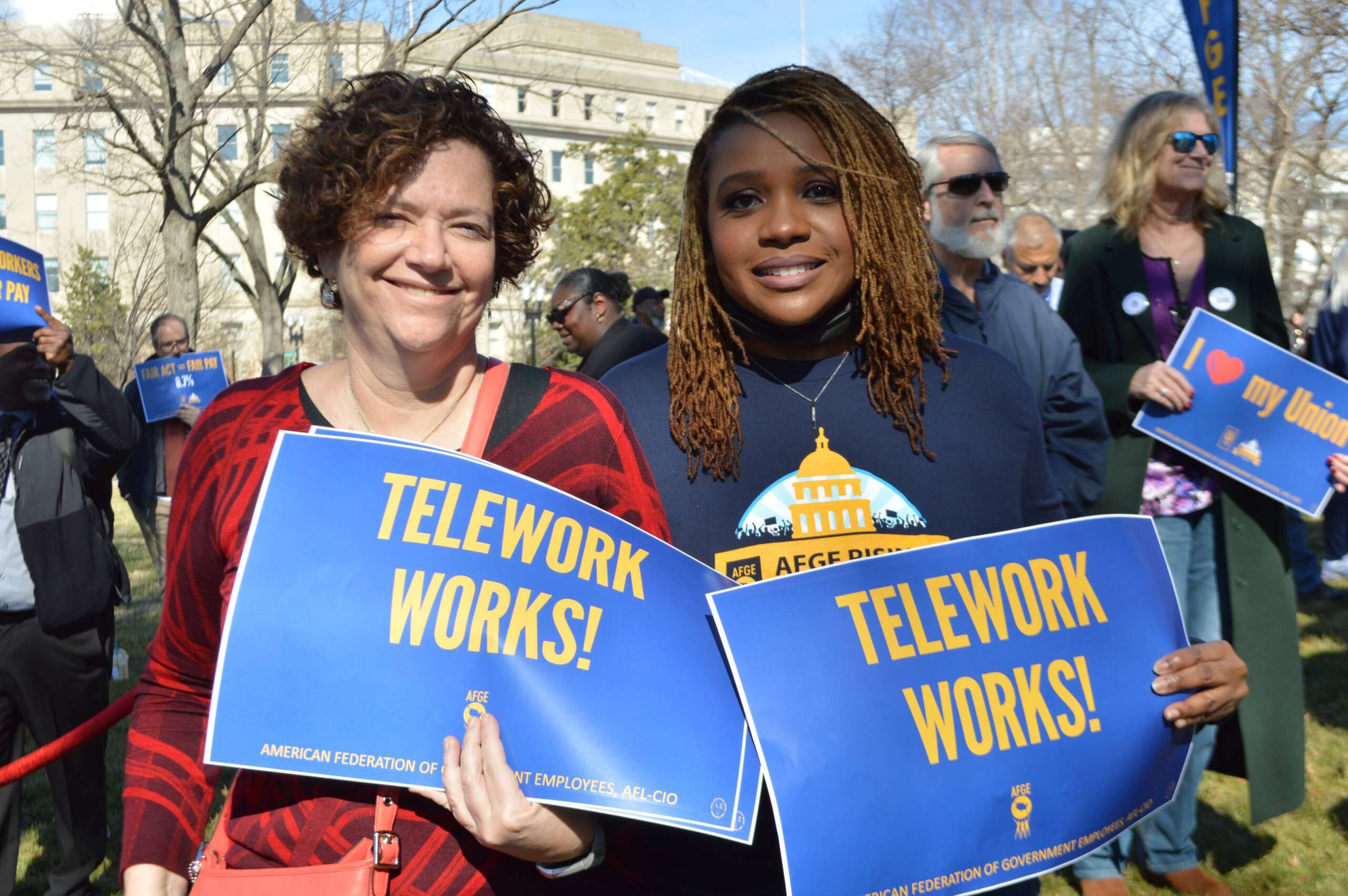
The Trump administration is trying to make clear how and when companies ought to approve exceptions to the return-to-office mandate, notably for federal workers with disabilities who request affordable lodging to telework.
A not too long ago printed “technical assistance” doc from the Workplace of Personnel Administration and Equal Employment Alternative Fee comes after President Donald Trump, on his first day in workplace, required all federal workers to return to the workplace full-time, with few exceptions.
In line with EEOC and OPM officers, their new steerage solutions frequent questions from companies as they proceed implementing Trump’s return-to-office orders, whereas additionally abiding by federal legislation. Businesses are required underneath the Rehabilitation Act to offer affordable lodging to certified workers with disabilities, so long as that lodging doesn’t end in “undue hardship” for companies.
“Returning to in-person work and upholding disability rights are not mutually exclusive,” OPM Director Scott Kupor mentioned in a Feb. 11 press launch. “This joint technical assistance gives agencies the clarity they need to implement the president’s directive while fully complying with federal civil rights law and ensuring fair, consistent accommodation decisions.”
Typically, the Trump administration’s new steerage states that companies shouldn’t take a “blanket approach” to rescinding or denying telework lodging. As an alternative, companies ought to make an “individualized determination” for every worker.
In lots of situations, the steerage prioritizes different lodging, resembling different work schedules or specialised tools, over telework. The steerage additionally particulars the steps companies ought to take when granting, modifying or denying telework requests from federal workers with disabilities.
Kupor estimated in a current weblog publish that governmentwide, about 10% of federal workers have acquired exemptions from Trump’s return-to-office orders.
However different federal workers have alleged their companies denied their requests for a telework lodging, regardless of having a medically documented incapacity.
Debra D’Agostino, a accomplice on the Federal Observe Group, mentioned points round telework-related affordable lodging are the No. 1 EEO criticism she has seen over the previous yr.
“Telework can resolve issues for people with all sorts of disabilities, but agencies have been contorting themselves to offer alternatives to telework,” D’Agostino mentioned. “If telework has been working, and this employee has outstanding appraisals, and it has not posed any impediment to their ability to do their job, why are we wasting resources to try to redo this?”
Revisiting prior telework approvals
The brand new steerage from OPM and EEOC emphasizes that workers will not be “entitled” to telework indefinitely, and that companies nonetheless reserve the precise to reassess beforehand granted lodging. Any reassessments that do happen could result in a distinct conclusion, probably changing a telework lodging with an “effective alternative,” the doc states.
When companies are reevaluating a telework lodging, the steerage provides that companies can take into account any “evidence” they discover that seems to battle with an worker’s must telework as a result of a incapacity.
“This is not a license to engage in fishing expeditions to undermine an employee’s request for accommodation,” the steerage states. “That being said, an agency is not required to turn a blind eye to evidence tending to show that an employee is not entitled to an accommodation.”
For example, the steerage says companies can take into account as proof a social media publish of an worker “routinely engaging in strenuous physical activity outside of work,” regardless of the worker stating they will’t do work involving “walking or other biomechanical motions.”
The brand new steerage moreover tells companies they’re allowed to evaluate workers’ medical documentation when reevaluating a beforehand granted telework lodging.
“Agencies may find that many original decisions to grant telework were made without sufficient information,” the steerage states. “In these cases, an agency likely will need to make new inquiries, including requests for updated medical documentation, to obtain sufficient information for a reevaluation decision.”
D’Agostino referred to as the administration’s steerage on medical documentation opinions “troubling,” including that in some instances, all these requests could quantity to a violation of the Rehabilitation Act.
“If an agency has been providing a reasonable accommodation, that means it’s already determined that the employee is disabled,” D’Agostino mentioned. “Demanding that employees continue producing medical documentation, especially when the diagnosis is a chronic condition, sets the agency up for liability.”
Moreover, OPM and EEOC’s new steerage states that in instances the place an worker with a incapacity has a “flare-up” of their situation, providing situational telework “is not necessarily required.”
As an alternative, the steerage says workers can dip into what it described as a “generous allotment of paid sick leave.” However companies can nonetheless provide situational telework in instances the place there may be “a net efficiency gain.”
Joshua Stanton, a not too long ago retired senior federal company legal professional who now provides illustration to federal workers with disabilities, mentioned the administration’s steerage on flare-ups “tries to simplify something that is way too complex.”
“It’s going to depend on the disability. It’s going to depend on the severity of the condition,” Stanton mentioned. “This leans too hard into the outcome the agency wants to reach.”
Psychological well being situations and telework
One other a part of the administration’s new doc discusses how companies ought to tackle telework requests from workers experiencing psychological well being impairments, resembling nervousness.
When contemplating lodging requests as a result of an nervousness dysfunction, the steerage says companies ought to first require workers to work in particular person, and from there assess whether or not they’re able to carry out satisfactorily on-site.
“Simple observation can be the best approach to telework requests in this vein,” the steerage states.
In distinction, D’Agostino mentioned psychological well being disabilities are sometimes more durable to accommodate within the office, and could be a lot much less seen. However relating to telework lodging, instances involving psychological well being disabilities have been “a more uphill battle” with the Trump administration, she added.
“A mental health condition can certainly be as debilitating as a physical health condition, but you may have no idea whatsoever by looking at a person or even working with a person,” D’Agostino mentioned. “And oftentimes, it cannot be resolved by just buying a piece of equipment.”
Most often, the Trump administration’s steerage states that nervousness is “unlikely” to create a barrier to working in particular person. If there’s a barrier, the doc says companies have to contemplate an lodging — “but not necessarily telework.” It states that approving a telework lodging is necessary “only if all other options are demonstrably ineffective.”
“Many common situations can be reasonably and effectively accommodated with in-office measures,” the doc says.
Stanton, nevertheless, mentioned the steerage seems to blur the excellence between workers with decrease ranges of undiagnosed nervousness, and workers who’ve a big nervousness dysfunction identified by a psychological well being skilled — and within the latter case, it rises to the extent of a incapacity.
“It really seems to be based in the stereotype that mental health conditions aren’t real disabilities, when they absolutely are,” Stanton mentioned.
Steerage on commuting
The Trump administration’s new telework steerage additionally covers how companies ought to be addressing lodging requests to telework, in instances the place an worker with a incapacity could face difficulties of their commute to and from their worksite.
The steerage states that companies “generally” should not have to grant telework requests when workers with disabilities need to cope with tough or prolonged commutes.
Citing EEOC case legislation, the steerage states that it’s the duty of the workers to make commuting preparations, and that it’s “unreasonable” for companies to be required to excuse workers from commuting.
“Agencies have reported instances when employees assert they cannot drive to commute to work but are routinely observed doing so for personal activities,” the doc states. “An agency may follow up on these incongruities.”
In a current weblog publish, Kupor additionally addressed the subject of commuting, pointing to situations of accredited lodging to telework for workers with disabilities, main care-giving duties, or navy spouses, the place commuting could also be tough.
“But — and I realize many people may disagree with this — commuting time alone is not grounds for an accommodation,” Kupor wrote.
As an alternative of approving telework as an lodging, the administration’s new steerage suggests first providing a versatile work schedule for the worker to “effectively accomplish their commute and access the worksite.”
D’Agostino, nevertheless, argued that the commute to the workplace and the worksite itself go hand in hand. A incapacity might also not essentially have an effect on an worker’s work immediately, however may nonetheless affect the power to commute daily.
“You can’t dismiss the commute from the job — it’s part of the workday,” D’Agostino mentioned. “It’s pretty extraordinary to us that they said that’s not something that they need to be looking at.”
If you need to contact this reporter about current adjustments within the federal authorities, please electronic mail drew.friedman@federalnewsnetwork.com or attain out on Sign at drewfriedman.11
Copyright
© 2026 Federal Information Community. All rights reserved. This web site is just not meant for customers situated throughout the European Financial Space.
