



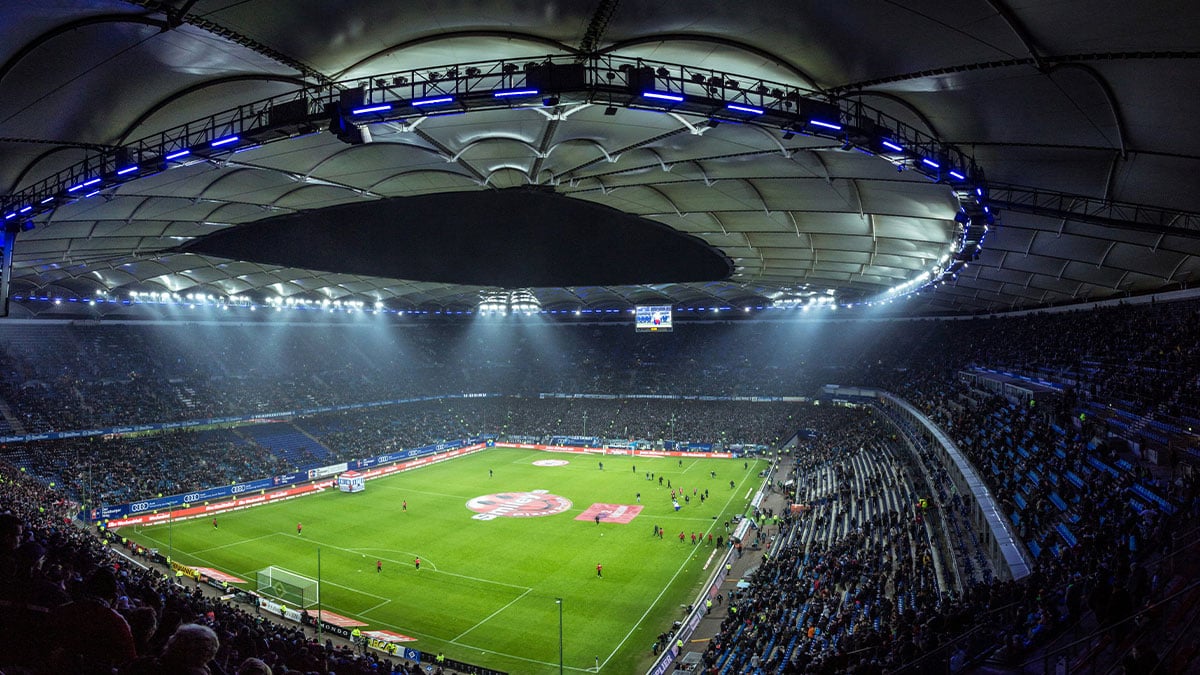
Secure connectivity at reside occasions is now important, a lot in order that dependable Wi-Fi is as necessary to fashionable sports activities venues as the sport itself. From reside streaming the profitable second, to putting cell meals orders, followers anticipate uninterrupted connectivity irrespective of the place they’re seated.
As an example, at Southampton’s St Mary’s Stadium, matchday and occasion connectivity has struggled beneath fan demand – prompting administration to acknowledge that cell and Wi-Fi entry have been unreliable throughout video games.
This situation highlights how even state-of-the-art venues can wrestle to fulfill in the present day’s fan expectations. To ship the trendy fan expertise, main occasion venues should proceed to evolve their networks – or threat falling wanting their ever-evolving fan expectations.
The Density Dilemma
Offering Wi-Fi in stadiums presents a novel set of challenges, pushed by excessive person density and unpredictable site visitors patterns. Tens of 1000’s of followers usually try to attach concurrently, particularly in high-traffic zones like seating bowls and concourses.
One occasion within the USA noticed 78% concurrent Wi-Fi utilization – that’s over 54,000 units related concurrently. This concentrated demand creates intense radio frequency (RF) interference, bandwidth congestion, and protection obstacles – all of which degrade community high quality. The problem is additional difficult by the presence of Bluetooth equipment, and even rogue entry factors, which contribute further RF interference.
Balancing Efficiency, Safety and Design
Usually forgotten is that stadium networks assist extra than simply public entry. Ticketing, safety, broadcasting, and different vital operations depend on wi-fi infrastructure. These techniques should coexist with out interference. They require exact community segmentation to make sure operational site visitors isn’t slowed down by social media uploads or streaming.
Wi-fi connectivity in stadiums is additional difficult by bodily obstructions like metal and concrete, unpredictable site visitors patterns and aesthetic constraints. Followers are continually on the transfer – roaming between seats, concourses, and facilities – which calls for seamless handoffs between entry factors (APs) to forestall dropped connections and degraded community high quality. Nevertheless, inconsistent AP placement may cause units to “stick” to distant APs, leading to sluggish speeds and poor person experiences. Compounding the difficulty, many venues require APs and antennas to be discreetly built-in into the structure for aesthetic or preservation causes, particularly in historic stadiums, limiting optimum placement and additional impacting community reliability.
Bringing Wi-Fi Nearer to the Motion
To deal with these challenges, improvements like under-seat APs provide stadiums a sturdy, scalable, and visually discreet method to ship high-density, high-performance Wi-Fi – making certain each fan satisfaction and operational effectivity. Open-roof venues or deployments with demanding efficiency necessities, require even higher strategic considering. In these venues putting APs nearer to customers is crucial. Proximity helps overcome sign degradation attributable to obstructions, whereas additionally enabling a extra managed and predictable RF setting. This permits for extra centered cell sizes and fewer co-channel interference.
Whereas each venue is exclusive, typical under-seat deployments require one AP for each 50 to 100 seats. This normally interprets to 1 AP each two to 3 rows, relying on the part format and general stadium capability. Hyper-directional AP deployments, by comparability, sometimes serve 200 to 300 seats per AP. The strategy delivers a variety of advantages, together with enhanced protection, elevated capability, quicker speeds, decrease latency, seamless connectivity, and constant efficiency throughout seating areas. Their casings are additionally sturdy sufficient to resist drink spills, cleansing merchandise, and even harsh climate situations. Most significantly, it provides future-readiness with Wi-Fi 7 scalability, making certain stadiums can meet evolving digital calls for and ship a superior fan expertise.
Wi-Fi 7: Reinventing Stadium Connectivity
Managing bandwidth successfully in high-density stadium settings requires a strategic mix of superior know-how, coverage enforcement, and operational greatest practices. When carried out successfully the result’s dependable, high-quality connections, even throughout the busiest moments of an occasion. Luckily, Wi-Fi 7 introduces a variety of options that assist handle the advanced connectivity challenges in stadium environments.
Improvements like AI-driven community optimisation and BeamFlex adaptive antenna applied sciences assist improve RF efficiency whereas high quality of service (QoS) mechanisms enable for prioritisation of mission-critical functions corresponding to ticketing and safety over common shopping. In some circumstances, shopper fee limiting is important to make sure honest bandwidth distribution throughout 1000’s of customers.
A well-designed stadium community additional incorporates segmentation methods, separating site visitors for followers, operations, media, and different stakeholders to enhance efficiency and safety. Actual-time monitoring allows dynamic changes based mostly on utilization patterns, whereas applied sciences like band steering assist information units to probably the most applicable frequency bands.
With 320 MHz channels, 4096-QAM modulation, and spectrum puncturing, Wi-Fi 7 delivers quick speeds, ultra-low latency, and superior interference administration. Even when system uptake occurs slowly, older units can nonetheless profit from Wi-Fi 7 succesful entry factors, because the chipsets evolve and allow higher sign high quality. In lots of circumstances, legacy units can see as much as 30% efficiency enchancment when related to Wi-Fi 7-enabled APs.
Because the bandwidth for digital fan engagement grows, the flexibility to offer secure, quick, and dependable connectivity received’t simply be about comfort. It can outline the fan expertise. With progressive infrastructure, AI-driven administration, and future-ready applied sciences, in the present day’s stadiums can lay the groundwork for a related future that thrills each on and off the sphere.

By: Alessandro Feitosa, Vice President, Market Improvement, RUCKUS Networks (a part of CommScope)
This text initially appeared within the February concern of IoT Insider.
