



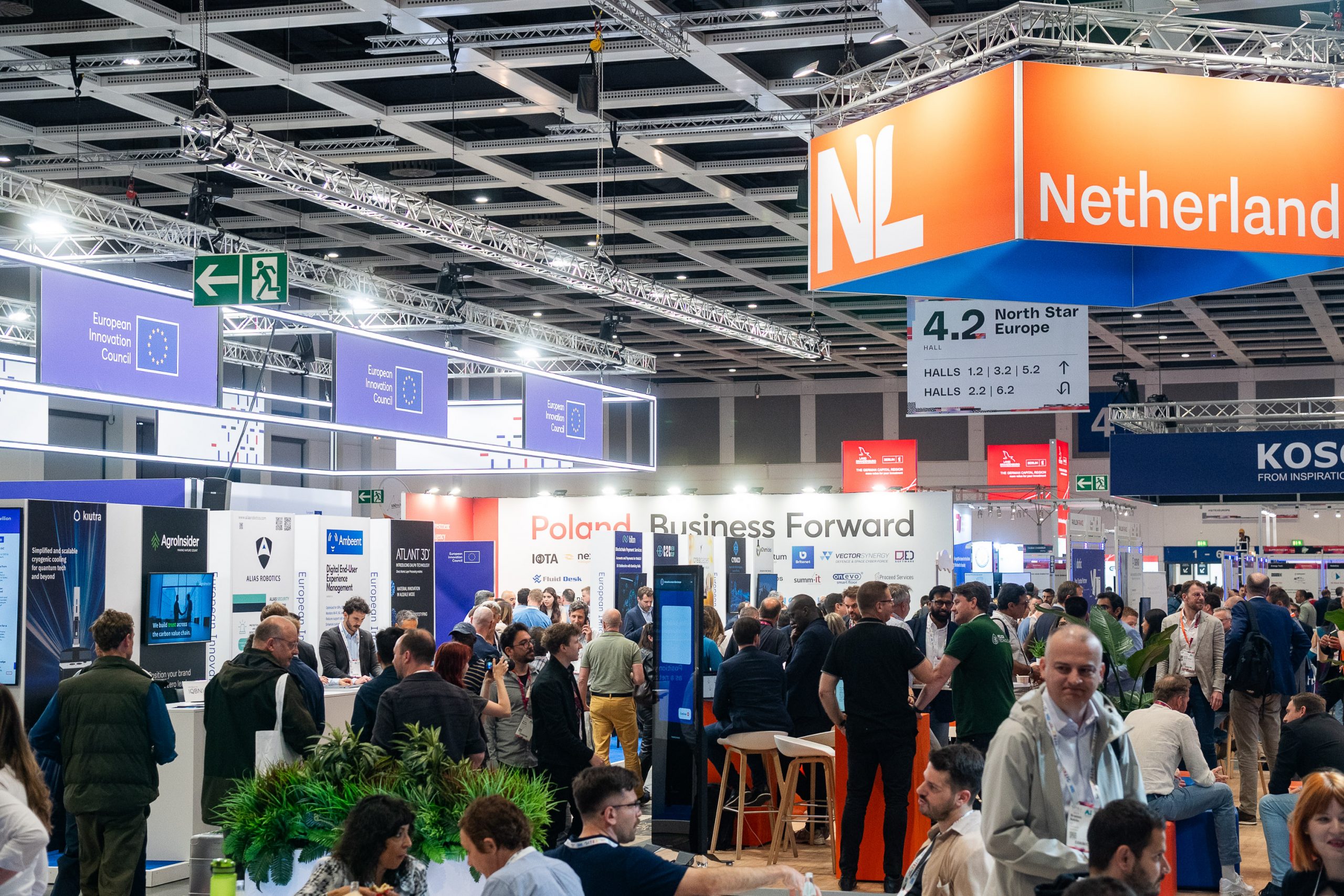
A brand new whitepaper launched by one in all Europe’s tech, startup and digital funding occasion, GITEX AI EUROPE, in partnership with analysis agency – LUE, maps out the foundations for Europe’s digital sovereignty; figuring out the imperatives that might outline the continent’s subsequent decade of technological management.
With Europe’s ICT market now valued at €1.02 trillion, the examine emphasises that Europe’s long-term tech competitiveness hinges on its capability to scale AI computing energy, set up cloud infrastructure, embed open-source requirements, and mobilise deeper swimming pools of startup capital. Collectively, these priorities kind the pillars of a ‘new industrial compact’ aligning Europe’s innovation capability with its financial and power development.
Compute as the brand new industrial energy
Whereas Europe’s knowledge centre capability is ready to develop by 70% by 2030, the report highlights that demand from AI functions is ready to rise even sooner. To maintain tempo, Europe should broaden each its compute and power infrastructure in tandem. Germany alone could must triple its knowledge centre capability by the top of the last decade, requiring as much as €60 billion in new funding to satisfy the projected industrial and AI workloads.
Initiatives such because the EU’s €200 billion InvestAI programme, which funds 5 AI gigafactories throughout Europe, are already anchoring this effort. These knowledge facilities can be geared up with 100,000 or extra specialised chips (GPUs), with entry open to massive industrial firms in addition to startups and analysis institutes.
The report notes that such expansions should evolve alongside clear power integration to make sure resilience and sustainability, successfully strengthening the hyperlink between digital sovereignty and Europe’s power transition.
Sovereign cloud, not cloud dependency
Cloud autonomy emerges because the second frontier. At this time, round 40% of European enterprises have no less than 40% of their functions hosted within the cloud, a determine anticipated to soar to 91% by 2028. But non-European hyperscalers management roughly 70% of the continent’s cloud market.
The paper requires a shift towards “sovereign-first” cloud architectures that assure operational, authorized and knowledge management inside European jurisdictions. The purpose isn’t to isolate, however to allow transparency, auditability and innovation freedom below European requirements.
Open supply as Europe’s edge
The examine identifies open source-based cloud applied sciences as a drive in reinforcing sovereignty. Cloud options which are based mostly on open-source software program, sometimes developed by international developer communities, provide new ranges of transparency, flexibility and independence from proprietary distributors.
Open requirements such because the Sovereign Cloud Stack (SCS), funded by the German Federal Ministry for Financial Affairs and Local weather Motion, allow firms to construct and migrate freely throughout platforms, fostering a tradition of shared innovation. In essence, open supply permits Europe to innovate collaboratively whereas remaining in command of its digital foundations.
Backing Europe’s deep-tech builders
In the end, sovereignty is sustained not solely by infrastructure however by funding. Regardless of Europe’s wealthy engineering expertise, solely round 5% of worldwide enterprise capital flows into the EU tech ecosystem, in accordance with the Bertelsmann Basis.
Closing that hole is essential. The whitepaper requires a brand new ecosystem of growth-stage financing, powered by public-private co-investment and industrial funds, to make sure that Europe’s brightest deep-tech startups, from AI and cloud to semiconductors, can scale globally with out migrating overseas.
Governments and establishments are creating new monetary scaffolding: from Germany’s KfW DeepTech Future Fund (€1 billion) backing high-growth innovators to the Vital Venture of Frequent European Curiosity (IPCEI) on Subsequent-Era Cloud and Providers, which channels €3 billion into EU-based knowledge and semiconductor initiatives.
The whitepaper concludes that Europe’s digital sovereignty can be achieved by means of coverage and coordinated execution, in partnership with international stakeholders. Sovereignty isn’t solitude; it’s about constructing programs which are open by design and safe by default.
GITEX AI EUROPE 2026 rallies international tech partnerships
Organised by KAOUN Worldwide, and endorsed by the Berlin Senate Division for Economics, Vitality and Public Enterprises, and Berlin Associate for Enterprise and Know-how, GITEX AI EUROPE launched earlier this 12 months because the one of many continent’s largest tech, startup, and digital funding debut occasion, convening over 1,400 enterprises and startups from greater than 34 European states and 100 nations.
The 2026 version, working from 30 June to 1 July 2026 at Messe Berlin, continues to function the defining nexus for Europe’s digital future – connecting AI, deep tech, quantum, cyber and cloud innovators, policymakers and traders in a collective pursuit of open, daring, and collaborative technological management.
GITEX AI EUROPE is a part of the GITEX international community of tech and startup occasions, going down in Abu Dhabi, Dubai, Brazil, Egypt, Germany, Kazakhstan, Kenya, Morocco, Nigeria, Serbia, Singapore, Türkiye and Vietnam. For extra data, please go to: www.gitexeurope.com.
Entry the complete whitepaper right here: https://event.gitexeurope.com/GE26-whitepaper2026
Touch upon this text by way of X: @IoTNow_ and go to our homepage IoT Now
