



Meta on Thursday stated it is taking authorized motion to deal with scams on its platforms by submitting lawsuits towards what it calls misleading advertisers primarily based in Brazil, China, and Vietnam.
As a part of the trouble, the advertisers’ strategies of fee have been suspended, associated accounts have been disabled, and the web site domains used to drag off the scams have been blocked.
Concurrently, the social media big stated it has additionally issued stop and desist letters to eight advertising and marketing consultants who marketed the flexibility to bypass its advert coverage enforcement programs. This included faux “un-ban” or account restoration companies and renting entry to trusted accounts in order to assist shoppers bypass its controls.
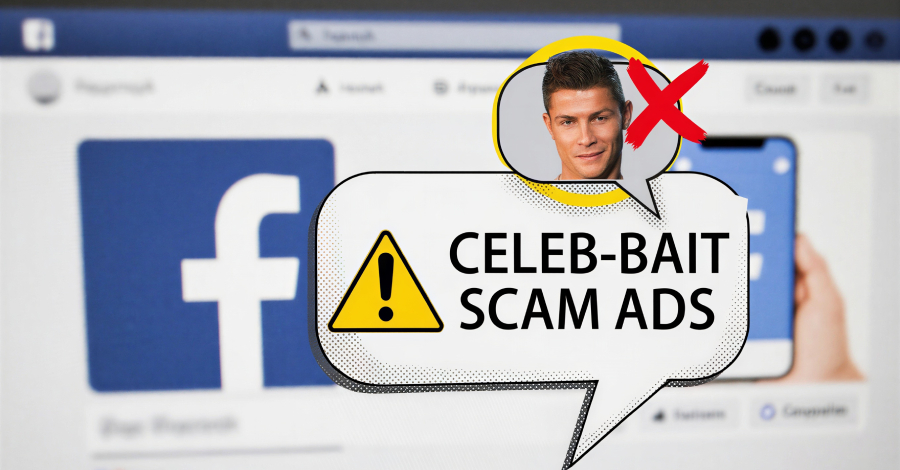
No less than three advertisers, two from Brazil and one from China, have been discovered to interact in celeb-bait scams, which regularly contain misusing the picture of well-known figures to trick individuals into clicking on bogus adverts that result in rip-off websites. These web sites are designed to reap delicate information or dupe unsuspecting customers into sending cash or investing in faux platforms.
The three advertisers towards whom Meta has filed lawsuits are listed beneath –
- Brazil-based Vitor Lourenço de Souza and Milena Luciani Sanchez are being sued for utilizing altered photos and voices of celebrities to advertise fraudulent healthcare merchandise.
- Brazil-based B&B Suplementos e Cosméticos Ltda. (Brites Corp), Brites Academia de Treinamento Ltda., Daniel de Brites Macieira Cordeiro, and José Victor de Brites Chaves de Araújo for being a part of a rip-off operation that leveraged artificial imagery of a distinguished doctor to promote healthcare merchandise with out regulatory approval and offered programs instructing the identical techniques.
- China-based Shenzhen Yunzheng Know-how Co., Ltd for utilizing celeb-bait adverts to focus on individuals in numerous nations, together with the U.S. and Japan, as a part of a fraud scheme designed to lure them into becoming a member of funding teams.
“To fight celeb-bait scams, we developed protections for celebrities whose images are repeatedly used in these schemes,” Meta stated. “This program currently protects the images of more than 500,000 celebrities and public figures around the world.”
As well as, the corporate famous that it sued Vietnam-based advertiser Lý Văn Lâm for utilizing cloaking methods to get round its assessment course of. Cloaking refers to an adversarial method that goals to hide the true nature of a web site linked to an advert in an try and idiot advert assessment programs by serving one model of its content material throughout the assessment and exhibiting a wholly totally different and malicious content material to actual customers.
On this case, the advertiser is alleged to have used rip-off adverts to supply discounted gadgets from well-known manufacturers in alternate for finishing a survey. Individuals who interacted with these adverts have been taken to phony web sites the place they have been requested to enter bank card data to buy gadgets that have been by no means delivered. Their bank cards additionally incurred unauthorized, recurring charges, a observe often called subscription fraud.
The event comes months after a Reuters investigation discovered that 19% of Meta’s $18 billion in advert gross sales in China in 2024 got here from adverts for scams, unlawful playing, pornography, and different banned content material. The report additionally uncovered companies that permit companies to run banned commercials, prompting the corporate to place its Badged Companions program underneath assessment.
In an evaluation of 14.5 million adverts operating on Meta platforms throughout the E.U. and U.Okay. over a 23-day interval, Gen Digital discovered that just about one in three of these adverts (about 30.99%) pointed to a rip-off, phishing, or malware hyperlink.
“In total, scam ads generated more than 300 million impressions in less than a month,” the cybersecurity firm stated earlier this month. “The activity was highly concentrated, with just 10 advertisers responsible for over 56% of all observed scam ads. Repeated campaign clusters were traced to shared payment and infrastructure linked to China and Hong Kong, indicating organized, industrial-scale operations rather than isolated bad actors.”
These findings additionally coincide with the invention of malicious infrastructure and underground companies which have been used to hawk numerous sorts of scams –
- Scams have been discovered to mix malvertising and pig butchering fraud fashions to defraud victims, primarily these in Japan, by tricking them into clicking on investment-themed adverts on social media. These adverts redirect victims to web sites that immediate them to interact with a supposed skilled by way of messaging apps by scanning a QR code.
- As soon as victims are added to one-on-one and group chats with these so-called specialists, who’re nothing however synthetic intelligence (AI)-powered chatbots in some circumstances, they’re persuaded to speculate progressively bigger quantities of cash, solely to demand a “release fee” to unlock non-existent earnings. Greater than 23,000 domains inside this ecosystem have been found.
- Risk actors are compromising routers to change DNS settings to make use of shadow resolvers hosted in Aeza Worldwide, a bulletproof internet hosting firm (BPH) sanctioned by the U.S. Authorities in July 2025. This unauthorized modification is engineered to selectively alter DNS responses related to Okta and Shopify, permitting the operators to direct customers to rip-off and malware content material by the use of an HTTP-based visitors distribution system (TDS).
- A malicious push notification community has been noticed utilizing a community of malicious domains to focus on Android Chrome customers all around the world with a gentle stream of undesirable push notifications (e.g., “Android infected with malware!” or “System needs a scan”) after acquiring permissions in a bid to direct to rip-off websites and grownup content material. In response to information from Infoblox, Bangladesh, India, Indonesia, and Pakistan represented 50% of all of the visitors.
- A community of over 150 cloned, faux web sites has been recognized impersonating actual regulation companies primarily based within the U.S. and the U.Okay., and concentrating on customers searching for authorized recommendation and illustration to advertise a enterprise impersonation rip-off.
- “The sites used the firm’s name, branding, and publicly available attorney identities, presenting themselves as legitimate legal and asset-recovery services, offering to help victims recover funds lost to prior fraud,” Sygnia stated. “The campaign targeted individuals who had already suffered financial fraud.”
The proliferation of scams, fueled by a booming pig butchering‑as‑a‑service (PBaaS) financial system, has not escaped regulation enforcement’s consideration, as evidenced by the dismantling of rip-off compounds in Southeast Asia in current months.
Earlier this month, the Cambodian authorities promised to crack down and dismantle cyber rip-off networks working inside its borders, including that police officers launched 48 operations within the first 9 months of 2025 to fight cyber fraud, arrested 168 individuals, and deported 2,722 individuals again to their residence nations.
The continuing efforts have reduce rip-off exercise in half because the begin of this 12 months, Senior Minister Chhay Sinarith, chairman of the Secretariat of the Fee for Combating Know-how Crimes, was quoted as saying this week. Cambodian Prime Minister Hun Manet additionally acknowledged that on-line rip-off centres working within the nation are damaging the nation’s status and undermining its financial system.
