



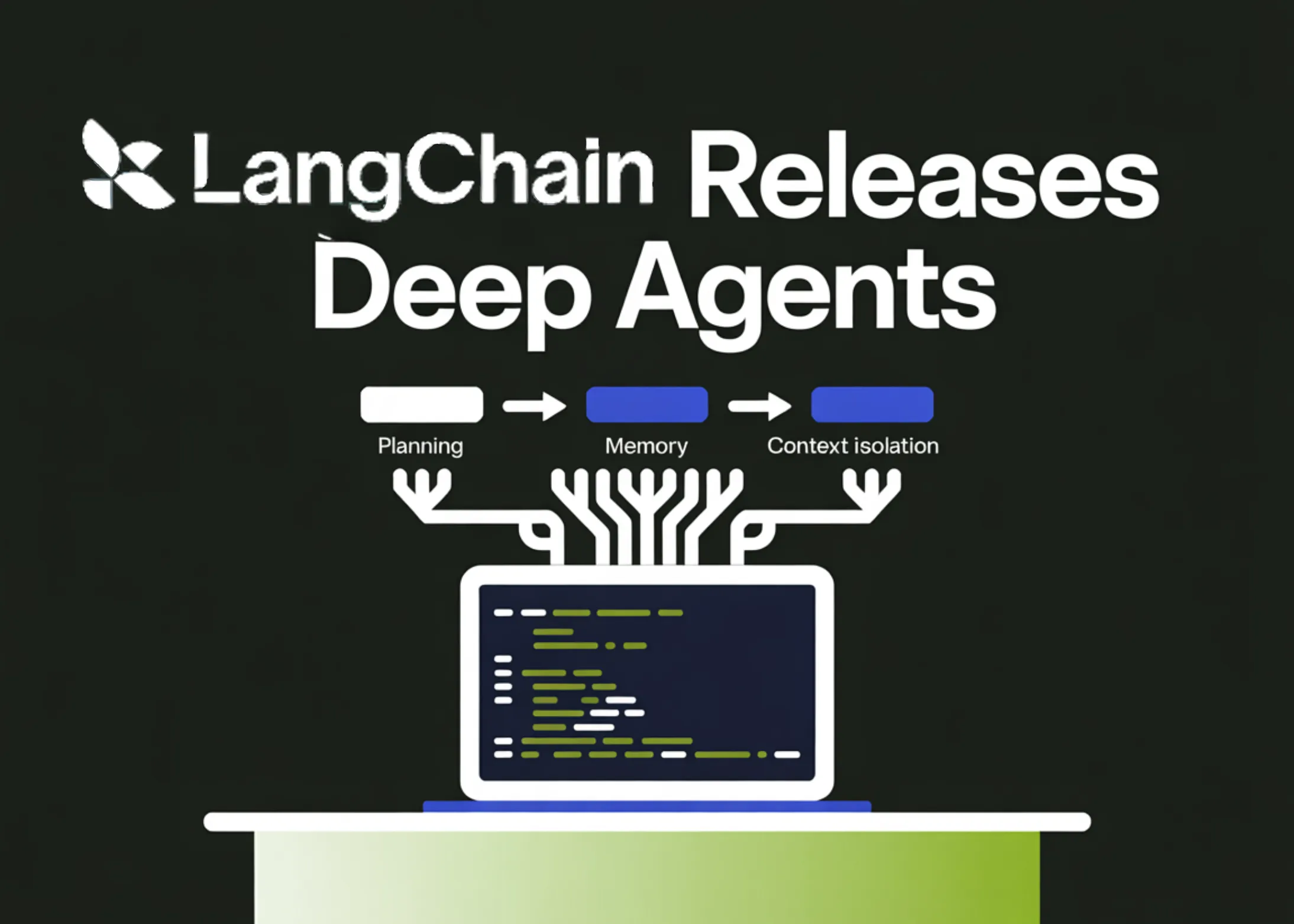
Most LLM brokers work nicely for brief tool-calling loops however begin to break down when the duty turns into multi-step, stateful, and artifact-heavy. LangChain’s Deep Brokers is designed for that hole. The mission is described by LangChain as an ‘agent harness‘: a standalone library built on top of LangChain’s agent constructing blocks and powered by the LangGraph runtime for sturdy execution, streaming, and human-in-the-loop workflows.
The vital level is that Deep Brokers doesn’t introduce a brand new reasoning mannequin or a brand new runtime separate from LangGraph. As an alternative, it packages a set of defaults and built-in instruments round the usual tool-calling loop. LangChain group positions it as the better start line for builders who want brokers that may plan, handle massive context, delegate subtasks, and persist info throughout conversations, whereas nonetheless preserving the choice to maneuver to easier LangChain brokers or customized LangGraph workflows when wanted.
What Deep Brokers Consists of by Default
The Deep Brokers GitHub repository lists the core elements straight. These embody a planning software referred to as write_todos, filesystem instruments comparable to read_file, write_file, edit_file, ls, glob, and grep, shell entry by means of execute with sandboxing, the job software for spawning subagents, and built-in context administration options comparable to auto-summarization and saving massive outputs to recordsdata.
That framing issues as a result of many agent methods depart planning, intermediate storage, and subtask delegation to the applying developer. Deep Brokers strikes these items into the default runtime.
Planning and Job Decomposition
Deep Brokers features a built-in write_todos software for planning and job decomposition. The aim is express: the agent can break a posh job into discrete steps, observe progress, and replace the plan as new info seems.
With out a planning layer, the mannequin tends to improvise every step from the present immediate. With write_todos, the workflow turns into extra structured, which is extra helpful for analysis duties, coding classes, or evaluation jobs that unfold over a number of steps.
Filesystem-Primarily based Context Administration
A second core characteristic is the usage of filesystem instruments for context administration. These instruments enable the agent to dump massive context into storage relatively than preserving every thing contained in the lively immediate window. LangChain group explicitly notes that this helps stop context window overflow and helps variable-length software outcomes.
It is a extra concrete design selection than obscure claims about ‘memory.’ The agent can write notes, generated code, intermediate experiences, or search outputs into recordsdata and retrieve them later. That makes the system extra appropriate for longer duties the place the output itself turns into a part of the working state.
Deep Brokers additionally helps a number of backend sorts for this digital filesystem. The customization docs checklist StateBackend, FilesystemBackend, LocalShellBackend, StoreBackend, and CompositeBackend. By default, the system makes use of StateBackend, which shops an ephemeral filesystem in LangGraph state for a single thread.
Subagents and Context Isolation
Deep Brokers additionally features a built-in job software for subagent spawning. This software permits the primary agent to create specialised subagents for context isolation, preserving the primary thread cleaner whereas letting the system go deeper on particular subtasks.
This is without doubt one of the cleaner solutions to a typical failure mode in agent methods. As soon as a single thread accumulates too many aims, software outputs, and non permanent selections, mannequin high quality usually drops. Splitting work into subagents reduces that overload and makes the orchestration path simpler to debug.
Lengthy-Time period Reminiscence and LangGraph Integration
The Deep Brokers GitHub repository additionally describe long-term reminiscence as a built-in functionality. Deep Brokers may be prolonged with persistent reminiscence throughout threads utilizing LangGraph’s Reminiscence Retailer, permitting the agent to avoid wasting and retrieve info from earlier conversations.
On the implementation facet, Deep Brokers stays totally contained in the LangGraph execution mannequin. The customization docs specify that create_deep_agent(...) returns a CompiledStateGraph. The ensuing graph can be utilized with normal LangGraph options comparable to streaming, Studio, and checkpointers.
Deep Brokers just isn’t a parallel abstraction layer that blocks entry to runtime options; it’s a prebuilt graph with defaults.
Deployment Particulars
For deployment, the official quickstart reveals a minimal Python setup: set up deepagents plus a search supplier comparable to tavily-python, export your mannequin API key and search API key, outline a search software, after which create the agent with create_deep_agent(...) utilizing a tool-calling mannequin. The docs notice that Deep Brokers requires software calling help, and the instance workflow is to initialize the agent along with your instruments and system_prompt, then run it with agent.invoke(...). LangChain group additionally factors builders towards LangGraph deployment choices for manufacturing, which inserts as a result of Deep Brokers runs on the LangGraph runtime and helps built-in streaming for observing execution.
# pip set up -qU deepagents
from deepagents import create_deep_agent

def get_weather(metropolis: str) -> str:
    """Get weather for a given city."""
    return f"It's always sunny in {city}!"

agent = create_deep_agent(
    instruments=[get_weather],
    system_prompt="You are a helpful assistant",
)

# Run the agent
agent.invoke(
    {"messages": [{"role": "user", "content": "what is the weather in sf"}]}
)
Key Takeaways
- Deep Brokers is an agent harness constructed on LangChain and the LangGraph runtime.
- It contains built-in planning by means of the
write_todossoftware for multi-step job decomposition. - It makes use of filesystem instruments to handle massive context and scale back prompt-window strain.
- It will probably spawn subagents with remoted context utilizing the built-in
jobsoftware. - It helps persistent reminiscence throughout threads by means of LangGraph’s Reminiscence Retailer.
Take a look at Repo and Docs. Additionally, be happy to observe us on Twitter and don’t neglect to affix our 120k+ ML SubReddit and Subscribe to our E-newsletter. Wait! are you on telegram? now you may be a part of us on telegram as nicely.
Michal Sutter is an information science skilled with a Grasp of Science in Information Science from the College of Padova. With a stable basis in statistical evaluation, machine studying, and knowledge engineering, Michal excels at reworking advanced datasets into actionable insights.
