



Key Insights
- Kelp has grown into one of many main restaking ecosystems, with $1.25 billion in TVL and $3.0 million in annualized income as of March 20, 2026.
- Stablecoins and RWAs have scaled, however no onchain credit score layer serves short-duration financing markets: world commerce receivables ($25+ trillion yearly) and cross-border cost settlement ($200+ trillion yearly).
- Trillions stay locked in prefunded settlement buffers, not as a consequence of capital shortage, however as a result of credit score can’t be accessed exactly when liquidity is required.
- Current DeFi lending protocols are constructed for speculative overcollateralization — structurally misaligned with the short-tenor, self-liquidating cycles of commerce finance and FX settlement.
- Kelp launched KUSD: a yield-bearing stablecoin backed by verified commerce receivables and real-world cost flows, producing over 10% yield from borrower repayments somewhat than token incentives.
Introduction
Kelp has established itself as a core participant within the increasing restaking and yield ecosystem. As restaking matures from an experimental idea to a foundational DeFi primitive, Kelp is constructing the infrastructure to safe networks, improve capital effectivity, and amplify yield alternatives throughout chains.
Via its flagship merchandise, rsETH, a liquid restaking token on Ethereum, and a set of high-efficiency reward Vaults, Kelp permits customers to restake property, entry liquidity, and compound returns throughout a rising variety of integrations and ecosystems. Kelp is now increasing into RWA infrastructure with the launch of KUSD, a yield-bearing stablecoin backed by commerce receivables and cross-border cost flows. KUSD helps onchain financing throughout use circumstances reminiscent of commerce finance, cross-border settlement, FX, and funds.
In contrast to most RWA protocols that tokenize current liquid property (treasuries, cash market funds, actual property), Kelp is financing the underlying exercise that generates these flows: the invoices, the shipments, the FX settlements. This can be a layer of real-world finance that onchain credit score markets haven’t reached.
Web site / X (Twitter) / Discord
Kelp’s Core Product Suite
Kelp’s structure is constructed round interconnected merchandise that serve distinct roles to reinforce capital effectivity, community safety, and yield technology. Every product targets a unique layer of consumer demand, from validator coordination to DeFi liquidity and structured yield.
Restaking
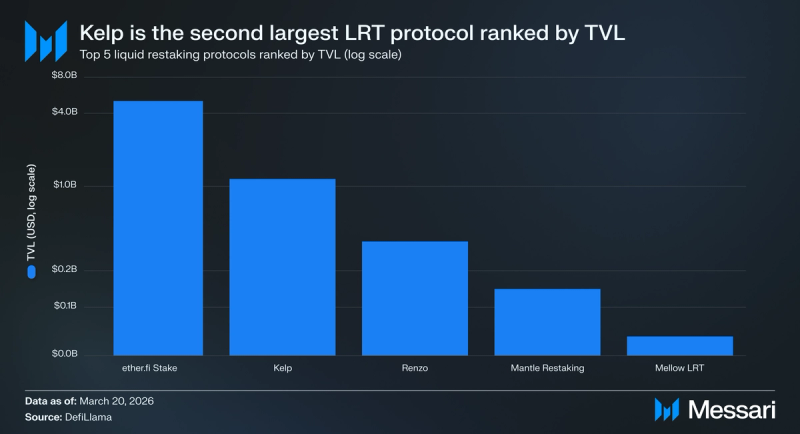
Kelp’s liquid restaking platform has roughly $1.25 billion in whole worth locked (TVL) as of March 20, 2026, making it the second-largest liquid restaking token (LRT) protocol by TVL. Constructed on EigenLayer, Kelp points rsETH, a liquid token that represents restaked ETH. Holders of rsETH earn staking and restaking rewards whereas retaining the power to deploy the asset throughout different DeFi protocols.
By changing restaked ETH into rsETH, Kelp permits members to make use of their capital for lending, borrowing, buying and selling, or liquidity provision with out giving up rewards. This twin operate has made rsETH one of the extensively adopted liquid restaking tokens, now built-in throughout main DeFi platforms together with Aave, Morpho, Spark, Compound, and Uniswap.
Kelp additionally simplifies restaking participation. As an alternative of choosing particular person providers or operators, customers delegate via Kelp, which robotically allocates rsETH to Actively Validated Companies (AVSs) and Decentralized Verifier Networks (DVNs). This lowers limitations for stakers whereas making certain that safety is distributed to the place it’s wanted within the ecosystem.
Vaults
Kelp’s reward-optimization layer simplifies the complexity of DeFi yield into automated vaults. Sensible contracts handle deposits and mint composable vault tokens that customers can deploy elsewhere to stack returns.
The suite consists of three core vaults:
Airdrop Achieve (agETH) is a technique that aggregates onchain ETH yield throughout a number of DeFi venues. The vault allocates capital dynamically throughout lending protocols reminiscent of Aave and Compound, decentralized exchanges (DEXs) reminiscent of Uniswap and Velodrome, and staking mechanisms.
Excessive Achieve (hgETH) provides a extra aggressive method by allocating restaked ETH and liquid staking tokens throughout higher-yield DeFi methods, together with lending and structured yield protocols. Since launch, the Excessive Achieve vault has persistently delivered a mean yield of round 10%.
Secure Achieve permits customers to deploy USDC or USDT into curated methods throughout protocols reminiscent of Aave, Spark, and Pendle. Deposits are tokenized into sbUSD, a liquid ERC-20 token that can be utilized inside DeFi whereas persevering with to earn yield from underlying stablecoin methods. Secure Achieve enhances the prevailing Airdrop and Excessive Achieve vaults by providing a lower-volatility possibility, making Kelp accessible to customers looking for extra predictable returns.
Collectively, these vaults handle over $66.4 million in TVL as of March 20, 2026. Every vault mints composable tokens that may be deployed throughout DeFi to generate further yield, providing customers not only one layer of rewards however the potential to stack returns throughout protocols. Kelp’s vaults automate delegation, vault composition, and reward harvesting, so customers don’t have to actively handle a number of positions or observe ecosystem updates.
On-Demand Credit score for the On the spot Economic system
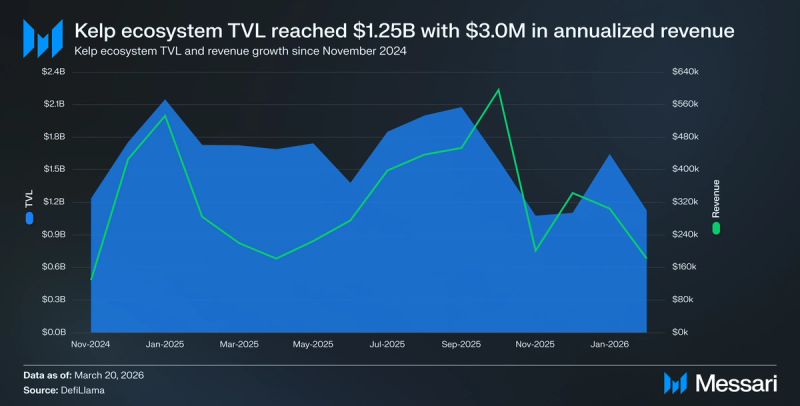
Kelp has constructed a powerful basis since its launch, with $1.25 billion in TVL and an annualized income of $3.0 million as of March 20, 2026. With vital property now held in good contracts and a rising consumer base throughout Ethereum and different chains, the protocol is increasing into real-world finance with KUSD, a yield-bearing stablecoin powered by short-term receivables throughout commerce finance and cross-border funds.
Stablecoin provide has crossed $300 billion, however incremental adoption is coming from funds, cross-border settlement, and treasury operations, not trading-driven demand. The credit score infrastructure to serve these use circumstances doesn’t exist onchain. International commerce receivables exceed $25 trillion yearly, with a $2.5 trillion financing hole that is still underserved by conventional banks. Cross-border cost flows exceed $200 trillion yearly. Current lending protocols are constructed for speculative overcollateralization, not short-duration commerce cycles or high-velocity settlement flows. Most RWA protocols tackle this hole by tokenizing current property. Kelp as an alternative focuses on financing settlement exercise itself, concentrating on the second of cost and settlement that current markets not often serve.
Reasonably than counting on token incentives or leverage-driven spreads, KUSD’s focused yield profile of over 10% is sourced from credit score repayments tied to underlying enterprise exercise. The construction emphasizes short-term exposures, usually hours to days somewhat than weeks, mixed with overcollateralization and counterparty verification. Threat monitoring is supported via Proof-of-Reserves frameworks and oracle-based reporting mechanisms.
Companies presently maintain trillions in prefunded capital to handle settlement delays. Throughout conventional finance, cost processors, FX desks, and PayFi, corporates park extra liquidity upfront to make sure transactions clear, tying up vital working capital. This capital could also be wanted for under minutes or hours, however is usually immobilized for days, limiting throughput and growing stability sheet pressure. Kelp replaces prefunding with on-demand credit score. Liquidity is drawn solely on the level of settlement, repaid as transactions clear, and made obtainable for reuse. This shifts settlement liquidity from idle float to just-in-time credit score, enhancing capital effectivity whereas holding credit score period brief and publicity tightly bounded.
For liquidity suppliers (LPs), the credit score layer reframes stablecoin yield as a operate of actual financial exercise. As an alternative of selecting between idle stablecoins or yields depending on leverage, volatility, or momentary incentives, LPs earn from short-duration, collateralized credit score prolonged to verified counterparties. KUSD implements this mannequin by representing claims on short-duration receivables backed by verified business exercise, with returns sourced from borrower repayments somewhat than token emissions. Taken collectively, Kelp’s credit score layer positions onchain credit score as monetary infrastructure, the place stablecoins assist settlement, RWAs generate yield, and capital effectivity turns into the first scaling constraint. In accordance with the Kelp crew, subtle LPs can leverage sKUSD’s composability inside DeFi protocols to implement further methods that will improve whole yield on KUSD to an estimated 20%.
KUSD
Liquidity suppliers mint KUSD by depositing accredited stablecoins, making capital obtainable as collateralized, short-duration credit score strains to verified institutional debtors. Debtors draw liquidity on demand and repay principal plus curiosity as transactions settle, with reimbursement flows accruing onchain to KUSD holders. These hyperlinks instantly allow real-world cost exercise, reminiscent of payroll processing, commerce settlement, and cross-border payouts.
KUSD maintains its peg via a managed mint and redemption framework anchored to underlying stablecoin reserves and short-duration credit score publicity. KUSD is minted one-to-one towards deposited stablecoins and might be redeemed instantly by KYB-verified entities. Secondary market liquidity on decentralized exchanges offers exit paths for non-KYB holders. As a result of credit score period is brief and capital is constantly recycled, excellent publicity is actively managed to protect liquidity and redemption confidence. The peg is additional supported by overcollateralization on the borrower stage and a powerful Proof of Reserves framework in partnership with Chainlink, with reserve attestations verified by a number of impartial events to reinforce transparency and redemption confidence.
Yield is earned by staking KUSD into sKUSD, which accrues curiosity from borrower repayments as credit score cycles full. At inception, sKUSD is issued at parity with KUSD, and its worth will increase over time as curiosity is compounded within the staking contract. Returns are variable and utilization-dependent, however are structured to mirror recurring cost flows somewhat than leverage- or incentive-driven demand. Yield distribution is smoothed via periodic settlement of borrower curiosity, decreasing short-term volatility and anchoring returns to underlying money stream technology.
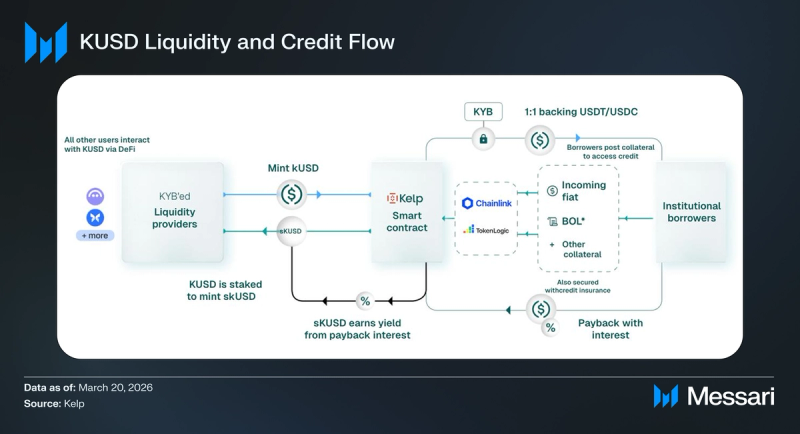
sKUSD stays totally composable inside DeFi. Whereas incomes yield from credit score repayments, it may be deployed throughout lending protocols, used as collateral, or offered as liquidity on decentralized exchanges. This permits holders to layer further return streams on high of the bottom sKUSD yield, growing capital effectivity by producing revenue from each real-world credit score publicity and onchain monetary exercise.
From a danger perspective, KUSD emphasizes transparency, brief credit score period, and layered safety. All debtors are topic to KYB processes. Actual-time collateral valuation, automated margining, and predefined liquidation procedures are enforced on the protocol stage. An insurance coverage fund, capitalized via protocol revenues, is designed to soak up losses within the occasion of borrower default and protect overcollateralization throughout the system. Collectively, these mechanisms place KUSD as a yield-bearing stablecoin grounded in settlement-driven credit score, with danger managed via construction somewhat than discretionary intervention.
The Credit score Infrastructure
Kelp’s credit score infrastructure establishes an onchain framework for short-term enterprise financing. Verified institutional debtors entry predefined credit score strains backed by liquidity from KUSD holders, drawing capital as wanted and repaying principal plus curiosity as underlying transactions settle.
The system is designed to serve settlement-driven demand throughout funds, commerce finance, international trade operations, and treasury workflows, areas that aren’t nicely aligned with DeFi lending markets structured round longer-duration, overcollateralized speculative borrowing. Credit score tenors are measured in minutes or hours somewhat than days or perhaps weeks, enabling capital to be recycled a number of occasions inside a single day.
Reasonably than working as a passive lending pool, the framework extends credit score to verified counterparties underneath predefined pricing, publicity limits, and reimbursement phrases enforced on the protocol stage. The construction emphasizes short-duration publicity, outlined danger parameters, and operational enforceability tied to transactional money flows or different verifiable ensures.
Actual-World Partnerships
KUSD’s credit score infrastructure is activated via institutional origination companions throughout commerce finance and cross-border funds. The companions featured beneath characterize a number of Kelp’s real-world community, not the total image of borrower relationships. Every companion brings verified deal stream, domain-specific underwriting, and structured collateral, connecting onchain liquidity to real-economy exercise.
OpenFX
OpenFX is a real-time worldwide funds infrastructure supplier settling billions in cross-border quantity month-to-month throughout greater than 40 forex pairs, with 90% of transactions accomplished in underneath 60 minutes. With over $45 billion in quantity processed, OpenFX generates the high-frequency, short-duration settlement flows that Kelp’s credit score layer is constructed to finance, offering the cost rails whereas Kelp offers just-in-time liquidity.
TradeQraft
TradeQraft is a commodity commerce finance origination and structuring platform working with a worldwide community of vetted merchants throughout power, agricultural commodities, and metals. With greater than $2 billion in transactions facilitated over three years, TradeQraft sources, conducts due diligence on, and buildings short-term, self-liquidating transactions (usually 30 to 180 days), connecting underserved commodity merchants with different capital extra shortly and with much less friction than conventional banking.
EG Retailers
EG Retailers is a boutique commodity home specializing in dry bulk and sustainable commodities and associated property. EG Retailers and Kelp partnered to tokenize and fund modern fashions of commerce and freight receivables, bringing commodity commerce finance buildings onchain and opening a brand new class of verified, asset-backed debtors inside KUSD’s credit score framework.
Capital4Trade
Capital4Trade is a logistics and commerce finance community with greater than 20 years of expertise throughout the U.S., LATAM, and Europe. The community originates and providers short-duration, asset-backed receivables. Capital4Trade permits Kelp’s credit score layer to attach onchain liquidity with real-world settlement flows. Via vetted operators, standardized underwriting, and management over items in transit, the community offers entry to verified debtors and verifiable collateral.
These featured companions give a cross-section of KUSD’s real-world credit score community: commodity buying and selling, logistics, FX settlement, and tokenized receivables. The frequent thread throughout all borrower relationships is verified counterparties, structured and collateralized exposures, and reimbursement tied to underlying business exercise.
Conclusion
Kelp has established itself as a number one restaking ecosystem, forming a cohesive stack that secures networks, unlocks liquidity, and simplifies yield technology. Collectively, these merchandise have attracted $1.25 billion in capital and generated recurring income throughout Ethereum and different supported networks, positioning Kelp as a core infrastructure supplier within the restaking market. This observe file de-risks Kelp’s growth right into a considerably bigger market: yield-bearing stablecoins.
The launch of KUSD marks a significant growth of Kelp’s scope. KUSD is designed to deal with a structural imbalance within the stablecoin market. Greater than $300 billion in stablecoins are both non-yielding or tied to crypto market-linked methods. This represents capital sitting idle whereas a $2.5 trillion commerce finance hole goes unfunded, and trillions extra are locked in prefunded settlement buffers for cross-border funds. KUSD addresses each: short-duration credit score towards verified commerce receivables and real-world cost flows, producing yield that exists independently of digital asset value cycles.
KUSD connects stablecoin liquidity to short-duration receivables financing. Stablecoin holders deposit USDC or USDT, and capital is prolonged to verified institutional debtors for brief tenors, usually hours to days, to assist cost processing and settlement flows. The focused yield of greater than 10% is derived from borrower repayments somewhat than token incentives or leverage-driven spreads. Credit score publicity is structured as short-term and overcollateralized, with returns linked to recurring transactional exercise somewhat than to speculative market situations.
Kelp is poised to bridge decentralized infrastructure and real-world finance. By prioritizing short-duration credit score towards verified commerce receivables and settlement flows over speculative incentives, the protocol positions itself to serve commerce finance, funds, and treasury operations at scale. Whereas many RWA protocols concentrate on digitizing property that already commerce in conventional markets, Kelp as an alternative targets the financing of underlying receivables and settlement exercise that these markets generate. If profitable, this can place Kelp not as a restaking platform increasing into credit score, however as monetary infrastructure the place stablecoins, yield technology, and real-world settlement exercise converge.
