



ASSEMBLY:
As producers double down on U.S. manufacturing, the dialog is now not nearly reshoring — it’s about reinvention.
GE Home equipment is making a $3 billion funding over 5 years to develop its U.S. operations, together with the latest launch of its first-ever in-house water filter manufacturing operation at Equipment Park in Louisville, Kentucky. However capital funding is just a part of the equation.
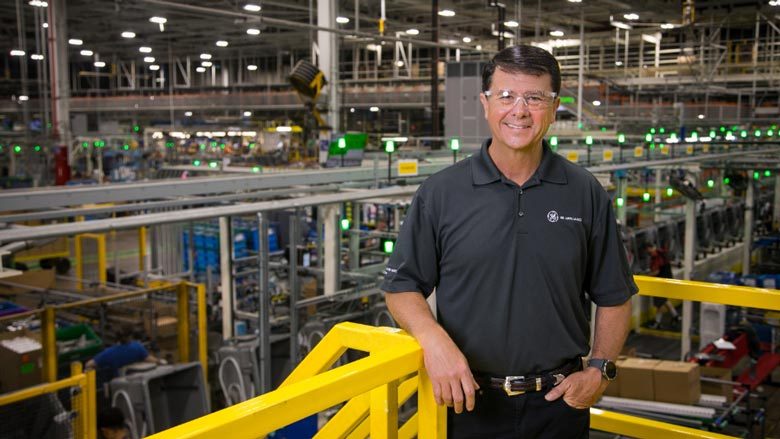
On this multi-part collection on ASSEMBLY Audible, Invoice Good, Vice President of Manufacturing and Provide Chain at GE Home equipment, shares how the corporate is modernizing its vegetation, upskilling its workforce and integrating automation and AI to drive productiveness and resilience. From redefining the worker worth proposition after the pandemic to deploying AI instruments that assist operators diagnose tools in actual time, this dialog explores what it takes to scale superior manufacturing in the US — and why velocity, expertise and expertise should evolve collectively.
This week, we’re specializing in the main impression AI is having on US manufacturing. Now we have plenty of inquiries to get via on that subject.
However first, I’d like to know a bit about what you’re seeing so far as automation goes… how it’s altering the kinds of jobs and expertise producers want. What expertise gaps concern you most, and the place do producers must rethink how they recruit, practice and retain expertise?
BILL:
It’s a query we’ve been engaged on for fairly a while. If you happen to return to the pandemic, what we discovered was a scarcity — individuals took themselves out of the workforce. There was plenty of concern about working in public and being round others. We didn’t let that disaster go to waste. We seemed deeply at our pipeline and what we anticipated from individuals in manufacturing.
For many years, recruiting adopted the identical components: that is the work and that is the pay. We flipped that the wrong way up and targeted on adapting the work to individuals, fairly than adapting individuals to the work. That shift in mindset was important.
On the lookout for fast solutions on meeting and manufacturing matters?
Strive Ask ASM, our new good AI search software.
Ask ASM
Automation has additionally modified the sport. Traditionally, operators carried out very bodily, troublesome work. At the moment, a lot of that has been automated. We concentrate on automating uninteresting, troublesome and soiled work — the roles individuals don’t need anyway — and transferring associates into roles the place they will add extra worth. That’s one piece.
The opposite is that this… Take into consideration a watch. An outdated analog watch merely instructed time. A smartwatch delivers well being information, takes calls and runs apps — all out of your wrist. The identical exponential shift has occurred in manufacturing. Tools that after required turning a dial or flipping a change is now run by computer systems. And you must have expertise to interface with the PLC and make changes.
For instance, in thermoforming, we convey an extruded flat sheet of plastic right into a course of the place it’s heated — much like a toaster oven — till it melts and is molded to create the within of a fridge. An operator should interface with a PLC to regulate heater temperatures and guarantee uniform plastic thickness with out weak spots. That’s only one instance of the complexity in at the moment’s tools.
Because of this, jobs have been upskilled. We’re far much less reliant on bodily lifting and molding roles and way more targeted on technical functionality. And we reserve the roles for operators that they might set up components on completed items.
Once we discuss gaps, there are three main classes. First is upkeep — associates educated to work on advanced tools. A long time in the past, many individuals grew up on farms or labored on automobiles and developed hands-on technical expertise. At the moment, fewer individuals work on their very own autos. That talent set is in excessive demand and troublesome to seek out.
Second is tooling — software builders who work on stamping presses, molding instruments and associated programs. That functionality can also be scarce. So now we have to develop these expertise.
Third is tools operators, whose roles now require a unique technical talent set than prior to now.
To deal with these gaps, we’ve developed inside packages — FAME packages, upkeep apprenticeships — constructing expertise from the bottom up, together with tooling experience and superior operator functionality.
ASSEMBLY:
We’ll be speaking much more about automation’s impression subsequent week, in addition to your digitization efforts and use of digital twins. However let’s shift at the moment’s discuss to AI. As you modernize operations and convey extra advanced processes in-house, the place do you see AI creating the most important benefit inside your vegetation?
BILL:
There are areas the place you’ll be able to create a closed-loop system. With AI, one of many largest alternatives is tools efficiency. AI lets you scale back dependence on one particular person’s expertise or depth of information.
You possibly can create programs the place tools diagnoses itself, makes changes and optimizes efficiency. An operator nonetheless oversees the method and intervenes when mandatory, however AI turns into a drive multiplier.
In our trade, AI will likely be a sport changer. Will probably be as transformational because the web or the PC. That’s why we’re doubling down on it. Its impression on manufacturing will likely be that important.
ASSEMBLY:
With AI turning into extra embedded in tools and diagnostics, how do you concentrate on the stability between automation and human experience on the manufacturing unit ground?
BILL:
There’ll all the time be a handshake between people and expertise. We want human interplay and interface.
Nonetheless, AI can present a significant benefit. Corporations that democratize using AI and construct organizational functionality round it can lead. That’s what we’re targeted on — embedding AI in ways in which improve human functionality, not exchange it.
ASSEMBLY:
Manufacturing has an consciousness and notion problem, particularly with youthful employees. As you develop U.S. operations, how are you working to vary that narrative and entice the subsequent era of expertise? Does AI play any position in attracting new expertise?
BILL:
After World Battle II, manufacturing jobs represented 25–30% of complete U.S. employment. At the moment, that quantity is nearer to 9–10%.
Younger individuals work together every day with robust client manufacturers — Amazon, Starbucks, Walmart — however manufacturing has misplaced visibility. It has turn into virtually an afterthought.
We have to transfer upstream and construct consciousness beginning in center and excessive colleges. Manufacturing jobs persistently pay 30–40% greater than many different blue-collar roles, and the advantages multiplier is powerful.
We even have to vary the notion of what these jobs appear to be. They aren’t the recent, soiled environments of fifty years in the past. We’ve invested in HVAC programs, air turnover and improved working situations. We’ve constructed cafés as a substitute of conventional cafeterias to enhance the affiliate expertise.
We’ve positioned workers on the middle of the setting. The individuals who take the leap into these jobs are paid pretty nicely, earn a residing wage and benefit from the work. We merely want to inform the story higher and rejuvenate curiosity, particularly for many who could not wish to pursue a university diploma. Manufacturing is a robust pathway to a superb residing.
ASSEMBLY:
You’ve talked about velocity being important in manufacturing. Are you able to share a sensible instance of the way you’re utilizing AI or digital instruments to assist operators diagnose issues sooner and shield uptime?
BILL:
I’m fearless with regards to tackling one thing as a result of I’m snug breaking issues aside and placing them again collectively. YouTube has modified the sport — if you wish to discover ways to do one thing, there’s a video for it.
YouTube has modified the sport — if you wish to discover ways to do one thing, there’s a video for it. We’re making use of that idea utilizing AI. Operators can interface with tools and primarily pull up step-by-step steerage or video-based diagnostics.
We’re making use of that idea utilizing AI. Operators can interface with tools and primarily pull up step-by-step steerage or video-based diagnostics. The system evolves over time, enhancing primarily based on prior incidents and options.
If a bit of apparatus fails in a method that solely occurs annually, it’s difficult to count on an operator to recollect precisely easy methods to repair it. An AI assistant — whether or not a bot or an agent — can information them step-by-step, reference what occurred beforehand and speed up decision.
Velocity issues in manufacturing. The flexibility to establish, reply to and resolve an issue rapidly can decide whether or not it’s a worthwhile day. AI processes data sooner than the human mind with regards to diagnosing patterns and suggesting options (drawback fixing).
You continue to want somebody to execute the duty, however arming operators with the suitable data in actual time is a sport changer. In considered one of our vegetation, 1% of misplaced output equals $1.5 million yearly. The multiplier impact is big.
ASSEMBLY:
If you’re investing billions into amenities and new capabilities, how do you pilot new applied sciences — like AI — and scale them throughout a number of vegetation successfully? What’s your recommendation for different producers?
BILL:
I’ve been a pupil of the Toyota Manufacturing System for many of my profession. Toyota constructed a producing system that many have tried to duplicate and that has been wildly profitable within the U.S. That philosophy has influenced how I believe.
We construct a mannequin cell, then a mannequin line, then a mannequin worth stream and ultimately a mannequin plant. We pilot new expertise or functionality in a single plant first.
Annually, I handle a capital price range to modernize vegetation — whether or not via automation or new product introductions. I take advantage of discretionary capital to make bets on concepts. As soon as we good an concept, show it out and display a return on funding, we scale it throughout our vegetation.
ASSEMBLY:
Thanks a lot, Invoice, for becoming a member of us at the moment on ASSEMBLY Audible. I’m very excited to proceed this dialog with you subsequent week, the place we’ll concentrate on automation and digitization. We’ll additionally see you on the Manufacturing and Automation Change going down March 24-26 in Nashville, Tennessee. And also you, our listeners, are all invited to attend, and listen to Invoice in our panel dialogue on reshoring Wednesday afternoon. Thanks for listening at the moment. I hope you’ll be a part of us once more quickly.
