




, context actually is all the things. The standard of an LLM’s output is tightly linked to the standard and quantity of data you present. In follow, many real-world use instances include huge contexts: code era over massive codebases, querying complicated information techniques, and even lengthy, meandering chats whereas researching the right vacation vacation spot (we’ve all been there).
Sadly, LLMs can solely work effectively with a restricted quantity of context. And this isn’t simply in regards to the arduous limits of the context window, particularly now that frontier fashions help lots of of hundreds, and even tens of millions, of tokens. And people limits are persevering with to develop. The larger problem is a phenomenon often called context rot, the place mannequin efficiency degrades because the context size will increase.
This impact is clearly demonstrated within the paper “RULER: What’s the Actual Context Dimension of Your Lengthy-Context Language Fashions?” by Hsieh et al. The authors introduce RULER, a brand new benchmark for evaluating long-context efficiency, and take a look at a variety of fashions. The outcomes present a constant sample: as context size grows, efficiency drops considerably throughout all fashions. In lots of instances, the efficient context size (the place efficiency stays akin to Llama 2–7B) is simply round 50% of the marketed context window, and even much less.
Of their current paper “Recursive Language Fashions”, Zhang et al. suggest a promising strategy to tackling the context rot downside. On this article, I’d prefer to take a better take a look at this concept and discover the way it works in follow, leveraging DSPy’s just lately added help for this inference technique.
Recursive Language Fashions
Recursive Language Fashions (RLMs) have been launched to deal with efficiency degradation as context size grows, and to allow LLMs to work with very massive contexts (as much as two orders of magnitude past the mannequin’s native context window). That is changing into more and more essential as we undertake LLMs for duties that contain processing lots of of tens of millions of tokens.
There are already a number of approaches for dealing with long-horizon duties. The commonest one (one thing you’ve most likely encountered when utilizing code brokers like Cursor) is context summarisation. On this setup, the dialog or working context is repeatedly summarised as soon as it approaches the mannequin’s context restrict. In follow, nevertheless, this typically falls brief: essential particulars and refined nuances from earlier steps are inclined to get misplaced because the mannequin “forgets” previous data to make room for brand new tokens.
Recursive Language Fashions take a distinct, and surprisingly elegant, strategy. As an alternative of passing your complete immediate to the LLM every time, the immediate is handled as a set of variables accessible in a Python REPL (Learn–Eval–Print Loop) setting. The mannequin is supplied with instruments that permit it to examine these variables or recursively invoke itself on programmatically chosen fragments.
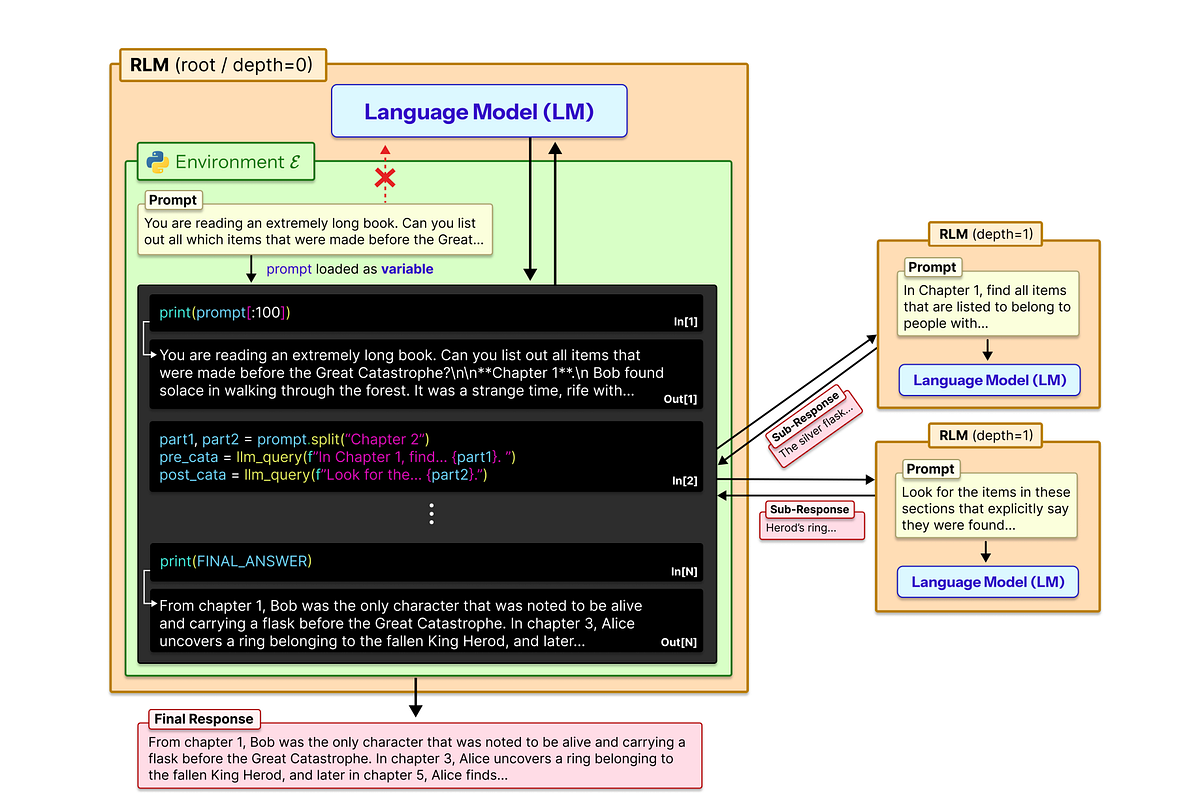
In different phrases, RLMs encourage the LLM to put in writing code that constructs its personal sub-tasks, after which clear up these sub-tasks by recursively calling itself. This shifts the burden from squeezing all the things right into a single immediate to structuring the issue in a manner that the mannequin can navigate massive contexts extra reliably.
The authors evaluated their strategy throughout a number of long-horizon duties, the place RLMs delivered robust outcomes on each GPT-5 and Qwen-3 fashions.
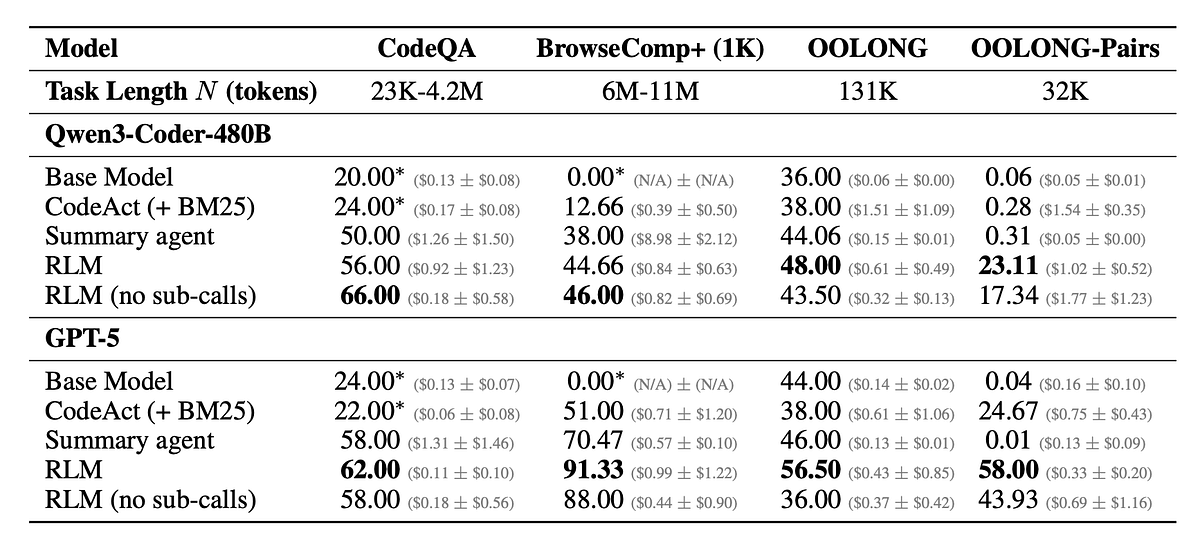
The outcomes look extraordinarily promising. RLMs (with or with out subcalls) constantly outperform different approaches throughout all duties. Let’s see how this works in follow.
Utilizing RLM in follow
One frequent situation the place lengthy context actually shines is answering questions over a big information base. In order that’s precisely what we’ll strive right here. I took all of the articles I’ve revealed on In direction of Knowledge Science and loaded them right into a single Markdown file. Considerably surprisingly, that provides as much as nearly 1.5 MB of textual content. Hopefully, that’s sufficient for the mannequin to dig via.
Fortuitously, DSPy has just lately launched an implementation of the Recursive Language Fashions inference strategy. This implies we don’t must construct something ourselves; we simply want DSPy model 3.1.2 or newer.
pip set up dspy --upgradeLet’s begin by loading the dataset.
with open('articles.md', 'r') as f:
    articles = f.learn()
Subsequent, let’s examine what number of tokens it incorporates.
import anthropic

consumer = anthropic.Anthropic(api_key=config['ANTHROPIC_API_KEY'])

# Rely tokens for messages
token_count = consumer.messages.count_tokens(
  mannequin="claude-sonnet-4-5",
  messages=[
    {"role": "user", "content": articles}
  ]
)

print(f"Enter tokens: {token_count.input_tokens}")
# Enter tokens: 386768
There are nearly 400K tokens in our context. Claude Sonnet 4.5 helps a 200K context window, so processing your complete dataset in a single immediate isn’t possible. That is precisely the place RLM turns into helpful.
To make use of DSPy, we first must configure the language mannequin. As mentioned earlier, RLM depends on code to work together with the immediate, so it really works greatest with fashions which have robust coding capabilities. For that reason, I’ll use Claude on this instance, because it’s recognized to carry out properly on code-related duties.
lm = dspy.LM('anthropic/claude-sonnet-4-5', api_key=config['ANTHROPIC_API_KEY'])
dspy.configure(lm=lm)
Subsequent, we initialise the RLM by specifying its signature. On this use case, I cross the total set of articles together with a query, and anticipate the mannequin to extract key tendencies and return them as an inventory of strings.
rlm = dspy.RLM('articles, query -> tendencies: listing[str]')Right here, I take advantage of Claude Sonnet 4.5 for each the principle mannequin and the recursive sub-calls. DSPy additionally means that you can use a smaller mannequin for sub-calls through the
sub_lmparameter, which may help scale back prices.
Now we are able to execute the RLM and entry the tendencies subject within the output.
output = rlm(
  articles = articles,
  query = '''What have been the principle AI tendencies of 2025 based mostly on supplied
    articles? Take note of the content material not solely the titles.'''
)

print('n'.be part of(output.tendencies))

# Agentic AI and Autonomous Techniques: Self-reflection patterns, iterative enchancment via suggestions loops (Self-Refine, Reflexion, CRITIC), and LLMs as reasoning engines that may autonomously plan and execute duties
# Multi-Agent AI Techniques: Evolution from single brokers to collaborative groups of specialised brokers with distinct roles, utilizing frameworks like LangGraph, CrewAI, and AutoGen for orchestration
# Context Engineering and RAG: Shifting past static prompting to dynamic retrieval-augmented era (RAG), adaptive reminiscence techniques, and self-improving contexts that study from expertise with out retraining
# Standardization Protocols: Emergence of Mannequin Context Protocol (MCP) for standardizing LLM-tool integrations and Agent Communication Protocol (ACP) for inter-agent communication, lowering integration complexity
# Instrument-Utilizing LLMs and Operate Calling: LLMs outfitted with skill to invoke exterior instruments, execute SQL queries, browse internet, and work together with APIs via structured operate calling mechanisms
# Manufacturing-Prepared AI Frameworks: Mature ecosystem together with LangGraph, DSPy, LangChain, NeMo Agent Toolkit, CrewAI, and AutoGen, targeted on transferring from prototype to manufacturing with built-in observability
# LLM Analysis and Observability: LLM-as-judge analysis patterns, complete metrics frameworks (Ragas, DeepEval, Evidently), trajectory analysis, and steady monitoring as important manufacturing infrastructure
# Programming Over Prompting: Shift towards declarative, code-based AI improvement with frameworks like DSPy and configuration-driven approaches (YAML-based) changing immediate engineering
# Framework Interoperability: Instruments designed to combine throughout a number of frameworks reasonably than create silos, enabling composable AI architectures that leverage greatest options from completely different ecosystems
# Native and Value-Efficient LLM Deployment: Operating smaller environment friendly fashions regionally (Llama, Ollama) to cut back API prices and allow experimentation, with give attention to cost-quality-latency tradeoffs
# SQL Brokers and Knowledge Evaluation Automation: LLM brokers specialised in knowledge evaluation duties, producing and executing SQL queries, with functions in changing or augmenting conventional knowledge analyst workflows
# Manufacturing High quality and Accuracy Enhancement: Strategies for bettering LLM accuracy together with chain-of-thought reasoning, structured outputs via operate calling, and iterative refinement for business-critical functions
The execution took round three minutes, and the consequence was a surprisingly believable abstract of the principle themes throughout my articles. Nonetheless, we’re not right here to study in regards to the tendencies themselves. The extra attention-grabbing query is how RLM managed to do that within the first place. So let’s dig deeper.
RLM below the hood
Naturally, probably the most fascinating half is knowing what’s really taking place below the hood.
RLM implementation
As mentioned earlier, the important thing thought behind Recursive Language Fashions is that lengthy contexts are handled as a part of an exterior setting, reasonably than being fed immediately into the mannequin as a single immediate. As an alternative, the LLM writes Python code to programmatically examine, decompose, and recursively invoke sub-LLMs over smaller snippets of the info.
At a excessive stage, the implementation has just a few core traits:
- It makes use of a sandboxed Python REPL (Learn–Eval–Print Loop) that permits the LLM to discover massive contexts via code execution.
- The LLM operates in a well-recognized agentic loop: it writes Python code, observes the output, after which decides what to do subsequent.
- It will probably carry out recursive sub-calls (successfully calling itself) utilizing instruments like
llm_query()andllm_query_batched()to analyse smaller chunks semantically. - As soon as the mannequin is happy with the consequence, it finalises the method by calling
SUBMIT()with the output.
Prompts
To essentially perceive how this works, I discover it useful to examine the precise messages despatched to and from the LLM. DSPy makes this simple with the next command.
# Examine the uncooked LLM calls - exhibits the precise prompts despatched to the mannequin
dspy.inspect_history(n=39)
This offers us full visibility into what was shared with the mannequin at every step.
Let’s begin with the system message. It defines the enter variables accessible to the mannequin (as specified within the RLM signature) and lists the capabilities the mannequin can name, equivalent to print, recursive LLM calls, and normal library utilities.
Notably, the RLM module additionally means that you can expose customized capabilities to the Python REPL through the
instrumentsparameter when initialising the RLM. On this instance, I solely relied on the default capabilities, however in additional superior setups this is usually a highly effective extension level.
Your enter fields are:
1. `variables_info` (str): Metadata in regards to the variables accessible within the REPL
2. `repl_history` (REPLHistory): Earlier REPL code executions and their outputs
3. `iteration` (str): Present iteration quantity (1-indexed) out of max_iterations
Your output fields are:
1. `reasoning` (str): Suppose step-by-step: what are you aware? What stays? Plan your subsequent motion.
2. `code` (str): Python code to execute.
All interactions can be structured within the following manner, with the suitable values stuffed in.

[[ ## variables_info ## ]]
{variables_info}

[[ ## repl_history ## ]]
{repl_history}

[[ ## iteration ## ]]
{iteration}

[[ ## reasoning ## ]]
{reasoning}

[[ ## code ## ]]
{code}

[[ ## completed ## ]]
In adhering to this construction, your goal is:
Given the fields `articles`, `query`, produce the fields `tendencies`.

You're tasked with producing the next outputs given the inputs `articles`, `query`:
- {tendencies}        # observe: the worth you produce should adhere to the JSON schema: {"kind": "array", "gadgets": {"kind": "string"}}

You will have entry to a Python REPL setting. Write Python code and will probably be executed. You will notice the output, then write extra code based mostly on what you realized. That is an iterative course of.

Obtainable:
- Variables: `articles`, `query` (your enter knowledge)
- `llm_query(immediate)` - question a sub-LLM (~500K char capability) for semantic evaluation
- `llm_query_batched(prompts)` - question a number of prompts concurrently (a lot sooner for a number of queries)
- `print()` - ALWAYS print to see outcomes
- `SUBMIT(tendencies)` - submit ultimate output when finished
- Customary libraries: re, json, collections, math, and so on.

IMPORTANT: That is ITERATIVE. Every code block you write will execute, you may see the output, then you definitely determine what to do subsequent. Do NOT attempt to clear up all the things in a single step.

1. EXPLORE FIRST - Take a look at your knowledge earlier than processing it. Print samples, examine sorts/lengths, perceive the construction.
2. ITERATE - Write small code snippets, observe outputs, then determine subsequent steps. State persists between iterations.
3. VERIFY BEFORE SUBMITTING - If outcomes appear mistaken (zeros, empty, surprising), rethink your strategy.
4. USE llm_query FOR SEMANTICS - String matching finds WHERE issues are; llm_query understands WHAT issues imply.
5. MINIMIZE RETYPING (INPUTS & OUTPUTS) - When values are lengthy, exact, or error-prone (IDs, numbers, code, quotes), re-access them through variables and parse/compute in code as an alternative of retyping. Use small, focused prints to sanity-check, however keep away from guide copying when variables can carry the precise worth.
6. SUBMIT ONLY AFTER SEEING OUTPUTS - SUBMIT ends the present run instantly. If you'll want to examine printed output, run it in a single step, evaluate the consequence, then name SUBMIT in a later step.

You will have max 50 sub-LLM calls. When finished, name SUBMIT() together with your output.
Let’s additionally check out the primary consumer message despatched to the LLM. This offers the mannequin an outline of the enter variables: their sorts, lengths (so the mannequin is aware of how a lot it may well learn without delay), and a preview of the content material to grasp the construction.
[[ ## variables_info ## ]]
[1] «««
    Variable: `articles` (entry it in your code)
    Kind: str
    Whole size: 1,392,921 characters
    Preview:
    ```
    ---
    title: "Agentic AI from First Ideas: Reflection"
    date: "2025-10-24T12:00:00-05:00"
    class: "Agentic AI"
    read_time: "21 min learn"
    url: "
    ---

    Arthur C. Clarke's Third Regulation says that "*any sufficiently superior expertise is indistinguishable from magic*". That is precisely how loads of right now's AI frameworks really feel. Instruments like GitHub Copilot, Claude Desktop, OpenAI Operator, and Perplexity Comet are automating everyda...
    ```
»»»
[2] «««
    Variable: `query` (entry it in your code)
    Kind: str
    Whole size: 114 characters
    Preview:
    ```
    What have been the principle AI tendencies of 2025 based mostly on supplied articles? Take note of the content material not solely the titles.
    ```
»»»
[3] «««
    Variable: `verbose` (entry it in your code)
    Kind: bool
    Whole size: 4 characters
    Preview:
    ```
    True
    ```
»»»

[[ ## repl_history ## ]]
You haven't interacted with the REPL setting but.

[[ ## iteration ## ]]
1/20

Reply with the corresponding output fields, beginning with the sector `[[ ## reasoning ## ]]`, then `[[ ## code ## ]]`, after which ending with the marker for `[[ ## completed ## ]]`.
Right here’s the mannequin’s preliminary response according to the format specified within the consumer message.
[[ ## reasoning ## ]]
I would like to investigate articles to establish major AI tendencies of 2025. Let me begin by exploring the info:

1. First, I will look at the construction and content material of the `articles` variable to grasp what I am working with
2. I will want to have a look at a number of articles, not simply titles, to grasp the precise content material
3. Then I will use semantic evaluation (llm_query) to extract and establish tendencies
4. Lastly, I will compile the tendencies into an inventory

Let me begin by exploring the articles knowledge to see its construction and get a way of what is accessible.

[[ ## code ## ]]
# First, let's perceive the construction of the articles
print("Kind of articles:", kind(articles))
print("nLength of articles:", len(articles))
print("n" + "="*80)
print("First 2000 characters:")
print(articles[:2000])
print("n" + "="*80)

# Let's examine if we are able to establish the construction - appears to be like like articles are separated
# Let's attempt to break up and depend them
article_separator = "---ntitle:"
article_parts = articles.break up(article_separator)
print(f"nNumber of article components discovered: {len(article_parts)}")
print(f"First half size: {len(article_parts[0])} (seemingly empty or header)")
print(f"Second half size: {len(article_parts[1]) if len(article_parts) > 1 else 0}")

[[ ## completed ## ]]
The uncooked logs gave us a stable understanding of how the LLM interacts with the setting below the hood. Subsequent, let’s look at the trajectory the LLM adopted to achieve its ultimate output.
Trajectory
For a structured view of the trajectory, we are able to examine output.trajectory. This offers entry to every step of the mannequin’s reasoning, the code it generates, and the ensuing outputs. Primarily, it gives a complete view of all REPL interactions.
# Look at the total trajectory - this exhibits all REPL interactions
for i, step in enumerate(output.trajectory):
  print(f"n{'='*60}")
  print(f"STEP {i+1}")
  print(f"{'='*60}")
  print(f"n📝 REASONING:n{step['reasoning']}")
  print(f"n💻 CODE:n{step['code']}")
  print(f"n📤 OUTPUT:n{step['output'][:1000]}{'...' if len(step['output']) > 1000 else ''}")
You may as well discover the total go surfing GitHub.
Reviewing the trajectory helps us perceive the principle patterns the LLM makes use of to unravel the issue. On this case, it took 13 steps to achieve the ultimate reply.
Step one, as anticipated, was exploring the articles variable: analyzing its construction and getting a way of the accessible knowledge. This preliminary exploration units the stage for all subsequent reasoning and sub-calls.
# First, let's perceive the construction of the articles
print("Kind of articles:", kind(articles))
print("nLength of articles:", len(articles))
print("n" + "="*80)
print("First 2000 characters:")
print(articles[:2000])
print("n" + "="*80)

# Let's examine if we are able to establish the construction - appears to be like like articles are separated
# Let's attempt to break up and depend them
article_separator = "---ntitle:"
article_parts = articles.break up(article_separator)
print(f"nNumber of article components discovered: {len(article_parts)}")
print(f"First half size: {len(article_parts[0])} (seemingly empty or header)")
print(f"Second half size: {len(article_parts[1]) if len(article_parts) > 1 else 0}")
Subsequent, the LLM realised that there have been 40 articles in complete, every separated by ---ntitle:, and that each article contained metadata fields like title, date, class, read_time, and url, adopted by the principle content material. Simply figuring out this construction from a 1.5 MB textual content file is already a major achievement.
Constructing on this understanding, the LLM then parsed the articles and generated a abstract of the article titles and major themes.
# Parse articles into structured format
import re

# Break up by the article separator
raw_articles = articles.break up("---ntitle:")

# Course of every article (skip the primary empty component)
parsed_articles = []
for i, raw_article in enumerate(raw_articles[1:], 1):  # Skip first empty component
  # Add again the "title:" that was eliminated by break up
  raw_article = "title:" + raw_article

  # Extract metadata utilizing regex
  title_match = re.search(r'title:s*"([^"]*)"', raw_article)
  date_match = re.search(r'date:s*"([^"]*)"', raw_article)
  category_match = re.search(r'class:s*"([^"]*)"', raw_article)

  # Discover the place content material begins (after the second "---")
  content_start = raw_article.discover("---", 10)  # Skip the primary half
  content material = raw_article[content_start+3:].strip() if content_start != -1 else ""

  parsed_articles.append({
    'index': i,
    'title': title_match.group(1) if title_match else "Unknown",
    'date': date_match.group(1) if date_match else "Unknown",
    'class': category_match.group(1) if category_match else "Unknown",
    'content material': content material,
    'content_length': len(content material)
  })

print(f"Efficiently parsed {len(parsed_articles)} articlesn")
print("="*80)
print("Pattern of articles (titles and classes):")
print("="*80)
for i, article in enumerate(parsed_articles[:10], 1):
  print(f"{i}. [{article['category']}] {article['title']}")
  print(f"   Content material size: {article['content_length']} chars")
  print()
After parsing the articles, the LLM determined to focus solely on AI-related content material, for the reason that query particularly requested about AI tendencies.
# Let's give attention to AI-related articles (AI, Agentic AI, LLM Purposes, ChatGPT classes)
# and pattern strategically to grasp content-based tendencies

ai_related = [a for a in parsed_articles if a['category'] in [
  'Artificial Intelligence', 'Agentic AI', 'LLM Applications', 'ChatGPT', 'Deep Learning'
]]
Subsequent, the LLM recognized the important thing articles it needed to give attention to. It was a subjective choice based mostly on relevance and content material. To analyse these intimately, it used recursive sub-calls, processing every article programmatically.
To handle the workload effectively, the LLM break up the articles into two batches and processed them sequentially. For every article, it additionally truncated the content material to the primary 15K characters. This technique allowed the mannequin to deal with a big quantity of textual content with out exceeding its context window, whereas nonetheless capturing an important insights from every article.
# Create prompts to extract AI tendencies from article content material
# I will embrace a considerable portion of every article's content material for evaluation

prompts_batch1 = []

for i, article in enumerate(selected_for_analysis[:8]):  # First batch of 8
  # Take first ~15K chars of content material to remain inside LLM limits whereas getting substance
  content_sample = article['content'][:15000]

  immediate = f"""Analyze this text about AI from 2025 and establish the principle AI tendencies, applied sciences, methodologies, or ideas it discusses.

Article Title: {article['title']}

Article Content material (excerpt):
{content_sample}

Based mostly on the content material above, listing the important thing AI tendencies, applied sciences, or ideas mentioned on this article. Give attention to:
- New frameworks, instruments, or methodologies talked about
- Rising patterns in AI improvement (e.g., agentic AI, multi-agent techniques)
- Necessary methods or approaches
- Manufacturing/deployment issues

Present a concise listing of 3-5 major tendencies/ideas from this text."""

  prompts_batch1.append(immediate)

print(f"Created {len(prompts_batch1)} prompts for first batch")
print("nProcessing first batch of articles...")

# Question the primary batch
results_batch1 = llm_query_batched(prompts_batch1)

print(f"nReceived {len(results_batch1)} outcomes")
print("nResults from first batch:")
print("="*80)

for i, (article, consequence) in enumerate(zip(selected_for_analysis[:8], results_batch1), 1):
  print(f"n{i}. {article['title']}")
  print("-"*80)
  print(consequence)
  print()
Lastly, the LLM reviewed the total listing of articles as soon as extra, recognized extra related subjects, and processed them utilizing recursive sub-calls in the identical manner. As soon as all the data had been retrieved, it synthesised the outcomes into the trends_2025 variable (an inventory of strings representing the principle AI tendencies) and submitted it as the ultimate reply.
##### STEP 12 #####

# Now let me synthesize all findings into complete AI tendencies
# I will evaluate all the outcomes and create a structured abstract

print("SYNTHESIZING ALL FINDINGS FROM 20 ANALYZED ARTICLES")
print("="*80)
print("nBased on deep content material evaluation of 20 AI-focused articles from 2025,")
print("listed here are the principle AI tendencies recognized:n")

# Compile the excellent listing of tendencies
trends_2025 = [
  "Agentic AI and Autonomous Systems: Self-reflection patterns, iterative improvement through feedback loops (Self-Refine, Reflexion, CRITIC), and LLMs as reasoning engines that can autonomously plan and execute tasks",
  "Multi-Agent AI Systems: Evolution from single agents to collaborative teams of specialized agents with distinct roles, using frameworks like LangGraph, CrewAI, and AutoGen for orchestration",
  "Context Engineering and RAG: Moving beyond static prompting to dynamic retrieval-augmented generation (RAG), adaptive memory systems, and self-improving contexts that learn from experience without retraining",
  "Standardization Protocols: Emergence of Model Context Protocol (MCP) for standardizing LLM-tool integrations and Agent Communication Protocol (ACP) for inter-agent communication, reducing integration complexity",
  "Tool-Using LLMs and Function Calling: LLMs equipped with ability to invoke external tools, execute SQL queries, browse web, and interact with APIs through structured function calling mechanisms",
  "Production-Ready AI Frameworks: Mature ecosystem including LangGraph, DSPy, LangChain, NeMo Agent Toolkit, CrewAI, and AutoGen, focused on moving from prototype to production with built-in observability",
  "LLM Evaluation and Observability: LLM-as-judge evaluation patterns, comprehensive metrics frameworks (Ragas, DeepEval, Evidently), trajectory evaluation, and continuous monitoring as essential production infrastructure",
  "Programming Over Prompting: Shift toward declarative, code-based AI development with frameworks like DSPy and configuration-driven approaches (YAML-based) replacing prompt engineering",
  "Framework Interoperability: Tools designed to integrate across multiple frameworks rather than create silos, enabling composable AI architectures that leverage best features from different ecosystems",
  "Local and Cost-Effective LLM Deployment: Running smaller efficient models locally (Llama, Ollama) to reduce API costs and enable experimentation, with focus on cost-quality-latency tradeoffs",
  "SQL Agents and Data Analysis Automation: LLM agents specialized in data analysis tasks, generating and executing SQL queries, with applications in replacing or augmenting traditional data analyst workflows",
  "Production Quality and Accuracy Enhancement: Techniques for improving LLM accuracy including chain-of-thought reasoning, structured outputs through function calling, and iterative refinement for business-critical applications"
]

print("MAIN AI TRENDS OF 2025:")
print("="*80)
for i, development in enumerate(trends_2025, 1):
  print(f"n{i}. {development}")

print("n" + "="*80)
print(f"nTotal tendencies recognized: {len(trends_2025)}")
print("nThese tendencies are based mostly on content material evaluation of articles overlaying:")
print("- Agentic AI techniques and design patterns")
print("- Multi-agent architectures and frameworks")
print("- Manufacturing deployment and analysis")
print("- Rising protocols and standardization")
print("- Instrument use and exterior system integration")
print("- Value-effective and correct LLM functions")

##### STEP 13 #####

# Submit the ultimate listing of AI tendencies from 2025
SUBMIT(trends_2025)
We will see that the mannequin was fairly inventive: it understood the construction of our content material, parsed the articles, and used recursive calls to course of each individually. Nonetheless, there was one important hole on this evaluation. It fully ignored filtering by yr, regardless that the metadata for every article clearly contained the publication date.
To deal with this, I repeated the request, this time emphasising the significance of filtering for 2025, to make sure the mannequin targeted solely on articles from that yr.
output2 = rlm(
  articles = articles,
  query = '''What have been the principle AI tendencies of 2025 based mostly on supplied
    articles? Take note of the content material not solely the titles.
    Remember to filter by yr, this data is current in
    metadata for every article.'''
)
This time, the mannequin thought of the yr and carried out extra refined parsing, utilizing common expressions to extract the publication date for every article.
import re
from datetime import datetime

# Break up articles by the separator "---" firstly of metadata blocks
# The sample is: --- adopted by metadata, adopted by --- adopted by content material
article_blocks = re.break up(r'n---n', articles)

print(f"Whole article blocks discovered: {len(article_blocks)}")
print("n" + "="*80)

# Let's look at the construction - articles appear to start out with "---ntitle:"
# Let me strive a distinct strategy - discover all articles by their metadata sample
article_pattern = r'---ntitle: "(.*?)"ndate: "(.*?)"ncategory: "(.*?)"nread_time: "(.*?)"nurl: "(.*?)"n---n(.*?)(?=n---ntitle:|$)'

matches = re.findall(article_pattern, articles, re.DOTALL)
print(f"Articles discovered with regex: {len(matches)}")

if len(matches) > 0:
  print("nFirst article metadata:")
  print(f"  Title: {matches[0][0]}")
  print(f"  Date: {matches[0][1]}")
  print(f"  Class: {matches[0][2]}")
  print(f"  Content material preview (first 200 chars): {matches[0][5][:200]}")
Subsequent, it filtered the articles by yr and recognized 13 articles from 2025.
# Parse articles and filter for 2025
articles_2025 = []

for match in matches:
  title, date_str, class, read_time, url, content material = match
  # Extract yr from date string (format: "2025-10-24T12:00:00-05:00")
  yr = date_str.break up('-')[0]

  if yr == "2025":
    articles_2025.append({
      'title': title,
      'date': date_str,
      'class': class,
      'content material': content material.strip()
    })

print(f"Whole articles: {len(matches)}")
print(f"Articles from 2025: {len(articles_2025)}")
print("n" + "="*80)
print("2025 Articles:")
print("="*80)

for i, article in enumerate(articles_2025, 1):
  print(f"n{i}. {article['title']}")
  print(f"   Date: {article['date']}")
  print(f"   Class: {article['category']}")
  print(f"   Content material size: {len(article['content'])} chars")
Then, it analysed these 13 articles utilizing recursive sub-calls and produced an up to date listing of tendencies. This time, the duty was accomplished accurately. As with many different examples, it highlights the significance of asking clear, express questions and specifying the factors and actions we wish the mannequin to comply with.
Agentic AI and Multi-Agent Techniques: Constructing autonomous AI brokers able to multi-step reasoning, software use, planning, and reflection, typically with a number of specialised brokers collaborating on complicated duties
Code Brokers: AI brokers that execute software calls utilizing precise code (Python) as an alternative of JSON-based software calling, enabling dynamic operate creation and reaching greater success charges with fewer steps
Mannequin Context Protocol (MCP): Anthropic's standardization protocol for connecting AI functions to exterior instruments and knowledge sources, lowering integration complexity from M*N to M+N and enabling reusable, framework-agnostic elements
Agent Communication Protocol (ACP): Rising open protocol below the Linux Basis for standardizing communication between AI brokers through RESTful APIs, enabling interoperability throughout completely different frameworks
Reflection and Self-Refinement Patterns: LLMs reviewing and bettering their very own outputs via iterative suggestions loops, together with self-feedback, verbal reinforcement studying, and tool-interactive critiquing, reaching 10-30% accuracy enhancements
Framework Ecosystem Proliferation: A number of competing frameworks together with LangGraph, smolagents, CrewAI, DSPy, and NeMo Agent Toolkit, with rising emphasis on interoperability and declarative configuration approaches
Manufacturing-Prepared LLM Infrastructure: Shifting past prototypes to deal with 'day 2' issues like API publicity, observability, monitoring, analysis frameworks, and deployment at scale
Parameter-Environment friendly Nice-Tuning (PEFT) and LoRA: Strategies for customizing LLMs by updating solely small subsets of parameters, enabling task-specific optimization whereas lowering computational prices and enabling on-premises deployment
Superior Nice-Tuning with Reminiscence Specialists: Lamini's Combination of Reminiscence Specialists (MoME) utilizing ~1 million LoRA adapters for near-perfect factual accuracy (95%) with zero loss on particular data
Shift from Prompting to Programming Paradigm: Frameworks like DSPy treating LLM duties as modular programming reasonably than guide immediate crafting, with structured signatures and reusable elements
LLM Analysis and High quality Assurance: Complete analysis frameworks (Evidently, DeepEval, MLFlow, LangSmith) for testing, monitoring, and guaranteeing reliability in manufacturing, particularly for regulated industries
RAG (Retrieval-Augmented Era): Offering related context and information bases to reinforce LLM precision and allow specialised capabilities in brokers
Instrument Use and Orchestration: AI techniques dynamically deciding on and executing instruments from a number of sources, with standardized software definitions and security controls
YAML-Based mostly Declarative Configuration: Defining LLM workflows, fashions, and agent habits via configuration information reasonably than purely code-based implementations
Interpretable AI and Rule-Based mostly Techniques: Utilizing determination bushes, extracted guidelines, and clear fashions as options to black-box approaches for compliance, explainability, and speedy deployment in regulated industries
Abstract
It’s time to wrap issues up and mirror on what we’ve realized. On this article, we explored RLM (Recursive Language Fashions) — a brand new inference technique that permits LLMs to deal with contexts as much as two orders of magnitude bigger than their normal context window, whereas mitigating the context rot downside.
I’m genuinely fascinated by this strategy. The paper proposes a easy but elegant technique of treating prompts as variables in a Python setting, which jogs my memory of my favorite agentic framework, smolagents by HuggingFace. I consider this technique is particularly environment friendly as a result of LLMs have been skilled on a lot code that programming seems like a local language to them. Utilizing code because the interface for reasoning and recursion is each sensible and highly effective.
General, Recursive Language Fashions supply a sensible and chic strategy to push the bounds of context size, making LLMs extra able to dealing with complicated, large-scale duties. Nonetheless, clear directions and considerate steerage are nonetheless key to getting the perfect outcomes.
Thanks for studying. I hope this text was insightful. Bear in mind Einstein’s recommendation: “The essential factor is to not cease questioning. Curiosity has its personal cause for current.” Could your curiosity lead you to your subsequent nice perception.
Reference
This text relies on the paper by Zhang et al., “Recursive Language Fashions”, revealed on December 31, 2025.
