




Key Insights
- Fuse’s Vitality Community targets an inefficiency in fashionable electrical energy markets: renewable vitality is more and more cost-effective, however grid congestion, balancing prices, and peak demand dynamics forestall these financial savings from reaching clients.
- Fuse is already servicing roughly 200,000 households with over $400 million ARR, primarily by its UK retail vitality and set up companies, offering an present buyer base to bootstrap the adoption of The Vitality Community.
- The Vitality Community capabilities as a crypto-incentivized coordination layer for distributed vitality sources (DERs), resembling batteries, EV chargers and photo voltaic panels. The community aggregates versatile family demand and device-level management right into a digital energy plant that reduces prices for members and your complete grid.
- ENERGY tokens are earned by verifiable grid providers, resembling shifting vitality utilization to off-peak instances, and will be burned for reductions on {hardware}. Over time, they might probably be used for energy-related providers like vitality payments.
Primer
Fuse Vitality is a vertically built-in vitality firm constructing a crypto-native coordination layer for electrical energy methods. The corporate operates throughout retail vitality provide, is a licensed dealer on wholesale energy and fuel markets, renewable technology, distributed vitality useful resource (DER) set up, and is growing The Vitality Community to combination household-level flexibility right into a grid-scale useful resource. On the heart of this method is the Vitality Greenback (ENERGY), a utility token on Solana that rewards verifiable contributions to grid stability, resembling shifting utilization to off peak instances. ENERGY will be burned to offer reductions on energy-related items and providers, completely decreasing provide. Fuse’s mission is to ship low-cost clear vitality to the world.
Fuse is concentrating on a structural inefficiency in fashionable electrical energy markets. Whereas wind and photo voltaic technology have pushed the price of producing electrical energy decrease, retail costs stay elevated because of grid congestion, balancing prices, and peak demand dynamics. Present grids have been constructed for centralized, dispatchable technology and wrestle to accommodate intermittent renewables alongside rising electrification from EVs, warmth pumps, and knowledge facilities. These methods have been optimized for predictable, one-way energy flows from massive thermal vegetation to passive customers, not for two-way flows, real-time variability, and hundreds of thousands of distributed units that each eat and export electrical energy. In consequence, grids are struggling scalability points – they depend on costly vegetation throughout peak durations and curtail extra renewable provide throughout low-demand hours, rising volatility and system prices.
The Vitality Community is designed to deal with this drawback by connecting and optimizing distributed vitality sources, resembling EV chargers, batteries, and photo voltaic, on the family degree. By shifting consumption away from peak durations and exporting vitality when the grid is beneath stress, members scale back system prices and are rewarded with ENERGY primarily based on their real-life actions. Fuse acts because the participation layer between these households and controlled vitality markets, enabling aggregated flexibility to perform as a digital energy plant (VPP) that reduces prices for each the grid and end-users.
Based by Alan Chang and Charles Orr, each early staff from Revolut, Fuse has raised $170 million from Accel, Multicoin, Lowercarbon, Balderton, and different buyers at a $5 billion valuation.
Web site / X
What’s Fuse Vitality
The core drawback Fuse targets is the disconnect between vitality technology price and vitality supply price. This divergence is down to 2 elements: restricted grid capability and a requirement base that’s passive and incapable of responding to cost or grid circumstances. The present system has a failure of coordination. Whereas the Levelized Price of Vitality (LCOE) for photo voltaic and wind has dropped dramatically, typically falling beneath the marginal price of coal and fuel, retail electrical energy costs haven’t adopted swimsuit. In truth, costs have risen in lots of jurisdictions.
A key issue retaining retail costs excessive is grid congestion and balancing prices:
- Renewables generate energy when nature dictates, demand doesn’t reply. Photo voltaic peaks at midday; passive demand peaks within the night. This forces grid operators to discard billions of low-cost, clear vitality in the course of the day and hearth up costly, soiled “peaker plants” at evening.
- Renewable vitality technology is usually positioned removed from demand facilities (e.g., offshore wind vs. cities). Transmitting this energy will increase congestion on restricted capability transmission strains.
- To take care of the grid’s frequency at precisely 50Hz or 60Hz, operators pay billions in “balancing services” and “congestion payments”, to make up for rigid demand. Within the UK alone, community fees and balancing prices now comprise as much as 40% of the family vitality invoice beneath the present value cap. That is mirrored throughout many Western nations.
Fuse sees this not as an inevitable price, however as a coordination failure. The grid lacks a real-time signaling mechanism to assist households routinely use vitality when it’s least expensive and cleanest. Legacy good meters and time-of-use tariffs are too blunt and gradual. Fuse targets this hole by creating an automatic layer that immediately aligns consumption with technology.
Fuse has developed a complete vitality platform that encompasses your complete worth chain.
On the base of the stack is Fuse’s regulated entity, a licensed electrical energy provider. At the moment reside within the UK, Fuse buys energy straight from the wholesale market and sells it to finish customers. This division has achieved speedy scale, with the Fuse group claiming to have onboarded over 200,000 households and reached $400 million in annual recurring income. Fuse additionally operates a portfolio of reside photo voltaic and wind farms, and a DER set up service to affect households.
The Vitality Community
The Vitality Community serves because the coordination layer, reworking this built-in utility footprint right into a programmable, token-incentivized platform for DERs and versatile demand.
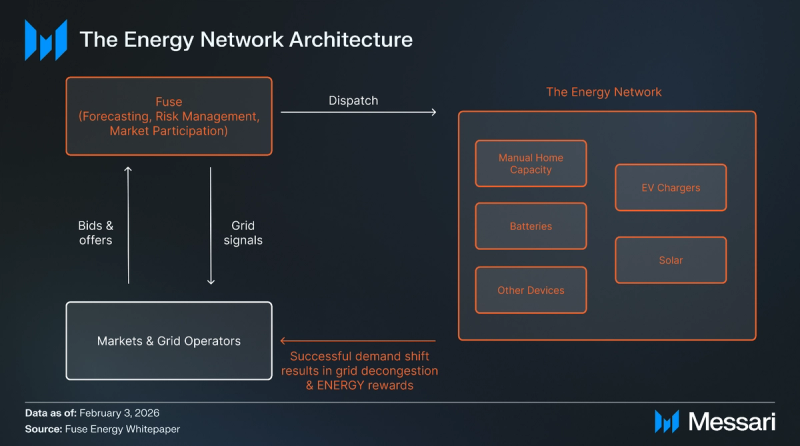
Key architectural parts embody:
- Gadget-agnostic {hardware} integration: The community is designed to work with a variety of EV chargers, batteries, and photo voltaic inverters, hundreds of thousands of which exist already in properties; no proprietary Fuse {hardware} is required.
- Sensible meter-led onboarding: When clients change their dwelling provide to the community, Fuse installs a sensible meter at no further price. The meter, mixed with software program integrations, connects family units, EVs, batteries, photo voltaic, and probably good home equipment, to The Vitality Community.
- Participation layer: Fuse acts because the interface between The Vitality Community and controlled markets, dealing with market entry, danger administration, settlement, and dispatch notifications. Since Fuse is licensed as a retailer, generator, dealer, and DER installer, it might each serve households and function a digital energy plant utilizing the identical underlying asset base.
- Optimization & dispatch: The community optimizes gadget utilization primarily based on value and grid indicators, topic to user-defined constraints resembling minimal battery cost state or time home windows for flexibility. The core monetary mechanism is time-based arbitrage: units cost or eat when costs are low and discharge or shift load when costs are excessive, reducing system prices. Financial savings are shared with clients by way of decrease payments and Vitality Greenback rewards.
- On/offchain break up: Initially, registration and dispatch logic run offchain because of latency and regulatory constraints. Over time, Fuse intends emigrate extra performance onchain because it turns into viable.
This structure permits The Vitality Community to perform as a digital energy plant at scale, orchestrating 1000’s or hundreds of thousands of small units as a single, responsive grid asset. It ingests real-time knowledge from good meters, inverters, and EV chargers, using this knowledge to forecast load and dispatch directions.
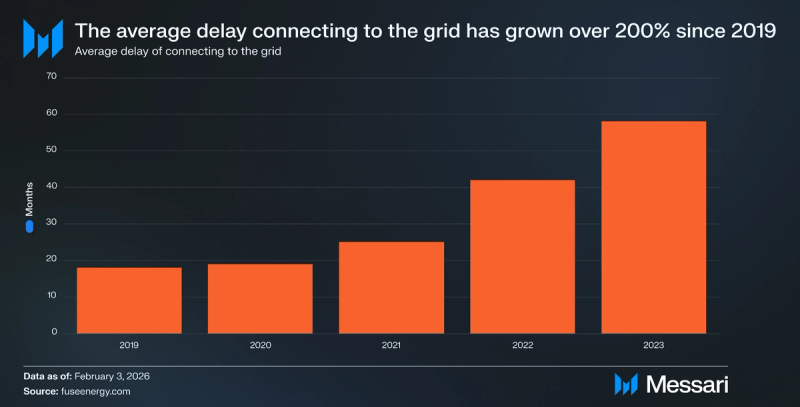
By coordinating when and the way electrical energy is used throughout linked properties, The Vitality Community reduces family vitality prices by shifting consumption away from costly peak durations and towards instances when clear vitality is plentiful and cheap. As an alternative of drawing energy throughout high-price hours, when grids are congested and prices spike, the community routinely schedules versatile units, resembling EV chargers and batteries, to eat, retailer, or export vitality when costs are decrease. This reduces wholesale vitality prices and avoids peak community fees, leading to financial savings which are handed straight again to households. Over time, as extra properties take part, this coordinated flexibility smooths demand throughout the day, stopping value spikes, decreasing system congestion, and reducing the general price of serving electrical energy with out requiring new energy vegetation or grid infrastructure.
ENERGY Tokenomics
The Vitality Greenback (ENERGY) is the native utility token of The Vitality Community. It quantifies the worth a consumer supplies to the grid, whether or not by shifting consumption away from peak hours, exporting clear vitality throughout a deficit, or investing in grid-stabilizing {hardware}.
The token acts because the financial bridge between the bodily physics of the grid (electrons, voltage, frequency) and the behavioral economics of the patron. It turns vitality payments into a chance to earn rewarding clients for flexibility actions they’d select anyway.
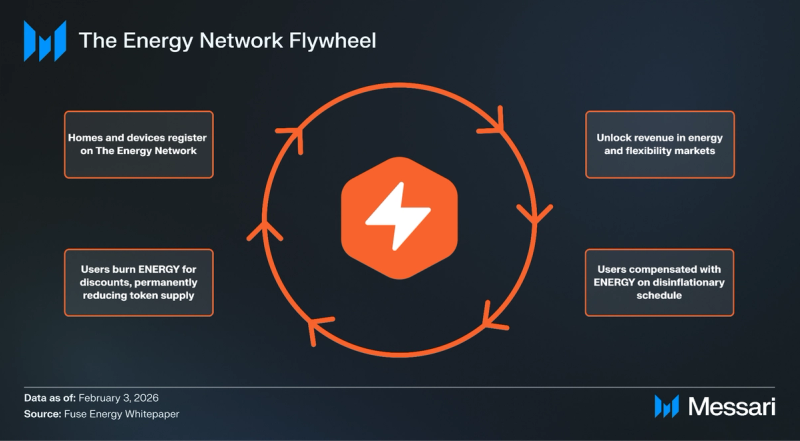
Customers accumulate ENERGY by actions, verifiable onchain on Solana. Examples of actions embody:
- Load Shifting: Delaying EV charging from peak hours to off-peak hours.
- Export: Utilizing a charged dwelling battery and sending the vitality again into the grid when native frequency dips.
Fuse will learn high-resolution good meter knowledge to coach its demand-forecasting AI fashions. The quantity of ENERGY earned is dynamic, calculated primarily based on work contributed to the community at that particular second. For instance, a kWh shifted throughout a crucial grid alert is price considerably extra tokens than a kWh shifted on a gentle spring day.
The first demand sink for the token is the “Burn” mechanism. When a consumer burns tokens, they’re completely faraway from circulation. This creates a deflationary stress on the availability. Customers can burn their ENERGY tokens to unlock reductions on Fuse items and providers, for instance:
- {Hardware} Subsidies: Tokens will be burned to cut back the upfront price of the photo voltaic package, dwelling batteries, or EV chargers.
The utmost provide is 10 billion ENERGY, with emissions deliberate over a 25-year interval. Reward distribution for a given interval is predefined by the core group, and members earn rewards primarily based on their share of the overall worth created throughout that interval.
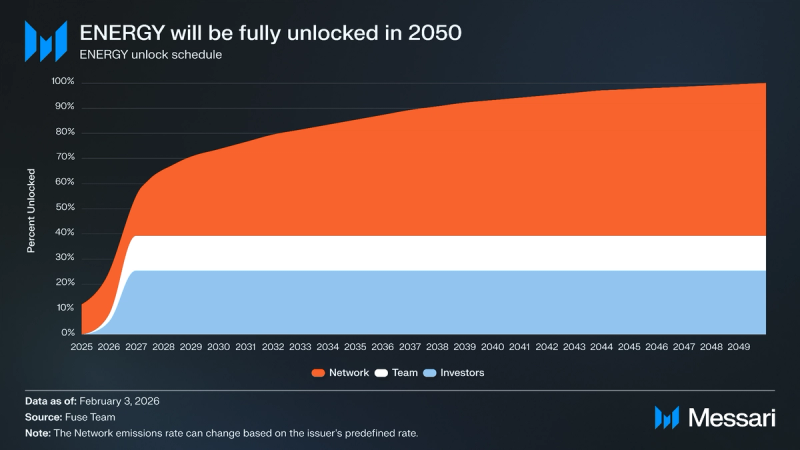
The token distribution is as follows:
- 60.8% (6.08 billion tokens) to the community
- 25.4% (2.54 billion tokens) to buyers
- 13.8% (1.38 billion tokens) to the core group
Crew and investor allocations have a cliff of 20% in December 2026, with the remaining 80% vesting in equal 20% quarterly increments thereafter.
TGE will happen in Q1, and ENERGY has already been added to Coinbase’s itemizing roadmap.
Roadmap
Per a roadmap shared on Telegram by the core group:
Q1 2026
- Launch of The Vitality Community and listings
- Applied export tariffs for photo voltaic clients
Q2 2026
- Launch of plug‑n‑play photo voltaic‑battery package (transportable, renter-friendly; positioned as dramatically cheaper than conventional methods)
- Launch of Autopilot (dwelling vitality OS optimizing utilization by way of time-of-use pricing; managing EV chargers/batteries/photo voltaic; multi-rate tariffs; rising Vitality Greenback earnings)
- Growth to Eire
H2 2026
- Growth to the US
- Growth to Spain
- Launch non-domestic vitality provide
2027+
- Improvement of vertically built-in international vitality provide infrastructure
- Deployment of 1 TW of unpolluted vitality capability
- Continued enlargement throughout Europe, North and South America, and the Asia-Pacific areas
- The Vitality Community turns into the de facto scaling layer for grid methods worldwide
Closing Abstract
Fuse Vitality is constructing a coordination layer to scale vitality methods which are more and more constrained by congestion, volatility, and a passive demand base. As renewable technology turns into cheaper, the first problem dealing with grids has shifted from vitality manufacturing to vitality distribution and balancing. Fuse’s core thesis is that introducing demand flexibility, coordinated throughout hundreds of thousands of small, household-level property, can unlock significant price financial savings and system resilience with out requiring large-scale investments in new technology or transmission infrastructure. The Vitality Community aggregates distributed vitality sources right into a programmable digital energy plant, utilizing tokenized incentives to align family conduct with real-time grid circumstances.
The Vitality Greenback (ENERGY) is designed as a consumptive utility token, with worth derived from verifiable grid providers and burn-based redemption for {hardware} and energy-related merchandise fairly than governance or payment seize. This anchors token demand to real-world utilization. Fuse’s thesis is that the grid doesn’t want customers to make use of much less. It wants higher coordination to drive down the price of vitality, so individuals and companies can use extra vitality to do extra and reside higher. If Fuse can efficiently execute its near-term roadmap, significantly the launch of the Vitality Community, deployment of Autopilot, and worldwide enlargement, the corporate may emerge as probably the most credible establishment to combine crypto incentives straight into crucial vitality infrastructure.
