



Menace hunters have referred to as consideration to a brand new marketing campaign as a part of which unhealthy actors masqueraded as pretend IT help to ship the Havoc command-and-control (C2) framework as a precursor to information exfiltration or ransomware assault.
The intrusions, recognized by Huntress final month throughout 5 companion organizations, concerned the menace actors utilizing e-mail spam as lures, adopted by a cellphone name from an IT desk that prompts a layered malware supply pipeline.
“In one organization, the adversary moved from initial access to nine additional endpoints over the course of eleven hours, deploying a mix of custom Havoc Demon payloads and legitimate RMM tools for persistence, with the speed of lateral movement strongly suggesting the end goal was data exfiltration, ransomware, or both,” researchers Michael Tigges, Anna Pham, and Bryan Masters mentioned.
It is price noting that the modus operandi is in step with e-mail bombing and Microsoft Groups phishing assaults orchestrated by menace actors related to the Black Basta ransomware operation prior to now. Whereas the cybercrime group seems to have gone silent following a public leak of its inside chat logs final 12 months, the continued presence of the group’s playbook suggests two potential situations.
One risk is that former Black Basta associates have moved on to different ransomware operations and are utilizing them to mount recent assaults, or two, rival menace actors have adopted the identical technique to conduct social engineering and acquire preliminary entry.
The assault chain begins with a spam marketing campaign aiming to overwhelm a goal’s inboxes with junk emails. Within the subsequent step, the menace actors, masquerading as IT help, contact the recipients and trick them into granting distant entry to their machines both by way of a Fast Help session or by putting in instruments like AnyDesk to assist remediate the issue.
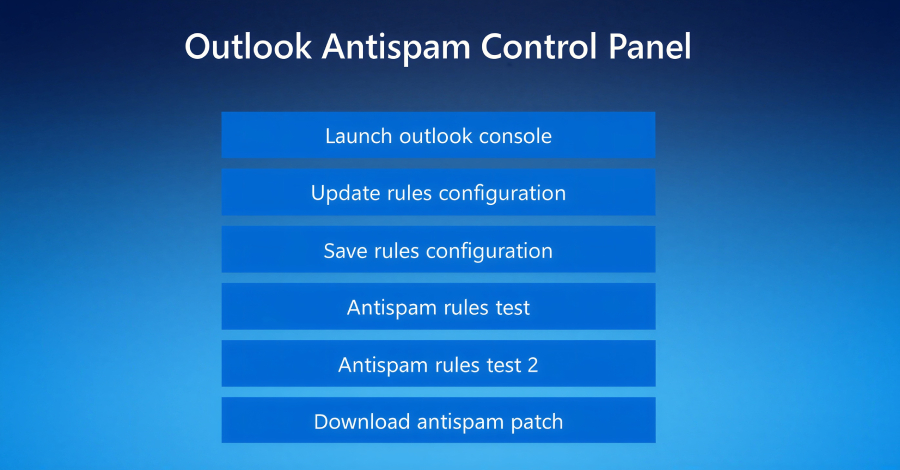
With the entry in place, the adversary wastes no time launching the online browser and navigating to a pretend touchdown web page hosted on Amazon Internet Providers (AWS) that impersonates Microsoft and instructs the sufferer to enter their e-mail tackle to entry Outlook’s anti-spam guidelines replace system and replace the spam guidelines.
Clicking a button to “Update rules configuration” on the counterfeit web page triggers the execution of a script that shows an overlay asking the person to enter their password.
“This mechanism serves two purposes: it allows the threat actor (TA) to harvest credentials, which, when combined with the required email address, provides access to the control panel; concurrently, it adds a layer of authenticity to the interaction, convincing the user the process is genuine,” Huntress mentioned.

The assault additionally hinges on downloading the supposed anti-spam patch, which, in flip, results in the execution of a legit binary named “ADNotificationManager.exe” (or “DLPUserAgent.exe” and “Werfault.exe”) to sideload a malicious DLL. The DLL payload implements protection evasion and executes the Havoc shellcode payload by spawning a thread containing the Demon agent.
At the very least one of many recognized DLLs (“vcruntime140_1.dll”) incorporates extra tips to sidestep detection by safety software program utilizing management movement obfuscation, timing-based delay loops, and strategies like Hell’s Gate and Halo’s Gate to hook ntdll.dll features and bypass endpoint detection and response (EDR) options.
“Following the successful deployment of the Havoc Demon on the beachhead host, the threat actors began lateral movement across the victim environment,” the researchers mentioned. “While the initial social engineering and malware delivery demonstrated some interesting techniques, the hands-on-keyboard activity that followed was comparatively straightforward.”
This contains creating scheduled duties to launch the Havoc Demon payload each time the contaminated endpoints are rebooted, offering the menace actors with persistent distant entry. That mentioned, the menace actor has been discovered to deploy legit distant monitoring and administration (RMM) instruments like Stage RMM and XEOX on some compromised hosts as a substitute of Havoc, thus diversifying their persistence mechanisms.
Some essential takeaways from these assaults are that menace actors are more than pleased to impersonate IT employees and name private cellphone numbers if it improves the success price, strategies like protection evasion that had been as soon as restricted to assaults on massive corporations or state-sponsored campaigns have gotten more and more widespread, and commodity malware is personalized to bypass pattern-based signatures.
Additionally of word is the velocity at which assaults progress swiftly and aggressively from preliminary compromise to lateral motion, in addition to the quite a few strategies used to take care of persistence.
“What begins as a phone call from ‘IT support’ ends with a fully instrumented network compromise – modified Havoc Demons deployed across endpoints, legitimate RMM tools repurposed as backup persistence,” Huntress concluded. “This campaign is a case study in how modern adversaries layer sophistication at every stage: social engineering to get in the door, DLL sideloading to stay invisible, and diversified persistence to survive remediation.”
