



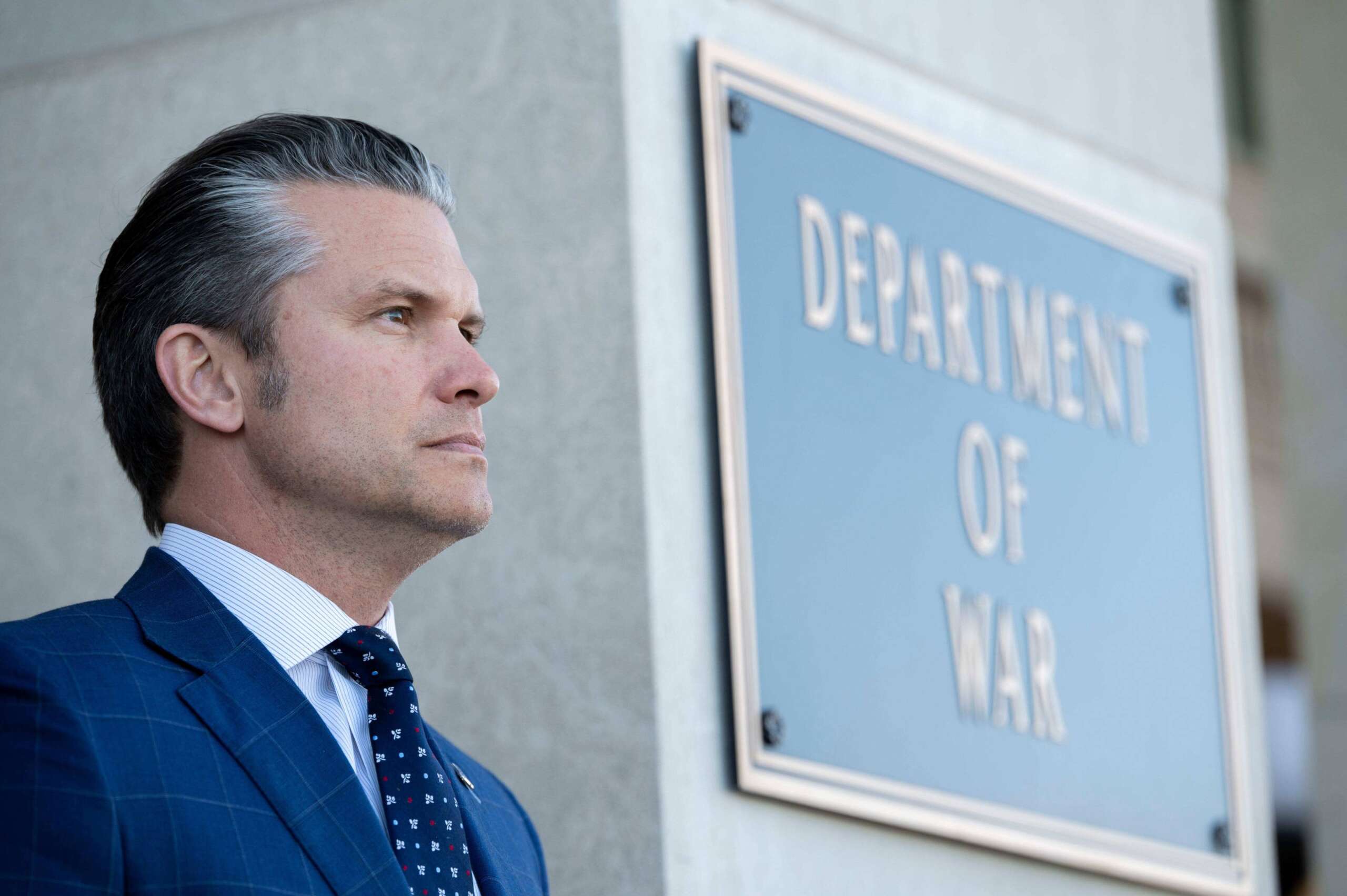
Protection Secretary Pete Hegseth has launched a “ruthless” assessment of how the army’s authorized places of work are organized, saying Pentagon authorized outlets needs to be to be measured in opposition to one normal: whether or not it makes the army extra deadly.
Hegseth framed the assessment as an effort to enhance effectivity by addressing overlapping duties, unsure reporting relationships and inefficient allocation of assets throughout the army’s authorized enterprise, which incorporates 1000’s of uniformed decide advocates and civilian attorneys.
Underneath the plan, Hegseth stated the army’s Choose Advocate Basic Corps ought to concentrate on areas like warfighting, army justice, operational regulation and the regulation of armed battle, or “everything that sharpens the edge in large-scale combat,” whereas civilian attorneys would assist non-operational capabilities, comparable to acquisitions, civilian personnel and IP.
“Over 20 years, legal shops across the services have grown bloated and duplicative. They’ve muddied lines of authority and pulled critical judge advocates away from what matters most — advising commanders,” Hegseth stated in a video posted on social media platform X.
“Scrub it clean, cut duplication and bureaucracy, clarify roles and reporting, no more moral ambiguity. Align functions so that military legal stays laser focused on warfighting and readiness. Let civilian lawyers handle non-operational stuff. We laid out our recommended split — military matters to JAGs and [staff judge advocates], civilian to general counsels, with room for limited shared areas like standards of conduct or [Freedom of Information Act] and privacy if it makes sense for the services,” he added.
The trouble is a part of a broader push to shift the division from what he has described as “tepid legality” towards “maximum lethality.”
Whereas decreasing duplication and clarifying duties may enhance effectivity, some authorized specialists say the assessment will seemingly be used to skinny out the ranks of army attorneys, push out skilled attorneys providing unbiased authorized opinions and exchange them with “box checkers.”
“There’s probably some truth to the fact that GS employees and uniformed JAGs have overlapping responsibilities and overlapping billets, and there’s work being done by both that could be done by one or the other. Restructuring or reorganizing to clearly differentiate and delineate who does what does sound like a prudent allocation of scarce resources. The truth is it’s probably done to intimidate the institutional knowledge,” Sean Timmons, a managing accomplice on the Tully Rinckey regulation agency, instructed Federal Information Community.
“The intent is to thin out the ranks considerably and get people to retire permanently and just disappear entirely. I think that’s the intent, and the reason for that is there’s a lot of institutional resistance within people who’ve been around prior administrations, and the impediment from institutional knowledge is probably a significant roadblock,” he added.
The overhaul comes after Hegseth fired prime army attorneys, labeling them as “roadblocks” to commander-in-chief orders.
“The commanders ultimately make a decision on what they want to do, but the attorneys have a right under their ethical guidelines to advise what they think is legal and not legal. Attorneys don’t make the ultimate decision. If the commander wants to override the advice of the attorney, they can do so. It’s just the attorney’s advice. The law says we can do this and we can do that, and we shouldn’t do this. If you do do this, you risk legal exposure, you risk legal liability. I think that’s irked a lot of senior leadership, to a significant extent and they are trying to get more ‘yes’ men,” Timmons stated.
Hegseth directed the army companies to submit stories inside 45 days and implement any modifications inside six months.
“Delineate functions, review component distribution and education, recommend fixes to kill redundancies and to boost efficiency, and then implement it fast,” Hegseth stated.
Timmons stated the companies can come again with a much-reduced JAG Corps.
“A lot of the positions are appropriated, they don’t have to fill them. They can reallocate the resources and say, ‘I actually don’t need all these people, so let’s get rid of half of them.’ And then you’re going to have a lot of gap. And a lot of ‘prioritize what needs to be done versus what doesn’t need to be done.’ That’s something that leadership can certainly do. They can certainly gut the resources available and reduce the size of the JAG Corps considerably,” Timmons stated.
In the meantime, over the previous yr, dozens of army attorneys have been pulled away from their duties to assist this administration’s broader priorities. Final yr, Hegseth started detailing army attorneys to the Justice Division to function particular assistant U.S. attorneys in places of work dealing with immigration enforcement — the Protection Division may element as much as 600 army attorneys to the Justice Division as short-term immigration judges.
Dozens of army attorneys have additionally been briefly assigned to function federal prosecutors supporting regulation enforcement surges in Minneapolis.
If you want to contact this reporter about current modifications within the federal authorities, please electronic mail anastasia.obis@federalnewsnetwork.com or attain out on Sign at (301) 830-2747.
Copyright
© 2026 Federal Information Community. All rights reserved. This web site will not be meant for customers positioned throughout the European Financial Space.
