




Think about you might be operating a bunch of microservices, every residing inside its personal boundary. What are a number of the challenges that come into thoughts when working them?
- Retries: Service-to-service calls are usually not all the time dependable. They’ll fail resulting from a variety of causes, starting from timeouts to transient community points, or downstream outages. With the intention to recuperate, it is not uncommon for functions to implement retry logic. Over time, this logic turns into tightly coupled with enterprise code, and each developer is anticipated to configure retries appropriately.
- Observability additionally presents an identical problem. Every service should be instrumented with metrics, logs, and traces to know request stream, latency, and failures. This instrumentation is usually repetitive and straightforward to get mistaken or overlook and when observability is inconsistent, debugging manufacturing points turns into sluggish and irritating.
That is the place Distributed Utility Runtime (Dapr) comes into image. Dapr is a CNCF-hosted, open-source runtime that gives constructing blocks for distributed functions via a sidecar structure. It helps summary most of those constructs right into a sidecar runtime so that you just as builders can consider enterprise logic. Merely put, it’s an open-source and event-driven runtime that simplifies a number of the widespread issues builders face with constructing distributed methods and microservices.
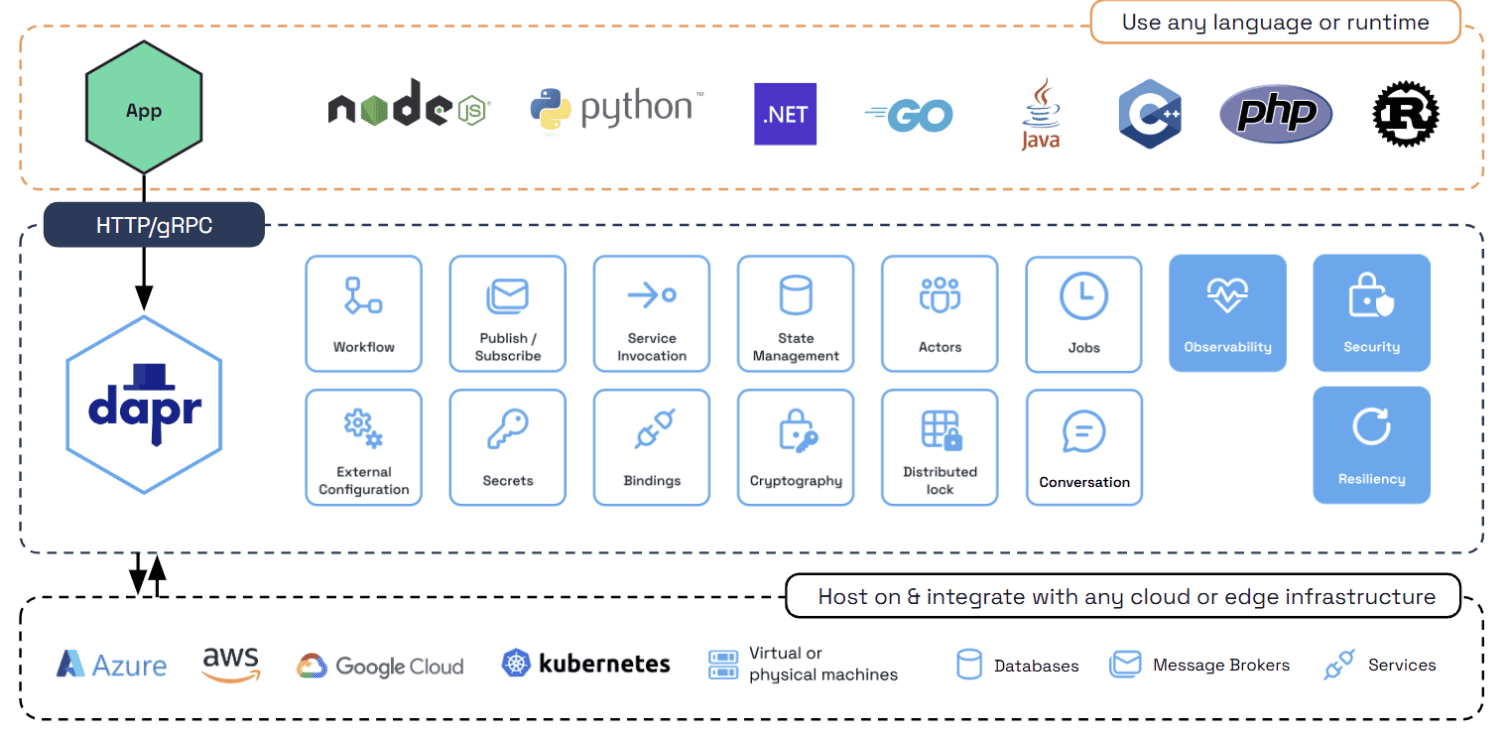
Beneath is an instance of a easy software interacting with the Dapr runtime to make use of a number of options, known as constructing blocks, akin to workflows, pub/sub, conversations, and jobs. Together with the constructing blocks, Dapr additionally gives SDKs for many main programming languages, making it simple to combine these capabilities into functions.
Supply:
As a part of this tutorial, we’ll cowl learn how to use the Dapr dialog constructing block for interacting with completely different Massive Language Fashions (LLM) suppliers.
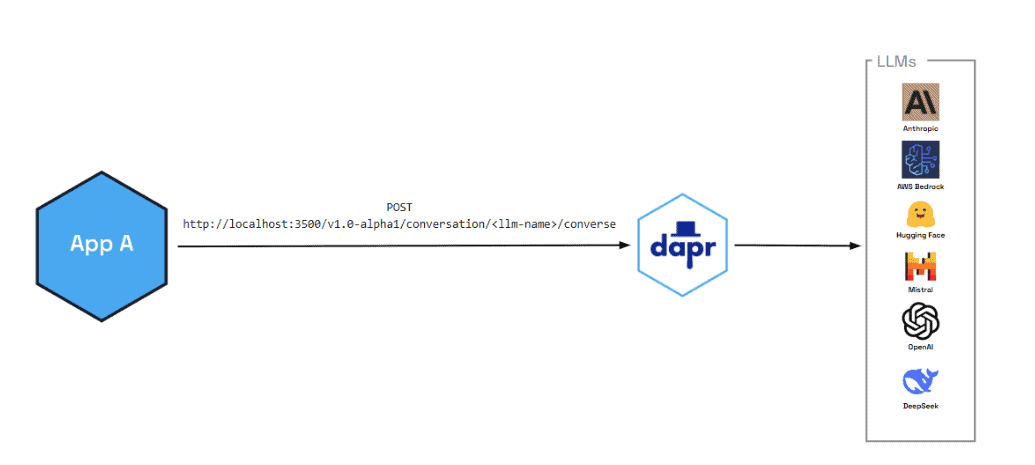
LLM suppliers akin to Anthropic, Google, OpenAI, and Ollama expose APIs that differ in each interface design and behavioral contracts. And supporting a number of suppliers usually forces functions to embed provider-specific logic instantly into the codebase. However, what if software builders solely needed to concentrate on prompts and power calls, whereas the runtime dealt with provider-specific implementations, API interactions, and retry habits? This type of abstraction wouldn’t solely simplify improvement but in addition make it simpler to undertake or swap between LLM suppliers over time.
By declaring the LLM as a element in Dapr, we will obtain this abstraction by letting the runtime deal with intricacies of software dealing with and LLM api calls to Dapr. For instance, with the intention to declare the anthropic element, we specify the sort as “conversation.anthropic” with mannequin values and api key.
apiVersion: dapr.io/v1alpha1
sort: Element
metadata:
  identify: anthropic
spec:
  kind: dialog.anthropic
  metadata:
  - identify: key
    worth: "anthropic-key"
  - identify: mannequin
    worth: claude-opus-4.5
  - identify: cacheTTL
    worth: 1m
Within the Dapr ecosystem, functionalities are delivered as elements. So, if you happen to have been to make use of for instance, the secrets and techniques performance (one other standard function), declare the secrets and techniques element in a yaml config and Dapr will choose it up. Extra in regards to the element idea will be discovered right here.
Now, coming again to the LLM element, just like Anthropic, if we need to discuss to OpenAI, we’ll use the “conversation.openai” spec kind and declare its corresponding fields.
apiVersion: dapr.io/v1alpha1
sort: Element
metadata:
  identify: openai
spec:
  kind: dialog.openai
  metadata:
  - identify: key
    worth: mykey
  - identify: mannequin
    worth: gpt-4-turbo
  - identify: endpoint
    worth: '
  - identify: cacheTTL
    worth: 10m
supply:
It’s time to see the dialog performance in motion. Set up the dapr cli, Docker Desktop after which run
dapr initSubsequent, clone the Dapr java-sdk repository which additionally comprises dialog element examples.
Run maven clear set up to obtain all of the packages and create jars.
mvn clear set up -DskipTests
Then, use the “dapr run” to start out the dapr runtime. The resources-path right here specifies the folder the place all Dapr elements information are declared.
dapr run --resources-path ./elements/dialog --app-id myapp --app-port 8080 --dapr-http-port 3500 --dapr-grpc-port 51439 --log-level debug -- java -jar goal/dapr-java-sdk-examples-exec.jar io.dapr.examples.dialog.AssistantMessageDemo Beneath are the contents of the “AssistantMessageDemo” java file:
ToolMessage – Accommodates the outcome returned from an exterior software or perform that was invoked by the assistant.
SystemMessage – Defines the AI assistant’s position, character, and behavioral directions.
UserMessage – Represents enter from the human person within the dialog.
AssistantMessage – The AI’s response, which might comprise each textual content content material and power/perform calls.
Lastly, we use the DaprClient to make a name to the Dapr runtime domestically printing out the response.
public class AssistantMessageDemo {

  public static void major(String[] args) {
    attempt (var shopper = new DaprClientBuilder().buildPreviewClient()) {

      var messages = Record.of(
          new SystemMessage(Record.of(
              new ConversationMessageContent(
                  "You are a helpful assistant for weather queries."
              ))),

          new UserMessage(Record.of(
              new ConversationMessageContent("What's the weather in San Francisco?")
          )),

          new AssistantMessage(
              Record.of(new ConversationMessageContent(
                  "Checking the weather."
              )),
              Record.of(new ConversationToolCalls(
                  new ConversationToolCallsOfFunction(
                      "get_weather",
                      "{"location":"San Francisco","unit":"fahrenheit"}"
                  )
              ))
          ),

          new ToolMessage(Record.of(
              new ConversationMessageContent(
                  "{"temperature":"72F","situation":"sunny"}"
              )
          )),

          new UserMessage(Record.of(
              new ConversationMessageContent(
                  "Should I wear a jacket?"
              )
          ))
      );

      var request = new ConversationRequestAlpha2(
          "echo",
          Record.of(new ConversationInputAlpha2(messages))
      );

      System.out.println(
          shopper.converseAlpha2(request)
                .block()
                .getOutputs().get(0)
                .getChoices().get(0)
                .getMessage().getContent()
      );
    }
  }
}
The above code instance reveals how Dapr’s dialog constructing block makes it simpler to work with Massive Language Fashions—with out tying your code to anyone supplier.
As a substitute of embedding provider-specific SDKs and dealing with API quirks your self, you declare your LLMs as Dapr elements. The runtime takes care of the combination particulars: retries, authentication, and all of the little variations between suppliers.
