



Picture by Editor
# Introduction
The emergence of agentic AI techniques marks a big shift in how builders strategy clever software growth. The Agent Improvement Package (ADK) from Google addresses a vital hole on this ecosystem by offering a framework that simplifies the development and deployment of multi-agent techniques. Current demonstrations from Google Cloud Labs illustrate how ADK transforms complicated agent orchestration into manageable, production-ready purposes.
# Understanding Agent Improvement Package’s Core Function
The Agent Improvement Package serves as a specialised framework designed to deal with the foundational work required for constructing AI brokers. Somewhat than forcing builders to implement agent coordination, state administration, and gear invocation patterns from scratch, ADK gives these capabilities as built-in abstractions. This strategy permits growth groups to deal with application-specific logic and enterprise necessities fairly than infrastructure considerations.
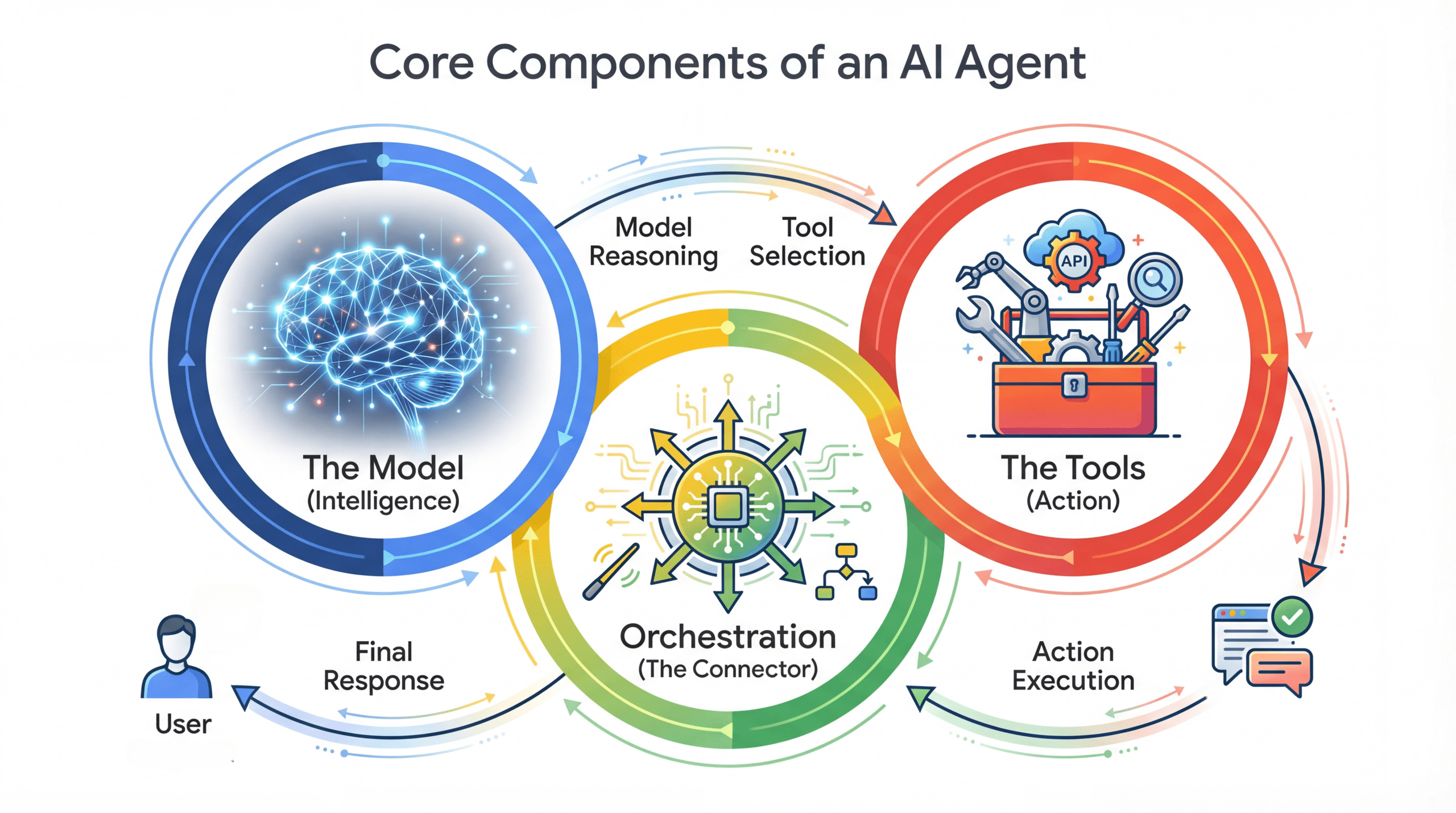
The framework defines an agent as a system that makes use of a mannequin to purpose about and choose applicable instruments to realize particular targets. This definition encompasses three vital parts: the mannequin that gives intelligence, the instruments that allow motion, and the orchestration layer that connects them. ADK focuses on managing this orchestration layer, making a standardized strategy to agent growth.

Manufacturing AI agent structure workflow between ADK, MCP, and Vertex AI | Picture by Editor (click on to enlarge)
# Multi-Agent Structure and Coordination
One in every of ADK’s distinguishing options lies in its assist for multi-agent techniques. Somewhat than limiting builders to single-agent architectures, the framework permits the creation of specialised brokers that work collectively to perform complicated duties. This sample proves notably invaluable for purposes requiring several types of processing or experience.
A consultant implementation may embrace three distinct brokers, every with particular obligations. A greeter agent handles preliminary consumer interplay and request parsing. A researcher agent retrieves info from exterior sources comparable to Wikipedia or enterprise databases. A response agent synthesizes info from different brokers into coherent, user-facing outputs. ADK manages the communication between these brokers, guaranteeing correct sequencing and knowledge circulate.
This multi-agent sample gives a number of architectural benefits. Every agent might be developed, examined, and optimized independently. Specialised brokers turn out to be reusable throughout completely different purposes. The system beneficial properties flexibility so as to add or modify brokers with out restructuring your entire software. Debugging and monitoring turn out to be extra granular, as points might be remoted to particular brokers.
# Integration with AI Fashions and Companies
ADK operates as middleware between consumer interfaces and AI fashions, managing the complexities of mannequin interplay. The framework integrates seamlessly with Vertex AI‘s Gemini fashions, dealing with API calls, response parsing, and error administration. This integration abstracts away the low-level particulars of mannequin communication, permitting builders to work at the next stage of abstraction.
The structure positions ADK between the presentation layer and the intelligence layer. Consumer requests arrive by means of an online UI or API. ADK receives these requests and determines which brokers ought to deal with them. Brokers leverage Vertex AI fashions for reasoning and decision-making. Outcomes circulate again by means of ADK to the consumer interface. This clear separation of considerations simplifies each growth and upkeep.
Importantly, ADK’s design doesn’t lock builders into particular mannequin suppliers. Whereas demonstrations deal with Vertex AI integration, the framework’s structure helps connections to varied mannequin backends, together with self-hosted fashions like Gemma operating on specialised infrastructure.
# Mannequin Context Protocol Integration
A vital functionality of ADK-based techniques includes integration with Mannequin Context Protocol (MCP) servers. These servers expose instruments and knowledge sources that brokers can invoke to increase their capabilities past pure language processing. ADK manages the invention, invocation, and end result dealing with for these exterior instruments.
The workflow for MCP integration follows a transparent sample. An agent receives a consumer question requiring exterior info or motion. ADK facilitates the agent’s evaluation of obtainable MCP instruments. The agent, utilizing its underlying mannequin, determines which software finest addresses the question. ADK handles the precise software invocation and captures the outcomes. The agent incorporates software outputs into its reasoning and response technology.
This integration permits highly effective use circumstances. Brokers can question databases by means of MCP-exposed database instruments. Exterior APIs turn out to be accessible as agent capabilities. Customized enterprise logic might be packaged as MCP instruments for agent consumption. Actual-time knowledge sources combine seamlessly into agent workflows.
The instance of a Wikipedia researcher agent demonstrates this sample successfully. The agent software connects to Wikipedia by means of an MCP server, enabling the agent to retrieve present info dynamically fairly than relying solely on coaching knowledge. This sample extends to any exterior useful resource that may be uncovered by means of the MCP protocol.
# Deployment Structure and Cloud Run Integration
ADK purposes deploy naturally to Cloud Run, Google’s serverless container platform. This deployment technique aligns with trendy cloud-native growth practices and gives particular benefits for agent-based purposes. The standard structure separates considerations between agent logic and mannequin inference, with ADK managing the previous.
In a manufacturing deployment, ADK runs on Cloud Run situations configured with CPU-only sources. These situations deal with software logic, agent coordination, request routing, and response meeting. The framework makes use of FastAPI as its net framework, offering environment friendly request dealing with and clear API definitions. As a result of ADK itself doesn’t carry out intensive mannequin inference, CPU situations show adequate and cost-effective.
The precise mannequin inference happens in a separate service, typically operating on GPU-enabled Cloud Run situations. This decoupling creates a number of advantages. Costly GPU sources are allotted solely the place mandatory for mannequin execution. The ADK layer scales independently based mostly on request quantity. Mannequin updates can happen with out affecting agent logic. Totally different fashions can serve completely different brokers inside the identical software.
# Improvement Workflow and Tooling
ADK integrates with Cloud Shell Editor, offering builders with an entire cloud-based growth surroundings. This integration eliminates native setup necessities and ensures constant growth experiences throughout groups. Builders can write agent code, check interactions, and deploy to Cloud Run with out leaving the browser-based IDE.
The online UI element of ADK serves a number of functions throughout growth. It gives a testing interface for agent interactions. Builders can observe agent decision-making processes in real-time. Device invocations and their outcomes turn out to be seen for debugging. Multi-agent coordination might be monitored and refined. This visibility proves invaluable when growing complicated agent techniques.
The framework helps iterative growth cycles. Builders can modify agent conduct and check modifications instantly. Cloud Run’s deployment pace permits fast experimentation. The separation between ADK configuration and mannequin choice permits testing with completely different fashions with out code modifications. This flexibility accelerates the event course of considerably.
# Dealing with Concurrent Customers and Scalability
Manufacturing purposes should deal with various hundreds effectively. ADK’s deployment on Cloud Run gives pure scalability mechanisms, however the framework itself contains design selections that assist concurrent operations. Understanding how ADK manages a number of simultaneous requests proves important for manufacturing deployments.
Contemplate a situation with three concurrent customers, every making requests that require a number of seconds of processing. With out correct structure, these requests may queue, creating poor consumer expertise. ADK’s integration with Cloud Run permits parallel processing by means of occasion scaling and concurrency configuration.
The framework manages request isolation, guaranteeing that concurrent requests to the identical agent don’t intrude with one another. State administration turns into vital on this context. ADK handles session knowledge appropriately, sustaining context for particular person conversations whereas sharing agent definitions throughout requests. This design permits environment friendly useful resource utilization with out compromising consumer expertise.
When mixed with Cloud Run’s autoscaling capabilities, ADK-based purposes can deal with site visitors spikes gracefully. As request quantity will increase, extra situations spawn mechanically. As site visitors decreases, situations scale down to attenuate prices. The framework’s stateless design for core operations facilitates this elastic scaling.
# Price Optimization Methods
The decoupled structure enabled by ADK creates alternatives for important price optimization. By separating agent logic from mannequin inference, organizations can allocate costly sources exactly the place wanted. ADK runs effectively on normal CPU situations, which price considerably lower than GPU-enabled infrastructure.
The sample works as follows. All agent coordination, software invocation, and response meeting happen on CPU situations. Solely when an agent wants mannequin inference does a request path to the GPU-enabled service. The GPU service handles the inference and returns outcomes. Management returns to the CPU-based ADK service for additional processing. This design minimizes GPU utilization and related prices.
Further optimization comes from Cloud Run’s scale-to-zero functionality. During times of inactivity, each ADK situations and mannequin companies can scale to zero, eliminating prices totally. When requests arrive, companies begin inside seconds, sustaining good consumer expertise whereas optimizing useful resource consumption.
For purposes with predictable site visitors patterns, builders can configure minimal and most occasion counts. This prevents chilly begins throughout identified busy durations whereas capping prices throughout site visitors spikes. ADK’s structure helps these configurations with out code modifications.
# Device Integration and Extensibility
ADK’s software integration capabilities prolong past MCP servers to incorporate numerous varieties of exterior sources. The framework gives patterns for integrating databases, APIs, file techniques, and customized enterprise logic. This extensibility transforms brokers from remoted language processors into complete software parts.
The software integration sample follows constant rules whatever the particular software sort. Instruments are outlined with clear descriptions that fashions can interpret. Parameters are specified with varieties and constraints. Outcomes are returned in structured codecs that brokers can course of. Error dealing with ensures swish degradation when instruments fail. ADK manages these interactions, abstracting complexity from particular person agent implementations.
Customized instruments might be developed to fulfill particular software necessities. A monetary software may embrace instruments for retrieving inventory costs, calculating portfolio metrics, or executing trades. A customer support software may expose instruments for querying order standing, initiating returns, or updating buyer info. ADK treats all instruments uniformly, simplifying agent growth.
# State Administration and Dialog Context
Agent purposes typically require sustaining context throughout a number of interactions. ADK addresses this requirement by means of structured state administration approaches. Whereas the framework encourages stateless design for scalability, it gives mechanisms for managing conversational state when mandatory.
For easy request-response patterns, ADK operates statelessly. Every request accommodates all mandatory context, and the agent processes it independently. This strategy maximizes scalability and simplifies deployment. For conversational purposes requiring reminiscence of earlier interactions, ADK helps state persistence by means of numerous backends.
The framework permits builders to decide on applicable state storage based mostly on necessities. Brief-term conversational state may reside in reminiscence or quick caching companies. Lengthy-term consumer preferences or historic knowledge may persist in databases. ADK abstracts these storage mechanisms, permitting purposes to evolve their state administration methods with out rewriting agent logic.
# Error Dealing with and Reliability
Manufacturing agent techniques should deal with numerous failure modes gracefully. Mannequin API calls could timeout or fail. Exterior instruments may turn out to be unavailable. Consumer inputs could also be ambiguous or contradictory. ADK incorporates patterns for managing these situations, bettering general system reliability.
The framework gives structured error dealing with for frequent failure modes. When a mannequin name fails, ADK can retry with exponential backoff or fall again to various fashions. When exterior instruments are unavailable, brokers can acknowledge limitations fairly than failing silently. When requests are ambiguous, brokers can search clarification by means of structured prompts.
Builders can customise error dealing with conduct based mostly on software necessities. Essential operations may require strict validation and assured execution. Informational queries may tolerate partial failures and approximations. ADK’s flexibility permits applicable error dealing with for various use circumstances.
# Safety and Permission Administration
Agent techniques that work together with exterior instruments and knowledge sources require cautious safety consideration. ADK incorporates patterns for managing permissions and guaranteeing safe software execution. The framework helps authentication and authorization at a number of ranges.
The demonstration contains consumer permission flows for software execution. When an agent determines {that a} software name is important, it may well request consumer approval earlier than continuing. This sample proves notably essential for instruments that modify knowledge or provoke exterior actions. ADK manages the permission request, consumer response, and conditional execution circulate.
For programmatic safety, ADK integrates with Google Cloud’s identification and entry administration techniques. Service accounts might be configured with minimal mandatory permissions. Device entry might be restricted based mostly on consumer roles. Audit logs observe software invocations for compliance necessities. These safety features make ADK appropriate for enterprise deployments dealing with delicate knowledge.
# Monitoring and Observability
Understanding agent conduct in manufacturing requires complete monitoring and logging. ADK integrations with Cloud Logging and Cloud Monitoring present visibility into agent operations. Builders can observe metrics comparable to request quantity, response latency, software invocation frequency, and error charges.
The framework mechanically logs key occasions in agent workflows. Request arrival and routing selections turn out to be seen. Device invocations and their outcomes are recorded. Mannequin interactions are tracked. This logging proves invaluable for debugging points, optimizing efficiency, and understanding utilization patterns.
Customized metrics might be outlined for application-specific monitoring. An e-commerce agent may observe product advice accuracy. A assist agent may monitor decision charges. ADK’s integration with monitoring techniques makes these customized metrics simple to implement and visualize.
# Sensible Implementation Concerns
A number of sensible elements affect profitable ADK implementations. The selection of agent granularity impacts each efficiency and maintainability. Extremely specialised brokers present flexibility however improve coordination complexity. Broader brokers simplify orchestration however could turn out to be troublesome to take care of. Discovering the precise steadiness requires understanding particular software necessities.
Device descriptions deserve cautious consideration, as fashions depend on these to pick applicable instruments. Clear, concise descriptions enhance agent decision-making. Effectively-defined parameters scale back errors. Considerate group of instruments by area or operate simplifies agent reasoning. Investing time in software design pays dividends in agent effectiveness.
Testing methods for agent techniques differ from conventional purposes. Deterministic testing proves difficult when fashions introduce variability. ADK helps test-friendly patterns comparable to mannequin mocking and gear stubbing. Analysis frameworks can assess agent efficiency throughout dialog situations. Steady testing ensures that modifications to brokers or instruments don’t degrade general system conduct.
# Future Instructions and Ecosystem Evolution
The agent growth panorama continues to evolve quickly. ADK represents a step towards standardizing agent growth patterns and lowering implementation complexity. Because the framework matures, extra capabilities will probably emerge.
Integration with extra mannequin suppliers will develop deployment flexibility. Enhanced state administration choices will assist extra subtle conversational purposes. Improved debugging and growth instruments will speed up implementation cycles. Richer libraries of pre-built brokers and instruments will scale back growth time for frequent use circumstances.
The convergence of ADK with serverless platforms and managed AI companies signifies a broader pattern. Organizations more and more choose built-in options that deal with infrastructure complexity whereas sustaining growth flexibility. ADK positions itself at this intersection, offering construction with out sacrificing adaptability.
# Conclusion
Agent Improvement Package addresses a vital want within the AI software ecosystem. By abstracting agent orchestration complexity, supporting multi-agent architectures, and integrating with cloud-native deployment platforms, ADK permits builders to construct production-ready agent techniques effectively. The framework’s emphasis on sensible deployment patterns, price optimization, and extensibility makes it appropriate for real-world purposes past prototype demonstrations.
Success with ADK requires understanding its architectural patterns and leveraging them appropriately. The separation of agent logic from mannequin inference, the usage of MCP for software integration, and the deployment to serverless infrastructure all contribute to scalable, maintainable techniques. As agentic AI strikes from experimentation to manufacturing, frameworks like ADK that deal with foundational complexity whereas sustaining flexibility will show more and more invaluable.
Rachel Kuznetsov has a Grasp’s in Enterprise Analytics and thrives on tackling complicated knowledge puzzles and trying to find recent challenges to tackle. She’s dedicated to creating intricate knowledge science ideas simpler to know and is exploring the varied methods AI makes an influence on our lives. On her steady quest to study and develop, she paperwork her journey so others can study alongside her. You could find her on LinkedIn.
