



An utility, composed of a number of containers as dictated by system structure, that operates both independently or as a part of a distributed collaboration—interacting with at the very least one different entity (container) or reaching quorum-based consensus. It leverages AI or Machine Studying capabilities to cause and execute actions inside event-driven methods, the place habits is triggered or modulated by alerts. Its defining attributes: embody differing ranges of autonomy in executing system or person duties, coupled with the flexibility to plan, orchestrate, and govern the continuation or completion of its personal execution. In cloud-native environments, these parts are generally packaged and deployed as containerized microservices.
Overview
Inside the cloud native ecosystem, there was an explosion in agentic AI. Speedy prototyping and adoption recommend potential for companies to speed up time to worth for services and products for organizations throughout all sectors and know-how verticals. Whereas this curiosity could be very promising for this burgeoning area, challenges exist when it comes to standardization and interoperability, that are presently missing.
Agentic methods present the means to carry out multi-hop reasoning, and subsequent motion calling based mostly upon alerts to reinforce and supply dynamism to traditional programming sequences.
This paper explores 4 key areas the place standardization is required to make sure interoperability, safety, and observability from the outset. The main target of this doc isn’t on how particular agentic protocols are applied, which programming languages are used, or their execution effectivity. As a substitute, it offers an agnostic view of greatest practices that allow deployments on this area to scale securely whereas remaining observable and explainable via a standard foundational framework.
The suggestions described are completely centered on cloud native environments constructed on Kubernetes. This extends to situations the place Kubernetes could also be deployed in public, personal, hybrid or edge compute kind situations, as there are nuances within the area of safety related to these environments and methods.
This doc offers a foundational guidelines for agentic requirements, however isn’t meant to be exhaustive and can proceed to evolve as practices and the instruments enhance.
Normal
This part outlines foundational container and observability greatest practices for cloud native workloads, together with agentic AI methods. Evolving challenges embrace the fast development of agent environments and capabilities, which require governance frameworks to adapt constantly. Future analysis and standardization efforts ought to concentrate on nuanced reward features, layered reasoning architectures with built-in controls, and strong security and alignment strategies to handle more and more succesful and autonomous methods.
Normal greatest practices for containers:
The containerization ideas outlined beneath embrace rising definitions of agentic providers (e.g., autonomous, signal-driven, reasoning-capable container methods deployed inside microservice-oriented architectures). The suggestions will not be particular to agentic use instances and apply to any containerized or serverless setting.
Normal greatest practices embrace: Safety, which covers minimizing assault floor and safeguarding container integrity; Observability, which focuses on accumulating actionable metrics, logs, and traces to know system habits; and Availability and Fault Tolerance, which outlines methods for sustaining service continuity and resilience beneath failure situations.
Safety
- Implement the precept of least privilege for containers. Solely grant the minimal permissions required for the container to function, minimizing the assault floor. This requires configuring person controls, community insurance policies, safety contexts of containers, and entry management.
- Data hiding – Keep away from exposing pointless dependencies exterior the container.
- Bundle solely what is required, use multi-stage builds to reduce picture dimension, and keep away from leaking construct instruments, credentials, or secrets and techniques.
- Use safe container photographs from official, trusted repositories, scanning photographs for vulnerabilities commonly. Signal and confirm photographs to make sure the integrity and provenance of container photographs. Add OCI-compliant annotations to container photographs to doc metadata resembling supply, model, authorship, scan standing, and signature info.
- Observe secret administration greatest practices. By no means bake secrets and techniques into container photographs. Use Kubernetes Secrets and techniques or combine with secret managers.
- Run containers as non-root customers. Outline a non-root person within the Dockerfile and configure the runtime to make use of it. This limits the blast radius in case of a safety breach.
- Repeatedly monitor and replace base photographs of the container to incorporate the newest safety patches and keep away from identified vulnerabilities. Use distroless photographs the place doable.
- Log and monitor container exercise. Monitor runtime habits, useful resource utilization, filesystem entry, community exercise, and system calls to detect anomalies or safety incidents early.
Observability
- Use a regular observability stack Metrics, Occasions, Logs, Traces (MELT). Consolidating metrics, logs, and traces to make sure viable explainability and achievable debugability of the system.
- Incorporate community observability by accumulating move logs for safety, efficiency monitoring, and troubleshooting.
- Monitor resource-specific metrics and related community metrics for system robustness on the info path between key parts
- Disk Utilization: Monitor disk utilization on nodes and protracted volumes to forestall outages brought on by storage exhaustion.
- CPU / GPU: Monitor utilization on the node and container degree to detect bottlenecks, and put together for potential In-Place pods resizing overhead
- Monitor management aircraft and node well being within the cluster.
- Instrument workloads with related metrics and expose application-level and business-critical metrics along with system-level metrics.
- Arrange alerting based mostly on SLOs/SLA thresholds.
- Implement price observability to help GPU and LLM benchmarking.
- Safe observability pipelines to keep away from tampering with audit trails from brokers.
- Arrange information retention and aggregation insurance policies.
Availability and fault tolerance (basic)
- Implement useful resource limits and requests to forestall noisy neighbor points and guarantee container stability. Set affordable CPU/GPU and reminiscence boundaries in your Kubernetes pod specs.
- Make the most of PodDisruptionBudgets to implement minimal pod availability throughout voluntary disruptions like upgrades or node drains.
- Use Pod Anti‑Affinity or Topology Unfold Constraints to distribute pod replicas throughout nodes or zones, minimizing the influence of node or zone-level failures when doable.
- Use Horizontal Pod Autoscaler (HPA) to scale workloads dynamically utilizing CPU, Reminiscence, or customized metrics resembling request quantity.
NOTE: The above objects are basic in nature, and whereas relevant to good load-balancing to inference fashions, doesn’t pertain to extra complete MCP / Agent to Agent or LLM tooling.
Availability and fault tolerance (inference particular)
- Inference extensions offered through the Gateway API be sure that path-based guidelines are to be utilized with a concentrate on inference served AI Fashions to reinforce robustness and availability. This functionality helps extra dynamic deployment situations utilized by brokers.
Pattern request move with Kubernetes Gateway API Inference Extensions InferencePool endpoints working a mannequin server framework
Supply:
PLEASE NOTE: The Normal Part isn’t an exhaustive checklist of each greatest observe, quite it’s included as a primer on quite a lot of adjoining basis matters related to the primary physique of this doc that’s centered in the direction of brokers. Hyperlinks to extra exhaustive overviews of such matters and practices may be discovered within the footnote part. Extra present literature, white papers, and documentation from the CNCF and Linux Basis must also be thought of to make sure the most effective selections are made round this consistently shifting know-how area.
Footnotes:
Management and communication
Microservice architectures have lengthy adopted the ideas and practices of knowledge hiding, minimal endpoint publicity for under the requisite and wanted providers, and clear contract-based communications. These similar ideas ought to be adopted within the context of agentic architectures. As multi-agent methods develop, the intricacy of making certain efficient coordination and communication rises considerably. Whereas Kubernetes offers the platform, the complexities of inter-agent communication protocols (like MCP, A2A) and managing “tool sprawl issues”, require particular consideration throughout the agent utility layer itself. Moreover, pre-empting the unpredictable nature of agent behaviour, requires elevated operational rigor, and focus round safe communications.
Communication associated attributes
The checklist beneath offers a non-exhaustive overview of communication-related attributes that ought to be thought of when creating Agent-to-X deployments (the place “X” might discuss with instruments, providers, fashions, or different brokers).
It ought to be famous, that for this part, the change revision could be very excessive; that is largely as a consequence of quite a few protocol specs which are but to be formally adopted and standardized within the area.
Orchestration move, security, and fault tolerance
- Design and implement orchestration methodologies utilizing GitOps ideas that optimize agent workflows, job assignments, and communication patterns. This could think about varied architectural patterns (e.g., centralized, decentralized, star, ring) and their implications together with security and fault-tolerance features for the safety and management of the answer.
Instruments and providers
- A typical method is pursued to entry instruments (MCP, A2A, ACP, and so on…). Pointless entropy can result in complexity within the means to function and monitor the answer successfully. Whereas the right instrument ought to be thought of for the duty required, cautious consideration ought to be given as to whether variance within the system/answer is important.
- Connectivity to entry management mechanisms must be utilized in a fashion the place contingency features are considered. What ought to the given behaviour be of an AI Agent or Device if it can’t attain a central Entry Management system? Which methods ought to stay accessible? Which telemetry information ought to be triggered within the case of a lack of communications?
Agent connectivity to AI Fashions
- Brokers want to speak with AI fashions, both inside an on-premise setting or inside a non-public or public cloud. In multi-agent architectures that will contain diverse fashions, which processes can proceed with the lack of a given mannequin, and which processes have to cease. A Kubernetes customized watcher pod/controller could also be thought of in choose situations to observe crucial assets (resembling a mannequin supplier), permitting for various deployments to be utilized within the case of communication disruptions. Observability of such faults, permitting for intervention, can be achieved via using a gateway and/or proxy coupled with strong observability mechanisms.
Brokers to different Brokers
- Protocols like Google’s A2A (described beneath) purpose to allow safe, dynamic, and structured peer-to-peer agent interplay, even throughout heterogeneous agent ecosystems.
Filtering and enter/output schema validation
- Given the unpredictable nature of generative AI, defining schemas utilizing JSON Schema, Protobuf, or OpenAPI to validate payloads throughout instrument calls and exterior service invocations can improve system predictability and keep away from cascading failures. Information constraints may be enforced to keep away from malformed enter, malicious content material injection, or drift brought on by inconsistent codecs.
Protocols right this moment (MCP, A2A, and so on…)
- Whereas there are a broad array of complementary applied sciences within the trade right this moment, quite a few protocols have gained a degree of curiosity for preliminary analysis within the area within the area of agentic AI. Every of those protocols goals at addressing a particular drawback area throughout the area, starting from instrument publicity to inter-framework communications or agent discovery, belief and identification providers.
- Mannequin Context Protocol from Anthropic: Offers a key concentrate on “tool exposure” offering a way to outline an “MCP Server” which is answerable for offering instrument entry to an “MCP Client”, in lots of situations using MCP can help each single and multi-agent frameworks in reaching standardized entry to particular tooling, with out the necessity to outline and program the logic from scratch. Concerns ought to be taken when it comes to solely making use of narrowly scoped MCP server tooling entry for the given instruments required, for each safety and optimum system efficiency causes. MCP makes use of JSON-RPC 2.0 over HTTPS and streamable HTTP transport. MCP has been donated to the Agentic AI Basis (AAIF).
- A2A from Google: Gives a way for brokers to speak with each other instantly, analogous to peer-to-peer communications. Offering an optimum means for brokers which can even exist in disparate domains or that make the most of disparate frameworks, with the means to determine communications with each other. A2A makes use of JSON-RPC 2.0 over HTTPS and streamable HTTP transport.
- AP2 from Google: Introduces a framework for safe cost by AI Brokers via using cryptographic signed certificates. The protocol introduces the idea of real-time and delegated operation fashions. Uniquely, the protocol adopts x402 extensions supporting its utilization in decentralized environments, together with utilization of Verifiable Credentials (VCs) and Decentralized Identifiers (DIDs).
Authentication and Authorization Centered Protocols
To handle the issue area of workload and job based mostly safety quite a lot of additional mechanisms are wanted to make sure that wanted belief boundaries may be achieved. So as to obtain these outcomes, there are a number of choices which exist within the cloud native area right this moment, centered in the direction of each workload safety and job based mostly authorization.
- SPIFFE/SPIRE: Centered in the direction of workload safety, this know-how stack offers a way to safe cryptographic id of workloads via using SVIDs within the type of JWT or X.509 paperwork. The answer permits for workload attestation and federation. (This know-how is roofed extra comprehensively within the safety part).
- Identification: The Agntcy id framework (not too long ago donated to the Linux Basis) nonetheless in comparatively nascent phases, takes the method of permitting diverse id suppliers for use in a BYOI (Carry Your Personal Identification) assemble. What’s notably completely different with this method for id is that it additionally helps the Web3 DID based mostly normal, which helps distributed id ideas. A novel method in the direction of the deployment of Identification inside Agent-based architectures.
Message and communication design concerns with REST, GRPC & Kafka
- To accommodate the info, the utilization of identified event-driven bus architectures resembling Kafka and Flink ought to be thought of. Occasion buses are particularly helpful when asynchronous communication is desired (e.g. long-running duties) or when constructing an event-driven structure (e.g. emitting telemetry, determination logs, or coordination alerts). Kafka ensures excessive reliability and supply ensures, helpful for information de-duplication in information administration pipelines (at-least-once supply), and Flink could also be thought of for stream processing use-cases to govern information in transit. Whereas these are quite common system structure patterns, the dealing with of this information, and its respective safety, wants cautious consideration when being utilized by agent based mostly methods.
- gRPC, the speed of knowledge at enter for streaming information ought to be thought of fastidiously to evaluate whether or not an ELT or ETL method must be taken. Different concerns across the influence that the quantity of streaming information might have on agent token limits when interfacing with fashions which are worthy of analysis.
- REST: Easy, interoperable protocol the place communication is discrete (request/response). Giant payloads might have an effect on latency, and are much less performant in contrast with gRPC. REST additionally lacks native streaming help, which can be required for particular agent based mostly flows and use instances, significantly in lengthy lived actions.
Discovery/agent registries
- DNS based mostly – Kubernetes-native DNS or service mesh registries can be utilized for agent and gear discovery, based mostly upon the configured agent system design.
- Service meshes have capabilities to keep up a dynamic listing of working providers, brokers, or instruments, together with their metadata and community endpoints.
- Goal-built agent and gear registries are rising and never solely observe community endpoints but additionally keep metadata resembling agent/instrument registry capabilities, well being, and standing. This permits agentic workflows to pick out essentially the most applicable assets at runtime and adapt to altering environments.
- Additional choices, resembling static registration, multicast based mostly registration, and others are additionally obtainable and price consideration in air hole situations with out entry to centralized registries.
Footnotes:
Observability within the context of agentic microservices manifests in quite a lot of methods. These encompass basic container well being (as described within the earlier basic part) to make sure that CPU, Reminiscence, and GPU assets are ample to carry out the requisite features of the service.
Observability metrics for agentic providers extends past primary container well being metrics architectures in quite a lot of methods. Metrics can be utilized as a way to establish the precision of requests dealt with, the time taken to finish a selected job, dwell time in a multi-agent structure per operate, and at the same time as a comparative worth to evaluate if a given instrument publicity is extra environment friendly from Service A or Service B.
Metrics
- Configuration of metrics to trace tokens used for inference actions with a given mannequin (or xLM if relevant), together with related metadata (function, mannequin, and so on…), and optionally extra granular metrics resembling TTFT/TPOT/ITL, enter/output/reasoning tokens, or different evolving efficiency measures, each inside and outdoors of a cluster.
- Interactions with exterior instruments/LLM ought to be utilized as a metric which may be monitored in time sequence for threshold adjustments, variance, as to permit for delta comparability, development evaluation, and diagnostics.
- Period of execution is a crucial parameter to trace, to permit for comparisons between fashions, and to help in figuring out load-related challenges.
- Value of inference is a viable and trackable parameter which is obtainable by many on-line fashions, comparable price values may be derived based mostly on personal metrics resembling price of energy and upkeep for personal cloud environments.
- Precision, percentage-based confidence degree on inference responses when interfacing with given fashions to permit for enchancment comparisons and steady analysis.
- Fee Limits hits when executing inference actions, together with related metadata resembling mannequin, account, and tokens used that resulted in rate-limit hits, this information is beneficial to adapt agent architectures to implement a pause, or capability traits to be up to date or mannequin choice modified, that is significantly related in on-prem deployments, the place concurrency could also be an element.
- File use-case-specific metrics, resembling prompts for validating correctness, hallucinations, or success fee for self-improving brokers.
The usage of observability traces permits for an end-to-end waterfall view of communications which happen between microservices together with brokers. Within the context of agentic microservice deployments, deploying the suitable ranges of traceability, can help a transparent and concise view of the communication flows between brokers, databases, and different ancillary parts which construct up the end-to-end utility move. Traceability is changing into an vital consideration for agentic architectures as a way to help requisite regional explainability mandates (EU AI Information Act, and so on…).
Traces and spans
- Customized instrumentation through OpenTelemetry supplier into corresponding agent code (Python, Rust, Go, and so on…) to permit for clear view of end-to-end communications together with particular course of hooks related to the methods execution move.
- Auto instrumentation of Open Telemetry inside K8s to observe system diagnostics is vital to think about, significantly in on-premise deployments the place GPU capability might have an effect on serving requisite fashions to a number of brokers or customers.
- Creation of agentic code permitting for “hooks” to make sure that practical execution may be monitored within the context of per-process executions (SPANs) inside a broader utility hint.
- Configuration of metadata (e.g., person ID, session ID, context-related exercise, container-ID) within the type of an OpenTelemetry sign, resembling baggage, to make sure that distinctive identifiers may be tracked which are frequent to every distinctive agentic workflow or motion to help debuggability and explainability.
Logs
- Authoring of viable and usable logs that are authored with a “natural language” in thoughts to permit for future re-usability by co-op AI mannequin based mostly methods for debugging.
- Deployment of a standard system time between agent architectures to make sure operational information and its corresponding move may be simply monitored and tracked.
- Keep a standard and structured information format all through the deployment to make sure that information cleansing and transformation duties are simplified.
- Concerns ought to be taken round canonical logging from the start, as to permit for legitimate log-based metrics to be saved to a central level for reuse in canonical log era, canonical logging can help higher autopsy diagnostics and auditability.
Steady monitoring and adaptive management
- Leverage the strong observability framework described using trade normal strategies resembling OTEL with clearly outlined semantic conventions for steady monitoring of agent trajectories and efficiency.
- Implement mechanisms for periodic reassessment to detect efficiency drift or rising points over time via time-series monitoring of key metrics.
- Combine suggestions loops, permitting brokers to study from previous experiences and constantly adapt their methods in dynamic environments, together with self-correction mechanisms resembling reinforcement studying to boost reliability.
Footnotes:
This part defines the crucial governance mechanisms mandatory to make sure the accountable, dependable, and safe operation of LLM-based multi-agent methods inside a Kubernetes ecosystem. Efficient governance spans your entire lifecycle of an agent, from preliminary growth and pre-deployment validation to steady monitoring and adaptation in manufacturing.
Agentic governance foundations
- Governance is taken into account a compulsory foundational layer and issue that have to be utilized in Cloud Native agentic deployments.
- Counter to present software program governance practices, adherence to a extra dynamic and versatile governance method is important to cope with emergent behaviours in multi-agent methods (LLM-MA’s).
- Provision for regulatory adherence, to keep away from future system design adjustments, design the system accurately from the start, together with transparency and accountability, to keep away from expensive refactoring and redesigns later.
Important steps and methodologies required earlier than an agent is deployed to make sure its health for function, together with adherence to outlined insurance policies and robustness in opposition to identified failure modes, ought to be thought of for manufacturing deployments.
Analysis elements ought to be thought of past the siloed metrics of job completion accuracy or job completion time, to think about multifaceted attributes as a part of a complete evaluation.
Analysis method
- Focused use case consideration
- Modify analysis priorities based mostly on utility and use case to permit for differential evaluation.
- Assist tailoring analysis approaches to the precise system the agent is embedded in.
- Clear definition of success criterion and success fee of execution together with high quality analysis of outputs.
- Complete price of utilization
- Computational Value (Processing time, Reminiscence Utilization)
- Tangible Monetary Prices (API Calls, Tokens Used)
- Environmental Impression (CO2, Carbon Credit)
- Human Value (Oversight / Setup Time)
- Obligatory storage of knowledge (backups, audit trails)
- Reliability and robustness
- Analysis of agent habits in numerous and atypical testing situations.
- Skill to resist adversarial, bias-based, and different assault vectors.
- Security and alignment
- Adherence to specified constraints, avoidance of dangerous outputs, and alignment with human values and intentions.
- Interplay high quality
- Naturalness, coherence, and user-centeredness of agent communication and habits throughout human interplay.
- Customary and uniform analysis protocols
- Clear tips should exist for take a look at administration, scoring, and setting configuration to make sure outcomes are comparable and reproducible. That is important for significant progress evaluation.
The instrumentation of testing constructions which permit for the right ranges of analysis is a key requirement in each benchmarking of what a viable goal analysis state ought to be, and the place enhancements or reductions in efficiency are evident. Setting clear constructions and analysis standards, via using a versatile framework, ensures that the system is tailor-made to fulfill the wants of the goal utility and use case being evaluated.
Artificial information era for take a look at execution
- Various and policy-driven artificial datasets and/or fault situations ought to be generated for testing.
- Checks executed ought to align to real-world situations with a priority in the direction of points that are extra commonplace than nook case situations.
- Human-in-the-loop (HITL) interplay ought to be doable to floor the testing setup for relevance and calibration.
- Skill to generate artificial situations at scale that embrace entropy within the testing datasets is vital to keep away from realized behaviour from invalidating take a look at cycles.
Granular and trajectory based mostly evaluation
- Stepwise analysis
- Implement detailed, step-by-step assessments of particular person agent actions and LLM calls, facilitating root trigger evaluation of errors and diagnosing particular failures in intermediate determination processes like instrument choice and reasoning high quality.
- Trajectory based mostly evaluation
- Analyze your entire sequence of steps taken by an agent in relation to an anticipated optimum path. This technique evaluates the agent’s decision-making course of, particularly for advanced multi-turn and multi-step duties.
Veracity of testing (precision of execution)
- Actual-world applicability measures bridge the hole between benchmark efficiency and sensible utility via integration testing (assessing brokers inside broader methods and workflows) and person acceptance metrics (measuring precise person satisfaction and belief).
- Reside benchmarks and steady adaptation make use of adaptive, constantly up to date benchmarks that may replicate real-world complexities and dynamic situations. Some frameworks exemplify this development, evolving to include stay datasets and multi-turn analysis logic to stay related.
This sub-section addresses the continued post-deployment governance necessities for brokers as soon as they’re deployed, making certain steady security, efficiency, and compliance.
Information privateness and minimization
- Implement strict information minimization practices, clear information governance insurance policies, and powerful safety measures to guard delicate person information that brokers might entry or course of. That is along with conventional information safety (layered safety). See the safety part for extra particulars.
Explainability and auditability of agent selections
- Mannequin provenance and telemetry of the fashions throughout the LLMOps lifecycle. Implement frameworks just like the Mannequin Openness Framework (MOF) to make sure clear documentation all through the LLM lifecycle, from information preparation and mannequin coaching to analysis, packaging, and deployment. This assurance course of ought to embrace the era of detailed mannequin playing cards and information playing cards, and cryptographically signing mannequin artifacts for integrity and provenance utilizing instruments like Sigstore.
- Automated auditing (LLM as a Choose), discover and implement automated analysis approaches utilizing “Agent-as-a-Judge”. This method can present steady, fine-grained, and cost-effective evaluation of agent efficiency and adherence to security insurance policies in manufacturing, decreasing the reliance on handbook human annotation for ongoing validation.
Past conventional Kubernetes self-healing, design agentic purposes to inherently deal with failures with out cascading influence. This entails implementing agent-level retry logic, circuit breakers, and sleek degradation methods particular to agent communication and gear interactions, making certain the general system stays resilient even when particular person brokers or exterior dependencies expertise transient failures.
- Built-in lifecycle governance
- Reiterate that efficient governance for Kubernetes based mostly agentic purposes isn’t a one-time train however an ongoing, built-in course of throughout your entire LLMOps lifecycle. It requires a symbiotic relationship between technical implementation, coverage frameworks, and steady oversight.
Footnotes:
This part defines the safety concerns concerned in constructing agentic methods. Three main objectives ought to information the design: authentication, authorization, and belief. Brokers and their parts should be capable of securely authenticate and will solely be granted the minimal permissions essential to operate. Belief boundaries have to be clearly established to forestall privilege escalation, information leakage, or unauthorized habits throughout the system.
Holding these objectives in thoughts person entry, agent id, tenancy, and information entry have to be intentionally designed and enforced. Every agent ought to have a novel, verifiable id to help traceability, accountability, and safe communication throughout system boundaries. Robust tenancy isolation is crucial, particularly in multi-tenant environments, to forestall cross-agent interference and be sure that brokers function inside their very own scoped contexts. Lastly, entry to information have to be managed by specific insurance policies that outline which information an agent can entry, beneath what situations, and for the way lengthy.
Agent id
Identification administration for AI brokers should transcend merely extending the person’s id. In a zero-trust structure, each person id and agent (workload) id have to be authenticated, approved, and remoted by clear belief boundaries.
When constructing brokers, it’s crucial to judge whether or not person id propagation is enough to be used instances resembling short-lived, user-initiated duties or whether or not the agent wants a devoted id. Brokers that act autonomously, function exterior the person’s permission scope, or persist past the person session require a definite id to make sure safe, auditable, and least-privilege entry to information and instruments.
When to make use of person id alone?
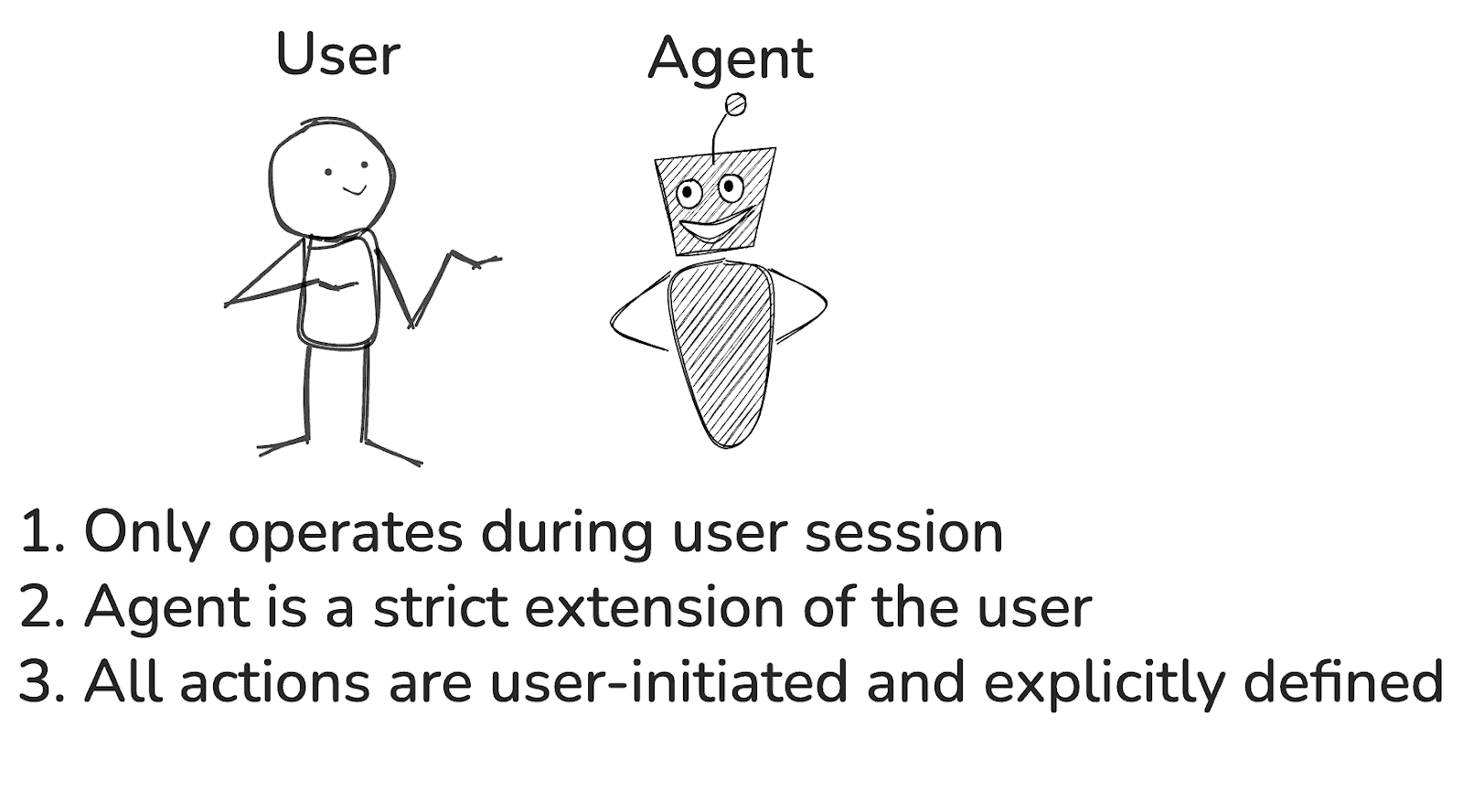
Supply: Diagram created by the authors utilizing Excalidraw.
If an agent’s existence and capabilities are strictly tied to the person being actively logged in or linked, the person id alone is enough for the agent id. As soon as the person logs out or their session expires, the agent must also stop functioning or lose entry. Within the state of affairs, the agent’s id and permissions mirror precisely these of the person.
When is agent id required?
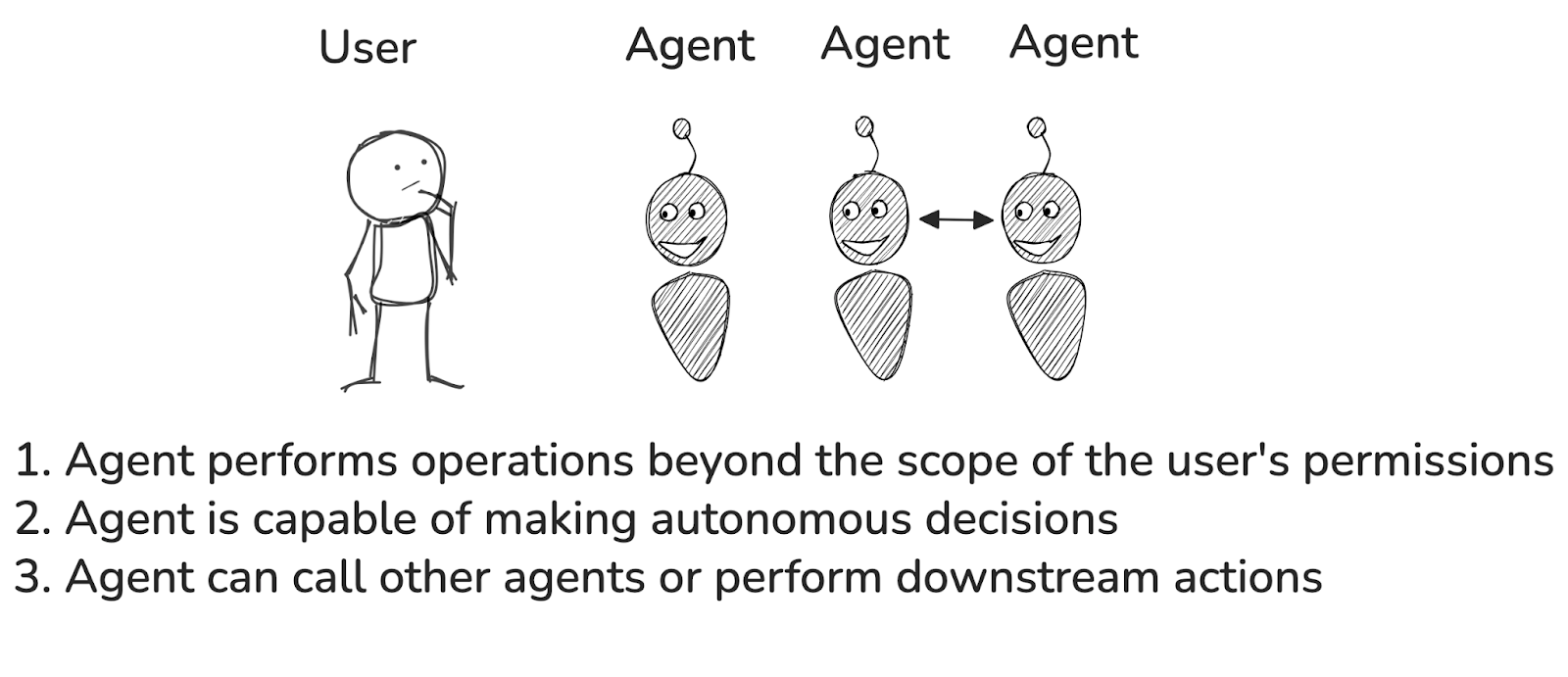
Supply: Diagram created by the authors utilizing Excalidraw.
Use agent-specific identities when the agent performs actions past the person’s permissions (for instance, accessing cross-department information or delicate info). That is additionally wanted if the agent could make autonomous selections (initiating workflows, API calls, inserting orders, and so on.) or if it might work together with different brokers and set off downstream processes.
By clearly distinguishing between person and agent identities and imposing authentication, authorization, and belief boundaries, methods can reduce the chance of overprivileged brokers, forestall lateral motion, and higher help auditing and coverage enforcement.
The next practices for agent id ought to adopted:
- Assign a novel workload id to every agent occasion
- Keep away from shared or reused identities, and as an alternative use Cloud Native workload identities resembling SPIFFE IDs, Kubernetes service accounts, and so on. Identification reuse throughout agent cases or periods may end up in brokers retaining or leaking state.
- Keep away from static service accounts with broad permissions. The agent id have to be scoped, ephemeral, and least privileged.
- Desire scoped JWTs or OAuth2 entry tokens versus static tokens to tightly management authorization at runtime, and set up clear insurance policies for entry fallback habits, together with for disconnected states.
- Use short-lived, routinely rotated credentials tied to agent lifetimes
- For brokers created dynamically (e.g., spawned per request or job), generate short-lived identities tied to their runtime scope with automated rotation (OIDC tokens with TTL, certs with restricted validity).
- Brokers ought to be issued time-bound OIDC tokens, SPIFFE/SVID certificates, or ephemeral API credentials with strict TTLs. These credentials ought to expire when the agent shuts down or after a session timeout.
- The place doable, bind the credential to the agent’s id and execution context (e.g., a particular namespace or pod UID) to forestall reuse or theft
- Audit and log agent id utilization
- Monitor which agent used which id, when, and for what function. That is crucial for accountability, particularly in multi-agent or distributed methods. Observe: Safe, tamper-proof logging could also be required to help non-repudiation and forensic evaluation. Think about using append-only logs or methods with cryptographic ensures to make sure log integrity.
- “Know your agents”. Keep a registry of validated brokers and observe who launched the agent, when, and what permissions it has.
- Guarantee delegated actions between brokers are logged and auditable to detect misuse of 1 agent’s id by one other.
- Confirm agent id earlier than every motion, not simply firstly
- Re-authenticate and re-authorize mid-session for delicate actions.
- Create enforcement boundaries for agent id
- Service meshes, Kubernetes NetworkPolicy, API gateways, and so on., to make sure brokers can solely talk with approved instruments and providers.
- This layered protection limits lateral motion if an agent is compromised or misbehaves as a consequence of immediate injection or instrument hijacking.
- Make sure that brokers can’t entry assets or carry out actions through one other agent with out specific authorization (delegation safety).
- If utilizing MCP Authorization, observe the authorization move described within the authorization spec if utilizing HTTP-based transport protocols.
- Use a safe, discoverable naming and id decision system
- Undertake frameworks just like the OWASP Agent Identify Service (ANS) for cryptographically verifiable agent discovery and naming.
Agent tenancy
Agent tenancy spans service-to-service publicity, entry to {hardware} assets (e.g., GPUs), permission scopes, and agent-to-agent interplay. To take care of safe, predictable, and truthful habits in multi-agent environments, tenancy controls have to be enforced at each id and execution layers.
Permissions tied to agent id ought to implement the precept of least privilege and use mechanisms resembling Simply-in-Time (JIT) to request entry solely when wanted and Attribute-Primarily based Entry Management (ABAC) and Coverage-Primarily based Entry Management (PBAC) to outline versatile and safe entry insurance policies. As brokers introduce probabilistic habits, adopting these controls based mostly on the agent id is important to sustaining belief, traceability, and safety at scale.
The next practices for agent tenancy ought to be adhered to:
- Allow Simply-in-Time (JIT) entry provisioning
- Create short-lived ephemeral permissions for the duty at hand. Brokers ought to request entry solely when wanted, and lose it when finished, decreasing the chance of extreme permissions.
- Implement the Precept of Least Privilege (PoLP)
- Brokers ought to solely obtain the minimal required permissions for his or her operation. Assume each granted permission will ultimately be used. “Just in case” permissions are harmful since brokers are designed to discover choices.
- Use fine-grained, scoped tokens per instrument with OAuth2 scopes.
- Dynamically strip or masks setting variables containing secrets and techniques or keys based mostly on the instrument context. For instance, don’t inject API keys into an agent that doesn’t carry out a job that requires the API key.
- Brokers ought to solely obtain the minimal required permissions for his or her operation. Assume each granted permission will ultimately be used. “Just in case” permissions are harmful since brokers are designed to discover choices.
- Use Attribute-Primarily based Entry Management (ABAC) and Coverage-Primarily based Entry Management (PBAC)
- Outline dynamic insurance policies to regulate permissions for the agent based mostly on the duty or setting.
- Isolate brokers per belief boundary utilizing strict workload partitioning
- Observe suggestions for isolating brokers based mostly on namespace separation, container isolation, community segmentation, or {hardware} partitioning (particularly these representing completely different customers, roles, or organizational features).
- Leverage service mesh capabilities (e.g., mTLS, identity-aware routing, and authorization insurance policies) to implement safe communication and fine-grained entry management between brokers working throughout belief boundaries.
Agent information entry
Brokers usually work together with numerous information shops, together with these shared throughout a number of brokers or tenants. This requires cautious design to implement sturdy authentication, fine-grained authorization, and clear belief boundaries to forestall information leakage, tampering, and privilege escalation. Correct entry management have to be applied to uphold least-privilege ideas, particularly when brokers function autonomously. This part outlines key safety issues associated to agent information entry, emphasizing distinctive threats resembling immediate injection, instrument hijacking, and runtime reminiscence vulnerabilities, and offers suggestions to mitigate these dangers.
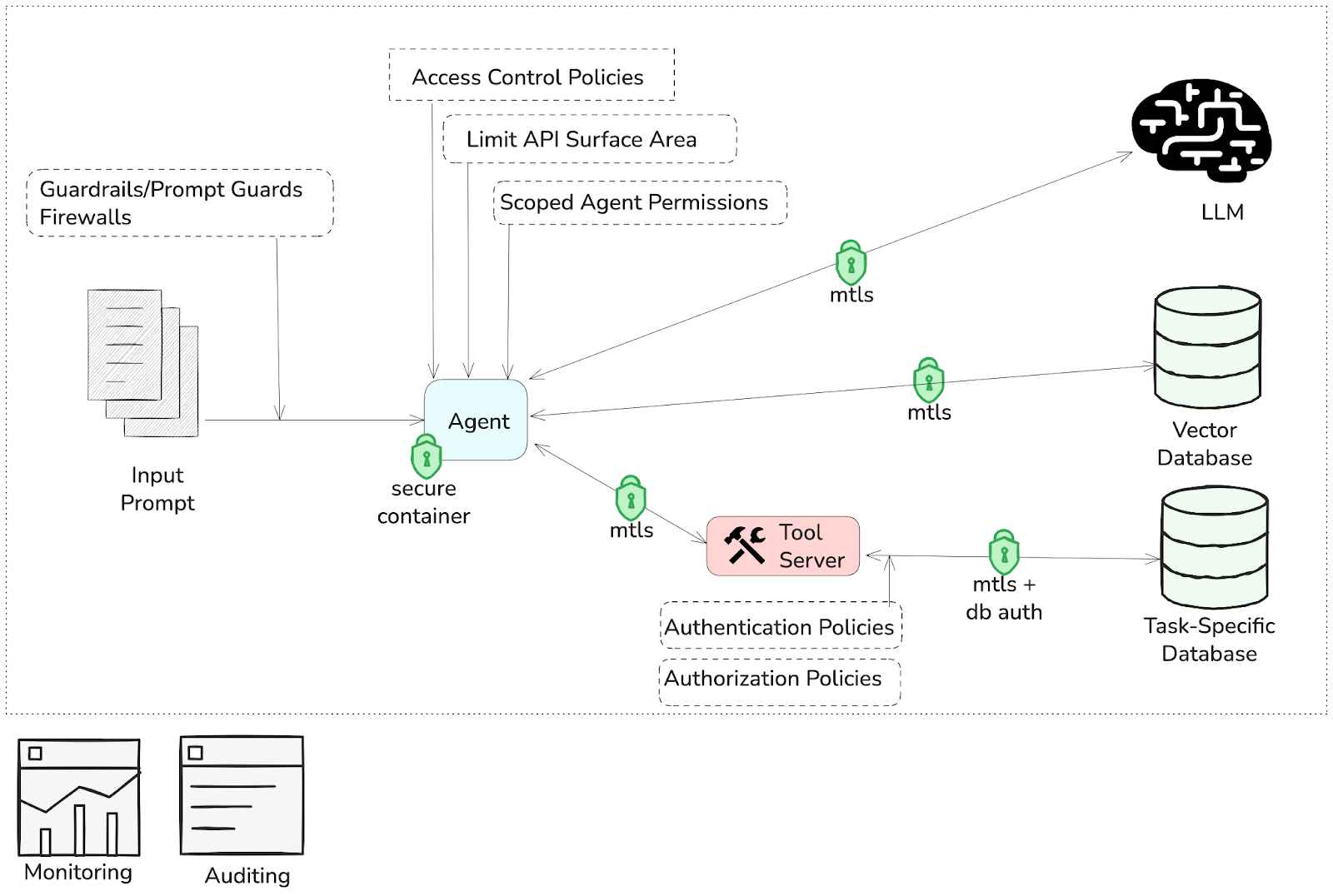
Supply: Diagram created by the authors utilizing Excalidraw.
- Management entry brokers have for information sources.
- Brokers should have strictly scoped entry to information shops, limiting publicity to solely the required info for his or her job
- When a number of brokers entry frequent shops (e.g., Retrieval-Augmented Era (RAG) databases), implement sturdy information segregation and query-level entry controls to forestall leakage.
- Mitigate immediate injection and jailbreaking vulnerabilities
- Implement rigorous enter validation and sanitization to filter out malicious payloads.
- Use context-aware immediate templates and guardrails that restrict agent responses to approved scopes.
- Make use of monitoring and anomaly detection to catch uncommon agent habits indicative of immediate tampering (see observability part for extra particulars).
- Limit entry to forestall instrument hijacking and unintended execution
- Implement strict permission boundaries on instrument invocation, permitting brokers to entry solely approved instruments.
- Solely enable brokers to make use of pre-approved instrument interfaces.
- Audit and log all instrument execution requests to detect unauthorized or surprising calls.
- Apply sturdy authentication and authorization on inside APIs, utilizing zero-trust ideas to restrict the dangers of exposing inside APIs and multi-agent collaboration
- Restrict API floor space uncovered to brokers, and segregate APIs by agent roles or duties.
- Use community segmentation and firewall guidelines to limit API entry to solely trusted agent processes.
- Repeatedly monitor API utilization for uncommon patterns or abuse.
- Use mTLS to safe all inter-service and agent-tool communications.
- Deploy brokers in remoted runtime environments (e.g., containers, sandboxes)
- Implement strict reminiscence and file system entry controls to restrict an agent’s visibility and scope.
- Leverage hardware-based isolation mechanisms, resembling Trusted Execution Environments (TEEs) or safe enclaves, and GPU-based confidential computing options to guard mannequin execution and intermediate reminiscence states when working brokers on shared infrastructure.
- Defend agent execution environments and inside logic
- Decrease system immediate leakage. Make sure that system prompts and configuration particulars will not be uncovered via user-facing APIs, logs, or client-side code. Use context-scoped prompts and redact delicate content material in observability instruments.
- Limit entry to agent supply code and runtime binaries. Keep away from delivery uncovered Python binaries or readable scripts; use compiled artifacts, signed containers, or encrypted packages the place doable.
- Redact or rewrite delicate flows. Add an extra layer of immediate moderation or transformation earlier than LLMs obtain inputs or return outputs.
Footnotes/Hyperlinks:
- MCP offers transport-level authorization that enables purchasers to securely request assets on behalf of useful resource homeowners. For HTTP-based transports, this entails standardized authorization headers and token-based authentication mechanisms. Implementations utilizing HTTP SHOULD adhere to the move outlined within the spec to make sure interoperability and correct entry management.
- ANS offers a DNS-like mechanism utilizing PKI, structured schemas, and Zero-Information Proofs (ZKP) to validate agent id and capabilities. This permits trusted decision throughout multi-agent methods whereas mitigating threats resembling agent impersonation and registry poisoning:
- Sources for guides for utilizing confidential containers and supporting GPUs:
This doc is topic to a high-change revision cycle because of the fast tempo of evolution within the agentic AI area. Group contributions are welcome and inspired.
For particulars on methods to suggest adjustments, draft updates, request critiques, and observe the versioning and governance course of, please see the Contributing Information.
