



eSIM or eUICC expands the pliability of mobile connectivity for bodily AI options, however flexibility alone is meaningless with out management. What organisations want is a approach to orchestrate networks to allow them to handle connections globally and at scale with out friction, Robby Hamblet, the CEO and co-founder of TEAL, tells George Malim, the managing editor of IoT Now.

The very first thing to absorb about TEAL is that it isn’t simply one other cell community or cell digital community operator (MNO/MVNO) masquerading as a specialised IoT connectivity supplier. “We’re a bit of a hybrid,” explains Hamblet. “Our primary business is network orchestration where we help customers deploy the devices they have. The other part of our business is that we like to fill in the gaps that customers face with their connectivity providers’ current capabilities.”
An ordinary operator relationship isn’t designed to assist with filling these gaps and that’s the place TEAL sees the chance to make connectivity simpler for IoT organisations. “Normally a customer comes to us when they are already using cellular technology,” he explains. “Often, they’ve built a painstakingly curated relationship with a vendor to provide the connectivity, but they have started to see the need for some flexibility. That might be because they’re looking at non-terrestrial networks (NTNs) or they might have deployed a device without realising their vendor doesn’t support LTE Cat-M in a certain market.”
“Others might have figured out they might only have leverage in their vendor relationship if they can actually change the devices out to another connectivity provider,” he provides. “On the other hand, they might be happy with that single network they’re working with in the US but they’re looking to supplement the coverage simply because a single operator, such as AT&T or Verizon, can’t cover everywhere.”
Hamblet particulars how creating that flexibility is advanced and unappealing. “They’ll need to achieve that by deploying another completely separate stock-keeping unit (SKU) with a different operator,” he says. “Maybe that’s T-Mobile in this scenario but they’ll have to go and build a whole new relationship with a different SKU from the product and supply chain perspective.”
Digitally distributed capabilities
That is the place TEAL is available in. “The customer comes to us with the need for more flexibility than the carrier they’re currently using offers and we show them our network orchestration service that lets them digitally distribute the things they are already doing with networks,” Hamblet explains. “You can pick up options as you need them and onboard the things you need, when you need them. You’re not restricted in any way with TEAL from using any operator in the world with our platform but an MVNO-type model typically has a reliance on their own agreements and their own relationships.”
Hamblet acknowledges that’s counter to the promise of an MVNO “eSIM”. “An eSIM is provided by an MVNO to tick a box and, yes, technically it is an eSIM,” he says. “It just doesn’t have any of the orchestration or flexibility that you would expect.”
Despite the promise of eSIM, connectivity suppliers nonetheless deal with sustaining the established order and force-fitting IoT corporations to their mannequin moderately than offering a brand new mannequin that works for IoT. “We want to be Switzerland,” smiles Hamblet. “We think that device makers deserve a neutral provisioning layer and deserve something more fully-baked than traditional eSIM vendors provide.”

MWC26 Barcelona
eSIM is certain to be a scorching matter for IoT system makers on the Barcelona mega-show, particularly with the latest SGP.32 specification now out there. Nonetheless, Hamblet nonetheless thinks the supply mannequin is flawed. “eSIM has failed in the past to lower the barrier to entry,” he confirms. “Look at the traditional models of eSIM delivery, and the ones given to you by MNOs and MVNOs are not really worth anything because they’re in a conflicted position.”
Different eSIM pioneers embody the foremost SIM distributors which have pursued bespoke tasks to simplify eSIM supply. “TEAL counts itself amongst those vendors and our technology platforms have been certified by the same standards bodies and we developed our own source code,” Hamblet provides. “What we’re doing is taking the expertise we have in eSIM and creating a free entry point for customers that want to simply convert something they’re doing today with a plastic SIM on a carrier SKU at no extra cost. Eventually, we hope that these customers develop more complex requirements – for example, opening up a RedCap profile in Africa – and that our marketplace can enable that for them.”
Simplicity is the important thing
“It’s critical that an example like that can be enacted without the device maker having to speak to a carrier for 10 months to develop a bespoke relationship,” he says. “Today, TEAL’s power is that it’s a free eSIM product and it’s a neutral layer. It’s self-serve so you can log right into the portal and self-onboard your existing relationships at no cost. When you’ve done that, you hold the key to the devices been able to do with the eSIM delivery models of the past.”
In distinction to the constrained selection of working with a service or a SIM know-how firm, TEAL is placing ahead its hybrid mannequin as a way to interrupt the service lock on IoT connectivity relationships. “We envision a digital catalogue for all the different service offerings that is more digital and more frictionless,” Hamblet explains. “We’ve been around since 2018 and we’re obviously very excited about SGP.32 and have patented some of the mechanisms that ended up getting adopted by the specification.”
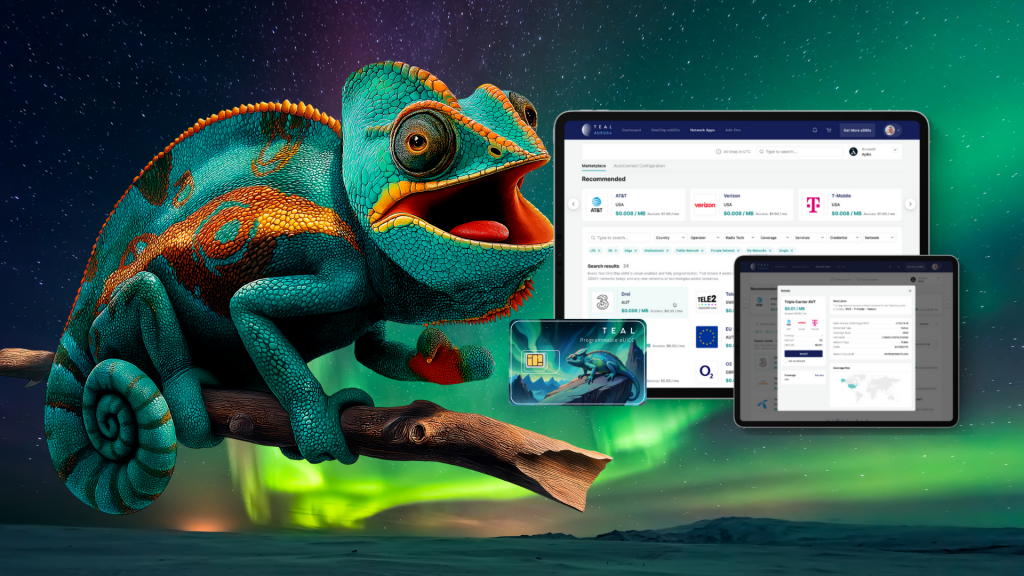
Hamblet factors to work achieved on simplifying the polling interface without having for SMS for instance. “Compared to SGP.02, SGP.32 is very easy and we’re enabling customers to self-serve their carrier integrations within minutes instead of that involving months and years of project-related work,” he provides. “This is where TEAL Chameleon Edition, our first SGP.32 product comes in. It’s built around our certified platform and we launched it in beta last year.”
“For eSIM to succeed, it has to break free from traditional models and for us to finally digitise this, it has got to be free, it has got to be neutral and it has got to be easy to use,” Hamblet concludes. “Chameleon Version encapsulates this and that’s what we’re actually enthusiastic about with community orchestration and what it might do for making connectivity versatile for system makers.
Touch upon this text by way of X: @IoTNow_ and go to our homepage IoT Now
