



From ASSEMBLY Journal headquarters in Birmingham, Michigan, that is Meeting Audible, the place we join nice concepts in product meeting to you. I am your host, JJ.
As we speak we’re speaking about one of many fastest-moving areas in manufacturing: AI-powered visible inspection. High quality inspection has all the time relied closely on human judgment, expertise, and a spotlight to element. However as manufacturing speeds improve and product complexity grows, producers are in search of methods to make inspections sooner, extra constant, and extra data-driven.
My visitor at this time is Blake Maurer from Loopr, an organization creating AI-enabled visible inspection know-how designed to work alongside human inspectors, not substitute them. We’ll speak about how producers can cut back variability in inspection, why structured knowledge is important earlier than AI can actually ship worth, and the place people nonetheless outperform machines on the manufacturing facility ground.
ASSEMBLY:
Loopr is simply one of many many companies that might be attending the Manufacturing and Automation Change, or the MAX Occasion, happening March 24–26 in Nashville, Tennessee.
Blake, we’re trying ahead to seeing you there… Inform us about what you propose to do on the present and the place you’ll be. Something you need listeners to know…
Blake:
Come have a dialog with me at Sales space 1243, proper subsequent to the primary stage on the MAX Present. I might be there, and I am stealing my four-year-old’s little Lego truck to do little in-person demos. I can run you thru how our inspection platform works. And if I can get it getting in time, I am going to have some little AI inspections and present you a few of these powers as nicely. So please come by and have a dialog, and maintain me accountable if I haven’t got these AI inspections prepared.
ASSEMBLY:
Nicely, that seems like loads of enjoyable, and I am trying ahead to the demonstrations at your sales space, but in addition at all the cubicles throughout the present. I believe it should be a good time. Focusing particularly on Loopr and our dialog at this time, Loopr is all about AI visible inspection. So what gaps had been you seeing available in the market that impressed you to give you this?
Searching for fast solutions on meeting and manufacturing matters?
Attempt Ask ASM, our new sensible AI search device.
Ask ASM
Blake: Nicely, I want I may take credit score for constructing the answer, however our founder grew up in factories: Priyansha. She’s the fifth-generation entrepreneur in her household, and he or she actually lives and breathes manufacturing. She understands it intuitively. She is aware of all concerning the enterprise aspect of it, in addition to the ground aspect of it. And so she simply noticed this large alternative in AI imaginative and prescient to go in and rationalize the subjectivity of visible inspections. And she or he knew, as a result of she got here from a high-mix, low-volume surroundings, that there was nothing on the market that was going to fill that want at present. So she constructed it. And that is an unbelievable factor to go do.
ASSEMBLY:
So inform me a bit of bit about your system and what makes it particular.
Blake:
The best way I actually like to think about our system is that I consider it as amplifying the output of the workforce. It is one thing that works immediately with the human. We now have a chunk of our software program the place there’s an operator override that exists inside it for that precise purpose, as a result of the human may see one thing that the pc doesn’t. And in the event that they see, “No, this is fine. There’s no reason why this should be getting rejected,” they’ll override that consequence. After which that enables our system to proceed to be taught. That is really the place the “loop” in Loopr is available in. And in order it loops over that data and initiates that steady enchancment course of, it actually improves itself over time.
ASSEMBLY:
Nicely, now we all know who put the “loop” in Loopr, I suppose, do not we? So Blake, what is the greatest problem, out of your perspective, dealing with producers at this time?
Blake:
So many factories at this time are already technologically superior. You have bought the robotic arms. You have bought unified processes. You have bought these implausible MES methods. There are such a lot of which are already on that innovative of producing. However then there’s this huge cohort which are nonetheless operating paper inspections. They’re nonetheless operating issues like a second out of time on these legacy methods, and in a manner that appears like it’s not a part of our present second. And it is a actually cool factor to assist deliver an accessible platform to assist deliver these methods on top of things in a manner that matches in with the present tempo of the market at this time. And that is a enjoyable journey to be on and an thrilling factor to speak about.
ASSEMBLY:
It is that outdated adage, “If it ain’t broke, don’t fix it,” proper? And I completely perceive that from the attitude of a producer that has a system that is working, and we need not mess it up. However you must preserve a watch out on new know-how, AI, automation, as a result of a lot is altering so shortly, and you do not wish to get left behind. So I believe hanging a steadiness there’s essential. What are some factors of frustration that you simply’re listening to from producers?
Blake:
As tempting as it’s to dunk on the IT frustrations that occur in each group, I believe I’ll keep away from that one and say it is a lack of structured, repeatable methods. And what I imply by that’s there is a degree of human variance that makes our world lovely and makes it enjoyable to expertise the change in. However once we’re attempting to create the very same factor the very same manner, over and again and again, that human variance can change into such a problem. And particularly within the manufacturing surroundings, the place we now have an expectation of issues being inside 2/1,000s of the identical each single time, that turns into an actual problem of that human variance. And as we introduce increasingly automation and management, it comes increasingly into management. And it is also enjoyable to take subjective visible inspections and switch these into structured and managed outcomes as nicely.
ASSEMBLY:
I actually like what you mentioned there concerning the human aspect and acknowledging the great thing about the human perspective, as a result of that’s what makes life fascinating and it is what makes life enjoyable. And manufacturing facility work may be enjoyable too. Manufacturing may be enjoyable, however it additionally must be exact. So when people are doing high quality inspection, what are some areas the place they excel, and what are some areas the place AI will help out?
Blake:
Human inspection actually excels within the areas the place individuals must suppose by way of the answer and determine the place it takes that processing energy and that sample recognition, and the issues which are detailed and require that data of how a cloth works, how a cloth shifts and modifications, and the way the temperature may have an effect on it. There are such a lot of variables that it is so laborious to craft a managed mannequin round them that there is simply no changing a human in these issues. However in relation to issues like coloration variance in paint, or in search of scratches, or verifying that there are torque stripes on all of those bolts, or counting the variety of bolts, these are time-suck duties which are actually simply busy work. Machines are excellent for them, as a result of they’re issues that people become bored with. So when there’s one thing that requires human thought and pleasure and vitality and engagement, it is one thing that is excellent for human inspection. When it is one thing that’s going to make somebody go to sleep, it is excellent for an AI inspection.
ASSEMBLY:
And that doesn’t simply lengthen to the office. Duties that individuals do not wish to do—the place is my AI for pulling weeds? Any person ought to have thought of that by now. An AI-enabled robotic to establish the weeds, pull the weeds, put them within the bag, and simply go up and down the entire neighborhood and do it. You’ll change into very wealthy if somebody takes this concept and makes it a actuality. I promise you that. That could be a nice use for AI. However going again to manufacturing and searching on the plant flooring, Blake, what are you seeing so far as balancing pace with accuracy? How can producers try this successfully, particularly in our Twenty first-century surroundings?
Blake:
Yeah, that is a very tough one, particularly once we’re speaking about environments the place the half you make may be a $30,000 half. So you must be correct, as a result of in case you’re not correct, you have simply wasted what number of 1000’s of {dollars} of not solely uncooked materials, however machine time and consumables like bits and oil, energy. And every part is on a trajectory that is up and to the fitting on value. Electrical energy is getting dearer. Gasoline is getting dearer. Folks’s time is getting dearer. So it is a actually tough needle to string.
The best way that I am seeing everybody determine it out is by adopting smarter methods and better-controlled methods, and taking the work of three individuals and consolidating it down into one system that may be executed by autonomy, automation, or getting it carried out by way of a greater construction, or transferring a stage gate again and doing this step of meeting right here as a result of it is slowing down issues additional down the road, after which rushing up a subassembly. However it’s taking place by way of design. It is taking place by way of know-how. There are loads of completely different ways in which individuals are fixing that at this time.
ASSEMBLY:
So loads of producers on the market are going to say, “We already have inspection tools.” So what’s it about AI inspection instruments, or your inspection device particularly, that you’d take into account to be a sport changer for the trade?
Blake:
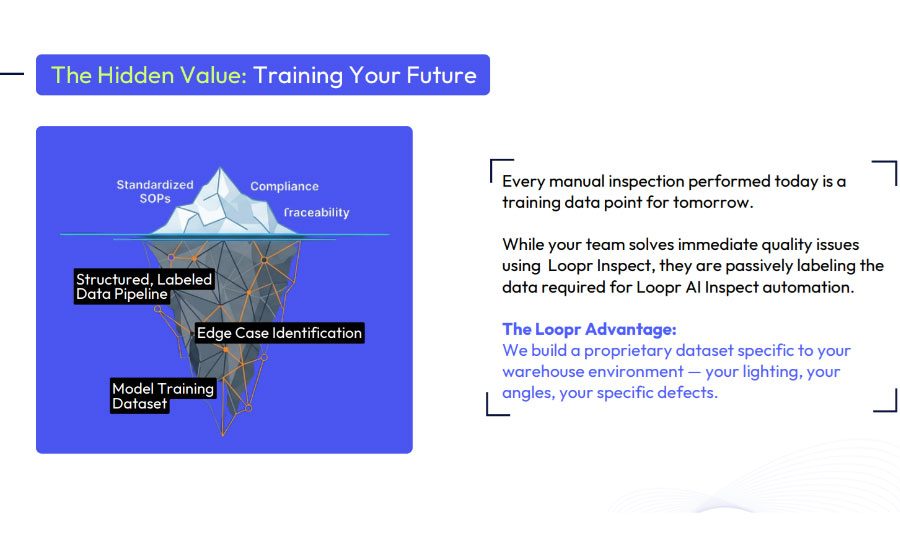
Rule-based intelligence is the only reply for that. And it actually comes all the way down to a system and being able to get the knowledge into the fitting context. We see, on a regular basis, there are corporations which have been digitizing their information since 2012, they usually make the choice that they are going to enter AI and take all of that data and plug it in because the pipeline, and the AI will make sense of it. And that is simply not the reality. It must be structured. It must be labeled. It must be cared for. It must be curated. It must be sorted in order that the machine could make sense of it. And that every one takes effort and time and cash.
[I]t actually comes all the way down to a system and being able to get the knowledge into the fitting context. … It must be structured. It must be labeled. It must be cared for. It must be curated. It must be sorted in order that the machine could make sense of it.
And that is one of many lovely issues about our platform. While you begin with our lowest-tier product, there isn’t any AI inspection on it. It is simply an inspection service that helps you digitize your information, and it truly is like the best complement to a QMS you possibly can probably think about. Your visible inspection information go into all of that. We are able to push it to your ERP. I am not right here to pitch that solely. However together with that, we construction your knowledge and label it. And we make it in order that while you wish to scale AI throughout your small business, you get to only flip it on. And that is a lovely factor. It is one thing that we’re not seeing anybody fixing at this time.
ASSEMBLY:
So loads of producers should still be on the fence about totally integrating AI into their methods. What are some misconceptions you are seeing within the trade?
Blake:
Yeah, it is virtually all the time the belief that AI goes to come back in like a magic bullet and repair every part in a single day. And there are some instances the place that is completely true. Take into consideration what AI did to copywriting in a single day, to talk to your guide, proper? It actually got here in and basically modified every part. However once we’re speaking concerning the change that it should make in manufacturing, it should take time for these methods to scale up and be taught and get to that 99.9% accuracy.
Now we all know, for a reality, from our prospects that we already work with that we are able to get there, and it does not really take that lengthy to get there. It is actually a matter of structuring your knowledge, placing it in the fitting context, watching the inputs which are getting in, watching the outputs, after which simply doing the work. And that’s the hardest half to get going. Particularly as a result of within the manufacturing world, everybody’s transferring quick. Everybody’s on a decent deadline. The whole lot is all the time “do more with less” on a regular basis. Preserve going.
The perfect place to be, and actually to make an AI system deploy accurately, is to decelerate. You must deliberately stroll slowly, construct accurately, after which watch it take over. Watch it personal all of those completely different processes that you simply arrange and actually deliver large quantities of worth to your group.
ASSEMBLY:
So give me the pitch for Loopr. Why do I want Loopr, or a system prefer it?
Blake:
High quality managers are instituting higher high quality checks extra typically by way of the manufacturing course of. We have already seen a lot of it with Trade 4.0 initiatives. We’re already seeing a lot of it with individuals rising their inspection information or using the Toyota Manufacturing System and higher manufacturing gates. However the extra you are catching these reworks and people scrap issues earlier, and also you’re utilizing that high quality intelligence to stop these unfavourable outcomes, the higher you may be within the market. For those who make fewer errors, you possibly can dominate a market by simply being the lowest-cost choice in America. The bottom-cost choice is all the time going to be enticing.
ASSEMBLY:
Blake, thanks a lot for being right here at this time. I stay up for visiting your sales space on the present. And a particular because of all of you, our listeners, for becoming a member of us at this time on ASSEMBLY Audible. I hope you’ll tune in once more quickly.
