



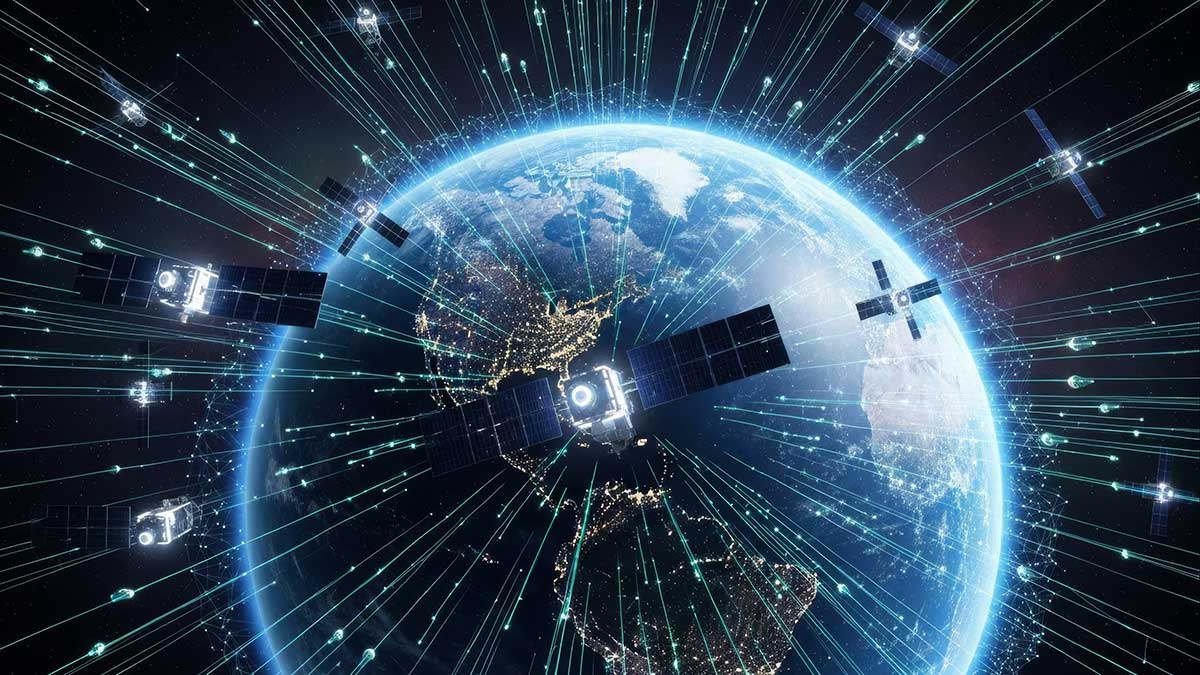
The skies above Earth are filling quick. With tons of of 1000’s of satellites deliberate by China, SpaceX, and Blue Origin, radio frequency bands are creaking underneath the stress, disrupting every thing from Earth imaging to astronomy.
One European start-up believes it has discovered an answer: Astrolight, a Lithuanian space-tech firm, is growing laser-based communication programs that may transmit vastly extra knowledge, resistant to interference, and doubtlessly unlock a brand new period of high-speed, safe satellite tv for pc connectivity.
In response to ABI Analysis, greater than 30,000 satellites are anticipated to launch over the subsequent 5 years. Whereas orbital area itself is huge, the invisible infrastructure that permits satellites to speak — the radio frequency spectrum — is tightly constrained and closely regulated.
Not like bodily area, radio spectrum is finite. Every band is pre-allocated by the Worldwide Telecommunication Union (ITU) for particular functions, from satellite tv for pc communications to cell networks, aviation, maritime programs, and emergency companies. This allocation system ensures that transmissions from one satellite tv for pc don’t intrude with others, significantly programs working in geostationary orbits, which stay fastened over the identical level on Earth.
Area jam
But as Elon Musk’s Starlink and Jeff Bezos’s Undertaking Kuiper launch 1000’s of satellites into low Earth orbit, these restrictions are being examined, exposing the bounds of a system designed for a lot fewer gamers.
With every new satellite tv for pc comes a necessity for spectrum to ship telemetry, management indicators, downlink knowledge, and typically talk with different satellites. Radio waves, even when directed, unfold past their meant goal, creating interference dangers and forcing operators into advanced coordination agreements.
“Some of the uses of RF comms for satellites already reached a limit,” stated Laurynas Mačiulis, Chief Govt and Co-Founding father of Astrolight, talking solely to IoT Insider from Vilnius. “Maybe this is not evident from a consumer point of view, but from a satellite operator perspective, you see that operators are moving to much higher frequencies. There was a lot of discussion about SpaceX acquiring spectrum for very large amounts of money — that just shows how scarce RF spectrum is becoming.”
The stress is compounded by trendy satellites themselves. Earth remark programs now produce hyperspectral imagery, high-resolution video, and radar datasets far bigger than earlier generations. Even when spectrum weren’t scarce, the demand per satellite tv for pc is rising quicker than accessible bandwidth. Operators reply by shifting to larger frequency bands — that are technically difficult — or compressing knowledge onboard, which limits operational flexibility.
Astrolight’s reply is to bypass radio spectrum completely.
“We are building a new type of communications system which will be based on lasers instead of radio waves,” Mačiulis stated. “We are building up a set of products and solutions across different domains and verticals — to connect satellites with the ground, satellites with each other, and also naval ships or terrestrial point-to-point connectivity, both for civil and military use cases.”
“The basic vulnerability of RF is that radio waves spread widely,” Mačiulis defined. “Antennas are typically wide field of view, and it’s very easy to jam or spoof a signal. Even if you encrypt it, everybody can see that the signal is there. And especially if it’s weak, it’s easy to drown it in noise.”
Lasers behave otherwise
“Lasers are extremely directional. It’s point-to-point — you are only transmitting information to that specific party, and you only see information coming from that party. You are not sensitive at all to outside signals. That extreme directionality is what makes it so secure on a physical layer.”
As a result of the beam is slender and doesn’t radiate outward, laser communication doesn’t create the identical type of shared-spectrum congestion. Every optical hyperlink successfully turns into its personal remoted hall. In concept, scaling to tens of 1000’s of satellites doesn’t create the identical interference dynamics that plague RF programs.
Capability is equally central to Astrolight’s pitch.
“Now we give you an instrument to download 10, 100 times more data,” Mačiulis stated. “You don’t need to sacrifice onboard processing power. You can save all the data and process it on the ground, where you have much larger resources. You even don’t know when you will need that data — maybe you come back to it one year later.”
For hyperspectral Earth remark and precision agriculture, that might imply richer datasets and higher long-term evaluation. “The more data you give to AI, the more clever it becomes,” he added.
Astrolight’s Atlas laser terminal has already been built-in into the European Area Company-funded ERMIS satellite tv for pc. One of many principal technical challenges is sustaining exact alignment between fast-moving satellites and floor stations.
“The typical challenge when implementing lasers on satellites is pointing,” Mačiulis defined. “You need to point that laser very precisely.”
To cut back that burden, Astrolight constructed fine-pointing functionality into the terminal itself. “Our terminal can steer the beam up to 20 degrees wide, and we have a tracking sensor that can track signals up to two degrees wide. That makes it much easier for the satellite to acquire and lock to the signal, even if the satellite does not point extremely precisely.”
The unit measures roughly 10 by 10 by 10 centimetres, sufficiently small for CubeSats and microsatellites, which kind a big a part of the projected 70,000-satellite growth.
‘Clouding’ the problem
Laser communication isn’t with out drawbacks. It requires clear line-of-sight between satellites and floor stations and is weak to cloud cowl. “It’s one of the challenges with laser communication,” Mačiulis acknowledged. “You couldn’t rely on one single place 24/7. But if you have multiple landing points from the Earth, and also the capability to route data in space through inter-satellite links, it becomes no problem. You can create a global network even in places that are cloudy some of the time.”
To mitigate these limitations, Astrolight has deployed what it describes as the primary Arctic optical floor station in Greenland. Excessive-latitude positioning will increase satellite tv for pc move frequency for polar-orbiting programs, whereas elements of Greenland provide Arctic desert situations for vital parts of the yr, offering clearer skies than a lot of Western Europe. “From a satellite operator perspective, you benefit from a global network,” Mačiulis added. “Maybe it’s cloudy in the UK, but the data can be routed through other stations where skies are clear.”
There’s loads of different editorial on our sister website, Digital Specifier! Or you possibly can at all times be a part of within the dialog by commenting under or visiting our LinkedIn web page.
