



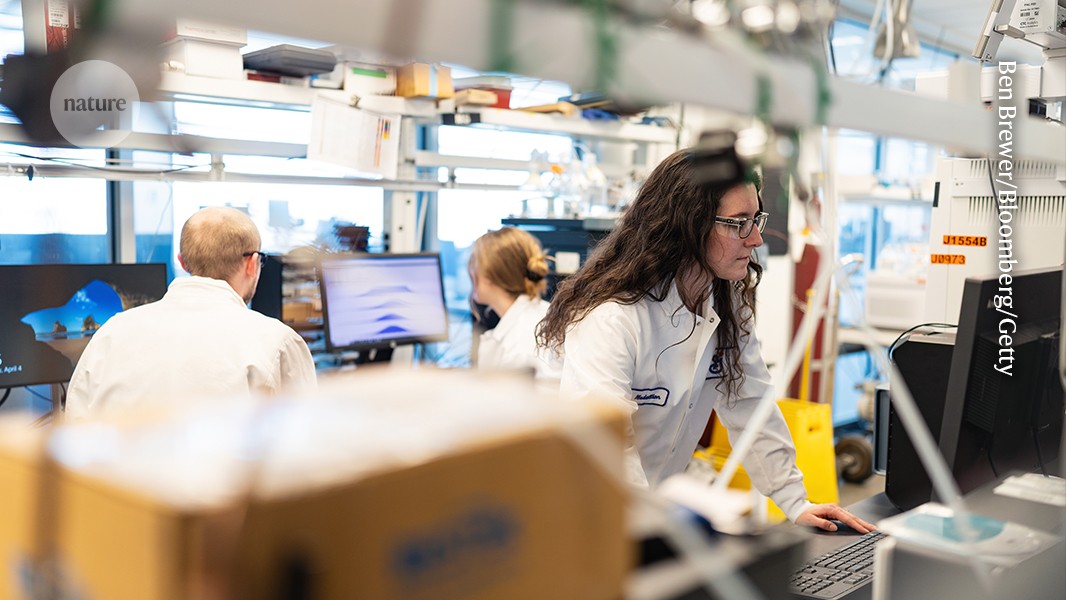
Synthetic-intelligence techniques is perhaps used to carry out giant elements of the analysis course of with minimal human oversight.Credit score: Ben Brewer/Bloomberg/Getty
This week, Nature is publishing a paper1 with, maybe, an unusually underwhelming discovering at its coronary heart: {that a} specific approach failed to enhance how synthetic neural networks study. It was not these findings that our editors discovered noteworthy. Slightly, it was how the work was achieved, which is in reality the principle focus of the paper.

AI is saving money and time in analysis — however at what price?
The consequence was created utilizing The AI Scientist engineered by researchers at Tokyo-based firm Sakana AI, particulars of which have been first made out there2 as a preprint in 2024. This artificial-intelligence system represents an effort to automate the scientific course of completely, from performing literature evaluate and conceiving an concept to executing experiments and writing them up. As detailed within the Nature paper, The AI Scientist was in a position to observe this course of and generate a analysis paper about its (adverse) consequence; the work handed the primary spherical of peer evaluate for submissions to a workshop at a serious machine-learning convention.
AI analysis assistants have since proliferated, with expertise corporations Google, OpenAI and Anthropic all trialling methods to automate analysis. Though their outputs have been restricted and infrequently progressive to this point, the consequences of with the ability to generate analysis papers rapidly and cheaply are rippling by way of the scientific ecosystem. Universities, funders, publishers and researchers should plan how they’ll adapt.
Many researchers hope that generative giant language fashions (LLMs) will speed up discovery by automating repetitive or difficult elements of the analysis course of, comparable to coding, information evaluation and literature evaluate. The AI Scientist goes additional. It goals to make use of AI techniques’ velocity, pattern-recognition expertise and talent to entry huge quantities of interdisciplinary data to automate even processes comparable to producing hypotheses and decoding outcomes.
Researchers constructed an ‘AI Scientist’ — what can it do?
Nature has printed particulars of The AI Scientist as a result of it’s important to know the way AI analysis assistants work, and their limitations, to evaluate their doubtless influence on science. On account of peer evaluate, the Nature paper expands on the preprint’s description of the system’s weaknesses, contains extra moral issues, and tones down the authors’ authentic statements about automating your entire analysis course of (people helped to filter essentially the most promising outputs). The AI Scientist produced three papers, one in every of which, following peer evaluate, reached the bar for acceptance at a workshop of the distinguished Worldwide Convention on Studying Representations. It didn’t meet the bar for the principle convention observe.
It comes after researchers final month launched a theoretical-physics preprint3 by which the state-of-the-art generative AI mannequin GPT5, from OpenAI in San Francisco, California, performed an important half. Nathaniel Craig, a physicist on the College of California, Santa Barbara, who was not concerned within the work, described the paper as ‘journal-level research’.
That AI fashions are able to such spectacular outputs represents an enormous technological feat, a few years within the making. However as with all new applied sciences, warning is required. The fashions nonetheless have basic points, and are restricted principally to theoretical or coding-based analysis. They continue to be suffering from ‘hallucinated’ information, comparable to made-up citations. Not like a human scientist, they battle to gauge their confidence in a given output and have issue in stringing collectively the numerous steps concerned in a typical analysis course of.

AI ‘scientists’ joined these analysis groups: right here’s what occurred
LLMs can already craft papers utilizing completely pretend however plausible-looking information. However even fashions that, for instance, use algorithms to iterate a knowledge evaluation till they discover one thing important threat producing noise that might overload convention, publishing and funding peer-review techniques, with out shifting the needle on discovery. This has been described as nothing greater than automated, large-scale P hacking — the method of tweaking analyses or sieving information to get statistically important outcomes. The temptation for under-pressure researchers to grab on such mass-produced ‘one-click’ science is large.
System overload isn’t the one fear. It’s laborious to hint a mannequin’s inspirations, which dangers exploiting different folks’s concepts with out giving credit score. AI-generated papers shred the long-standing (if tough) correlation between authors making use of effort and the work having worth. Nobody has labored out the right way to account for AI-inflated outputs in hiring and promotion selections, nor what is going to occur to early-career researchers if duties which might be essential to their coaching as scientists are achieved by a machine.
AI-driven science may change the character of discovery itself. There are already tentative indications that the expertise is influencing how folks write and motive. A paper3 by researchers at Tsinghua College in Beijing discovered that adopting AI could make researchers extra productive, but in addition shrinks the variety of subjects they examine4. There’s a threat that the benefit of AI-based investigations may skew science in direction of sure fields and sorts of analysis, significantly in data-rich domains — doubtlessly decreasing scientific variety.

AI is threatening science jobs. Which of them are most in danger?
Some researchers argue that AI merely adjustments the place to focus human expertise, simply as calculators freed people from counting on their very own arithmetic. However nobody ever needed to fear {that a} calculator’s response was fallacious. It is because of this that Nature already requires transparency in how LLMs are utilized in submitted articles, and won’t settle for such fashions as authors (see go.nature.com/40j450w). For the sake of reproducibility, when a mannequin contributes to the artistic a part of a examine, Nature encourages researchers to submit transcripts of prompts and mannequin responses alongside the ultimate outputs, as one would with information units.
Publishing the main points of The AI Scientist is a step in direction of understanding what worth automation can convey to science. Much more work is required to make sure that such instruments can profit the entire analysis ecosystem. It’s as much as the analysis neighborhood to place guard rails in place to make sure that occurs.
