



Sponsored Content material
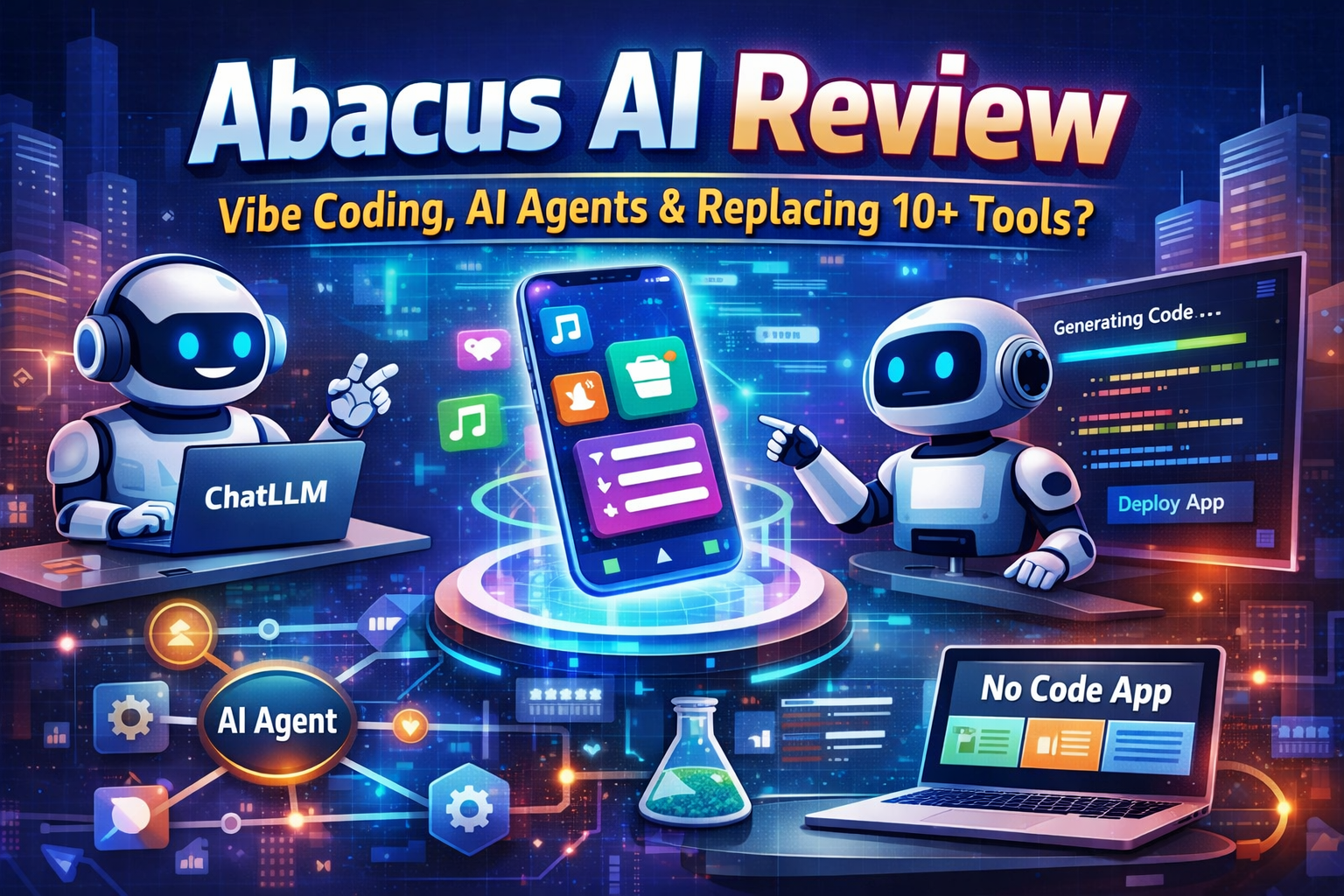
On this Abacus AI evaluation, we discover how ChatLLM, the AI assistant constructed on the Abacus ecosystem, permits customers to experiment with vibe coding, construct clever brokers, and handle a number of AI workflows from a single interface.
TL;DR – Construct Apps With AI Brokers As a substitute of Writing Code
- The platform combines a number of AI instruments into one atmosphere.
- ChatLLM acts as a central assistant linked to coding brokers and workflows.
- DeepAgent allows natural-language improvement by an idea often known as vibe coding ai.
- Customers can generate working functions, automation workflows, and AI instruments shortly.
- Pricing begins round $10/month, making experimentation comparatively reasonably priced.
It really works finest for speedy prototyping, experimentation, and constructing AI-powered instruments shortly, although complicated enterprise programs nonetheless require developer oversight.
The Imaginative and prescient Behind Abacus AI
Many AI instruments at this time resolve a single drawback. Some enable you to write code. Others generate content material or automate workflows. The problem is that actual initiatives often require all of those capabilities collectively.
The system reviewed right here makes an attempt to unravel that by offering infrastructure the place a number of AI brokers collaborate on duties. As a substitute of switching between separate instruments, customers work together with a single interface that may deal with coding, knowledge processing, analysis, and automation.
This structure is what allows options like DeepAgent, which acts much less like a chatbot and extra like a mission coordinator able to producing functions.
The attention-grabbing half is that the platform isn’t centered solely on chat interactions. It’s designed to help actual improvement workflows, which suggests it could possibly generate structured code, handle knowledge, and create deployable functions.
Key Capabilities
ChatLLM: The Central AI Assistant
ChatLLM acts as the principle interface by which customers work together with the system. Reasonably than connecting to a single mannequin, the assistant can leverage completely different fashions relying on the duty.
In sensible phrases, this implies customers can carry out duties similar to:
- researching matters
- producing code
- creating automation workflows
- analyzing datasets
- constructing software logic
The assistant additionally connects straight with different instruments contained in the platform, which permits customers to maneuver from dialog to execution with out leaving the atmosphere.
This integration is what makes the system really feel extra like a improvement workspace than a easy chatbot.
DeepAgent: Turning Concepts Into Purposes
Essentially the most attention-grabbing functionality is DeepAgent, which powers the vibe coding ai workflow.
As a substitute of writing code step-by-step, customers describe what they need to construct in pure language. The system interprets these directions and generates the technical elements required to make the applying work.
When testing the device, the method typically adopted this construction:
- The consumer describes the thought.
- The system asks clarification questions.
- It generates an structure plan.
- Backend and frontend code are created.
- A previewable software is produced.
This method considerably shortens the time wanted to construct prototypes.
CodeLLM and AppLLM
Two further instruments help completely different consumer sorts.
CodeLLM focuses on builders who need to speed up conventional coding workflows. It supplies autocomplete solutions, debugging assist, and mission scaffolding.
AppLLM, alternatively, is designed for non-technical customers. It permits individuals to generate functions straight from prompts without having to write down code.
Collectively, these instruments create a improvement atmosphere the place each skilled engineers and novices can experiment with constructing software program.
Understanding Vibe Coding
The idea of vibe coding ai has been gaining traction just lately. The thought is straightforward: as an alternative of considering like a programmer, you describe the end result you need, and the system handles the technical implementation.
In conventional improvement, constructing an software often entails a number of levels:
- planning structure
- designing databases
- writing backend logic
- creating frontend interfaces
With vibe coding, these steps change into automated.
You begin with a immediate describing the product concept. The system then interprets that immediate and generates the mandatory elements routinely.
This doesn’t get rid of the necessity for builders solely, however it drastically reduces the time required to create working prototypes.
Actual-World Take a look at: Constructing an App From a Immediate
To check the workflow, I tried to generate a easy cell software utilizing pure language directions.
The immediate described an app that means recipes, music playlists, and buying lists primarily based on the consumer’s temper.
As a substitute of instantly producing code, the system requested just a few clarification questions:
- Ought to the app retailer consumer preferences?
- What number of temper classes ought to exist?
- Ought to playlists hyperlink to exterior platforms?
This step was surprisingly useful as a result of it mirrored the sort of questions a human developer would possibly ask throughout mission planning.
After gathering these particulars, the agent generated a improvement plan and commenced constructing the applying.
Inside minutes, the system produced a working prototype full with interface components, database logic, and interactive options.
Pricing and Worth
One side that stands out is the pricing construction.
Many AI instruments require separate subscriptions, which may shortly add up. Coding assistants, analysis instruments, automation software program, and LLM entry typically value greater than $100 per thirty days mixed.
This platform bundles lots of these capabilities right into a single subscription beginning round 10–$20 month-to-month.
Right here’s a easy comparability:
| Function | Conventional AI Instruments | Abacus AI |
|---|---|---|
| Chat AI |
Separate subscription | Included |
| Code technology | Separate device | Included |
| AI workflows | Separate platform | Included |
| App improvement | A number of instruments | Built-in |
| Month-to-month value | $80–$200+ | $10 |
Who Ought to Use Abacus AI?
Builders and Startups
For builders, the platform is especially helpful for:
- speedy prototyping
- testing startup concepts
- producing MVPs shortly
As a substitute of spending weeks constructing infrastructure, groups can deal with validating product ideas.
Non-Technical Builders
Apparently, the platform could also be much more beneficial for non-technical creators.
Entrepreneurs, entrepreneurs, and creators can experiment with software concepts without having to be taught programming languages first.
This dramatically lowers the barrier to entry for software program improvement.
Ultimate Verdict: Can Abacus AI Substitute 10+ Instruments?
Abacus AI represents an attention-grabbing shift in how AI software program platforms are evolving. As a substitute of specializing in one functionality, the platform makes an attempt to combine many AI instruments right into a unified ecosystem.
Its strongest characteristic – vibe coding by DeepAgent exhibits how shortly software program improvement is altering. The power to show pure language descriptions into working functions is now not experimental; it’s changing into sensible for real-world use circumstances.
Nonetheless, the platform doesn’t utterly change conventional improvement workflows but. Advanced programs nonetheless require human experience, debugging, and architectural selections.
However as a device for speedy experimentation, AI-driven workflows, and early-stage improvement, Abacus AI is genuinely compelling.
Supply:
