



# Cybersecurity Weekly Roundup: New Threats That Blur the Line Between Theft and Terror
The cybersecurity landscape this week has been especially unsettling — not just because of the number of new vulnerabilities and attacks, but because of how creatively attackers are now designing their tools. From malware that psychologically torments its victims to AI-powered wallet drainers, this week’s developments reveal a threat environment that is becoming both more sophisticated and more personal.
Here is a breakdown of the most important stories you need to know.
—
## A Malware Builder That Terrorizes Victims on Purpose
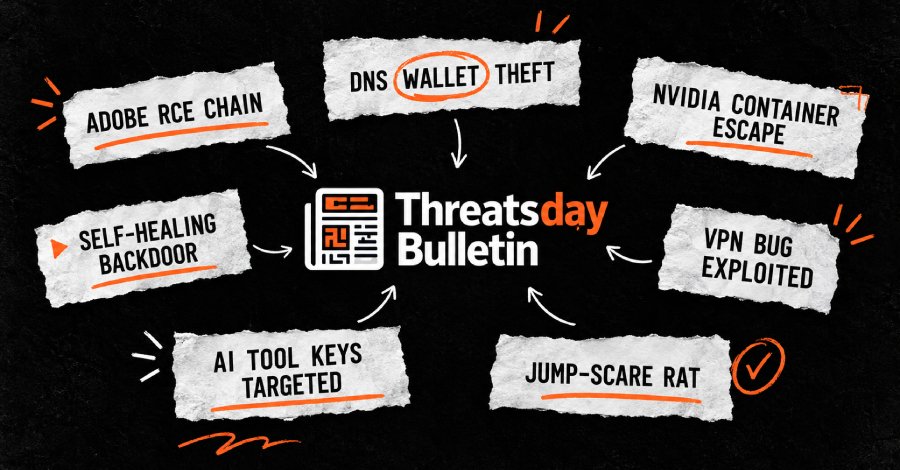
Security researchers have uncovered a Windows-based remote access tool being sold on underground forums that goes far beyond typical data theft. The tool, which has been available since late 2025, offers its operators full control over infected machines. It includes features like keylogging, credential harvesting, hidden desktop takeover, and ransomware deployment. But what truly sets it apart is a collection of built-in psychological harassment features — including screamer functions, jump scares, and the ability to force blue screens of death. The developers refer to these as “fun settings,” suggesting a troubling mindset where causing fear is considered a legitimate feature. The tool has been in development and testing since at least early 2022, long before it was publicly marketed.
—
## Crypto Wallets Drained Using Nothing More Than a DNS Record
A newly identified cryptocurrency wallet drainer, branded as Noir, uses a highly unusual method to operate. Instead of relying on traditional command-and-control servers, it queries DNS TXT records through public DNS-over-HTTPS services to discover where its backend infrastructure is hosted — in this case, a pool running on a major cloud platform. Once a user grants the drainer initial read permissions, it builds a tailored plan for stealing from the specific wallet. It then requests spending permissions in a way that appears less suspicious than a direct transfer, all while operating from infrastructure controlled by the attacker. Security analysts suspect the malware’s creator used artificial intelligence assistance to build and maintain it.
—
## A Remote Access Trojan Hiding Inside Discord Messages
Researchers have identified a Rust-based remote access trojan delivered through a convincing document-themed lure. The attack chain begins with a malicious shortcut file and a PDF containing a hidden payload. Once executed, the malware uses a multi-stage process involving a Nim-based loader, a user account control bypass, and a library search-order hijacking technique to establish persistence. It then uses the messaging platform Discord as its command-and-control channel, leveraging a tunneling service to hide its traffic. The malware can capture screenshots, execute commands remotely, transfer files, and steal data — all while blending into normal Discord activity.
—
## Exploitation of a Major Enterprise VPN Vulnerability Is Underway
An authentication bypass flaw in a widely used enterprise VPN solution is being actively exploited in the wild. The vulnerability, which was publicly disclosed several months ago, allows attackers to bypass authentication entirely and gain access through a victim’s own VPN connection. Because the traffic appears to come from a legitimate remote worker, malicious activity can go unnoticed until significant damage has already been done — including credential theft, lateral movement across networks, data exfiltration, and ransomware deployment. Security experts are urging organizations to patch immediately, terminate all existing VPN sessions after applying updates, and investigate any unexpected connection activity.
—
## Live-Screen Surveillance RAT Spotted in the Wild
A previously undocumented surveillance tool targeting Windows systems has been observed in a multi-stage infection chain. The first stage is a native 64-bit program that gathers basic system information and reaches out to a specific domain over an encrypted connection to retrieve a hidden payload. The second stage, which researchers have named BotHelper RAT, installs itself in a concealed location, sets up a scheduled task to restart itself every half hour, and begins communicating with its operator through web-based endpoints. Its most notable capability is live screen surveillance, allowing attackers to watch everything happening on an infected machine in real time.
—
## AI Developer Credentials Are the New Gold Mine
A growing wave of malware is specifically targeting the credentials and session files used by AI-powered coding assistants. Tools like AI chat assistants, automated coding platforms, and related development environments are being targeted by infostealers designed to harvest API keys, authentication tokens, and session data. These stolen credentials are highly valuable because they allow attackers to impersonate legitimate developers, access connected repositories and cloud services, and potentially bypass security safeguards that assume requests are coming from trusted users. Industry reports indicate that AI service credentials have become one of the most sought-after commodities in the underground economy, with some being resold on illicit marketplaces.
—
## Major Tech Company Discloses Breach via Stolen GitHub Credentials
A well-known technology company has notified approximately 1,500 individuals — primarily its own employees in the United States — that unknown threat actors gained access to internal software repositories. The breach was carried out using an employee’s stolen login credentials, and the unauthorized access was discovered and terminated only recently. The incident highlights how a single compromised set of credentials can expose sensitive internal codebases and the personal data of employees.
—
## Russia’s Hybrid Warfare Strategy Is Expanding Across Europe
A major intelligence analysis firm has assessed that a foreign nation has significantly escalated its use of hybrid warfare tactics across the European continent following a large-scale military conflict. These operations do not involve conventional military invasions but instead rely on a complex combination of cyberattacks, psychological operations, and physical actions designed to test defenses, degrade critical infrastructure, and create widespread fear among populations and governments. The goal is to weaken a nation’s ability to respond effectively, both in the digital and physical domains.
—
## Google Rolls Out Major Anti-Scam Protections for Android Users
Google has announced a comprehensive set of new anti-scam features for Android devices. The updates include AI-powered scam detection that processes warnings privately on the device, enhanced link safety checks, and redesigned alerts before users tap on unfamiliar URLs. A particularly notable feature blocks incoming phone calls from numbers claiming to represent banks if the call was not actually initiated by that bank — a move that has already blocked over three million spoofed calls from two major Brazilian banks since it launched earlier this year. Additional improvements include automatic screen-share privacy protections and prevention of apps silently enabling call forwarding in the background.
—
## Self-Healing Malware Infects WordPress Sites Using Blockchain Technology
Security researchers have discovered a WordPress backdoor malware that uses several techniques to survive removal attempts. The malware installs itself as a required plugin and uses blockchain-based hiding techniques to obscure the location of its command servers, making it extremely difficult for defenders to shut down its communication channels. Once installed, it can create hidden administrator accounts, harvest passwords, modify site content, exfiltrate data, and spread to other WordPress installations on the same server.
—
## Vulnerability in Open-Source Container Registry Exposes Cloud Credentials
A security flaw in a popular open-source container registry platform could allow any registered user to steal cloud credentials from the server. The vulnerability, which carries a high severity score, works by abusing a server-side request forgery issue in the platform’s webhook functionality. A user with project creation permissions can redirect a webhook to the cloud metadata endpoint and silently retrieve the server’s identity and access credentials.
—
## Several Critical Vulnerabilities Patched Across Different Platforms
A range of important security patches were released this week across multiple platforms. A critical flaw in an enterprise experiment-tracking tool, which was discovered by an AI assistant, could have allowed unauthenticated attackers to execute commands on servers. A separate set of four high-severity code execution vulnerabilities was patched in a network management tool. Additionally, a race condition in a popular open-source virtualization platform could have allowed a guest virtual machine to escape its sandbox and gain full control of the host machine. All affected products have released updates, and users are strongly encouraged to apply them promptly.
—
## AI Model Developers Announce Major New Defenses Against Data Theft
A leading AI company has reported significant improvements in protecting its models against a technique used to secretly copy and steal AI capabilities. By implementing several new protective measures — including a two-stage content classification system, a preserved reasoning feature, and new charging mechanisms for blocked requests — the company says it has reduced successful data harvesting attempts by an estimated 90 to 99 percent.
—
## Browser Makers Raise Rewards and Enterprise Offerings
Two major developments in the browser space signal growing importance of web security. One company has significantly increased bug bounty payouts for memory-safety vulnerabilities in its flagship browser, quadrupling base rewards to encourage more researchers to find and report flaws. Another company has launched a specialized enterprise browser edition designed for organizations with strict security, governance, and compliance requirements, giving IT teams enhanced control over data and browser environments.
—
## Preparing for the Post-Quantum Era
A major technology company has issued a strong warning to organizations to begin preparing their digital certificate systems for a future where current encryption methods may no longer be secure. The company recommends that organizations inventory all certificate dependencies, assess vendor roadmaps for quantum-resistant alternatives, identify long-lived infrastructure that will need updating, and set up testing environments before quantum-safe authentication becomes mandatory at scale.
—
## FAQ
**What is a remote access trojan (RAT)?**
A RAT is a type of malware that gives an attacker unauthorized remote control over an infected device. It can allow the attacker to view screens, steal files, capture keystrokes, execute commands, and monitor activity — all without the user’s knowledge.
**How do DNS-based attacks work?**
DNS-based attacks abuse the Domain Name System, which translates website names into IP addresses. Attackers can hide their command servers behind legitimate DNS records, making it harder for security tools to detect malicious communication between malware and its operator.
**What is hybrid warfare?**
Hybrid warfare combines conventional military tactics with cyberattacks, disinformation campaigns, economic pressure, and other asymmetric strategies to destabilize a country without a traditional armed invasion.
**Why are AI credentials so valuable to attackers?**
AI credentials such as API keys and session tokens give attackers the ability to use AI services as if they were legitimate developers. This means they can access private data, run their own workloads, use the victim’s API quota, and potentially access sensitive conversations or code repositories.
**What is a blockchain-based backdoor?**
A blockchain-based backdoor hides its command-and-control infrastructure behind a smart contract on a blockchain network. Because blockchain records are distributed and resistant to takedowns, this makes the malware’s communication channel extremely resilient to disruption by defenders.
**What should I do if a service I use has a critical vulnerability?**
Apply patches and updates as soon as they are released. If you are part of an organization, coordinate with your IT or security team to ensure all systems are updated promptly. Monitor for any signs of unauthorized access, especially if the vulnerability was exploited before a fix was available.
**How can I protect my cryptocurrency wallet from drainers?**
Never grant unnecessary permissions to unfamiliar websites or browser extensions. Be cautious of links in unsolicited messages. Use hardware wallets for long-term storage, and regularly review the permissions granted to websites and applications that interact with your wallet.
—
## Conclusion
The cybersecurity threats reported this week share a common theme: attackers are finding increasingly creative ways to exploit both technical weaknesses and human trust. Whether it is a malware builder designed to psychologically harass victims, a wallet drainer that operates through a simple DNS record, or the targeting of valuable AI credentials, the message is clear — no system is too small and no credential is too safe to ignore.
Patching vulnerabilities, monitoring for unusual activity, using multi-factor authentication, and staying informed about emerging threats are not optional practices. They are essential layers of defense in an environment where attackers are constantly evolving their tactics. The best time to prepare is now, before the next wave of surprises arrives.
Thank you for reading.
