



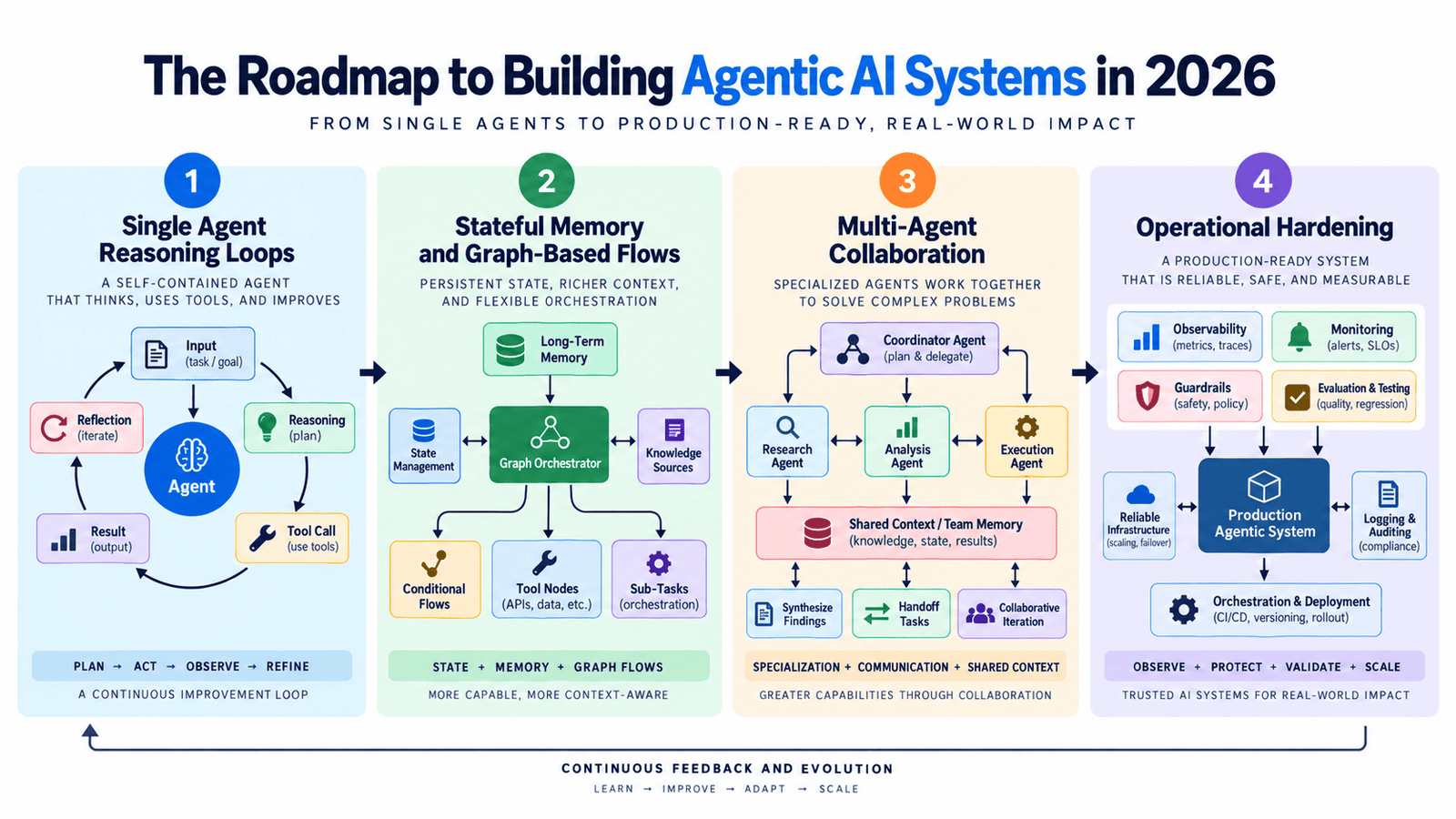
# A Practical Roadmap for Building Agentic AI Systems in 2026
Agentic AI has quickly evolved from a theoretical concept into a practical part of modern infrastructure. Today, we see systems that can autonomously plan, use external tools, and refine their approach being used for everything from automated code reviews to customer support platforms.
However, creating an agent that works reliably in the real world is far more challenging than building a convincing demo. The jump from a simple chatbot to a fully autonomous, multi-step system requires a new set of engineering skills: managing complex states, recovering from errors, safely executing code, and evaluating entire sequences of actions rather than just single responses.
This roadmap breaks down the journey into four progressive levels, starting with the fundamentals of a single agent’s brain and moving all the way through to building, securing, and monitoring sophisticated multi-agent teams.
## Level 1: Understanding Single Agents and How They Think
Before you can build a team of agents, you need to master the inner workings of one. An agent differs from a standard AI model call because it operates in a continuous loop: it assesses its environment, chooses an action, executes it through a tool, and then uses the outcome to decide what to do next.
There are several strategies agents use to manage this loop:
* **Reason-and-Act:** The agent pauses to think through its approach, takes a tool-based action, observes the result, and then thinks again. This creates a clear, traceable path of “thought, action, observation.”
* **Plan-First:** The agent maps out the entire project before executing a single step, which works well when the task is straightforward and predictable.
* **Self-Reflection:** The agent pauses to critique its own work before finalizing it, catching errors that standard generation often misses.
* **Branching Exploration:** The agent generates multiple possible solutions at once, evaluates them side-by-side, and follows the most promising path.
A critical component of this level is how agents interact with tools. Using structured data formats (like JSON) for tool calls ensures the agent requests exactly what it needs. Strict validation checks before executing these requests prevent small formatting mistakes from cascading into system crashes. Finally, because long-running agents consume a lot of context, managing what stays in the active memory window versus what gets archived is essential for both cost and performance.
**Portfolio Project:** Build a single agent that answers complex research questions by combining web searches with a calculator. Keep a log of every thought process and tool call it makes.
## Level 2: Persistent Memory and Dynamic Workflows
A basic agent that forgets everything once its task is complete is fragile. The next level introduces persistent memory and flexible, non-linear workflows.
Agent memory comes in three forms:
* **Active Context:** The immediate information the agent is looking at right now. It’s fast but limited in size.
* **Episodic Memory:** A storage of past interactions that the agent can search through to recall specific events from previous sessions.
* **Semantic Memory:** A structured knowledge base that helps the agent understand concepts and relationships, much like an encyclopedia.
Equally important is moving away from rigid, step-by-step execution. Real-world tasks rarely follow a straight line. An agent might need to pivot if it finds a source, or loop back if a code execution fails. Using graph-based control flows—where steps are connected as a flexible network rather than a simple list—allows agents to navigate these complexities.
State persistence is what separates production systems from prototypes. By saving the agent’s progress at every stage, you enable critical features: the ability to roll back if an error occurs, resume a task after a pause, or simply replay the decision-making process to find out exactly where things went wrong.
**Portfolio Project:** Upgrade your single agent from Level 1 by adding a memory database. Store past research queries and have the agent retrieve relevant history when it encounters a similar topic.
## Level 3: Building Teams and Managing Communication
Sometimes, a single agent isn’t enough. Complex projects require multiple specialized agents working together.
When designing agent teams, you must first choose a topology:
* **Hierarchical:** A lead agent breaks down a large task, assigns pieces to specialized workers, and then compiles the final output. This is the most common and easily debugged approach.
* **Debate-Style:** A generator creates an output, and a separate reviewer challenges it to improve quality before it’s accepted.
* **Peer-to-Peer:** Agents work side-by-side without a central boss, which is useful for exploring different angles of a problem simultaneously.
Communication design is the hidden challenge of multi-agent systems. If agents talk to each other using unstructured, conversational text, misunderstandings accumulate quickly. Instead, define strict message formats for assigning tasks, requesting updates, and handing off results.
You also need a strategy for conflict resolution. When one agent says the sky is blue and another says it is grey, the system needs a defined process—whether that means voting, re-examining the data, or flagging it for human review.
**Portfolio Project:** Create a three-agent system: one researcher, one writer, and one critic. Have the critic reject the writer’s draft, and document how the system recovers and revises the work.
## Level 4: Hardening, Sandboxing, and Monitoring
A multi-agent system that works perfectly in a test environment but fails unpredictably in production isn’t finished. The final level focuses on making these systems safe and reliable at scale.
The first operational risk is the runaway loop. An agent stuck in a repetitive cycle can consume infinite resources and time. You must build safeguards like hard limits on how many steps an agent can take or how much it can spend on computing power.
Any agent that can write and run code needs a sandboxed environment. Never let an agent execute arbitrary code on your main servers. Instead, use isolated containers or secure cloud sandboxes to safely contain the agent’s actions.
Finally, observability is non-negotiable. You cannot fix what you cannot see. Traditional error tracking isn’t enough; you need execution graph tracing that records every single step, tool call, and state change throughout the agent’s journey. This allows you to pinpoint exactly where in the workflow the agent made a mistake, not just whether the final answer was wrong.
**Portfolio Project:** Take your multi-agent team from Level 3, add tracing to every step, run it through ten test cases, and write a report identifying the most frequent point of failure in the workflow.
## Frequently Asked Questions (FAQ)
**Q: What exactly is an “agentic” AI system?**
A: Unlike a traditional AI that simply responds to a single prompt, an agentic AI system acts autonomously. It perceives its environment, makes a plan, uses external tools to gather information or take action, and evaluates the results to decide its next move—all without constant human intervention.
**Q: Why is memory so important for these systems?**
A: Memory prevents agents from experiencing amnesia between steps. It allows them to remember what they have already tried, what tools they have used, and what information they gathered, which is essential for solving long, complex problems where context can easily be lost.
**Q: How do you prevent an agent from getting stuck in an endless loop?**
A: The primary defense is building circuit breakers directly into the agent’s logic. This includes setting a strict maximum number of steps (recursion depth), capping the total amount of computing power or tokens the agent can use, and implementing automatic timeouts that halt execution if no progress is detected.
**Q: What is the best way to evaluate an agent’s performance?**
A: You cannot just look at the final answer. The gold standard is trajectory-level evaluation, where you score not only the final output but also the efficiency, safety, and correctness of every single step the agent took to get there. This reveals *why* an agent failed, not just *that* it failed.
**Q: Do I need to use specific programming languages to build these systems?**
A: Most modern agent frameworks are Python-based due to the dominance of AI and machine learning libraries in that ecosystem. However, the core concepts of state management, tool calling, and workflow design can be applied using any language that can make API calls and parse structured data like JSON.
## Conclusion
Building agentic AI is a journey from creating reactive chatbots to engineering proactive, goal-oriented systems. The transition introduces significant complexity, but by approaching it layer by layer—from validating individual tool calls, to managing persistent state, to coordinating team communications, and finally to sandboxing and tracing—you can build systems that are both powerful and dependable. The investment you make in hardening each level of the stack directly determines the reliability of the final product. Approach the process deliberately, and the rewards are immense.
Thank you for reading
