



# How a Music-Tech Idea From the Mid-2010s Predicted Modern AI Agents
## A Simple System That Predicted Everything
Imagine a rock concert. A guitarist wears an instrument equipped with sensors that capture every note, bend, and strum. Cameras pointed at the audience read their faces and body language. Fans in the crowd submit real-time reactions from their phones — thumbs up, thumbs down, comments. All of this streams into a central system that makes a single judgment: is this performance landing? And if it’s not, the system tells the musician while there’s still time to adjust.
In one version of the idea, an LED embedded in the guitar neck glows green when the note is right, flashes yellow when the tempo starts to drift, and turns red when something goes wrong. The entire feedback cycle — sense, judge, tell — was meant to complete in under a second.
This was conceived roughly a decade ago, when the term “artificially intelligent analytics engine” was the best available vocabulary. Today, when we look at that same design, something remarkable emerges: it maps almost perfectly onto what we now call an AI agent.
## Breaking Down the Blueprint
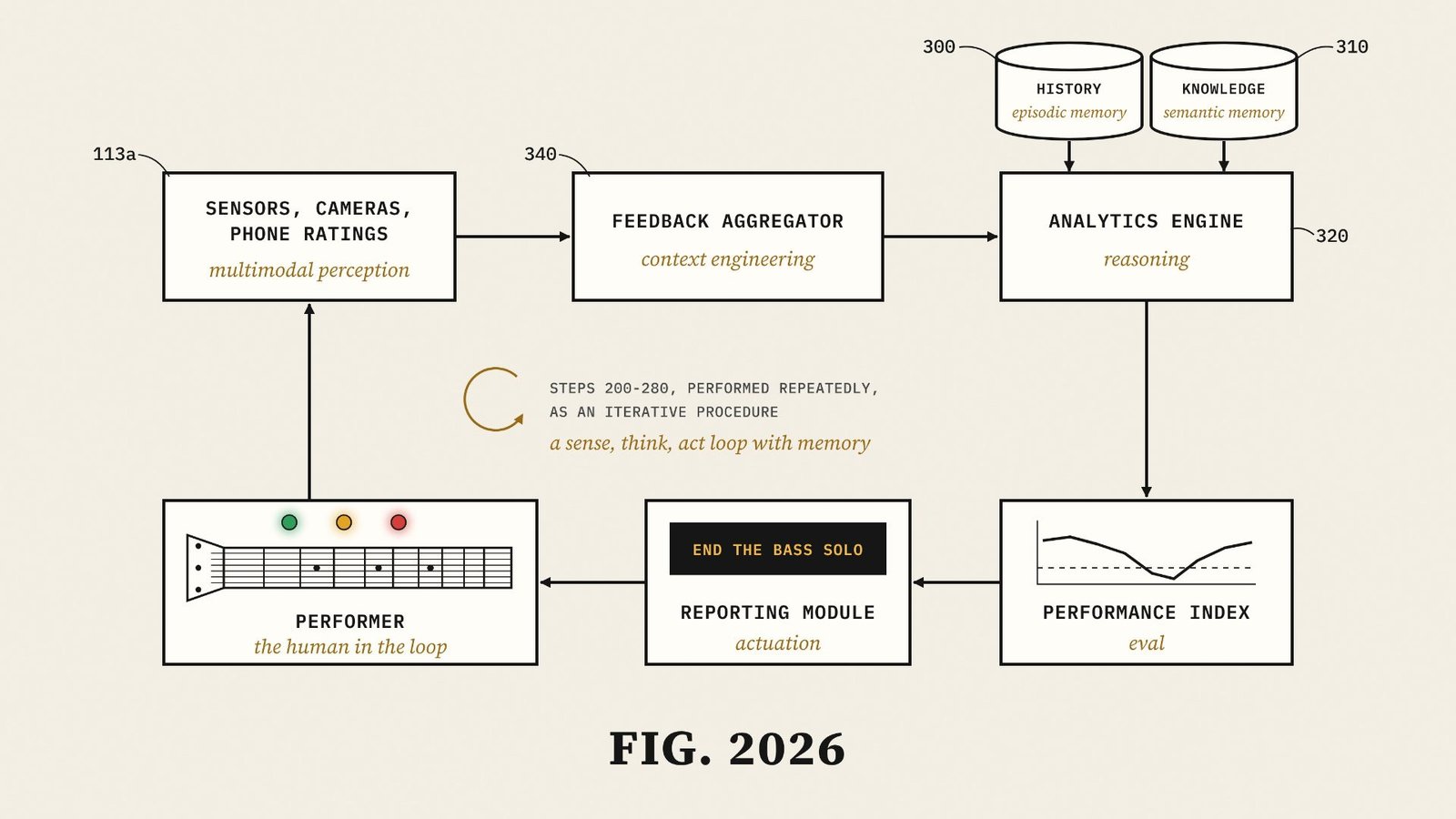
Strip away the jargon, and the system has seven distinct pieces that every modern agent engineer would recognize.
### Multimodal Perception
The system ingested three entirely different types of input at once. Embedded sensors and microphones captured objective performance data — timing, pitch, volume, and more, across dozens of signal types. Cameras captured involuntary audience signals: facial expressions, posture, movement. And a separate channel carried deliberate, human-generated feedback: ratings and comments submitted through personal devices. The key insight was recognizing that these signals belong to different categories and should be treated differently, not averaged together carelessly.
### Context Assembly
Raw data from three sources is useless without organization. A middle layer tagged every piece of information by where it came from and what kind of signal it represented, sorted it into per-performer streams, and reformatted it for the reasoning component. This is what engineers today call context engineering — deciding what the system actually “sees” and in what form.
### Memory-Grounded Inference
The reasoning component didn’t work in a vacuum. It drew on two kinds of stored knowledge. One was a historical record of past performances by the same musicians — what tempos previously kept audiences engaged, which songs landed well, which didn’t. The other was domain-level knowledge about music theory and structure. Together, these two memory systems let the engine compare what was happening live against what it knew to be true, including detecting when a musician had drifted into the wrong key or was performing material that didn’t match the audience’s energy.
### A Hand-Crafted Evaluation Function
Rather than relying on a single opaque score, the system used a transparent, interpretable evaluation function. It combined audience sentiment from social reactions, facial analysis, body language, and objective musical accuracy into one normalized number. Thresholds defined when things were going well and when they weren’t, and the score was tracked over time to spot trends, not just snapshots.
### Human-in-the-Loop Actuation
This is where the design gets especially thoughtful. The system offered three escalating levels of guidance. First, it could simply display a score — pure information. Second, it could name what it inferred — “the audience is disengaged.” Third, it could suggest a specific action — “shorten this solo.” In every case, the final decision and action belonged to the human performer. The system had an autonomy dial built into its architecture, choosing how much to recommend based on the situation.
### A Hard Real-Time Constraint
Every step in the loop had a deadline. If the feedback arrived too late, the musician couldn’t use it. The entire cycle — from sensor input to recommendation — was designed to complete in under a second, with a hard ceiling of a few seconds at most. This is what separates agents that actively shape outcomes from agents that merely report on them after the fact.
### Iteration as the Core Mechanism
Steps two through seven were designed to repeat continuously throughout the performance, turning the system into a persistent, ongoing cycle rather than a one-shot analysis.
## What the Design Got Right
Four principles from this early concept have proven timeless, and they are all matters of data architecture, not model sophistication.
**The loop is the product.** Value was never in any single inference — it was in the closed cycle of observation, evaluation, and correction. Systems that attach a model to a workflow without closing that loop discover this gap the hard way.
**Inference must be grounded in memory.** A system that assesses sentiment without historical context is just a classifier shouting into the void. Modern agents that lack both episodic memory and domain knowledge make the same mistake — they sound fluent but cannot connect Tuesday’s events to Wednesday’s decisions.
**Evidence carries provenance.** Treating sensor data, inferred sentiment, and deliberate ratings as distinct families of evidence — each with its own reliability profile — is exactly how a well-designed agent should weigh tool outputs, retrieved documents, and user inputs.
**The human is a first-class architectural component.** The system was built around the constraints of its actuator: limited attention, split-second timing, and high cognitive load. The LED on the guitar neck wasn’t a gimmick — it was an exercise in delivering one clear, timely message under tight interface constraints.
## What a Decade of Distance Reveals
Looking back at the design with today’s experience exposes honest gaps that teach more than the successes.
**The intelligence was the weakest link, and nobody called it that.** The system’s reasoning layer — the part that was supposed to fuse frowning faces, sarcastic comments, and sensor streams into nuanced judgments — was mostly rules and classifiers. The structure was sound but the reasoning was aspiration. Today, the situation has inverted: the reasoning component is powerful, and it is everything around it — the memory, the context, the loop — that often remains weak in production systems.
**Memory was permanent, and forgetting was an afterthought.** The historical record only grew. Nothing expired, nothing decayed, nothing could be formally removed. In the mid-2010s, this seemed like a virtue. Today, an agent memory without designed forgetting accumulates stale facts that poison decisions and collects personal data without lifecycle governance. Retention policies, decay mechanisms, and provable erasure are architectural necessities, not cleanup tasks.
**Permissions were entirely absent.** The system specified cameras analyzing individual audience members’ faces with the ability to zoom in on specific people, along with continuous tracking of sentiment per person. There was no discussion of consent, data ownership, or access control anywhere in the design. This was a product of its time — the regulatory landscape had not yet caught up. Today, defining what a system is allowed to observe, retain, and act upon, and on whose behalf, is a foundational layer of agent design.
**The system never improved from its own outcomes.** It inferred and recommended, but no result ever fed back to make the system better. The “weights” — in every sense — were frozen. The distance between storing everything and actually learning from experience remains one of the honest open challenges in agentic AI, and repeatedly treating retrieval as a substitute for learning repeats the same optimism in newer terminology.
## What This Means for Building Agents Today
The pattern behind this concept — perception, context assembly, memory-grounded reasoning, evaluation, bounded action, and a hard latency budget — has been sketched by engineers for decades, in decision support systems, in industrial control loops, and in monitoring platforms. What has genuinely changed is that the reasoning component now works at a level that makes the rest of the pattern actually viable.
That means the hard parts haven’t disappeared — they’ve shifted. The scarce skills in building production agents are the same skills that were visible in embryonic form in this old design: architecting memory with lifecycle management and forgetting, engineering context with proper provenance, building auditable evaluations, embedding entitlements directly into the data layer, respecting latency budgets, and deliberately deciding where the human sits in each action loop.
We didn’t lack the idea back then. We lacked the model to execute it. Now that models exist, what production systems consistently lack is the disciplined architecture around them. The guitar-neck LED remains the right metaphor for the entire field: build a system that knows enough, remembers enough, and is permitted to know enough, to deliver one true and timely piece of guidance while there’s still time to act on it.
—
## Frequently Asked Questions
**Is the design described here actually used in modern AI agents?**
The specific use case — monitoring live musical performances — is not a common production scenario. But the architectural pattern it illustrates is exactly what modern agent systems are built on: multimodal input, structured context, memory with episodic and semantic layers, a transparent evaluation function, human-in-the-loop actuation, and hard real-time constraints. The pattern is widely used in customer service agents, monitoring systems, and workflow automation.
**Why is the human-in-the-loop design considered important?**
Because every actuator has limits. A performer can only process so much information in real time, and a wrong recommendation delivered at the wrong moment can make things worse. Building the system around the constraints of its human actuator — rather than treating the human as an afterthought — produces better outcomes than either full automation or fully passive feedback.
**What does “memory with forgetting” mean in the context of AI agents?**
It means designing storage layers where stored information has a designed lifecycle. Some facts should expire, some should decay in importance over time, and some should be formally deleted when they are no longer relevant or when they represent personal data. An agent that remembers everything forever is as problematic as one that remembers nothing.
**How does the evaluation function relate to modern reward models?**
The evaluation function described here was hand-crafted, transparent, and auditable — weights and thresholds chosen by engineers. Modern learned reward models are more flexible and can capture subtler patterns, but they are opaque and harder to audit. The honest trade-off between interpretability and sophistication is one that teams building production agents still navigate daily.
**What was the biggest blind spot in the original design?**
The biggest blind spot was permissions and consent. The system designed ways to observe and analyze individuals in close to real time with no framework for who had agreed to be observed, what data could be retained, or how long it could be kept. That blind spot wasn’t unique to the mid-2010s — it was simply a reflection of the moment. Today, data governance and consent are architectural requirements, not optional layers.
**Can an agent learn from its own outcomes?**
Not in the way described in this concept. The original design inferred and recommended but never updated itself based on results. Modern agent systems are exploring this problem through various approaches — reinforcement learning, outcome tracking, feedback loops — but building reliable, safe learning into agent systems remains an active area of research and engineering.
—
## Conclusion
The distance between a 2010s concept for giving live feedback to rock musicians and a modern AI agent is shorter than it might seem. The architecture — sense, aggregate, reason from memory, evaluate, act within constraints — is the same. What changed was that one critical component finally caught up: the reasoning engine.
But catching up the reasoning engine didn’t solve the other six problems. It made them more visible. Memory design, context engineering, evaluation transparency, human placement, latency discipline, and permissions governance are where production systems succeed or fail today — and every one of those concerns was at least gestured at in that early design.
The takeaway for anyone building agents is both humbling and encouraging. The fundamental patterns are well understood. The discipline of executing them consistently — designing memory that forgets, context that carries provenance, evaluation that can be audited, constraints that are enforced in the data layer — that is what separates working systems from prototypes. We had the loop then. We have the reasoning now. What we need most is the engineering discipline to make the whole thing work together.
Thank you for reading
