



# The CFTC’s Empty Seats: What Rebuilding the Commission Means for Digital Asset Regulation
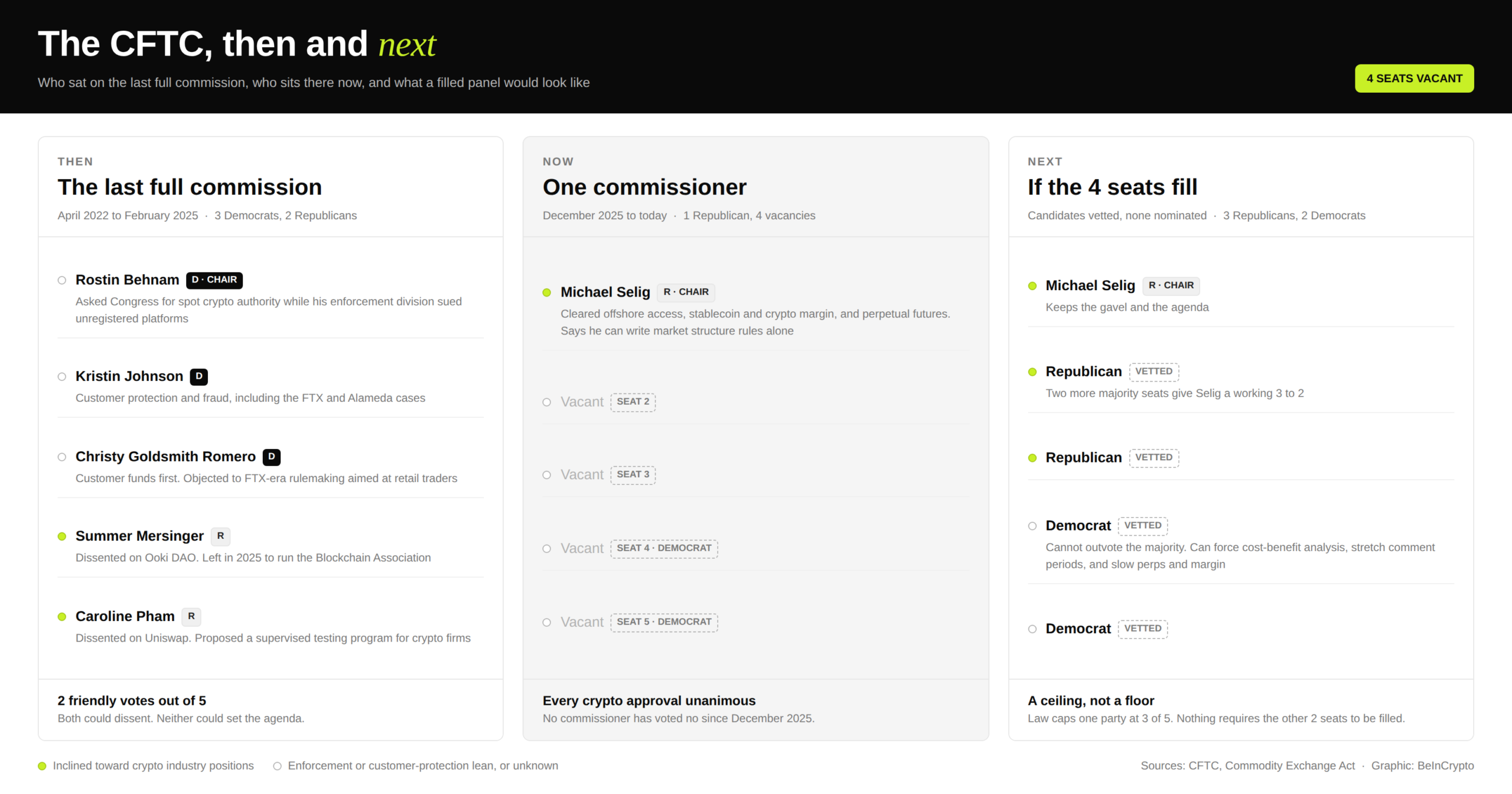
The Commodity Futures Trading Commission currently operates with a single vote cast — its sole remaining commissioner, Chairman Michael Selig. Four positions sit vacant after a mass departure of officials over the past year, leaving the federal agency tasked with overseeing futures and derivatives markets effectively running on one voice.
President Trump has reportedly begun vetting candidates for all four empty positions, according to reporting at the time. Two of the four openings would traditionally fall to the president’s party, though legal experts emphasize that no statute demands a single seat be filled by a member of any specific political affiliation.
This moment raises fundamental questions about the future of U.S. digital asset regulation, the balance of power between parties, and how much influence a single commissioner can truly wield.
—
## The Previous Commission: A Full Panel That Shaped Crypto Policy
For nearly three years — from April 2022 through February 2025 — all five CFTC seats were occupied. The resulting dynamic was one of sharp ideological division, with both sides leaving lasting marks on the agency’s approach to digital assets.
### The Democratic Bloc
The Democratic majority, led by Chairman Rostin Behnam, aggressively pursued enforcement against digital asset platforms operating in the U.S. without proper registration. Behnam repeatedly called on Congress to grant the CFTC spot authority over digital commodities, arguing that existing loopholes left American consumers exposed.
Commissioners Kristin Johnson and Christy Goldsmith Romero focused heavily on customer protection. Johnson championed enforcement actions tied to the safeguarding of client funds, while Goldsmith Romero publicly pushed back against rulemaking proposals during the FTX era that would have extended derivatives access directly to retail traders.
### The Republican Voices
Summer Mersinger and Caroline Pham spent their tenures in opposition. Mersinger famously dissented in the Ooki DAO case — a landmark legal action against a decentralized autonomous organization — arguing the precedent set by the case was dangerous for the broader blockchain ecosystem.
Pham charted her own course as well. She broke with the majority on the Uniswap settlement and instead proposed a supervised testing framework that would allow crypto companies to experiment with new products under regulatory observation before seeking full approvals.
Though neither Republican commissioner could set the agenda unilaterally, the industry took notice. By May 2025, Mersinger had stepped down and been named chief executive of the Blockchain Association, the sector’s primary lobbying organization in Washington.
—
## A Solo Chairman and a Shift in Direction
As vacancies accumulated — Mersinger and Goldsmith Romero departed together, followed by Johnson in September and Pham holding on until December — the CFTC entered uncharted territory. By the close of 2025, Chairman Selig stood alone.
Surprisingly, his tenure as the only voting commissioner proved remarkably productive on digital asset matters. In August, Selig cleared an advisory allowing certain offshore exchanges expanded access to U.S. markets. Weeks later, he floated the idea of treating stablecoins as eligible collateral for derivatives. By December, a pilot program was underway allowing Bitcoin and ether to serve as margin collateral.
Each of these moves built upon guidance and frameworks established under prior leadership, but Selig’s willingness to advance them as the sole decision-maker signaled a clear pivot in tone.
—
## Why Party Affiliation May Not Dictate the Roster
Understanding the commission’s composition requires a look at the legal framework. The Commodity Exchange Act provides for five commissioners serving staggered five-year terms, each requiring Senate confirmation. The president names one commissioner to serve as chairman.
A critical feature of the statute is its party cap: no more than three commissioners may belong to the same political party. This functions as a ceiling, not a floor. It prevents a fourth commissioner from joining the majority party, but it does not mandate that any particular party hold a specific number of seats.
Customarily, the president’s party assumes the majority. Presidents also traditionally solicit opposition candidates from Senate leadership — a practice that explains why minority leader Chuck Schumer submitted names for both the CFTC and the SEC during negotiations over a major digital assets bill.
However, both customs are entirely optional. A president could choose to leave seats empty, appoint all members from one party within the legal limit, or ignore the tradition of bipartisan consultation entirely. Three Republicans and two unfilled chairs would be entirely lawful.
—
## What the Industry Wants — and What It Fears
Digital asset firms generally prefer an arithmetic outcome: Selig’s existing policy trajectory continuing with two additional Republican commissioners forming a comfortable majority, while moderate figures occupy the remaining minority seats.
Under such a scenario, two Democrats could not overturn decisions. However, they would retain procedural tools — forcing cost-benefit analyses, extending public comment periods, and delaying approvals on contentious products like perpetual futures and new margin requirements.
The political trade-off is less visible but equally significant. Senate Democrats have conditioned their support for the CLARITY Act — legislation that would formally divide digital asset oversight between the CFTC and the SEC — on the full seating of the commission. Passage appeared uncertain ahead of a procedural vote in mid-September, and sources familiar with White House thinking indicated that the administration has little incentive to fill the seats if the bill stalls.
A permanent statute carries more weight than any single commissioner’s interpretation. The CFTC is about to discover whether statutory constraints or executive leadership will prove more influential in shaping its digital asset posture.
—
## FAQ: Frequently Asked Questions
**What is the CFTC?**
The Commodity Futures Trading Commission is a federal agency responsible for regulating futures, options, and swaps markets in the United States. It oversees market integrity, consumer protection, and the development of derivatives products.
**How many commissioners does the CFTC have?**
By statute, the CFTC is composed of five commissioners, each serving staggered five-year terms. Only three may belong to the same political party.
**Why are seats currently vacant?**
Multiple commissioners departed over a concentrated period beginning in late 2024 and extending through early 2026, leaving four positions unfilled as of the most recent reporting.
**Can a commission operate with fewer than five members?**
Yes. While a full panel is ideal for balanced governance, the law does not require all seats to be filled. The commission can continue to function — and has — with a single member casting votes.
**What is the difference between the CFTC and the SEC?**
The CFTC primarily regulates futures, swaps, and derivatives markets, while the Securities and Exchange Commission oversees securities offerings and exchanges. The proposed CLARITY Act aims to formalize this division of digital asset oversight between the two agencies.
**Why does the party cap matter?**
The cap prevents one party from holding a supermajority of seats, which could allow unilateral rulemaking. It also ensures that no single party can block all appointments if it holds fewer than three seats.
**What happens if the seats remain unfilled?**
Unfilled seats reduce the commission’s voting capacity and can limit its ability to conduct business, issue rules, and approve enforcement actions. A single commissioner can still issue guidance and advance policy, but major decisions require a quorum.
**What is the CLARITY Act?**
The CLARITY Act is proposed legislation designed to split regulatory responsibility for digital assets between the CFTC and the SEC, clarifying which agency oversees which types of tokens and products.
—
## Conclusion
The CFTC stands at a crossroads. With only one commissioner casting votes and four seats awaiting presidential appointment, the agency’s direction on digital asset policy hangs in the balance. The decisions made in the coming months — whether seats are filled, who is nominated, and whether congressional legislation passes — will define the regulatory landscape for digital assets in the United States for years to come.
For the crypto industry, the calculus is clear: statutory constraints are far harder to overturn than the preferences of any single chairman. Whether Washington chooses to fill those seats and how it chooses to fill them will reveal which regulatory reality the market prefers to plan around.
The era of one vote is temporary, but its consequences will be lasting.
Thank you for reading
