



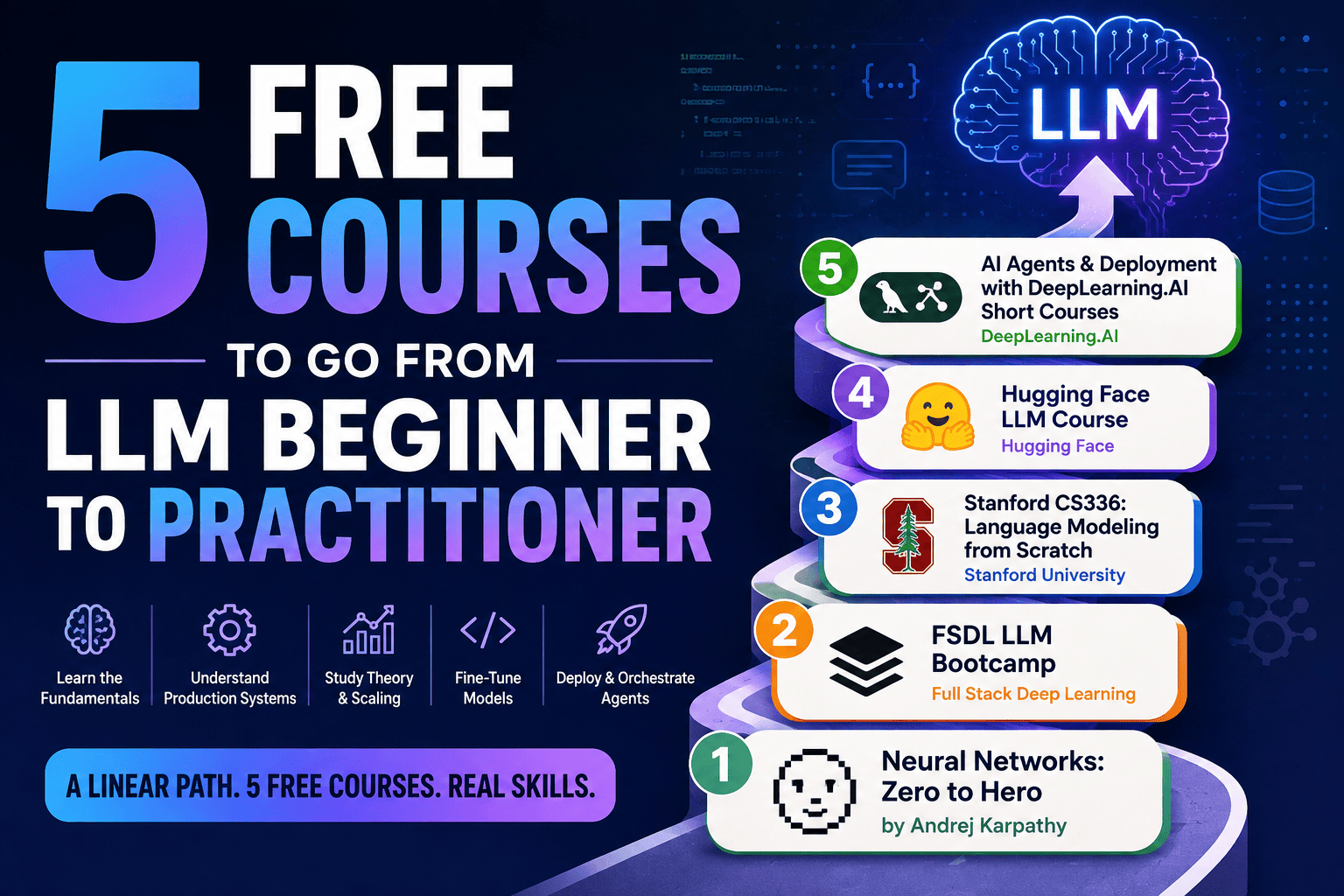
# 5 Free Courses That Take You From LLM Beginner to Practitioners
The sheer volume of available resources on large language models can be overwhelming. Many tutorials are either surface-level introductions or outdated guides that don’t reflect modern fine-tuning and deployment workflows. What learners really need is a structured, sequential curriculum — one where each course builds on the skills acquired in the previous one.
This curated list does exactly that. The five courses below follow a deliberate linear progression: understanding the foundational mathematics and mechanics of language models, learning production system architecture, diving into academic theory and scaling laws, gaining hands-on fine-tuning experience, and finally deploying agents in real-world settings. Whether you’re a developer looking to transition into AI engineering or a data professional aiming to deepen your LLM expertise, this path takes you from zero to practitioner.
—
## 1. Laying the Groundwork with a Neural Networks Deep Dive
Before interacting with any large language model productively, you need to understand what’s happening beneath the surface. A standout free resource walks learners through constructing neural networks entirely from raw Python, avoiding shortcuts that frameworks typically hide behind.
The course begins by building a lightweight automatic differentiation engine from the ground up, transforming backpropagation from a mysterious concept into something you can follow instruction by instruction. You then progress through creating a character-level language model using bigram patterns and multilayer perceptrons, ultimately constructing a working transformer architecture at the scale of GPT-2 — including implementing a byte-pair encoding tokenizer manually.
**Highlights of what you will build:**
– A custom autograd engine implemented in pure Python
– A bigram language model and a multilayer perceptron variant
– A full transformer model trained on real text corpora
– A tokenizer replicating the byte-pair encoding approach used by leading AI labs
**Prerequisites:** Strong Python programming skills and a basic understanding of calculus and derivatives.
**Format:** A free video playlist with nine lectures, supplemented by hands-on Jupyter notebooks hosted on GitHub. Active coding sessions typically span 20 to 30 hours.
This foundational course is worth every minute of effort. The act of building these components yourself creates an intuition that simply watching lectures or calling APIs never will.
—
## 2. Understanding Production Systems with a Full Stack Deep Learning Bootcamp
Once you grasp how language models function mechanically, the natural next question is how they operate in real-world applications. A bootcamp-style resource from Full Stack Deep Learning addresses this exact transition, recorded during a two-day intensive event and released for free.
This program focuses on the engineering layer that surrounds large language models: system-level prompt design, operational practices for LLM deployments, building evaluation frameworks, managing latency and cost trade-offs, designing intuitive user experiences for language interfaces, and implementing model-based evaluation pipelines. It assumes you can already work with APIs and write Python confidently, and its core value lies in demonstrating how individual components assemble into a monitored, production-ready application.
**Key topics covered:**
– Structuring LLM applications for reliability and cost efficiency
– Designing evaluation pipelines, including those powered by other models
– Deployment monitoring and operational best practices
– Advanced prompt engineering strategies beyond basic templates
**Format:** A free video playlist with accompanying slide decks. Keep in mind this is the 2023 edition, so some API references may reflect older services, but the architectural patterns and principles remain highly relevant.
The biggest insight this course offers is understanding what breaks in production and why — something that’s nearly impossible to learn from isolated tutorials alone.
—
## 3. Mastering Theory Through an Academic Building-From-Scratch Approach
For a rigorous, graduate-level exploration of how language models are designed, trained, and evaluated at scale, a Stanford University course stands out as the most comprehensive free academic resource available. Taught by faculty members specializing in AI safety and systems, the course takes a philosophy similar to operating systems education: you learn by building the entire system yourself.
Rather than focusing on how to use pre-trained models, the curriculum guides you through the complete lifecycle: collecting and cleaning training data, constructing tokenizers, implementing the transformer architecture, optimizing training processes, and designing evaluation frameworks before deployment. Topics extend into scaling laws, data provenance and curation, alignment considerations, and the infrastructure decisions required for training across different hardware configurations.
**Core areas of study:**
– Data collection, deduplication strategies, and pre-training corpus design
– Implementing transformer architecture components from scratch
– Training optimization techniques including learning rate scheduling and gradient clipping
– Evaluation methodology and benchmark construction
**Format:** All lecture slides, assignments, and course notes are publicly accessible on the course website. This is graduate-level material and should be expected to be academically demanding.
This course rewards persistence. The deep understanding gained here sets apart engineers who can fine-tune models from those who can design and train them from the ground up.
—
## 4. Gaining Hands-On Fine-Tuning Skills with a Leading AI Platform’s Course
Theory must eventually meet tooling, and a comprehensive thirteen-chapter course from a major open-source AI platform bridges that gap perfectly. Originally launched as an NLP course and continuously updated through 2026, this resource covers the entire ecosystem of the platform’s libraries and tools.
The curriculum spans transformer architectures, tokenizer implementations, dataset management libraries, supervised fine-tuning workflows using modern training libraries, low-rank adaptation techniques, and most recently, building reasoning-based models using group-relative policy optimization methods. Later chapters are particularly valuable, covering dataset curation tools, instruction-tuning workflows, and reinforcement learning alternatives like direct preference optimization.
**Hands-on projects you will complete:**
– Fine-tuning models using low-rank adaptation on custom datasets
– Curating and formatting datasets for instruction-based tuning
– Training a reasoning model with advanced optimization techniques
– Creating interactive demos for sharing model outputs with others
A practical code snippet from the course illustrates the standard fine-tuning workflow in just a few lines, connecting model configuration, training datasets, and the training execution in a streamlined pattern that the course explores in depth.
**Format:** Thirteen chapters with progressive complexity, designed to take 15 to 20 hours of focused work.
This course transforms theoretical knowledge into muscle memory — the kind that comes from actually running training loops and debugging failed experiments firsthand.
—
## 5. Deploying and Orchestrating Intelligent Agents with a Short Course Platform
The final stage of this learning path focuses on the operational layer: serving models efficiently at scale, constructing stateful agents with memory and tool access, and connecting language models to external systems. A well-known AI education platform offers a modular catalog of short, focused courses that cover these deployment and orchestration skills.
Key courses in this track teach you to build controllable agents from scratch and then reconstruct them using stateful graph-based abstractions that make complex agent behaviors manageable. Additional courses cover high-throughput model serving infrastructure, designing retrieval-augmented generation pipelines with vector databases and re-ranking, and semantic routing strategies for directing queries to the right model. Each course is concise — running between one and three hours — and is taught directly by the creators of the frameworks and specialists from production AI infrastructure companies.
**Projects you will develop:**
– A stateful agent with human-in-the-loop checkpoints and conversation management
– A retrieval-augmented generation pipeline with vector search and result re-ranking
– A high-performance model serving endpoint optimized for throughput and response time
**Format:** Free during the platform’s learning period. Availability of individual courses may vary, so it’s worth checking the platform’s current catalog for up-to-date offerings.
This stage transforms you from someone who can train and fine-tune models into someone who can ship working AI applications that users interact with daily.
—
## Recommended Path Through the Courses
These five courses map cleanly to a natural progression through the world of large language models:
| Learning Stage | Course | Estimated Time |
|—|—|—|
| Core Mechanics | Neural Networks Deep Dive | 20–30 hours |
| Production Architecture | Full Stack Bootcamp | 8–10 hours |
| Theory and Scaling | Stanford Academic Course | 30–40 hours |
| Fine-Tuning Skills | Platform Ecosystem Course | 15–20 hours |
| Deployment and Agents | Short Course Track | 10–15 hours |
You don’t need to complete every course start to finish before moving to the next. A practical strategy is to work through the foundational course thoroughly, skim the production bootcamp for architectural intuition, explore the academic course selectively based on your interests, and then dive into the hands-on fine-tuning and deployment courses once you have a specific project to build toward. The gap between understanding LLMs conceptually and being able to build with them comes down to repetition — how many times you’ve run a training loop, examined a loss curve, and debugged a failed experiment. These five courses give you exactly that practice.
—
## Frequently Asked Questions
**Do I need a background in machine learning to start this path?**
A solid understanding of Python is essential. Familiarity with basic calculus concepts, particularly derivatives and gradients, will also help you get the most out of the foundational course. No prior machine learning experience is strictly required, but comfort with programming is non-negotiable.
**Can I complete these courses without a GPU?**
The foundational courses focus heavily on building small models and engines that can run on standard CPUs. However, the fine-tuning and deployment courses will eventually benefit from access to GPU resources, whether through cloud services or local hardware. Many cloud providers offer free tiers that can be used for lighter experimentation.
**Is the order of courses strictly enforced?**
While the courses are designed as a progression, you have flexibility. The early courses build intuitions that make the later ones more productive, but you can adjust the order based on your immediate needs. Just be aware that skipping the foundation may make production and fine-tuning concepts harder to absorb fully.
**Are there paid alternatives that are worth considering?**
Yes, many paid platforms offer structured LLM curricula with mentorship and certification. However, the courses listed here cover the full path without cost, and they are created by leading practitioners and institutions in the AI field. The free options here are genuinely high quality.
**How long does it take to complete all five courses?**
At a steady pace of dedicated learning, you can expect roughly 85 to 115 hours total, which translates to approximately two to three months if you commit around 10 hours per week.
**What kind of projects can I build after completing this path?**
Graduates of this curriculum will be equipped to build fine-tuned models for specific domains, create retrieval-augmented generation systems for knowledge management, develop stateful AI agents with tool access, and deploy serving infrastructure for production applications.
—
## Conclusion
A curated list of five courses offers far more value than ten courses selected without a unifying thread. Each course in this path serves a distinct purpose — from demystifying the math inside neural networks, to understanding how production systems are structured, to mastering academic theory, to developing practical fine-tuning skills, and finally to deploying and orchestrating agents in the real world. The journey from beginner to practitioner is not about consuming content passively; it’s about writing code, running experiments, debugging failures, and building projects that solve real problems.
Start with the foundational course to internalize what’s happening inside these models, deepen your understanding with production and academic resources, sharpen your technical skills through hands-on fine-tuning, and bring it all together by deploying working applications. By the end of this path, you’ll possess the vocabulary, the intuition, and the practical experience to tackle LLM projects that go well beyond simply calling a hosted API.
Thank you for reading
