



Bridging Intent and Code: A Local-First Search Layer for Modern Agents
Coding agents frequently burn through their allocated tool budget on search operations. When a developer knows the exact symbol, standard text matching tools work perfectly. But when a target is a behavior described in plain language, keyword matching often falls short. This forces the agent into inefficient fallback loops—guessing alternative terms, reading entire files, and manually assembling context. Each detour consumes tool calls, tokens, and valuable wall-clock time.
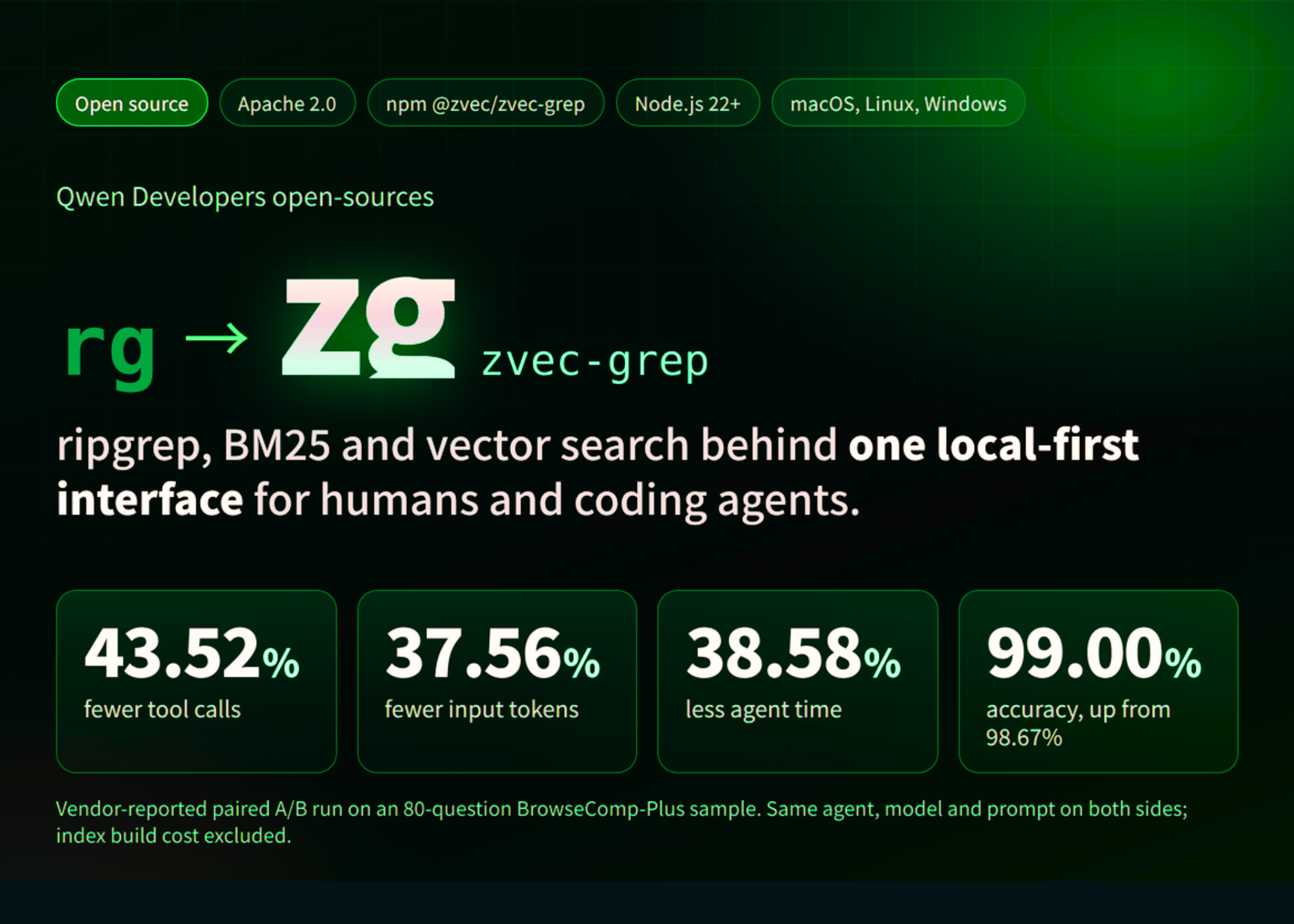
To solve this, a new open-source, local-first search layer has been introduced that unifies semantic search, BM25 lexical ranking, and classic exact matching behind a single interface for both humans and coding agents. Deployable today, the tool installs via npm, requires Node.js 22 or newer, and runs on macOS, Linux, or Windows without needing a GPU for its default model. Released under the Apache 2.0 license, it is fully compatible with commercial use.
The architecture is built on a once-indexed workspace that supports four distinct retrieval routes. A hybrid default runs intent-based matching and lexical anchors in parallel. A BM25 route ranks exact terms, while a vector route handles conceptual similarity using on-device embeddings without relying on lexical ranking. Finally, an exact-match route bypasses the index entirely, which proves essential when a repository has not yet been processed. The index automatically excludes version control folders, build artifacts, dependency directories, and repository-specific ignore rules. Re-indexing updates incrementally, though switching embedding models requires an explicit full rebuild because vector spaces from different models are incompatible even if their dimensions match. Results also carry a freshness state, allowing agents to proceed with a good-enough answer without running a preflight status check first.
For agent integration, the system is built with deliberate restraint. It automatically detects popular coding agent environments and establishes a local Model Context Protocol connection. The default agent-facing toolset exposes only two tools: one for retrieving results when the intent is known but the exact string is not, and another for exhaustive literal or regex matching when a symbol or path is provided. Index lifecycle management remains strictly on the command line; agents cannot silently create, rebuild, or delete persistent indexes by design. Output is optimized for context economy, grouping results by file with line spans, omitting source previews by default, and rejecting flags that would alter the compact result format.
On the topic of embeddings, processing runs on-device by default using static models, ensuring full data privacy. Heavier local options are available for those needing higher capacity, and external endpoints exist for broader coverage. However, remote usage is strictly gated; configuring credentials does not authorize data transfer. Users must explicitly enable remote access per command or establish a signed, revocable workspace grant to route queries externally.
Early evaluation metrics from paired A/B tests demonstrate notable efficiency gains. In a sample of 20 software engineering questions, the tool cut tool calls by more than half and input tokens by nearly half while slightly raising answer quality scores. In a larger sample of 80 deep-research questions, accuracy improved marginally while input tokens dropped by over a third, tool calls fell by more than 40 percent, and agent execution time decreased by nearly 40 percent. Indexing a repository of over 3,400 files reportedly finishes in under 30 seconds on modern Apple Silicon hardware. It is worth noting that these figures come from controlled runs with small sample sizes, so independent replication will be an important next step for the community.
Conclusion
This local-first search layer represents a meaningful step forward in agent tooling. By bridging the gap between plain-language agent intent and the rigid demands of code search, it preserves context, reduces token consumption, and keeps sensitive codebases entirely on-device. As coding agents continue to evolve, tools that streamline the retrieval process without sacrificing precision or privacy will be essential for sustainable development workflows.
FAQ
Q: Does this search tool require a GPU to function?
A: No. The default embedding model is a static, CPU-optimized model, so a GPU is unnecessary for standard operations.
Q: Can I use this tool in a commercial project?
A: Yes. The software is released under the Apache 2.0 license, which explicitly permits commercial use.
Q: What happens if I decide to switch to a different embedding model?
A: You must explicitly trigger a full index rebuild. Vector spaces generated by different models are incompatible, even if the underlying vector dimensions happen to match.
Q: Does the coding agent automatically manage the search index?
A: No. By design, the default integration restricts agents to searching only. Index lifecycle management, including creation and deletion, is intentionally kept within the command-line interface.
Q: Are the benchmark performance claims independently verified?
A: No. The reported metrics originate from controlled A/B tests conducted by the creators on small sample sizes. Independent replication by third-party researchers is the logical next step.
Thank you for reading
