



# The Rise of Physical AI: How Big Tech Is Reshaping the Robotics Landscape
The robotics industry is undergoing a transformative shift. Over the past year alone, several promising robotics startups have been acquired by major technology firms at striking valuations — a trend that signals both the enormous potential and growing complexity of physical AI development.
## Acquisitions Accelerate the Push Toward Intelligent Machines
In early 2025, Mobileye made headlines with a $900 million acquisition of a humanoid robotics firm focused on legged locomotion and autonomous operation. Shortly after, Amazon moved to purchase a company specializing in autonomous mobile manipulation, and Meta followed suit by acquiring a robotics intelligence startup in mid-2025.
These deals are not isolated events. As artificial intelligence continues to advance, large technology companies see robotics as the next frontier for deploying their computing power, data assets, and machine learning expertise. For industrial users, these acquisitions carry significant implications — they could accelerate the availability of capable robotic systems or, conversely, narrow the competitive landscape by consolidating key technologies within a few dominant players.
## The Funding Environment Becomes More Selective
While headline-grabbing rounds and mega-deals dominate the news, the broader venture capital landscape for robotics startups has grown more cautious. Early-stage funding has tightened, pushing younger companies to demonstrate clearer paths to commercialization and real-world viability sooner than in previous years.
This selectivity could have a dual effect. On one hand, it may reduce the number of new entrants, consolidating resources around the most promising ideas. On the other hand, it may drive more meaningful innovation — companies that survive will likely be those solving genuine operational problems rather than chasing novelty. Increased collaboration between startups, established industrial firms, and larger technology players may also emerge as a practical alternative to standalone funding.
## What Are AI-Native Robots?
A term gaining traction in the industry is “AI-native robots.” These are systems designed from the ground up to integrate artificial intelligence into their core architecture — enabling them to perceive environments, make decisions in real time, and adapt to unpredictable conditions.
This represents a fundamental departure from traditional industrial robots, which are typically programmed to follow fixed instructions within structured environments. AI-native robots, by contrast, are built to handle uncertainty, learn from experience, and operate alongside humans in dynamic settings.
Progress has been rapid in areas like visual perception, motion planning, and natural interaction. However, for industrial deployment, reliability and safety remain non-negotiable. Adoption will therefore unfold incrementally, as these systems prove their dependability across real-world workflows.
## Software as the Bridge Between AI and Hardware
One of the most significant challenges in physical AI is the mismatch between development speeds. AI models and software can be iterated and improved continuously, while robotic hardware requires extensive design, testing, and validation before it can be trusted in production environments.
Industry leaders are addressing this gap by adopting modular architectures and standardized interfaces. By decoupling software development from hardware design, companies can deploy new AI capabilities onto existing robotic platforms without waiting for entirely new generations of machinery. This approach allows the robotics sector to keep pace with the rapid advancement of AI while preserving the stability and durability that industrial applications demand.
## The Power of Open Ecosystems
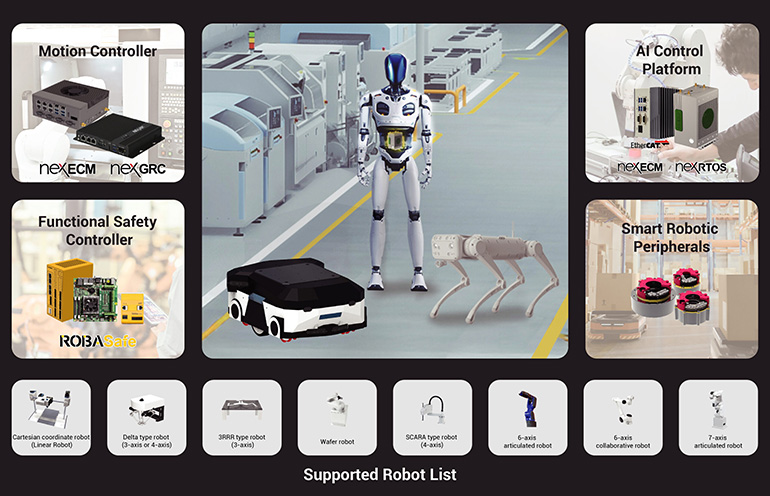
Open robot control platforms are becoming an increasingly important differentiator for suppliers and users alike. Rather than locking customers into a single proprietary stack, open ecosystems enable manufacturers to mix and match components from multiple vendors, tailoring systems to their specific needs.
One tangible benefit is a dramatically shortened development timeline. By adopting a certified safety controller built on open architecture, one industrial client reduced its development cycle from an estimated three to five years to just two — a reduction that can translate to millions of dollars in saved time and accelerated time-to-market.
For suppliers, open platforms expand their addressable market considerably, as products become compatible across a wider range of systems and industries. They also foster a collaborative environment where AI frameworks and software tools can be shared and improved collectively, lowering barriers to entry for smaller developers.
## Where Will Physical AI Make Its Mark?
Near-term adoption is expected to concentrate in established sectors such as manufacturing, logistics, and warehousing — areas where the business case for automation is already compelling and where return on investment can be measured clearly.
Looking further ahead, advances in AI are beginning to unlock possibilities in less structured and more complex environments, including service industries and healthcare support. Humanoid robots, mobile platforms, and systems designed for dynamic and unstructured settings align particularly well with the strengths of large technology companies, which possess the AI expertise, computing infrastructure, and software development capacity needed to advance these applications.
Highly specialized robots built for narrow tasks may attract less attention unless they offer unique intellectual property or address exceptionally large markets. The most strategic bet for technology firms will be on platforms that can scale across multiple applications and create lasting competitive advantages.
—
## Frequently Asked Questions (FAQ)
**Q: Why are major technology companies acquiring robotics startups at such high valuations?**
A: Large technology firms view robotics as a critical extension of their AI and computing capabilities. Acquiring startups provides them with direct access to specialized expertise in areas like autonomous control, robot learning, and perception — technologies that would take years and far more capital to develop internally.
**Q: What does “physical AI” mean in the context of robotics?**
A: Physical AI refers to artificial intelligence systems that operate in and interact with the physical world through robotic bodies. Unlike purely software-based AI, physical AI involves perception, decision-making, and action in real-time, real-world environments — requiring seamless integration of AI models with sensors, actuators, and control systems.
**Q: How do open ecosystems benefit end users of robotic systems?**
A: Open ecosystems give users greater flexibility to select components from different vendors, avoid vendor lock-in, and integrate technologies best suited to their specific applications. They also reduce integration complexity and can significantly shorten development timelines by leveraging pre-certified, interoperable components.
**Q: What are the biggest barriers to widespread adoption of AI-native robots in industry?**
A: Reliability, safety certification, and cost remain the primary barriers. Industrial environments demand consistency and predictability, and any robotic system must prove it can operate safely alongside human workers over long periods before companies will commit to large-scale deployment.
**Q: Will humanoid robots see the most investment from Big Tech?**
A: Humanoid robots are a major area of interest due to their versatility and the significant media and investor attention they attract. However, mobile robots and systems for dynamic environments are also drawing substantial investment, particularly where they can be deployed sooner in logistics, warehousing, and service applications.
—
## Conclusion
The convergence of artificial intelligence and robotics is reshaping the industrial landscape at a pace that few predicted just a few years ago. Major acquisitions are consolidating expertise and capital in ways that could accelerate innovation — or reshape which companies control the foundational technologies of tomorrow’s automated world.
For developers and manufacturers, the path forward lies in building adaptable, software-defined platforms that can keep up with rapid AI advances while meeting the uncompromising demands of safety and reliability. Open ecosystems and modular architectures will likely play a central role in making physical AI accessible across industries, from traditional manufacturing to emerging service and healthcare applications.
The next few years will determine whether physical AI fulfills its promise as a truly transformative technology — and the choices made by both Big Tech and independent innovators will shape that outcome.
Thank you for reading
