



**The Rise of Agentic AI: How Autonomous Agents Are Transforming Enterprise Workflows**
In 2026, the artificial intelligence landscape is undergoing a profound shift. The era of conversational chatbots—systems that wait passively for human prompts—is giving way to a new paradigm: agentic AI. These advanced systems are moving from research labs into enterprise production, representing a leap from simple text generation to autonomous execution. Unlike their predecessors, AI agents can plan, execute, and adapt multi-step tasks across diverse external tools, databases, and APIs without constant human oversight.
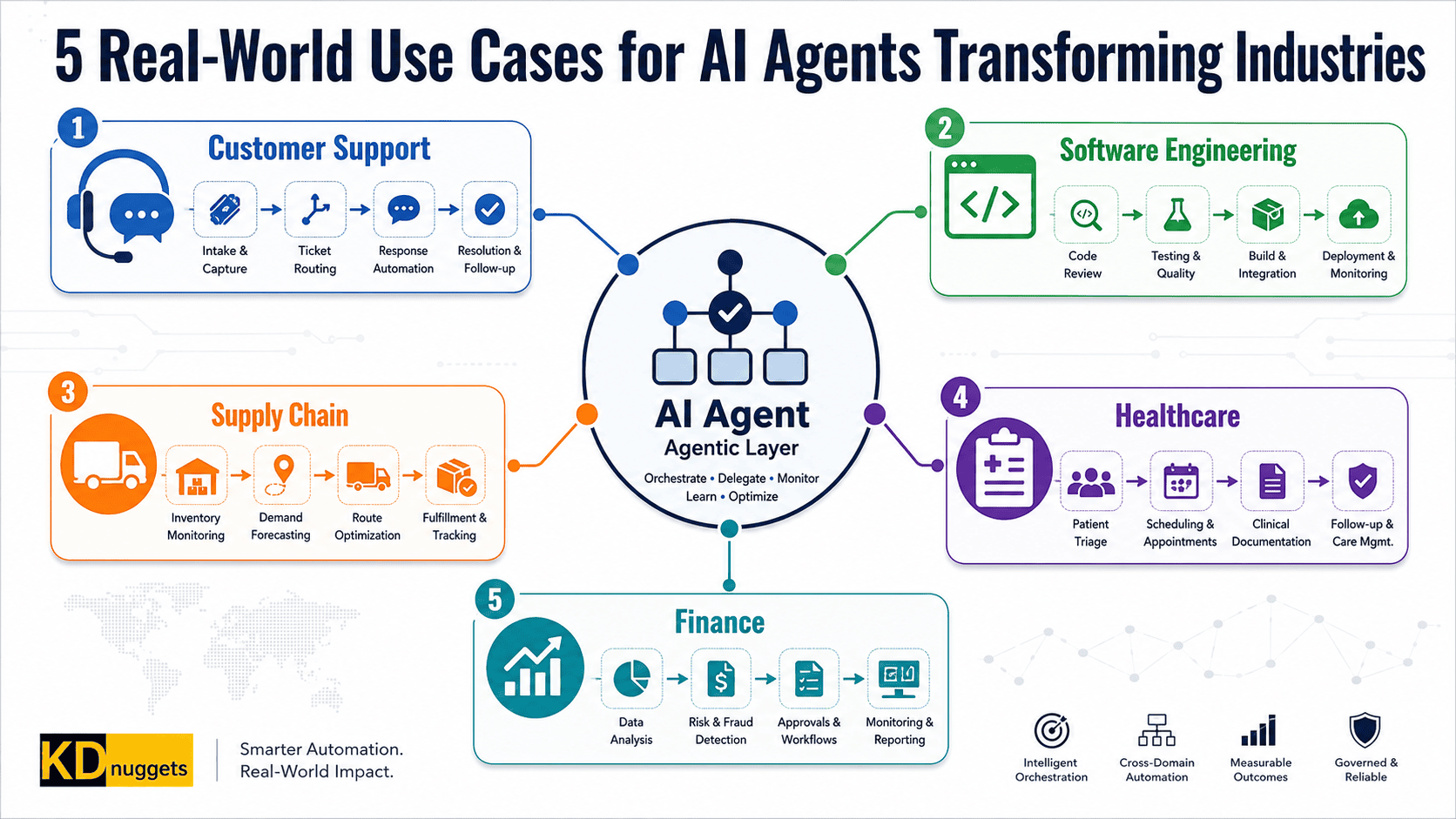
Enterprises are already reaping significant productivity gains by deploying these agents. They allow human workers to step out of the loop for routine execution and into an oversight role, focusing on strategy and exception handling rather than repetitive tasks. To understand this transformation, examining real-world use cases is essential. Below, we explore five major industries where AI agents are driving tangible change, along with practical resources for implementation.
—
### 1. Automating End-to-End Customer Support and Triage
Customer service is no longer limited to deflecting tickets with rigid, rule-based chatbots. Modern support teams face growing demands, with customers expecting fast, accurate resolutions across email, chat, phone, and social channels. Today’s AI support agents integrate directly into customer relationship management (CRM) systems, resolving complex, multi-step issues autonomously while maintaining context across all channels.
**How support agents are changing the workflow:**
– **Autonomous Execution:** Agents can draft responses, look up inventory in databases, process returns via APIs, and update CRM tickets without human intervention.
– **Intelligent Routing:** When a query requires human empathy or high-level authorization, the agent escalates the ticket instantly, passing along a summary and all prior context.
– **Proactive Follow-ups:** Instead of waiting for complaints about delayed flights or orders, agents anticipate issues, rebook services, and notify customers preemptively.
The result is a dramatic reduction in average handle time, with human agents shifting from repetitive lookups to complex, relationship-sensitive conversations.
**Learning Resource:** Explore the [LangChain documentation](https://www.kdnuggets.com/linked_resource/placeholder) on building customer support agents to learn how to connect language models to external ticketing tools and CRM APIs.
—
### 2. Accelerating Software Engineering and Testing
Software development is witnessing a revolution with autonomous coding agents. These agents can take high-level GitHub issues, search codebases, write features, run unit tests, and submit pull requests—all without a developer typing a single line.
**Key features of engineering agents:**
– **Contextual Codebase Understanding:** Using the Model Context Protocol (MCP), agents read and understand entire repositories, ensuring new code aligns with existing architectures and naming conventions.
– **Automated Quality Assurance (QA):** They autonomously write and execute test suites, debug failures by reading error logs, and iterate until all tests pass.
– **Legacy Modernization:** Companies deploy agents to translate decades-old COBOL or Java systems into modern frameworks—a task that previously required months of specialist contractor time.
For engineering teams, the implications extend beyond speed. Developers are shifting from boilerplate and bug triage toward system design, code review, and higher-order architectural decisions.
**Learning Resource:** Check out [SWE-agent](https://www.kdnuggets.com/linked_resource/placeholder) to see how open-source agents can resolve genuine software engineering issues autonomously on real GitHub repositories.
—
### 3. Orchestrating Adaptive Supply Chains
Global supply chains are vulnerable to sudden disruptions—from port congestion and weather events to geopolitical trade restrictions and raw material shortages. Logistics companies now deploy multi-agent systems that monitor global data feeds and autonomously reroute shipments the moment a disruption is detected, compressing responses that once took days of human coordination into minutes.
**What supply chain agents offer:**
– **Real-time Re-routing:** When a port is congested or a storm halts transit, agents automatically search for alternative routes and contact vendors to adjust delivery windows.
– **Dynamic Inventory Management:** Agents continuously monitor demand signals and autonomously execute purchase orders when stock levels dip below predicted requirements, preventing costly stockouts.
– **Invoice Reconciliation:** AI agents match thousands of supplier invoices against purchase orders and shipping receipts, flagging discrepancies for human review and reducing manual effort in accounts payable.
**Learning Resource:** Read up on multi-agent reinforcement learning (MARL) concepts at the [Berkeley AI Research](https://www.kdnuggets.com/linked_resource/placeholder) lab to understand how distinct agents negotiate and optimize complex logistical networks.
—
### 4. Streamlining Clinical Triage and Healthcare Workflows
In healthcare, clinician burnout is a systemic crisis driven heavily by administrative overhead. Studies show physicians spend nearly as much time on documentation and paperwork as on direct patient care. AI agents are being deployed to securely manage patient data, coordinate scheduling, and handle the administrative layer of clinical decision-making—giving time back to those who need it most.
**Here’s how agents are being applied in healthcare:**
– **Ambient Documentation:** Agents listen to patient-doctor interactions, autonomously generate structured clinical notes, and route them to Electronic Health Record (EHR) systems, eliminating after-hours documentation burden.
– **Insurance Pre-authorization:** AI agents analyze treatment plans, cross-reference them with payer policies, and submit pre-authorization paperwork in minutes rather than days.
– **Post-Discharge Monitoring:** Agents autonomously follow up with patients via text or voice to monitor recovery, escalating anomalies to nurses when necessary and catching complications earlier.
**Learning Resource:** Review the [Kore.ai](https://www.kdnuggets.com/linked_resource/placeholder) healthcare agent framework to see how enterprise platforms handle HIPAA-compliant, multi-step clinical workflows at scale.
—
### 5. Scaling Anti-Money Laundering and Fraud Detection
Financial institutions are engaged in a constant arms race against fraudsters. Traditional rule-based systems generate massive volumes of false positives, overwhelming compliance teams and causing them to miss genuinely suspicious activity. Today, banks use AI agents to conduct deep, contextual investigations into flagged activities, making faster and more accurate decisions.
**Why financial agents are changing compliance:**
– **Deep Know Your Customer (KYC) Investigations:** Instead of simply checking databases, agents autonomously scrape public records, news articles, and corporate registries to build comprehensive risk profiles on new clients in a fraction of the time.
– **Contextual Fraud Analysis:** When a transaction is flagged, the agent reviews the user’s historical behavior, location data, and device telemetry to make an immediate “block or allow” decision with full audit trail documentation.
– **Automated Suspicious Activity Reports (SARs):** If fraud is confirmed, the agent drafts mandatory regulatory reports, significantly reducing compliance burden and accelerating filing timelines.
**Learning Resource:** Explore the [DeepLearning.AI](https://www.kdnuggets.com/linked_resource/placeholder) courses on AI for finance to understand how machine learning models are trained for anomaly detection and risk scoring in financial environments.
—
### Frequently Asked Questions (FAQ)
**Q: What is agentic AI?**
Agentic AI refers to systems that can autonomously plan, execute, and adapt multi-step tasks across external tools, databases, and APIs without continuous human oversight. Unlike conversational chatbots, these agents can execute entire workflows independently.
**Q: Which industries are being transformed by AI agents?**
The article highlights five major industries: customer service, software engineering, supply chain management, healthcare, and financial compliance (anti-money laundering and fraud detection).
**Q: How do AI agents improve productivity in customer service?**
AI support agents autonomously handle tasks like drafting responses, accessing inventory, processing returns, and updating CRM systems. They also intelligently route complex issues to humans and proactively address problems before customers notice them, reducing handle times and improving efficiency.
**Q: Can AI agents replace software developers?**
No. While AI agents automate routine coding, testing, and legacy modernization tasks, developers shift toward higher-level responsibilities like system design, code review, and architectural decisions. The agents augment, rather than replace, human expertise.
**Q: How do supply chain agents handle disruptions?**
When a disruption (e.g., port congestion or weather events) is detected, agents automatically search for alternative routes, contact vendors to adjust delivery windows, dynamically manage inventory, and reconcile invoices—all in minutes instead of days.
**Q: What role do AI agents play in healthcare?**
Agents handle ambient documentation, insurance pre-authorization, and post-discharge monitoring. This reduces administrative burdens on clinicians, giving them more time for direct patient care and improving overall workflow efficiency.
**Q: How are AI agents used in fraud detection?**
Agents conduct deep KYC investigations by scraping public records and news, perform contextual fraud analysis by reviewing historical behavior, and automate suspicious activity report filings—making compliance faster and more accurate.
—
### Conclusion
The transition from generative AI to agentic AI marks a pivotal moment where technology evolves from answering questions to actively doing the work. Across customer service, software engineering, supply chains, healthcare, and finance, a consistent pattern emerges: agents absorb high-volume, rule-bound, time-sensitive execution tasks, while humans shift into oversight, exception handling, and strategic roles.
This division of labor is not a distant vision—it is already running in production at enterprises across every sector. The five industries highlighted here are merely a starting point. wherever a high-volume, repetitive execution layer sits between humans and critical decisions, there is likely an agent already at work. The learning resources provided offer a pathway to understand and implement these systems, empowering professionals to build the next generation of intelligent workflows.
As agentic AI continues to mature, its ability to autonomously manage complex business processes will become increasingly integral to organizational efficiency and innovation. Those who embrace this shift today will be best positioned to thrive in the autonomous enterprise of tomorrow.
—
**Vinod Chugani** is an AI and data science educator who bridges the gap between emerging AI technologies and practical application for working professionals. His focus areas include agentic AI, machine learning applications, and automation workflows. Through his work as a technical mentor and instructor, Vinod has supported data professionals through skill development and career transitions. He brings analytical expertise from quantitative finance to his hands-on teaching approach. His content emphasizes actionable strategies and frameworks that professionals can apply immediately.
