



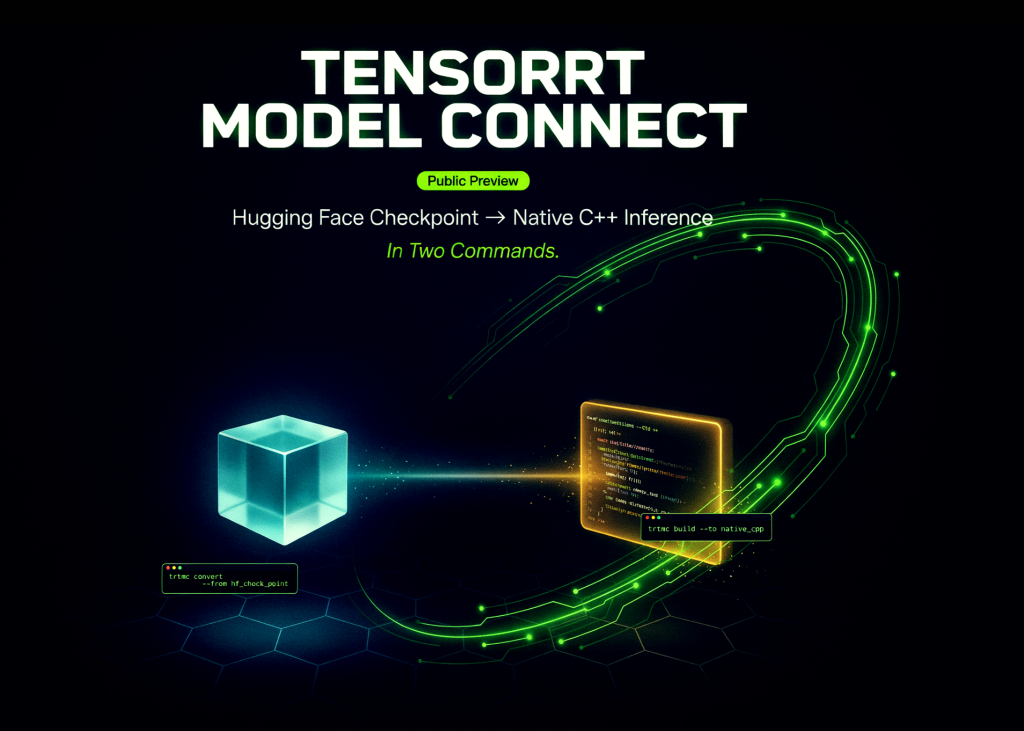
**NVIDIA TensorRT Model Connect: Deploying Hugging Face Models to C++ Inference in Two Commands**
NVIDIA has open-sourced **TensorRT Model Connect (TRTMC)**, a toolchain that converts Hugging Face or local model checkpoints into a versioned `.bundle` artifact for **native C++ inference with TensorRT**, eliminating the traditional ONNX export step. Built entirely using OpenAI Codex agents under human direction, the project is Apache 2.0 licensed and targets **Linux aarch64** platforms with Python 3.10/3.12 support.
—
### **Problem with Traditional TensorRT Deployment**
Deploying models to production with TensorRT has historically involved a fragile pipeline:
1. PyTorch checkpoint
2. Export to ONNX or TorchScript
3. Build TensorRT engine
4. Model-specific C++ integration for tokenizers, samplers, and caching
This process introduces multiple failure points—export gaps, per-model glue code, and validation across separate artifacts.
—
### **TensorRT Model Connect Solution**
TRTMC collapses this pipeline into **two commands**:
“`bash
# Build a versioned bundle from a Hugging Face model
trtmc build Qwen/Qwen3-0.6B –precision bf16 –max-cache-length 16384 –output qwen3-0.6b.bundle
# Run inference directly from the bundle
trtmc run ./qwen3-0.6b.bundle –prompt “What is the capital of France? Answer in one word.” –chat-template –no-thinking
“`
The resulting `.bundle` artifact is a self-contained, versioned package that can be loaded in **pure C++** via `trtmc::load(“./qwen3-0.6b.bundle”)` and executed through native task APIs like `generate()`, `transcribe()`, `embed()`, and `solve()`—all **without PyTorch or ONNX in the runtime path**.
—
### **Key Design Decisions**
– **No intermediate ONNX export**: The build process natively compiles checkpoints to TensorRT engines.
– **Bundle-based handoff**: The `.bundle` separates build-time from runtime, enabling PyTorch-free inference in C++ services, embedded systems, or robotics stacks.
– **Family-owned reference implementations**: Rather than a single generic converter, TRTMC provides optimized, model-family-specific builders.
– **Auditable artifacts**: `trtmc inspect` exposes bundle metadata including model family, precision, runtime identity, and engine details.
—
### **Supported Use Cases**
TRTMC is ideal for environments where inference must run in **C++ binaries**, including:
– On-device text generation and chat
– Speech recognition and synthesis
– OCR and document parsing
– Embedding and reranking services
– Diffusion image/video generation
– Segmentation and time-series forecasting
—
### **Release Snapshot & Performance**
NVIDIA’s July 29, 2026 **GB300 snapshot** includes **105 inference profiles across 76 model families**. In internal testing:
– **102 profiles** outperformed their declared reference by more than 5%
– **1 profile** matched within 5%
– **2 profiles** regressed by more than 5%
These results highlight TRTMC’s effectiveness in delivering optimized, low-overhead inference paths.
—
### **System Requirements**
– **Platform**: Linux aarch64 only
– **Python**: 3.10 or 3.12
– **glibc**: ≥ 2.39
– **TensorRT**: 11.1.0.106
> **Note**: x86_64 users must use the Docker source-build path, as pre-built wheels are not published for that architecture.
—
### **Key Takeaways**
– Two commands move a Hugging Face checkpoint to native C++ TensorRT inference without ONNX.
– A versioned `.bundle` artifact decouples Python model building from C++ runtime execution.
– The July 2026 snapshot demonstrates strong performance across 76 model families on GB300.
– Current wheels target Linux aarch64; x86_64 requires source builds.
—
### **FAQ**
**Q: What is TensorRT Model Connect?**
A: TRTMC is an open-source toolchain that converts Hugging Face or local model checkpoints into `.bundle` artifacts for native C++ inference using TensorRT, bypassing ONNX entirely.
**Q: Which platforms are supported?**
A: Pre-built wheels currently support Linux aarch64 with Python 3.10/3.12 and TensorRT 11.1.0.106. x86_64 users must build from source using Docker.
**Q: Do I need PyTorch at inference time?**
A: No. The `.bundle` contains a TensorRT engine and can be executed in C++ without PyTorch or ONNX in the runtime.
**Q: What models are supported?**
A: The July 2026 snapshot covers 105 profiles across 76 families, including decoder LMs, hybrid architectures, embeddings, OCR, ASR, TTS, diffusion models, segmentation, and forecasting.
**Q: How do I inspect a bundle?**
A: Use `trtmc inspect ./model.bundle` to view bundle kind, model family, precision, runtime identity, and available engines.
**Q: Can I use TRTMC in production today?**
A: Yes, for teams with their own inference stack—particularly NVIDIA-shop startups, robotics companies, and platform teams. Regulated enterprises should wait for a tagged release before standardizing.
—
### **Conclusion**
TensorRT Model Connect represents a significant step forward in deploying Hugging Face models to production C++ environments. By removing the ONNX export bottleneck and providing family-optimized builders, TRTMC reduces integration complexity and accelerates time-to-production for edge, embedded, and robotic applications. With strong benchmark performance and an open-source, Apache 2.0–licensed model, it is a compelling option for teams running inference outside of Python.
